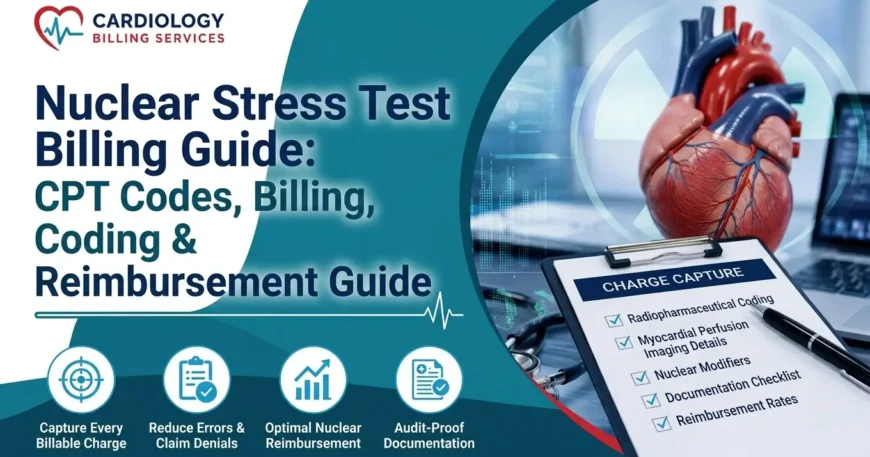
Nuclear stress test CPT codes: billing, coding and reimbursement guide

A nuclear stress test claim rarely fails because of one bad code. It usually fails because two separate services get billed as if they were a single line item. CPT codes 78451 through 78454 report the myocardial perfusion imaging. CPT codes 93015 through 93018 report the cardiovascular stress test that induces the perfusion changes the imaging is meant to capture. Where one code family ends and the other begins is the question behind most nuclear stress test denials and it comes up more often than payer-specific quirks or authorization paperwork.
This guide walks through the nuclear stress test CPT code set the way a coder has to use it in practice: what each code represents, how the imaging and the stress test relate to each other on the same claim, when modifier 26 or TC applies, what documentation a payer expects and where these claims most often break down. It stays focused on nuclear myocardial perfusion imaging rather than general cardiac stress testing. For CPT coding on a standard exercise or pharmacologic stress test performed without nuclear imaging, see our stress test billing guide.
What are nuclear stress test CPT codes?
“Nuclear stress test” is clinical shorthand, not a billing code. When a physician orders one, a coder is actually looking at two distinct, separately reportable services performed in the same session: a cardiovascular stress test that raises myocardial oxygen demand through exercise, a pharmacologic agent, or both and a nuclear myocardial perfusion imaging (MPI) study that uses a radiopharmaceutical tracer and a gamma camera to show how blood flows through the heart muscle under those conditions.
The imaging is reported with CPT codes 78451 to 78454. Code selection depends on whether the study used SPECT (tomographic) or planar technique and whether it involved a single study or multiple studies at rest and/or stress. The stress-inducing portion is reported separately with CPT codes 93015 to 93018, selected according to who performed supervision, tracing and interpretation and where. A radiopharmaceutical HCPCS code and for pharmacologic protocols a stress-agent HCPCS code, complete the claim.
This is where generic stress test content tends to fall short. An exercise ECG stress test with no imaging is billed with 93015 to 93018 alone; no nuclear medicine code belongs on that claim at all. A true nuclear stress test needs both code families, each matched correctly to what was actually performed, by whom and where, not assigned automatically just because the order says “nuclear stress test.”
Nuclear stress test CPT codes at a glance
The table below covers the core SPECT and planar myocardial perfusion imaging codes. Confirm current descriptors against your CPT code set and your MAC or payer’s coverage article before billing, since code status and coverage detail can change from one CPT or HCPCS update cycle to the next.
| CPT code | Service description | Typical reporting context | Key billing consideration |
| 78451 | Myocardial perfusion imaging, tomographic (SPECT), including attenuation correction, wall motion, ejection fraction and quantification when performed; single study, at rest or stress | A SPECT MPI study limited to one phase, rest only or stress only | Less common than 78452 in practice; confirm the record documents only one phase before defaulting to this code |
| 78452 | Myocardial perfusion imaging, tomographic (SPECT), including attenuation correction, wall motion, ejection fraction and quantification when performed; multiple studies, at rest and/or stress | The typical rest-and-stress SPECT MPI protocol most nuclear stress tests use | Most MPI codes, including 78452, carry a medically unlikely edit limiting them to one unit per date of service; billing two units for a single combined study is a frequent overpayment finding |
| 78453 | Myocardial perfusion imaging, planar, including wall motion, ejection fraction and quantification when performed; single study, at rest or stress | Planar (non-tomographic) imaging limited to one phase | Planar technique is used far less often than SPECT in current nuclear cardiology practice; verify the imaging method in the report before selecting a planar code |
| 78454 | Myocardial perfusion imaging, planar, including wall motion, ejection fraction and quantification when performed; multiple studies, at rest and/or stress | Planar imaging with both rest and stress phases | Do not select this code by habit when the department only performs SPECT; the modality documented in the report drives SPECT versus planar selection, not the code the practice bills most often |
Two related points matter as much as the codes themselves. First, positron emission tomography (PET) myocardial perfusion imaging is a separate, less commonly available modality with its own code family entirely apart from 78451 to 78454; a practice performing cardiac PET should not default to the SPECT codes just because both are called nuclear imaging. Second, cardiac blood pool imaging (MUGA) and infarct-avid imaging use different nuclear medicine codes than perfusion imaging does, because they answer a different clinical question. If your documentation says perfusion, the perfusion code family is correct; if it says ejection fraction assessment by blood pool study, it is not.
Understanding nuclear myocardial perfusion imaging
Nuclear MPI compares blood flow to the heart muscle under two conditions: at rest and under stress. The comparison is what makes the study diagnostically useful and it is also what drives code selection.
Rest imaging captures baseline perfusion with the patient at rest, after a resting dose of radiopharmaceutical.
Stress imaging captures perfusion at or near peak stress, whether that stress was induced by exercise or a pharmacologic agent.
Combined rest and stress imaging is the typical real-world protocol and is what code 78452 (SPECT) or 78454 (planar) describes: multiple studies performed at rest and/or stress in the same overall session, whether on the same day or across two days.
A single-study code (78451 or 78453) applies only when the record supports one phase alone, such as a rest-only study performed to evaluate an acute presentation, or a stress-only protocol in a specific clinical scenario. Coders should not assume 78452 by default; the number of studies actually acquired and interpreted, not the general reputation of “nuclear stress test” as a combined procedure, determines whether the single or multiple study code applies.
Exercise versus pharmacologic nuclear stress testing
The method used to stress the heart, exercise or a pharmacologic agent, does not change which imaging code family applies. It does change which stress test code and which drug-related HCPCS codes belong on the claim and it changes what the documentation needs to show.
An exercise-based nuclear stress test uses a treadmill or bicycle protocol to raise heart rate and myocardial oxygen demand, with imaging performed once the patient reaches an adequate workload. A pharmacologic nuclear stress test substitutes a vasodilator or inotropic agent (commonly reported under its own HCPCS code, such as J2785 for regadenoson or J0153 for adenosine) when a patient cannot exercise adequately, whether from orthopedic limitation, deconditioning, certain lung disease, or other documented reasons.
From a billing standpoint, three things matter regardless of stress method:
- The record needs to state which method was used and, for pharmacologic studies, why exercise was not appropriate. Payers reviewing pharmacologic stress claims look for that rationale specifically; its absence is a common, avoidable denial trigger.
- The pharmacologic agent is typically billable under its own HCPCS code, but administration of that agent, the needle insertion or IV access used solely to deliver it, is generally not separately billable, because the NCCI Policy Manual treats stress test administration as integral to the stress test procedure itself.
- This guide does not address dosing, agent selection, or contraindications; those are clinical decisions that belong in the physician’s protocol and documentation, not in a billing and coding discussion.
Nuclear stress test CPT coding: what each component represents
A complete nuclear stress test claim generally includes services from more than one code family, each representing a distinct, separately performed piece of work.
Myocardial perfusion imaging (78451 to 78454) covers the acquisition, processing and physician interpretation of the perfusion study itself, including attenuation correction, wall motion and ejection fraction when performed as part of that imaging.
Cardiovascular stress testing (93015 to 93018) covers the exercise or pharmacologic stress procedure: patient monitoring, continuous ECG tracing and supervision and interpretation of the stress test response, separate from the nuclear images. Code 93015 is the global stress test code, appropriate only when one entity performs supervision, tracing and interpretation. When those pieces are split across different providers or between a physician and a facility, the component codes apply instead: 93016 for supervision alone, 93017 for tracing alone and 93018 for interpretation and report alone.
Professional and technical components apply within the imaging code family itself. A single global 78451 to 78454 code covers both the technical work (equipment, technologist, radiopharmaceutical handling) and the professional work (physician supervision and interpretation) when one entity furnishes both. When they are split, modifiers separate the professional interpretation from the technical acquisition.
Because these are genuinely distinct services, most complete nuclear stress tests report an imaging code and a stress test code together, not one code standing in for the whole encounter. That said, exactly which combination is correct, global stress test versus split components, single study versus multiple, SPECT versus planar, depends entirely on what was performed and who performed each piece. Reporting multiple codes simply because multiple clinical steps occurred, without documentation supporting each one, is unbundling, not accurate coding.
Modifier 26 and modifier TC for nuclear stress testing
Nuclear MPI codes carry a professional/technical component split on the Medicare Physician Fee Schedule, meaning they can be billed globally, or divided between the entity that owns the equipment and performs the technical work and the physician who provides the professional interpretation.
Modifier 26 (professional component) applies when a physician bills only for supervision and interpretation of the study and the technical work, the equipment, radiopharmaceutical and technologist time, was furnished by a separate entity, such as a hospital or an independent facility.
Modifier TC (technical component) applies when a facility or independent diagnostic testing facility bills only for the equipment, supplies and technologist work, while a separate physician bills the professional interpretation.
No modifier (global billing) applies when the same entity, a practice that owns its own nuclear cardiology equipment and employs or contracts the interpreting physician, furnishes both the technical and professional components for the same patient.
None of this is automatic. Modifier 26 does not belong on a claim simply because a cardiologist interpreted the study; it belongs there when the billing arrangement and the site of service genuinely separate the technical work from the professional work and the documentation supports that split. The same is true in reverse for modifier TC. Appending either modifier to secure a higher combined reimbursement, without a real component split behind it, is a coding error that payer audits are specifically built to catch.
Site of service factors into this too. As of January 1, 2026, CMS made permanent a policy allowing supervising physicians and non-physician practitioners to meet direct supervision requirements for diagnostic tests, including nuclear cardiology studies, through real-time, two-way audio-video technology rather than physical presence alone. That flexibility affects how supervision is documented and staffed; it does not change which entity is billing the technical component, which still depends on who owns the equipment and employs the staff performing the study.
How to select the correct nuclear stress test CPT code
Working through code selection in order, rather than reaching for 78452 because it is the most common code, prevents most of the errors covered later in this guide.
- Confirm the imaging technique. SPECT versus planar determines whether 78451/78452 or 78453/78454 is even the right family.
- Confirm the number of studies performed. Rest only, stress only, or combined rest and stress determines single study versus multiple study coding within that family.
- Confirm the stress method. Exercise or pharmacologic does not change the imaging code, but it does determine the correct stress test code and any pharmacologic agent HCPCS code.
- Confirm who performed each component. This determines whether the stress test is billed globally under 93015 or split across 93016 to 93018 and whether the imaging is billed globally or split with modifier 26 or TC.
- Confirm the place of service. Physician office, hospital outpatient department and independent diagnostic testing facility settings each affect who is eligible to bill the technical component.
- Confirm the payer’s specific requirements. Medicare, Medicare Advantage and commercial payers do not always apply identical component, authorization, or documentation rules to the same clinical scenario.
ICD-10-CM diagnosis coding and medical necessity
A correctly selected CPT code still will not get paid if the diagnosis coding does not support medical necessity for that specific service. Payers, including Medicare, generally cover nuclear MPI when the documented clinical indication and the ICD-10-CM code reported match a covered indication under the applicable coverage policy; an ICD-10-CM code being technically related to cardiac care is not the same as that code supporting medical necessity for this particular test.
Diagnosis categories commonly associated with nuclear stress test orders include chest pain (category R07), known or suspected coronary artery disease (category I25), angina (category I20), prior myocardial infarction (I21, I25.2), abnormal cardiovascular function findings on prior testing (category R94), shortness of breath on exertion (category R06) and post-revascularization status (Z95.1, Z95.5, or similar aftercare and status codes). These are examples of categories that frequently appear on covered claims, not a guarantee that any code from that category supports coverage for every scenario. Coverage policies can be specific down to the individual code: a MAC’s coverage article may include several codes within a category while excluding the unspecified code in that same category, so specificity matters as much as category.
Two points deserve particular attention. First, sequencing matters when more than one diagnosis is documented; the code that most directly supports the reason the test was ordered generally belongs in the primary position, not simply the first condition mentioned in the note. Second, medical necessity is ultimately a documentation question, not a code lookup: the diagnosis code has to be a specific, accurate reflection of what the ordering provider documented as the reason for the test, not the code that historically gets claims paid.
Documentation requirements
Every element of a nuclear stress test claim traces back to something in the medical record. Strong documentation supports CPT selection, diagnosis coding, medical necessity, component billing, modifier use, prior authorization and any appeal that follows a denial.
At minimum, a complete nuclear stress test record should reflect:
- The reason for the study and relevant clinical history from the ordering provider
- The specific indication supporting medical necessity, in the physician’s own clinical language, not just a diagnosis code
- The stress method used, exercise or pharmacologic and for pharmacologic studies, why exercise was not performed
- The imaging technique (SPECT or planar) and whether rest, stress, or both phases were acquired
- Technical details supporting the technical component, including radiopharmaceutical administered and imaging protocol
- The physician’s interpretation and final signed report, including findings and their clinical significance
- Physician or qualified health professional authentication, with a date and time that supports the date of service billed
It helps to separate two related but different documentation questions: what proves the service was actually performed, versus what a specific payer’s policy independently requires to consider the claim payable. A complete, well-written report satisfies the first question. Meeting the second sometimes requires additional payer-specific elements, such as a specific attestation format or referenced coverage criteria, that go beyond what clinical documentation alone would include. For a broader look at documentation and audit-readiness practices across cardiology coding generally, see our guide to cardiology coding compliance.
Prior authorization and eligibility
Prior authorization requirements for nuclear stress testing vary by payer, plan and sometimes by place of service; there is no single rule that applies across every insurer. Traditional Medicare generally does not require prior authorization for diagnostic testing in the way commercial plans do, but Medicare Advantage plans and many commercial and Medicaid managed care plans do commonly require it for advanced cardiac imaging, often managed through a radiology benefit management (RBM) vendor rather than the health plan directly. Practices should verify the current requirement for each specific payer and plan before scheduling, rather than assuming last year’s rule still applies.
Common authorization failure points include:
- Authorization obtained for the wrong CPT code, such as an authorization on file for stress echocardiography when a nuclear study was ultimately performed
- Authorization tied to a provider or facility other than the one that actually performed the service
- An authorization that expired before the date of service
- A study performed at a different location than the one named on the authorization
Eligibility verification is a separate step from authorization and does not guarantee payment on its own. Active coverage, network status, deductible and cost-sharing status and whether nuclear cardiology services fall under any plan-specific exclusion all affect the outcome, even when authorization was correctly obtained. Confirming eligibility and authorization together, ahead of the date of service, is one of the more reliable ways to prevent a downstream denial; this is one of the areas where a dedicated cardiology medical billing workflow, built around verifying both before the appointment, reduces avoidable rework.
Medicare rules for nuclear stress test billing
Medicare coverage for nuclear MPI is addressed both nationally and locally. CMS maintains national coverage determinations addressing SPECT and PET perfusion imaging of the heart within the broader NCD manual and individual Medicare Administrative Contractors maintain their own local coverage determinations, such as policies addressing cardiac radionuclide imaging, along with companion billing and coding articles that lay out the specific CPT, HCPCS and ICD-10-CM detail tied to that LCD. Because LCDs and their coding articles are MAC-specific, the exact covered diagnosis list and documentation expectations can differ depending on which MAC processes the claim, even though the underlying CPT codes are the same nationwide.
A few Medicare-specific points are worth calling out directly:
- Nuclear MPI codes carry a professional/technical component split on the Medicare Physician Fee Schedule, so modifier 26 and TC apply the same way described earlier in this guide when billing Medicare.
- NCCI edits apply to Medicare claims and bundle certain services into the nuclear procedure codes, including supervision and handling of the radionuclide itself and drug administration for the pharmacologic stress agent; these are not separately billable to Medicare even though they are real work performed.
- As of January 1, 2026, CMS permanently allows virtual direct supervision, using real-time two-way audio and video, for diagnostic tests including nuclear cardiology studies, in both office/IDTF settings and hospital outpatient departments, replacing the prior requirement for in-person physical presence in most cases.
- Place of service affects payment methodology: services in a physician office are generally paid under the Medicare Physician Fee Schedule at the non-facility rate, while the technical component of a hospital outpatient nuclear study is generally paid to the facility under the Outpatient Prospective Payment System, not the physician fee schedule.
Medicare rules should never be treated as a stand-in for commercial payer policy. They are a useful, well-documented baseline, but a rule that is accurate for Medicare is not automatically accurate for a Medicare Advantage plan, a commercial PPO, or a state Medicaid program.
Commercial payer considerations for nuclear stress testing
Commercial payers frequently diverge from Medicare on several fronts relevant to nuclear stress testing: prior authorization is more commonly required, medical necessity criteria may reference a different clinical guideline than the MAC’s LCD, referral requirements may apply where Medicare has none and timely filing and appeal deadlines are set by the individual payer contract rather than a uniform federal rule.
Many commercial payers and Medicaid managed care plans route advanced cardiac imaging authorization through a dedicated radiology benefit manager, such as Carelon Medical Benefits Management or National Imaging Associates, rather than reviewing the request internally. These vendors apply their own clinical criteria and their own documentation submission process, separate from the payer’s general medical policy, which is one reason a study that clears Medicare’s coverage bar without incident can still be denied by a commercial plan for insufficient authorization documentation.
Because these requirements are payer-specific and change over time, this guide does not name a specific insurer’s current policy as representative of commercial payers generally. Verifying the current authorization, medical necessity and filing requirements for each patient’s specific plan, before the date of service, remains the most reliable approach.
Common nuclear stress test billing and coding mistakes
| Billing or coding error | Why it can cause a denial | How to prevent it |
| Defaulting to 78452 without confirming the study count | Payer may deny or downcode if documentation only supports a single study | Verify rest, stress, or both phases were actually acquired before coding |
| Billing SPECT codes for a planar study, or the reverse | Code does not match the imaging technique documented in the report | Confirm imaging modality directly from the technologist and physician report |
| Appending modifier 26 or TC without a genuine component split | Modifier is unsupported by the billing arrangement or site of service | Confirm equipment ownership and physician employment arrangement before appending either modifier |
| Billing 93015 together with 93016 or 93018 for the same test | Global code and component codes describe the same work; billing both is duplicate reporting | Determine up front whether one entity or multiple entities performed the stress test |
| Reporting IV access or drug administration separately from the nuclear procedure | NCCI treats stress-agent administration as integral to the procedure | Confirm current NCCI edits before adding a separate administration line |
| Diagnosis code technically related to cardiology but not supporting this specific test | Payer’s coverage policy does not recognize that code as medically necessary for MPI | Match the ICD-10-CM code to the documented clinical indication for the test, not a general cardiac diagnosis |
| Using an unspecified diagnosis code when a more specific code applies | Coverage policies frequently exclude unspecified codes even within a covered category | Code to the highest specificity supported by the documentation |
| Missing or expired prior authorization | Service was never cleared for coverage before it was performed | Verify authorization status and expiration before the date of service, not after |
| Authorization on file for the wrong CPT code or provider | Authorization does not match what was actually billed | Cross-check the authorized CPT code and rendering provider against the claim before submission |
| Incorrect place of service for the billing arrangement | Facility versus non-facility payment and component eligibility depend on POS | Confirm POS reflects where the technical component was actually furnished |
| Billing two units of a code carrying a one-unit medically unlikely edit | Claim line is automatically reduced or denied | Confirm unit limits for imaging codes before submission |
| Incomplete or unsigned interpretation report | Documentation does not support that a professional component was actually performed | Confirm the final report is authenticated before the claim is released |
| Submitting a claim without verifying eligibility first | Coverage may have lapsed, changed, or excluded the service entirely | Verify eligibility close to the date of service, not weeks in advance |
| Duplicate claim submission after a delayed remittance | Payer systems flag the second claim as a duplicate rather than a follow-up | Track claim status before resubmitting instead of resubmitting on a fixed schedule |
Common nuclear stress test claim denials
Medical necessity. The diagnosis code reported does not match a covered indication under the payer’s policy for this specific test. Review the ordering documentation against the payer’s coverage criteria and confirm the most specific, accurate diagnosis was reported before deciding whether to correct the code or appeal with additional clinical support.
Incorrect CPT code. The code billed does not match what the report documents, whether that is study count, imaging modality, or component split. Review the technologist and physician documentation directly rather than assuming the code used on similar prior claims is automatically correct here.
Incorrect or unsupported ICD-10-CM code. Related to but distinct from a medical necessity denial; this occurs when the diagnosis code itself is invalid, insufficiently specific, or sequenced incorrectly. Review coding guidelines and the record together before resubmitting.
Modifier errors. Modifier 26 or TC appended without a documented, verifiable component split, or omitted when one was required. Review the billing arrangement and site of service, not just the claim history.
NCCI or bundling edits. A service billed separately that current NCCI edits bundle into the primary procedure. Review current edits before assuming a modifier will bypass the bundle; in most cases it should not.
Missing or invalid prior authorization. Confirm whether authorization was obtained, for the correct code, provider and location and whether it was still valid on the date of service.
Eligibility issues. Coverage lapsed, changed plans, or the service fell outside the patient’s specific benefit design. Verify eligibility at the time of the denial, not only at the time of scheduling.
Non-covered service. The plan does not cover nuclear MPI under any circumstance, or excludes it for the billed indication specifically. Confirm this against the actual plan document rather than a general payer policy.
Duplicate claim. The same service was billed more than once, whether from a system resubmission error or a genuine repeat claim. Track the original claim’s status before resubmitting.
Timely filing. The claim was submitted after the payer’s filing deadline. Review the specific payer’s deadline, since it is contract-specific and document the original submission date if the claim was, in fact, filed on time.
Incorrect place of service. POS does not match the billing arrangement or the technical component’s actual location. Confirm where the equipment and staff performing the study were actually located.
Provider enrollment. The interpreting physician was not properly enrolled, credentialed, or recognized by the payer as qualified to interpret nuclear cardiology studies at the time of service. Review credentialing status before the claim is submitted, not after a denial.
Documentation deficiencies. The record does not support the code, the modifier, or the medical necessity claimed. Review the report for completeness and physician authentication.
Frequency limitations. The payer’s policy limits how often MPI can be repeated within a defined period for the same indication. Review the patient’s testing history and the specific payer’s frequency policy before scheduling a repeat study.
Not every denial reflects a payer error and not every denial reflects a practice error either. The point of reviewing root cause before responding is to determine, case by case, which one it is and whether a corrected claim or a formal appeal is the appropriate next step.
Claim rejection, denial and underpayment
These three outcomes get treated as interchangeable in casual conversation, but they call for different responses.
| Status | What it means | Typical next step |
| Claim rejection | The claim never entered adjudication; it failed a front-end edit (invalid member ID, missing NPI, formatting error) | Correct the specific error and resubmit; this is not an appeal |
| Claim denial | The claim was adjudicated and the payer determined it is not payable, in whole or in part, for a stated reason | Review the denial reason, correct the claim if the fix is straightforward, or file a formal appeal if it is not |
| Underpayment | The claim was paid, but at less than the contracted or expected rate | Compare the remittance against the fee schedule or contract; pursue as a contract or coding discrepancy, not a denial |
Payer systems do not always use these exact three terms on the remittance advice or explanation of benefits, so the billing team’s process should key off the actual status code and description on the ERA or EOB, not assume a given payer’s wording matches this framework exactly.
NCCI edits and bundling in nuclear cardiology
The National Correct Coding Initiative bundles some services into nuclear cardiology procedure codes as a matter of correct coding, not payer discretion. A few bundling relationships come up often enough in nuclear stress test billing to call out specifically:
- Insertion of the needle or catheter and administration of the pharmacologic stress agent are generally considered part of the cardiovascular stress test procedure itself, not separately billable, even though the drug supply may be billed under its own HCPCS code.
- Supervision and handling of the radionuclide is considered integral to the nuclear medicine procedure and is not separately reported.
- Ancillary calculations performed as part of SPECT processing, such as a heart-lung ratio obtained during the same study, are included in the SPECT code itself and should not be billed as an additional line.
Modifiers exist to indicate a genuinely separate, distinct service, not to override an edit for convenience. Modifier 59, or one of the more specific Medicare X-modifiers (XE, XS, XP, XU), applies only when documentation supports that two services were truly separate, such as distinct sessions or unrelated procedures performed the same day, not when a practice wants to recover payment for work that correct coding treats as part of the primary procedure. Verifying current NCCI edits before submission, rather than after a denial, avoids both the rework and the audit exposure that comes with routinely overriding bundling edits.
Global billing considerations
“Global” means two different things in this context and mixing them up causes confusion. A global surgical period, the post-operative window during which certain follow-up care is bundled into a procedure’s payment, generally does not apply to diagnostic nuclear cardiology studies at all; MPI is a diagnostic test, not a surgical procedure with a follow-up period attached.
The other sense of “global,” used earlier in this guide, refers to billing the professional and technical components of an imaging code together, without modifier 26 or TC, because one entity furnished both. That is a component-billing concept, not a surgical global period and the two should not be conflated when researching payer policy or explaining a denial to clinical staff.
How to handle a denied nuclear stress test claim
- Identify the denial or rejection and confirm which one it actually is.
- Review the denial code and description on the remittance advice or explanation of benefits.
- Pull the original claim and compare it line by line against what was actually billed.
- Verify the CPT code against the technologist and physician documentation.
- Verify the ICD-10-CM code against the documented indication.
- Review any modifiers used against the actual component or billing arrangement.
- Check authorization status, including CPT code, provider, facility and validity dates.
- Check eligibility and benefits as of the date of service.
- Review the medical record for completeness and physician authentication.
- Verify the applicable payer or MAC coverage policy.
- Identify the root cause, not just the denial code on the page.
- Determine whether a corrected claim or a formal appeal is the appropriate response.
- Correct the claim if the issue is a straightforward coding or data error.
- Prepare supporting documentation if the response requires a formal appeal instead.
- Submit the corrected claim or appeal following the payer’s specific instructions.
- Track the response and follow up according to the payer’s stated timeline.
- Post the resulting payment or adjustment accurately once resolved.
- Record the root cause so the same pattern can be addressed at its source.
Resubmitting the same claim unchanged, without addressing the reason it was denied, tends to produce the same denial a second time and it can also create a duplicate-claim flag that adds a second issue on top of the original one. For a closer look at how claims move through submission and tracking before they ever reach this stage, see our claims submission and tracking overview.
Nuclear stress test denial root-cause analysis
Recurring denials usually share a pattern that is only visible when claims are reviewed as a group rather than one at a time. Tracking denials by denial reason, payer, CPT code, ICD-10-CM code, modifier, rendering provider, location, place of service, stress method, authorization status, date of service and dollar amount makes it possible to see, for example, that a specific location is consistently missing authorization, or that a specific provider’s documentation habits are generating a disproportionate share of medical necessity denials. Individual denials get corrected one at a time; the underlying workflow problem behind a recurring pattern usually needs to be corrected once, at its source, to stop generating new denials of the same kind.
Nuclear stress test denial metrics
A few metrics are useful for tracking nuclear stress test denial performance over time: overall denial rate, denied claim volume and dollar value, top denial reasons by frequency, payer-specific and CPT-specific denial rates, the share of denials tied to authorization versus medical necessity versus coding, appeal overturn rate and average days to resolution.
If your practice calculates a denial rate, the standard structure is straightforward: denial rate equals denied claims divided by applicable adjudicated claims, multiplied by 100. What varies between organizations is the denominator, whether it includes all claims submitted, only claims that reached adjudication, or only claims for a specific procedure family. Define that denominator clearly and apply it consistently, since two practices reporting different denial rates may simply be measuring different things. There is no universal benchmark denial rate for nuclear stress testing that applies evenly across payers, regions and practice types, so treat any specific percentage you see elsewhere with appropriate skepticism unless the source defines exactly what it measured.
Realistic nuclear stress test billing scenarios
The following are hypothetical, illustrative examples, not real patient cases, meant to show how the concepts above play out in practice.
Scenario 1: Code selection. A patient undergoes SPECT imaging at rest and again after a pharmacologic stress agent. The coder defaults to 78452 without checking whether both phases were actually interpreted. Reviewing the physician’s final report before code selection, rather than assuming the typical protocol was followed, is what prevents this from becoming a downcoded or denied claim.
Scenario 2: Professional versus technical component. A cardiology practice refers a patient to a hospital-owned imaging suite for the technical portion of a nuclear study, while the practice’s own cardiologist interprets it. Whether modifier 26 applies to the practice’s claim depends on confirming, in writing, that the hospital furnished the technical component and billed accordingly, not on assuming the split because two different organizations were involved.
Scenario 3: Modifier 26. A cardiologist interprets a nuclear stress test performed at an outside imaging center. The claim is billed globally by mistake. Reviewing the imaging center’s own billing to confirm it separately billed the technical component with modifier TC is what confirms modifier 26 was, in fact, the correct choice on the physician’s claim.
Scenario 4: Modifier TC. An independent diagnostic testing facility performs the technical portion of a nuclear study and sends the images to an outside radiologist for interpretation. Billing globally here, rather than with modifier TC, overstates what the facility actually performed and risks recoupment once the payer identifies that a separate professional claim was also submitted for the same study.
Scenario 5: Exercise versus pharmacologic stress. A patient scheduled for an exercise protocol is switched to a pharmacologic agent mid-visit due to an inability to reach target heart rate. If the documentation still describes an exercise protocol, the stress test code and the HCPCS drug code will not match the record. Confirming the final stress method actually used and updating the documentation and coding to match, prevents this mismatch from surfacing as a denial or, worse, in an audit.
Scenario 6: Medical necessity denial. A claim is denied because the diagnosis code reported, while cardiac in nature, is not among the indications the payer’s policy recognizes for MPI. Reviewing the ordering physician’s documented rationale for the test and confirming whether a more specific and better-supported diagnosis code was available, determines whether this is correctable or requires a clinical appeal.
Scenario 7: Prior authorization denial. A nuclear stress test is denied because the authorization on file was issued for a stress echocardiogram, not a nuclear study, after the ordering plan changed following the initial authorization request. Verifying that the authorized CPT code matches the service actually performed, before the date of service rather than after the denial, is the preventive step this scenario points to.
Scenario 8: NCCI or bundling denial. A claim is denied because a separate line for stress-agent administration was billed alongside the nuclear procedure code. Reviewing current NCCI edits confirms the administration is integral to the procedure and should not have been billed as a separate line in the first place.
Scenario 9: Duplicate billing. A claim is resubmitted after a delayed remittance and the payer’s system flags it as a duplicate rather than processing it as a follow-up. Tracking claim status directly with the payer before resubmitting, rather than resubmitting on a fixed internal schedule, prevents this specific pattern.
Scenario 10: Diagnosis-service mismatch. A claim lists an unspecified chest pain code when the physician’s note documents a more specific, better-supported indication. Coding to the specificity the documentation actually supports, rather than defaulting to the broadest available code, is what prevents this type of denial from recurring across similar claims.
Nuclear stress test reimbursement
Reimbursement for nuclear stress testing depends on several variables working together, not a single universal rate. Under Medicare, physician-fee-schedule payment is driven by the relative value units assigned to each code, the conversion factor in effect for that year and the geographic practice cost index for the locality where the service was performed. Site of service matters separately: physician office (non-facility) rates differ from facility rates and the technical component of a hospital outpatient nuclear study is generally paid to the hospital under the Outpatient Prospective Payment System rather than the physician fee schedule that pays the professional component.
Commercial payer reimbursement follows each payer’s own contracted rate and methodology, which may or may not track Medicare’s relative value structure closely and can vary practice to practice based on individual contract terms. Because of this, no single dollar figure accurately represents “nuclear stress test reimbursement” across payers, localities and settings. Confirming current rates requires checking the specific fee schedule, whether that is the current year’s Medicare Physician Fee Schedule for a given locality or a specific payer’s contracted rate, rather than relying on a figure quoted in a general guide like this one.
Related cardiology services and nuclear stress test coding
Nuclear stress testing sits alongside several other cardiac diagnostic services that share some coding concepts but follow their own specific rules. Stress echocardiography uses ultrasound rather than a radiopharmaceutical and is billed under a different code family (93350/93351) alongside stress test supervision codes, not the nuclear MPI codes covered in this guide; see our echocardiography billing guide for that code set specifically. Cardiac catheterization and coronary angiography, often ordered as a follow-up when nuclear imaging shows a significant perfusion defect, use an entirely separate invasive-procedure code family covered in our cardiac catheterization billing guide. Ambulatory ECG monitoring, sometimes ordered alongside or instead of stress testing depending on the clinical question, follows its own documentation and billing logic, detailed in our Holter monitor billing guide. Keeping these code families separate in both documentation and claims prevents the kind of cross-contamination, wrong code family entirely, that shows up as an immediate denial rather than a partial payment.
How professional cardiology billing services can help
Nuclear stress test billing brings together several things that are each manageable on their own but compound quickly in combination: two code families that have to be matched correctly to documentation, a professional/technical split that depends on ownership and site of service, payer-specific prior authorization tracking, medical necessity review against MAC or commercial coverage policy and a denial and appeal workload that grows with claim volume.
Specialized cardiology billing services can support nuclear cardiology claims specifically by reviewing CPT and ICD-10-CM coding against documentation before submission, verifying eligibility and prior authorization ahead of the date of service, tracking claims through submission and adjudication, managing denials back to root cause rather than one claim at a time, preparing appeal documentation and posting payments against contracted rates so underpayments get flagged rather than absorbed. None of that changes the underlying coding rules covered in this guide and no billing service can guarantee a specific reimbursement outcome or a specific reduction in denials; what it can do is apply these rules consistently across a high volume of claims, which is where many practices lose time and revenue even when the coding knowledge exists in-house.
Frequently asked questions
What CPT codes are used for a nuclear stress test? A nuclear stress test typically involves an imaging code from the 78451 to 78454 family for the myocardial perfusion study, along with a cardiovascular stress test code from the 93015 to 93018 family for the exercise or pharmacologic stress portion, plus applicable HCPCS codes for the radiopharmaceutical and, for pharmacologic studies, the stress agent.
What is the CPT code for myocardial perfusion imaging? The specific code depends on imaging technique and study count: 78451 (SPECT, single study), 78452 (SPECT, multiple studies), 78453 (planar, single study), or 78454 (planar, multiple studies).
Is nuclear imaging billed separately from the stress test? Generally yes. The myocardial perfusion imaging and the cardiovascular stress test are distinct, separately reportable services, though which specific codes and components apply depends on how the test was performed and by whom.
What is the difference between nuclear imaging and a regular stress test? A regular exercise ECG stress test evaluates heart rate, blood pressure and ECG changes under stress using codes 93015 to 93018 alone. A nuclear stress test adds myocardial perfusion imaging on top of that stress test, using the 78451 to 78454 code family in addition.
When is modifier 26 used for nuclear stress testing? When a physician bills only the professional interpretation of a nuclear MPI study and a separate entity furnished the technical component (equipment, technologist, radiopharmaceutical), supported by documentation confirming that split.
When is modifier TC used? When a facility or independent diagnostic testing facility bills only the technical component of a nuclear MPI study, with the professional interpretation billed separately by a different physician.
How are nuclear stress tests billed in a physician office versus a hospital outpatient setting? In a physician office that owns its equipment, the practice may bill globally under the Medicare Physician Fee Schedule non-facility rate. In a hospital outpatient department, the facility typically bills the technical component under the Outpatient Prospective Payment System while the interpreting physician bills the professional component separately.
Does Medicare cover nuclear stress testing? Medicare covers nuclear MPI when it meets the medical necessity criteria in the applicable national coverage determination and any relevant local coverage determination, supported by appropriate documentation and diagnosis coding; coverage is not automatic for every clinical scenario.
Does a nuclear stress test require prior authorization? It depends on the payer. Traditional Medicare generally does not require prior authorization for this type of diagnostic test, while many Medicare Advantage and commercial plans do, often through a radiology benefit management vendor. Verify requirements for the specific plan before scheduling.
What diagnosis codes support nuclear stress test medical necessity? Common categories include chest pain, known or suspected coronary artery disease, angina, prior myocardial infarction, abnormal findings on prior cardiac testing and post-revascularization status, coded as specifically as the documentation supports. No single diagnosis code guarantees coverage on its own.
What documentation is needed to bill a nuclear stress test? At minimum, the indication for the test, the stress method used, the imaging technique and studies performed, the physician’s signed interpretation and findings and authentication supporting the date of service billed.
What causes most nuclear stress test claim denials? Medical necessity mismatches, incorrect or unsupported CPT and modifier selection, missing or mismatched prior authorization, NCCI bundling conflicts and documentation that does not fully support the service billed are among the most frequent causes.
How should a denied nuclear stress test claim be appealed? Start by reading the denial reason carefully, compare the claim against the medical record and applicable payer policy, gather the specific supporting documentation the denial calls for and follow the payer’s stated appeal method and deadline exactly, since both vary by payer and denial type.
Key takeaways
- A nuclear stress test claim typically needs two distinct code families: myocardial perfusion imaging (78451 to 78454) and the cardiovascular stress test (93015 to 93018), not one code standing in for both.
- Code selection depends on imaging technique, study count, stress method and who performed each component, not on habit or the most commonly used code.
- Modifier 26 and modifier TC apply only when a genuine professional/technical split exists and is documented; neither modifier should be added to chase reimbursement.
- Medical necessity depends on matching a specific, well-documented diagnosis to the payer’s actual coverage policy, not on submitting any cardiac-related ICD-10-CM code.
- Medicare and commercial payer rules differ on prior authorization, coverage criteria and appeal deadlines; a rule that is accurate for Medicare should not be assumed to apply to a commercial or Medicare Advantage plan.
- Denial prevention works best when it happens before the claim is submitted: verified eligibility and authorization, documentation that matches the code and diagnosis coding that matches the documented indication.
Conclusion
Nuclear stress test CPT codes are not especially difficult once the imaging component and the stress test component are treated as the two separate services they actually are. Most of the denials covered in this guide trace back to that same distinction getting blurred somewhere between the order, the documentation and the claim: a wrong study count, an unsupported modifier, a mismatched authorization, or a diagnosis code that does not match the documented indication. Coding each piece to what the record actually supports, verifying payer-specific rules instead of assuming Medicare’s approach applies everywhere and reviewing denials for root cause instead of resubmitting on autopilot are what keep nuclear stress test claims clean on the first pass.