
Echocardiography Billing: CPT Codes, Documentation, Denials & Reimbursement

Echocardiography is one of the highest-volume diagnostic services in most cardiology practices and it is also one of the most frequently downcoded and denied. A single complete study coded a step too high, a Doppler add-on appended where it doesn’t belong, or a missing line in the interpretation can turn a clean claim into a rework project. Echocardiography billing is the process of translating what happened during a cardiac ultrasound the study performed, the components documented and the clinical reason for it into codes, modifiers and a claim a payer will actually pay on the first pass.
This guide walks through how echocardiography services are coded and billed, what documentation supports each code, how professional and technical components work, which modifiers matter, why echo claims get denied and how to correct and appeal them. It is written for cardiologists, echo providers, practice administrators, coders and billing teams who want fewer denials and cleaner reimbursement, without guesswork about what the rules actually say.
Codes, edits and payer policies change. Everything below reflects guidance current for 2026, but CPT, HCPCS, ICD-10-CM, NCCI edits and individual payer rules should always be verified against CMS, the AMA, your Medicare Administrative Contractor (MAC) and each payer’s current medical policy before you submit.
What is echocardiography billing?
Echocardiography billing is the coding and claim-submission process used to obtain reimbursement for cardiac ultrasound studies. It involves selecting the correct CPT code for the study performed (transthoracic, transesophageal, stress, or Doppler), attaching supported ICD-10-CM diagnosis codes, applying modifiers only when justified, splitting the professional and technical components where appropriate and submitting a claim that matches the documentation in the medical record.
In practice, echo billing sits at the intersection of three things: what the sonographer and physician actually did, what the report documents and what the payer’s policy will cover. When those three line up, the claim pays. When they drift apart a complete code on a limited study, a diagnosis that doesn’t meet a coverage policy, a component billed twice by two entities the claim denies. Most of this article is about keeping those three aligned.
How echocardiography billing works
Every echo has two potential billable parts. The technical component covers the equipment, sonographer time, supplies and image acquisition. The professional component covers the physician’s interpretation and signed written report. When the same entity performs and interprets the study a cardiology office that owns the machine, employs the sonographer and reads its own studies the code is billed globally with no component modifier. When two different entities are involved, the work splits: the facility bills the technical component and the interpreting physician bills the professional component.
From there, the claim moves through a familiar cycle: verify eligibility and benefits, confirm any prior authorization or referral, perform and document the study, code it, scrub for edits, submit and then post payment or work the denial. Echo is unusual only in how many places that cycle can break component splits, Doppler bundling, medical-necessity coverage policies and frequency limits all sit on the same claim.
Accurate coding at the front of that cycle is the cheapest denial prevention available. A study built on solid cardiology medical coding and a report that documents each billed component rarely comes back for the reasons echo claims usually come back.
Common echocardiography services and billing considerations
Echocardiography is not a single service with a single code. The right code depends on the approach (transthoracic, transesophageal, or stress), how complete the study was, whether Doppler was performed and interpreted and who performed each component.
Transthoracic echocardiography (TTE)
TTE is the standard non-invasive cardiac ultrasound and the most commonly performed echo study. A complete TTE evaluates the full heart chambers, valves, walls and pericardium and, in most modern studies, includes spectral Doppler and color flow Doppler. A complete TTE performed with both Doppler modalities is reported with CPT 93306. A complete anatomic TTE performed without Doppler is 93307.
Doppler and color flow Doppler
Doppler assesses blood flow velocity and direction; color flow Doppler maps that flow visually. The key billing point is that these are already included in the 93306 descriptor. When they are performed and interpreted as part of a complete study, they are captured by 93306 alone. When they are performed alongside a study that does not already include them (a no-Doppler complete study, a limited study, or a TEE), they may be reported with the Doppler add-on codes described later.
Stress echocardiography
Stress echo pairs cardiac ultrasound with exercise or pharmacologic stress (often dobutamine when a patient cannot exercise). The code turns on who provides continuous ECG monitoring and supervision: 93350 reports the stress echo with interpretation and report, while 93351 reports the stress echo including continuous ECG monitoring performed under physician supervision as one combined service. In most outpatient cardiology settings where the cardiologist supervises the full study, 93351 applies. When contrast is administered to improve image quality, the contrast add-on 93352 may apply with supporting documentation of the agent and clinical justification.
Transesophageal echocardiography (TEE)
TEE places the ultrasound probe through the esophagus for higher-resolution imaging. The diagnostic TEE codes split by who does what: 93312 covers the complete study (probe placement, image acquisition and interpretation), 93313 covers probe placement only and 93314 covers acquisition and interpretation only. A separate code, 93355, applies when TEE guides a structural heart intervention such as TAVR or a transcatheter mitral repair. Because 93312, 93313 and 93314 describe overlapping portions of the same service, billing the complete code with a component code is a coding conflict.
Limited and follow-up studies
Not every echo is a full evaluation. A limited or follow-up TTE focuses on a specific clinical question rechecking a known finding, reassessing ventricular function, or evaluating a single structure and is reported with 93308. The code follows the scope of the study, not the patient’s diagnosis. A heart-failure patient returning for a quick focused recheck of one finding is a 93308, even though the same patient’s full reassessment would have been a 93306.
Congenital and pediatric considerations
Echocardiography performed for congenital cardiac anomalies uses a separate code family (complete versus follow-up/limited congenital studies). Pediatric echo often falls into this family. These studies carry their own documentation expectations and the Doppler add-on codes may apply because the congenital codes do not bundle Doppler the way 93306 does. Pediatric and congenital coverage and frequency rules can also differ by payer.
Echocardiography CPT coding
CPT coding is where most echo revenue is won or lost. The goal is simple to state and easy to miss: the code must match what the report documents, not what was intended or ordered.
Selecting the appropriate CPT code
Work from the report outward. Ask three questions in order. Was the study transthoracic, transesophageal, or a stress study? Was it complete or limited? Were spectral Doppler and color flow Doppler performed and interpreted? The answers point to a single code. A complete TTE with both Dopplers interpreted is 93306. Drop either Doppler and it becomes 93307. Narrow the study to a focused question and it becomes 93308.
Complete vs limited studies
A complete study evaluates the heart comprehensively; a limited study answers a targeted question. Coding a limited study as complete to capture higher reimbursement is a compliance problem and coding a complete study as limited quietly leaves earned revenue on the table. Both are worth catching. A periodic review of a practice’s complete-to-limited ratio, paired with documentation audits, tends to surface systematic miscoding before it hardens into a denial pattern.
Doppler add-on codes and bundling
The single most common echo unbundling error involves the Doppler add-ons. 93320 reports pulsed- and/or continuous-wave spectral Doppler and 93325 reports color flow velocity mapping. These are add-on codes that belong with studies where Doppler is not already included 93307, 93308, the congenital codes and the TEE codes. They must not be appended to 93306, which already bundles both. Doing so trips a hard NCCI edit with no modifier override; appending modifier 59 does not rescue it. If you’re adding 93320 or 93325 to a 93306, the fix is to remove them.
The following table summarizes the codes referenced throughout this guide. Descriptions are simplified; always verify current CPT wording and rules against the AMA CPT code set before billing.
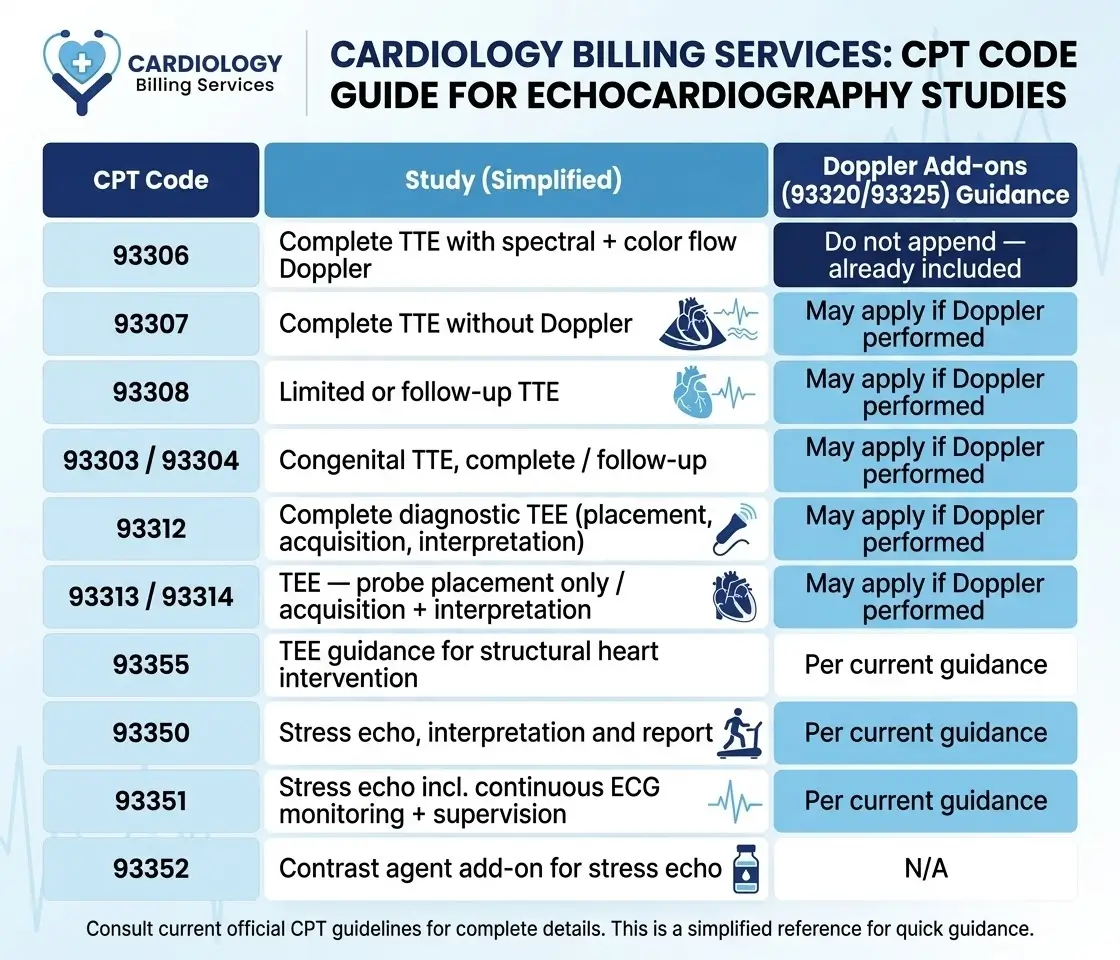
Do not treat this as a substitute for the full code descriptors and instructional notes in the current CPT manual and your payer policies.
Professional vs technical component
Understanding the component split prevents one of the most avoidable denials in cardiac imaging: two entities billing for the same work.
When modifier 26 may apply
Modifier 26 identifies the professional component only. It applies when a physician interprets a study performed on equipment they do not own most often a hospital-based cardiologist reading a study done in the hospital echo lab, where the hospital bills 93306-TC and the cardiologist bills 93306-26. It does not apply automatically to every echo claim. A cardiology office that owns the machine, employs the sonographer and reads its own studies bills globally with no modifier; adding modifier 26 there would bill only for interpretation and forfeit the technical payment.
The correct choice comes down to a CMS field: the PC/TC indicator on the Medicare Physician Fee Schedule. Codes with a PC/TC indicator of 1, which include the complete echo codes, allow the professional/technical split. Verifying that indicator before submitting a component-split claim is a small step that prevents an invalid-modifier denial. Because these component splits are common in cardiac imaging, they’re a frequent driver of rework and a core focus of cardiac imaging billing.
ICD-10-CM diagnosis coding for echocardiography
Diagnosis coding is what tells the payer why the study was done. The CPT code says what was performed; the ICD-10-CM code, drawn from the documented clinical picture, establishes medical necessity. A technically perfect echo code with an unsupported or nonspecific diagnosis is a medical-necessity denial waiting to happen.
Several principles carry most of the weight. The diagnosis must reflect what the record documents, not a code chosen to match a coverage policy. It should be coded to the highest available specificity, because vague or unspecified codes are a frequent denial trigger. And the diagnosis has to logically connect to the study performed a limited follow-up echo should link to the condition being followed. Sequencing matters too; the primary reason for the study should lead.
One caution worth stating plainly: no ICD-10-CM code guarantees payment. Medicare Local Coverage Determinations (LCDs) and commercial medical policies publish lists of diagnoses that support coverage for echo, but coverage still depends on documentation, frequency and the specific policy in force on the date of service. Treat those covered-diagnosis lists as a starting point for your compliance checks, not as a promise.
Echocardiography documentation requirements
Documentation is the evidence behind the codes. Exact requirements vary by service, payer and applicable policy, but a defensible echo report generally supports the following:
- The clinical indication and reason for the study — the symptom, condition, or clinical question prompting it.
- Relevant clinical history connecting the study to the patient’s presentation.
- The order from the physician or qualified health professional, where required.
- The study performed — complete versus limited, transthoracic versus transesophageal and whether spectral and color flow Doppler were done.
- The findings, including the measurements and structural assessments expected for the code billed (for a complete study, that generally means chamber measurements, valve morphology, wall motion, ejection fraction and Doppler velocities).
- A signed interpretation and report with authentication as required.
It helps to separate two ideas that often get blurred: documentation that supports the service (what clinically happened) and documentation specifically required by a payer or policy (a signed order, a stated indication in policy language, contrast justification). A report can fully describe a study and still fail a coverage audit if it omits the element a specific policy requires. For a complete study coded 93306, one practical safeguard is a report template that requires interpreted Doppler findings in the narrative rather than boilerplate — auditors read the interpretation, not the auto-populated header.
Medical necessity for echocardiography
Medical necessity is the standard a payer uses to decide whether a covered service was appropriate for this patient on this date. For echo, it means the documented clinical picture justifies the study performed and the diagnosis submitted supports it under the applicable policy.
A few realities follow from that. A diagnosis code alone does not establish medical necessity; the record has to support the diagnosis. Medicare coverage for echo is often governed by LCDs that specify covered indications and, in some cases, frequency limits a repeat study without documentation explaining why it was needed is a common denial. Commercial payers apply their own medical policies, which may differ from Medicare’s. And “medically necessary” is not the same as “covered”: a study can be clinically reasonable and still fall outside a payer’s coverage policy or frequency allowance, which is why verifying coverage before the study matters as much as documenting it after.
Modifier guidance
Modifiers add necessary context, but they are not tools for prying loose a payment the underlying claim doesn’t support. Each should be applied only when the documentation backs it.
Modifier 26 / TC Split the professional and technical components when two different entities perform the interpretation and the technical work. Use 26 for interpretation-only, TC for the technical-only and no modifier when one entity does both. Component-split claims should have separate documentation of the professional and technical work; payers scrutinize these closely.
Modifier 59 (and X{EPSU}) Identifies a distinct procedural service to allow separate reporting of two services that would otherwise bundle under NCCI, when the services are genuinely separate. CMS prefers the more specific X modifiers XE (separate encounter), XS (separate structure), XP (separate practitioner), XU (unusual non-overlapping service) over the broad 59. Critically, modifier 59 does not override the 93306/Doppler bundle; there is no distinct-service scenario that makes appending 93320 or 93325 to 93306 correct.
Modifier 76 / 77 Report a repeat study on the same date when it is clinically necessary. Use 76 when the same physician repeats the service and 77 when a different physician does. Document why the repeat was needed and check Medically Unlikely Edits (MUEs) before billing multiple units.
Modifier 25 Applies to a significant, separately identifiable evaluation and management service performed on the same day as a procedure. It is not an echo modifier, but it becomes relevant when a distinct E/M visit accompanies an echo on the same date and the documentation supports both services independently.
The general rule across all of these: a modifier should never be added simply to obtain reimbursement or bypass an edit. Misapplied modifiers are a leading source of post-payment recoupment.
NCCI edits and bundling
The National Correct Coding Initiative (NCCI), maintained by CMS, defines which code pairs may not be reported together and which are mutually exclusive. Two NCCI concepts drive most echo bundling issues.
Procedure-to-procedure (PTP) edits pair a comprehensive service with a component service and prevent billing both. The 93306/Doppler pair is the textbook example: because 93306 comprehensively includes spectral and color flow Doppler, reporting 93320 or 93325 alongside it is unbundling. This particular edit has no modifier override. Mutually exclusive edits flag services that cannot reasonably be performed together for instance, billing a complete TEE (93312) with one of its component codes.
Modifiers can allow separate reporting when and only when two services are genuinely distinct and the documentation supports it. They are not a routine workaround for edits. Before overriding any edit, confirm the pairing against the current NCCI PTP files or your MAC’s lookup tool and make sure the record actually reflects two separate, separately reportable services.
Prior authorization and eligibility
Advanced cardiac imaging is an increasingly common target for utilization management. Plain resting TTE frequently does not require prior authorization, but stress echo, TEE and nuclear studies increasingly do and requirements vary by payer, plan and sometimes by the delegated radiology-benefit manager a plan uses. Medicare Advantage and commercial plans often carry authorization requirements that traditional Medicare does not.
The prevention step is procedural, not clever: verify eligibility and benefits before the study, confirm whether prior authorization or a referral is required for the specific service, obtain it and make sure the authorization on file matches the CPT code actually billed. An authorization for one echo code will not cover a different code performed on the day. When a study is done without a required authorization, the resulting denial is often difficult to overturn on appeal, which is why the check belongs at the front of the workflow rather than after the denial.
Common echocardiography billing errors
Most echo denials trace back to a short list of preventable mistakes. The table below pairs each with why it causes a problem and how to prevent it.
| Billing mistake | Why it can cause a problem | Prevention |
| Coding a limited study as complete | Documentation doesn’t support the higher code; downcode or denial on audit | Code to the documented scope; audit complete-to-limited ratios |
| Appending 93320/93325 to 93306 | Unbundling; hard NCCI edit with no override | Remove add-ons; report them only with non-Doppler codes |
| Wrong or missing PC/TC modifier | Two entities bill the same work, or global billed when only a component was provided | Confirm who owns equipment and interprets; verify PC/TC indicator |
| Unsupported or nonspecific diagnosis | Fails medical-necessity coverage policy | Code to specificity; match diagnosis to the documented indication |
| Missing prior authorization | Service not authorized; denial often hard to appeal | Verify and obtain authorization before the study; match to billed code |
| Eligibility not verified | Coverage inactive or plan changed on date of service | Verify eligibility and benefits before every study |
| Claim sent to the wrong payer/plan | Denial for coverage or coordination-of-benefits issues | Confirm active plan and COB order at intake |
| Duplicate claim | Second submission flagged before the first adjudicates | Track claim status before resubmitting |
| Incorrect units on repeat studies | Exceeds MUE; units not supported | Check MUEs; document repeats with modifier 76/77 |
| Missing or unsigned interpretation | No professional-component support | Require a signed, authenticated report before billing |
| Incorrect place of service | POS conflicts with the component or setting billed | Confirm POS matches where the study was performed |
| Timely filing missed | Claim rejected regardless of merit | Track filing deadlines by payer; submit and rework promptly |
Common echocardiography claim denials
Denials cluster into recognizable categories. Working them by category rather than one claim at a time is what turns denial management into denial prevention.
| Denial reason | Example | Prevention |
| Medical necessity | Complete echo with a nonspecific diagnosis outside the LCD | Match a specific, supported diagnosis to the documented indication |
| Incorrect CPT coding | 93306 billed on a study with no interpreted Doppler | Verify all four components before billing 93306; otherwise 93307/93308 |
| Diagnosis doesn’t support the service | Follow-up echo linked to an unrelated diagnosis | Link the diagnosis to the condition being evaluated |
| Modifier error | Modifier 26 on a globally performed office study | Apply component modifiers only to true component-split claims |
| NCCI / bundling | 93325 billed with 93306 | Do not append bundled Doppler add-ons to 93306 |
| Missing documentation | Report lacks the measurements expected for a complete study | Use templates that require the documented elements per code |
| Prior authorization | Stress echo performed without required authorization | Verify and obtain authorization before advanced imaging |
| Eligibility / coverage | Plan terminated before date of service | Verify eligibility and benefits at intake |
| Frequency limitation | Repeat echo exceeds the policy’s allowed interval | Check frequency limits; document why a repeat was needed |
| Duplicate claim | Same claim submitted twice | Confirm status before resubmitting |
| Component billed twice | Facility and physician both bill globally | Coordinate TC/26 split between entities |
| Timely filing | Claim submitted after the payer deadline | Track and meet payer-specific filing windows |
Persistent denials in any of these categories usually point to a process gap rather than bad luck and that’s where structured denial management earns its place tracing each denial to a root cause and fixing the step that produced it.
Rejection vs denial vs underpayment
These terms are often used interchangeably, but the right response differs for each. Payer systems don’t always use identical language, so confirm how a specific payer defines each status.
| Claim status | What it generally means | Typical response |
| Rejection | Claim failed a front-end edit and never entered adjudication (bad demographics, invalid code, format error) | Correct the error and submit as a fresh claim — usually no appeal needed |
| Denial | Claim was adjudicated and payment was refused (medical necessity, no authorization, bundling) | Determine whether a corrected claim or an appeal is appropriate |
| Partial denial | Some line items paid, others denied on the same claim | Work the denied lines; verify the paid lines were paid correctly |
| Underpayment | Claim paid, but below the contracted or expected rate | Compare against the fee schedule or contract; pursue the difference |
A rejection is a clerical fix; a denial is a decision that may need documentation or an appeal; an underpayment is a payment-accuracy problem that surfaces only when payments are reconciled against contracted rates. Catching underpayments in particular depends on disciplined payment posting, because a claim that pays something can quietly pay too little.
Echocardiography billing workflow
A repeatable workflow prevents most denials before submission and makes the rest easier to work. A practical sequence:
- Verify patient eligibility and active coverage.
- Verify benefits and any coverage or frequency limitations for the study.
- Check referral requirements.
- Check and obtain prior authorization where required.
- Confirm provider and network status.
- Review the order and clinical indication.
- Perform and document the study.
- Confirm the documentation supports the specific code to be billed.
- Select the appropriate CPT code for the study performed.
- Select supported, specific ICD-10-CM diagnosis codes.
- Apply modifiers only when documentation supports them.
- Scrub for NCCI, MUE and payer-specific edits.
- Validate demographics, payer, POS and provider information.
- Submit the claim.
- Monitor rejections and denials.
- Follow up on unpaid claims.
- Correct or appeal as appropriate.
- Track recurring denial patterns and fix the upstream process.
The last step matters more than it looks. Resubmitting a denied claim unchanged same code, same missing authorization, same unsupported diagnosis produces the same denial. The claim only pays when the underlying reason is addressed, which is why root-cause tracking, not resubmission, is the durable fix.
How to prevent echocardiography billing denials
Prevention is cheaper than appeals and it’s mostly a matter of doing the right check at the right stage.
Before the study
Verify eligibility and benefits, confirm referral and prior authorization requirements for the specific service, check network status and note any coverage or frequency limitations that apply to the study being scheduled.
During the service
Document the clinical indication, the study actually performed (complete vs limited, transthoracic vs transesophageal, Doppler performed and interpreted), the findings and measurements expected for the code and a clear connection to medical necessity.
During coding
Match the CPT code to the documented study, select specific supported ICD-10-CM codes, apply modifiers only when justified, confirm the professional/technical component, verify units against MUEs and run NCCI and payer-specific edits.
Before claim submission
Validate the claim end to end: demographics, correct payer and plan, authorization number matching the billed code, coding edits cleared, correct rendering and billing provider and the right place of service.
After submission
Track the claim, monitor for rejections and denials, follow up on aging accounts receivable, appeal or correct where appropriate, post payments accurately and run root-cause analysis on recurring denials. Tightening this back-end loop is a large part of effective revenue cycle management for cardiology.
How to handle a denied echocardiography claim
When an echo claim denies, resist the reflex to resubmit. Start by reading the denial reason on the remittance advice (ERA) or explanation of benefits (EOB) and identifying the actual reason the denial code often points to a category (medical necessity, authorization, bundling) that tells you where to look. Pull the claim and the medical record and determine whether the problem is a correctable error (wrong code, missing modifier, transposed diagnosis) or a payment decision that requires an appeal.
Correctable errors take a corrected claim. Payment decisions that you believe are wrong a supported study denied for medical necessity, a properly documented service denied for bundling take an appeal. Getting this fork right saves time: appealing a claim that just needed a corrected diagnosis wastes the appeal and resubmitting a claim that actually needs an appeal restarts the clock without changing the outcome.
How to appeal an echocardiography claim denial
An echocardiography appeal is a focused argument that the service was performed, documented, medically necessary and correctly coded under the payer’s own policy. A workable sequence:
- Read the denial reason carefully and confirm what the payer actually decided.
- Review the claim as submitted for coding and data errors.
- Review the medical record against the code billed.
- Identify the true reason for denial, which is not always the reason stated.
- Decide whether a corrected claim or a formal appeal is the right path.
- Review the payer’s applicable medical or coverage policy for the date of service.
- Gather the supporting documentation the specific denial requires.
- Write a concise appeal that ties the documentation to the payer’s own coverage criteria.
- Submit through the payer’s required method and level.
- Meet the payer’s appeal deadline.
- Track the outcome and feed it back into root-cause analysis.
Appeal levels, formats and deadlines vary by payer and denial type and Medicare’s multi-level appeals process differs from commercial timelines. Confirm the requirements for each payer rather than assuming a single process. Because claim tracking and timely rework determine whether an appeal is even filed in time, the follow-up system matters as much as the argument.
Appeal documentation
The documents an appeal needs depend on the denial. Not every appeal requires every item; match the evidence to the reason. Depending on the denial, relevant documents may include the claim details, the ERA/EOB, the echo report, the physician’s documentation and clinical history, the order, diagnostic findings, authorization or referral information, the coding rationale, the applicable payer policy and specific medical-necessity documentation. A medical-necessity denial usually turns on the report and diagnosis; an authorization denial turns on the authorization record; a bundling denial turns on the coding rationale and the record showing distinct services.
Denial root-cause analysis
Individual appeals recover individual claims; root-cause analysis stops the denials from recurring. The idea is to stop treating denials as isolated events and start looking at them as data. Track denials across several dimensions denial reason, payer, CPT code, ICD-10-CM code, rendering provider, location, echo service type, date of service, dollar amount, frequency, authorization status and appeal outcome and patterns surface quickly.
Those patterns usually reveal a process problem, not a coding accident. A cluster of medical-necessity denials on one code from one payer often points to a documentation template that omits a required element. A run of authorization denials points to a front-desk verification gap. A spike in component denials points to a TC/26 coordination failure with a facility. Fixing the process fixes the category, which is worth far more than winning the appeals one at a time.
Denial metrics
A handful of metrics make echo denial performance measurable. Useful ones include denial rate, denied claim volume, denied dollar value, top denial reasons, payer-specific denial rate, coding-related denials, authorization-related denials, medical-necessity denials, appeal overturn rate, days to resolution and recurring denial categories.
The most common headline metric is denial rate:
Denial rate = denied claims ÷ applicable adjudicated claims × 100
The catch is the denominator. Organizations define it differently some use total claims submitted, others use adjudicated claims, others use a dollar-weighted basis so a denial rate is only comparable when the denominator is defined and held consistent. Define yours explicitly, apply it the same way each period and avoid comparing your number against an outside benchmark that was calculated on a different basis.
Medicare echocardiography billing considerations
Medicare has its own coverage architecture and applying it correctly (and only to Medicare claims) prevents a lot of rework.
Coverage for echo under Medicare is frequently governed by Local Coverage Determinations published by the MAC for a jurisdiction and in some areas by National Coverage Determinations. These policies specify covered indications and may set frequency parameters, so the covered-diagnosis list and any frequency limits should be checked against the MAC policy in force for the date of service. Medicare also relies on NCCI edits and MUEs, expects documentation that supports the code billed and recognizes the PC/TC component split through the modifier and PC/TC indicator framework described earlier.
On payment, CMS finalized the CY 2026 Medicare Physician Fee Schedule (final rule CMS-1832-F, effective January 1, 2026). For the first time, the rule set two conversion factors: roughly $33.57 for qualifying alternative payment model participants and $33.40 for non-qualifying practitioners. CMS also finalized a 2.5% efficiency adjustment to work RVUs and intra-service time for non-time-based codes and a reduction in facility practice expense and professional organizations including the American Society of Echocardiography and the American College of Cardiology have noted that diagnostic imaging services, echocardiography among them, may see reduced Medicare payment as a result despite the conversion-factor increase. Because these figures and adjustments change annually, confirm current values through CMS before relying on them.
One rule worth repeating: Medicare requirements are not universal. LCD-covered diagnoses, Medicare frequency rules and Medicare appeal timelines apply to Medicare claims and they should not be assumed to govern commercial claims.
Commercial payer considerations
Commercial payer requirements often diverge from Medicare and from each other. Differences commonly appear in prior authorization (more common and broader among commercial and Medicare Advantage plans, sometimes administered through a radiology-benefit manager), referral requirements, medical and coverage policies, network participation rules, timely-filing windows, corrected-claim and appeal deadlines, documentation expectations and frequency and benefit limitations.
The practical takeaway is that echo coverage and process should be verified per payer and per plan rather than assumed. A study covered and paid by one commercial plan may require authorization, a different diagnosis basis, or a shorter filing window under another. Specific commercial payer requirements should be confirmed against each payer’s current published policy rather than inferred from Medicare or from another payer.
Medicare vs commercial payers
The table below highlights where the two commonly differ. It is a general orientation, not a policy source — commercial policies vary by payer and plan and Medicare rules vary by MAC.
| Area | Medicare | Commercial payer |
| Coverage | Often governed by LCDs/NCDs with covered-indication lists | Governed by each payer’s medical policy; varies by plan |
| Medical necessity | Tied to LCD/NCD criteria and documentation | Tied to the payer’s own coverage criteria |
| Prior authorization | Traditional Medicare often does not require it for resting TTE; Medicare Advantage may | Frequently required for advanced imaging; varies by plan/RBM |
| Documentation | Must support the code and meet LCD requirements | Must meet the payer’s specific policy requirements |
| Modifiers | Follows CMS/NCCI modifier and PC/TC rules | Generally follows CMS structure; verify payer edits |
| Timely filing | Medicare filing window | Varies widely by payer and contract |
| Appeals | Defined multi-level Medicare appeals process | Payer-specific levels and deadlines |
Do not apply Medicare rules to commercial claims by default. The safest posture is to treat each payer’s current policy as the authority for that payer’s claims.
Realistic echocardiography billing scenarios
The following scenarios are hypothetical and illustrative. They are not real patient cases and are provided only to show how coding and billing problems arise and how they can be prevented.
Scenario 1 — Doppler unbundling. A practice bills 93306 with 93325 appended for a complete echo. Problem: color flow Doppler is already included in 93306; the add-on triggers a hard NCCI edit. Review: the report and the code combination. Prevention: remove 93325; report color flow add-ons only with non-Doppler codes.
Scenario 2 — Complete coded as, but documented as limited. A follow-up echo rechecking one finding is billed 93306. Problem: the report supports a focused study, not a complete four-component evaluation. Review: the documented scope against the code. Prevention: code the documented scope (93308 here); audit the complete-to-limited ratio.
Scenario 3 — Missing component modifier. A hospital-based cardiologist reads a study performed in the hospital lab and bills 93306 globally. Problem: the hospital also bills 93306-TC, so one claim denies for a duplicate component. Review: who owns the equipment and who interpreted. Prevention: the physician bills 93306-26; the facility bills 93306-TC.
Scenario 4 — Diagnosis doesn’t support the test. A complete echo is submitted with a vague, unspecified diagnosis outside the applicable LCD. Problem: medical-necessity denial. Review: the documented indication and the coverage policy. Prevention: code a specific, supported diagnosis matching the documented reason.
Scenario 5 — Missing prior authorization. A stress echo is performed without the payer’s required authorization. Problem: denial that is often difficult to overturn. Review: the payer’s authorization requirement for the service. Prevention: verify and obtain authorization before advanced imaging; match it to the billed code.
Scenario 6 — Frequency limitation. A repeat echo is performed sooner than a payer’s policy allows, with no explanation in the record. Problem: frequency denial. Review: the policy’s allowed interval and the documentation. Prevention: check frequency limits; document the clinical reason a repeat was needed.
Scenario 7 — Duplicate claim. A denied claim is resubmitted before the original adjudicates. Problem: duplicate-claim denial that adds to the backlog. Review: claim status before resubmission. Prevention: track status and rework rather than resubmit blindly.
Scenario 8 — Missing interpretation. A technical study is billed before the signed interpretation is completed. Problem: no professional-component support if global is billed. Review: whether a signed report exists. Prevention: require an authenticated report before billing the professional or global service.
Coding errors and review steps
A quick reference tying common coding issues to their likely consequence and the review step that catches them.
| Coding issue | Potential consequence | Review step |
| 93306 without interpreted Doppler | Downcode or denial | Confirm both Dopplers documented before billing 93306 |
| Doppler add-on on 93306 | NCCI bundling denial | Remove add-on; verify code pairing |
| Component modifier misuse | Duplicate-component or invalid-modifier denial | Confirm equipment ownership and PC/TC indicator |
| Nonspecific diagnosis | Medical-necessity denial | Recode to specificity against the indication |
| Complete vs limited mismatch | Downcode, recoupment, or lost revenue | Match code to documented scope |
| Unsupported modifier 59/76/77 | Edit denial or recoupment | Verify documentation supports distinctness/repeat |
How professional cardiology billing services can help
Not every practice needs outside billing help and this article is not an argument that it does. But there are specific, recognizable situations where dedicated support tends to pay for itself: a persistently high echo denial rate, repeated coding errors on the same codes, a growing appeals workload, an accounts-receivable backlog that never quite clears, payer-specific rules that keep shifting, authorization tracking that overwhelms the front desk and the professional/technical component complexity that comes with cardiac imaging.
A cardiology-focused billing team addresses those problems where they originate accurate coding and documentation review up front, component-split accuracy, edit scrubbing before submission, structured denial root-cause analysis, disciplined AR follow-up and reconciliation that catches underpayments. Because these workflows are cardiac-specific, they benefit from a team that works only in this specialty rather than one splitting attention across many. Cardiology Billing Services provides this kind of specialty-focused support, including non-invasive cardiology billing for echo, stress testing and related studies. The right question is not who is “best,” but whether a given practice’s echo revenue is leaking in ways a dedicated process would close.
Frequently asked questions
What is echocardiography billing? Echocardiography billing is the coding and claim-submission process used to obtain reimbursement for cardiac ultrasound studies. It involves selecting the correct CPT code for the study performed, attaching supported ICD-10-CM diagnoses, applying justified modifiers, handling the professional/technical component split and submitting a claim that matches the documentation.
How are echocardiograms billed? An echo is coded by the study performed (transthoracic, transesophageal, or stress), whether it was complete or limited and whether Doppler was performed and interpreted. It is billed globally when one entity performs and interprets it, or split into technical (TC) and professional (26) components when two entities are involved.
What CPT codes are used for echocardiography? Common codes include 93306 (complete TTE with Doppler), 93307 (complete TTE without Doppler), 93308 (limited/follow-up TTE), 93312–93314 and 93355 (TEE), 93350 and 93351 (stress echo) and the Doppler add-ons 93320 and 93325. Congenital studies use a separate code family. Always verify current CPT wording and rules.
What is the difference between professional and technical component billing? The technical component (modifier TC) covers the equipment, sonographer and image acquisition. The professional component (modifier 26) covers the physician’s interpretation and report. When one entity does both, the study is billed globally with no modifier.
When is modifier 26 used for echocardiography? Modifier 26 applies when a physician interprets a study performed on equipment they do not own — typically a hospital-based cardiologist reading a study done in the hospital lab. It does not apply to an office that owns the equipment and reads its own studies; that is billed globally.
Can incorrect ICD-10-CM coding cause an echocardiography denial? Yes. A nonspecific or unsupported diagnosis, or one that falls outside the applicable coverage policy, is a leading cause of medical-necessity denials. The diagnosis must reflect the documented indication and be coded to specificity, though no diagnosis code guarantees payment.
What documentation supports echocardiography billing? Generally the clinical indication, relevant history, the order where required, the study performed, the findings and measurements expected for the code and a signed interpretation and report. Exact requirements vary by service and payer and some payers require specific elements to establish coverage.
What are common echocardiography billing errors? Frequent errors include coding a limited study as complete, appending Doppler add-ons to 93306, missing or incorrect component modifiers, nonspecific diagnoses, missing prior authorization, unverified eligibility, duplicate claims and incorrect place of service.
Why are echocardiography claims denied? Common reasons include medical necessity, incorrect CPT coding, unsupported diagnoses, modifier errors, NCCI/bundling issues, missing documentation, missing prior authorization, eligibility problems, frequency limits and timely-filing failures.
What is a medical necessity denial for an echocardiogram? It is a denial stating that the documented clinical picture and diagnosis did not justify the study under the payer’s coverage policy. It is corrected by matching a specific, supported diagnosis to the documented indication or, where the study was justified, by appealing with the report and policy criteria.
Does echocardiography require prior authorization? It depends on the payer and the service. Plain resting TTE often does not, but stress echo, TEE and nuclear imaging increasingly do, especially under commercial and Medicare Advantage plans. Verify the requirement per payer and plan before the study.
How does Medicare handle echocardiography billing? Medicare coverage is frequently governed by LCDs (and sometimes NCDs) that list covered indications and may set frequency limits, applies NCCI edits and MUEs, recognizes the PC/TC split and pays under the annually updated Physician Fee Schedule. Requirements can vary by MAC.
Do commercial insurers follow the same echocardiography billing rules as Medicare? Not necessarily. Commercial payers set their own medical policies, authorization requirements, filing windows and appeal deadlines, which may differ from Medicare and from each other. Medicare rules should not be applied to commercial claims by default.
How can cardiology practices reduce echocardiography claim denials? By verifying eligibility and authorization before the study, documenting the indication and each billed component, coding to the documented scope with specific diagnoses, scrubbing for NCCI and MUE edits and tracking denials to root cause so the same problem does not recur.
How do you appeal an echocardiography claim denial? Read the denial reason, review the claim and record, identify the true cause, decide between a corrected claim and a formal appeal, review the payer’s policy, gather the documentation the denial requires, write a concise argument tied to coverage criteria and submit through the payer’s required method within the deadline.
Key takeaways
- Echocardiography billing succeeds when the study performed, the report and the payer’s coverage policy all line up; most denials come from a gap among those three.
- The code follows the documented study: complete with Doppler (93306), complete without Doppler (93307), or limited/follow-up (93308) plus separate families for TEE, stress and congenital studies.
- Do not append the Doppler add-ons 93320 or 93325 to 93306; the Doppler is already included and the NCCI edit has no modifier override.
- Use modifier 26/TC only for true component splits; verify the PC/TC indicator and bill globally when one entity performs and interprets.
- Prior authorization, medical necessity and frequency rules vary by payer; verify them per payer and per plan and never assume Medicare rules govern commercial claims.
- Rework the process, not just the claim: resubmitting a denial unchanged reproduces it, while root-cause analysis fixes the category.
- Confirm all current CPT, ICD-10-CM, NCCI and payer specifics against CMS, the AMA, your MAC and each payer before submitting.
Conclusion
Echocardiography billing rewards precision at a small number of decision points: the right code for the documented study, the correct component split, a specific and supported diagnosis, the required authorization and clean edits before the claim goes out. Get those right and echo becomes one of the more predictable revenue streams in a cardiology practice. Get them wrong and the same study generates a steady stream of downcodes, bundling edits and medical-necessity denials that quietly erode margin.
The practices that keep echo revenue intact tend to share a habit rather than a secret: they check coverage before the study, document each billed component, code to what the record shows and treat every denial as information about a process to fix rather than a claim to resubmit. Whether that work is handled in-house or with specialty billing support, the standard is the same verify current rules, match the claim to the documentation and close the loop on denials so they don’t come back.