
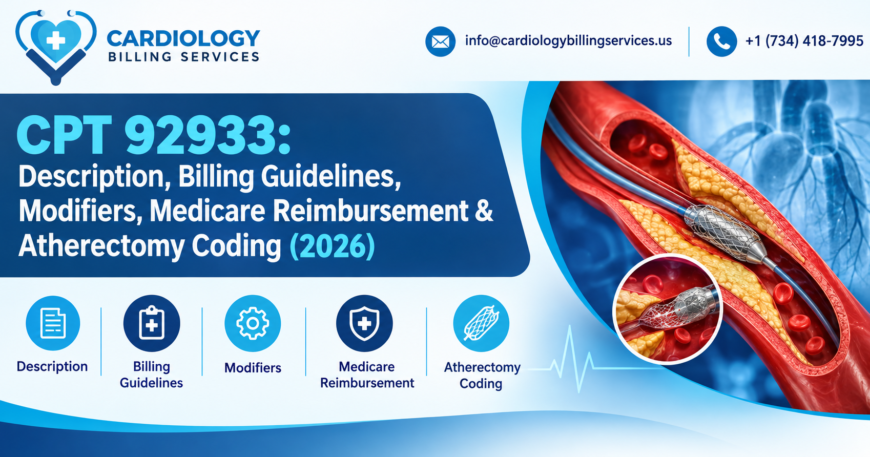
CPT 92933: Description, Billing Guidelines, Modifiers, Medicare Reimbursement & Atherectomy Coding (2026)

CPT 92933 reports percutaneous coronary atherectomy with intracoronary stent placement, including balloon angioplasty when performed, in a single major coronary artery and/or its branches. It describes one combined intervention in a native coronary artery, not each device or lesion separately.
Since January 1, 2026, the code sits in a restructured PCI family. The additional-branch add-on codes, including 92934, were deleted, and new code 92930 covers complex stenting. This guide explains what 92933 includes, how it differs from neighboring codes, how modifiers apply, and what drives Medicare payment and denials. It is educational, so confirm details against current AMA CPT, CMS, your MAC, and payer policy.
CPT 92933 at a Glance
| Element | Detail |
|---|---|
| Code | 92933 |
| Category | Percutaneous coronary intervention (PCI), native coronary artery |
| Key components | Atherectomy plus stent in the same artery; balloon angioplasty included |
| Reporting unit | One base code per major coronary artery, branches included |
| Main considerations | Artery modifier, code hierarchy, separately reportable add-ons, diagnostic cath criteria, 2026 changes |
What Is CPT Code 92933?
CPT code 92933 captures the physician's work when plaque is modified with an atherectomy device (rotational, orbital, or laser) and a stent is then placed in the same coronary artery. Operators typically choose atherectomy for calcified or fibrotic lesions that would block stent delivery or expansion. The code goes on the professional claim, and the hospital reports facility services separately.
92933 CPT Code Description
In plain terms, the descriptor has four parts: transluminal coronary atherectomy, an intracoronary stent, balloon angioplasty when performed, and one major coronary artery and/or its branches. Because angioplasty is built in, pre- and post-dilation are not billed on top.
What Does CPT 92933 Include?
According to SCAI's November 2025 PCI coding guidelines, every PCI base code includes vessel access, crossing the lesion, related radiological supervision and interpretation, access-site closure, distal embolic protection, and imaging that documents completion.
These add-ons may be reported separately when performed and documented:
- 92972 (coronary lithotripsy)
- 92973 (mechanical aspiration thrombectomy)
- 92978/92979 (IVUS or OCT)
- 93571/93572 (flow or pressure measurement)
- 92974 (brachytherapy device placement)
Diagnostic angiography qualifies only under specific criteria, covered below.
What Changed for CPT 92933 in 2026
- No more branch add-ons. Branches fold into the base code.
- New 92930. It covers stenting of two or more distinct lesions with multiple stents across multiple segments, or a bifurcation treated in both main vessel and side branch.
- Revalued. CMS finalized a work RVU of 11.94 for 92933, down from 12.29 in 2025 (Federal Register).
- Payer lag. Industry educators noted that many payers had not published full 2026 PCI policies at rollout. Verify each payer's current edits.
CPT 92933 vs Other Coronary Intervention Codes
Selection starts with one rule: report the code describing the most intensive service in each major artery, and only one base code per artery.
| Code | What it describes | Use instead of 92933 when |
|---|---|---|
| 92920 | Balloon angioplasty only | No atherectomy, no stent |
| 92924 | Atherectomy, no stent | Atherectomy done, stent not placed |
| 92928 | Stent, one lesion | Stenting without atherectomy |
| 92930 | Complex stenting (new 2026) | Stent-only treatment of multiple distinct lesions or a bifurcation |
| 92937 | Revascularization through a bypass graft | Treated through a graft |
| 92941 | PCI during acute MI | Emergent PCI of a culprit vessel meeting CPT criteria |
| 92943 / 92945 | Chronic total occlusion (antegrade / combined) | Lesion meets the CTO definition |
The last four codes already include any combination of atherectomy and stenting, so 92933 is not added for the same vessel.
What Is the CPT Code for Coronary Atherectomy?
There is no single code. Atherectomy without a stent is 92924, and atherectomy with a stent is 92933. When the case involves a bypass graft, acute MI, or chronic total occlusion, the matching "any method" code (92937, 92941, 92943, or 92945) replaces both. Don't default to 92933 for every atherectomy. Peripheral atherectomy belongs to an entirely different code family.
Does CPT 92933 Need a Modifier?
No modifier is built into 92933, but PCI reporting expects a coronary artery modifier (LC, LD, LM, RC, or RI) to identify the treated vessel, and many payers edit for it. Branches use the parent artery's modifier. When one lesion bridges two vessels and a single intervention treats it, report one code with the modifiers for both arteries.
| Modifier | May apply | Should not be used |
|---|---|---|
| LC, LD, LM, RC, RI | To identify the artery treated | To justify a second base code for the same artery |
| 59 or XS/XU | On a separately reportable diagnostic cath or other bundled service, with documented criteria | To bypass an NCCI edit for work already included in PCI |
| 22 | Substantially greater work, clearly documented | Routine calcification or standard device use |
| 51 | Where a commercial payer requires it | Medicare doesn't require it |
Unnecessary modifier use, especially 59, draws audit attention. See our Modifier 59 guide. Payer rules vary, so verify before building claim-scrubber rules.
Documentation Requirements for CPT 92933
A reviewer should be able to reconstruct the code from the operative report alone.
| Element | What the record should show |
|---|---|
| Indication | Symptoms, ischemia findings, elective vs acute |
| Atherectomy rationale | Why it was needed (for example, calcification limiting stent delivery) |
| Vessel and branch | LM, LAD, LCx, RCA, or ramus; branch; native vs graft |
| Lesion detail | Location, segments, distinct lesions, bifurcation |
| Atherectomy | Device type, performed before stenting |
| Stents | Number, size, location, post-dilation |
| Result | Residual stenosis, flow, complications |
| Add-on services | IVUS/OCT, FFR, lithotripsy, thrombectomy, with vessel and interpretation |
Diagnostic cath: per SCAI, it is separately reportable when no prior study exists and the decision to intervene came from it. It also qualifies when prior imaging was inadequate, the indication changed, or a clinical change required evaluating a separate area. The record must say which applies.
Medical Necessity
Payers want evidence that both the intervention and the atherectomy were warranted. Claims fall apart when the indication is vague, diagnoses don't match the procedure, or the note never explains why atherectomy was required. When the provider documents a calcified lesion, ICD-10-CM code I25.84 can support it, alongside the underlying coronary atherosclerosis code.
Some MACs publish PCI billing and coding articles. SCAI cites National Government Services article A56823 as one example. Inconsistent records lead to coding queries, record requests, medical necessity denials, audits, and delayed payment.
CPT 92933 Medicare Reimbursement
Medicare pays physicians under the Physician Fee Schedule. Work, practice expense, and malpractice RVUs are adjusted by geographic practice cost indices and multiplied by a conversion factor. For 2026 there are two conversion factors, roughly $33.40 and $33.57, depending on qualifying APM status.
- Work value. The finalized 11.94 work RVU is subject to CMS's 2.5% efficiency adjustment for non-time-based services.
- Facility setting. CMS halved the work-based indirect practice expense allocation for facility-performed services, which lowers physician payment for hospital-based PCI.
- Benchmark. Manufacturer guides built on the final rule list a national, unadjusted physician payment near $553 (example). Treat that as a benchmark, not a fee, and verify it in CMS's PFS relative value files.
- Actual payment. It varies with locality, multiple-procedure reductions when several arteries are treated, sequestration, and MIPS adjustments. The allowed amount is not the billed charge.
- Facility claims. They are separate. CMS's 2026 outpatient file lists 92933 as status indicator J1, APC 5194.
Commercial Insurance Reimbursement
Commercial payers pay under negotiated contracts, so the same 92933 claim can pay very differently by payer and network.
| Factor | Medicare | Commercial / Medicare Advantage |
|---|---|---|
| Payment basis | PFS RVUs, GPCI, conversion factor | Contracted fee schedule, often a percentage of Medicare or proprietary rates |
| Edits | NCCI and MAC articles | NCCI plus proprietary and policy-specific edits |
| Authorization | Not typically required in fee-for-service | Often required for elective PCI; verify per plan |
| 2026 code adoption | Follows CMS files | May lag or reject new and deleted codes |
Common CPT 92933 Billing Errors and Denials
Most problems trace to a mismatch between report and code, missing modifiers, weak necessity support, or bundled services billed separately.
| Denial or error | Typical cause | Prevention |
|---|---|---|
| Wrong or invalid code | 92933 billed without documented atherectomy; 92934 submitted on 2026 dates of service | Match code to operative report; update charge master; query provider |
| Modifier issues | Missing artery modifier; unsupported 59 | Prompt for artery at charge entry; require documentation for 59 |
| Medical necessity | Diagnosis doesn't support intervention or atherectomy | Link ICD-10 codes to the procedure; strengthen indication |
| Bundling / NCCI | Angiography, distal protection, or dilation billed separately | Review edits; apply cath criteria |
| Authorization | No prior auth on commercial or MA plan | Verify at scheduling; pursue retro-authorization if allowed |
| Duplicate or overlap | Two base codes in one artery | One base code per artery (native plus graft is the exception) |
Coding Scenarios (Educational Only)
- Standard case. Calcified proximal LAD, rotational atherectomy, then one stent: 92933-LD. An adequate recent cath with no clinical change means no separate diagnostic cath.
- Different arteries. Atherectomy and stent in the LAD, stent only in the RCA: 92933-LD plus 92928-RC.
- Not 92933. Atherectomy in the circumflex, no stent placed: 92924-LC.
- Same-session cath. No prior angiogram, and the cath drives the decision to intervene before atherectomy and stenting in the RCA: 92933-RC plus the diagnostic cath with a distinct-service modifier, per payer and documentation.
- Complex case. Atherectomy and stent in the mid-LAD plus a second distinct stented LAD lesion. Don't guess between 92933 and 92930. Send a coding query and check CPT hierarchy language and payer policy.
- Denial follow-up. A commercial payer denies elective PCI for missing authorization. Pull the operative report and medical necessity documentation, request retro-authorization, appeal within the timely-filing window, and fix the scheduling workflow.
CPT 92933 Coding Checklist
- Operative report documents atherectomy and stent in the same artery
- Native vessel, not a graft, AMI, or CTO
- Artery modifier assigned
- One base code per major artery
- Add-ons documented and separately reportable
- Diagnostic cath criteria met and stated
- ICD-10 codes linked to the PCI line
- Payer authorization, 2026 code acceptance, and modifier rules verified
- No deleted codes (such as 92934) in the charge master
How Professional Cardiology Billing Support Helps
PCI claims combine code hierarchy, NCCI edits, authorization, and payer variation, so review before submission matters more than rework after denial. A team experienced in interventional cardiology billing can reconcile operative reports with code selection through medical coding services. It can also run payer-specific scrubbing through claims submission and tracking. When denials arrive, denial management sorts them by cause and appeals with documentation, and A/R follow-up works aging balances by payer. These functions sit within cardiology revenue cycle management, where recurring error patterns become visible. Billing support supplements provider documentation and compliance oversight; it doesn't replace them.
Key Takeaways
- 92933 is atherectomy plus stent in one major coronary artery and/or its branches, with angioplasty included.
- 2026 deleted 92934 and added 92930, so update charge masters.
- Use artery modifiers, and reserve 59 for documented cases.
- Documentation drives both code selection and medical necessity.
- Medicare payment is a formula, and commercial payment is contract-based.
Conclusion
CPT 92933 rewards precision. Match the code to the operative report, identify the artery, document why atherectomy was needed, and confirm payer rules before submission. With the 2026 PCI restructuring, compliant coding and complete documentation are the best defense against denials and audits.
Frequently Asked Questions
What is CPT 92933?
It reports coronary atherectomy plus stent placement, with angioplasty when performed, in a single major coronary artery and/or its branches.
What is CPT Code 92933 in billing terms?
It's a native-artery PCI code on the professional claim. The facility reports its own services separately.
What is the 92933 CPT code description?
Paraphrased: coronary atherectomy with an intracoronary stent, including angioplasty when performed, for one major coronary artery and/or its branches.
What is the CPT code for coronary atherectomy?
92924 without a stent, 92933 with a stent, and the any-method codes for graft, acute MI, or CTO cases.
What does CPT 92933 include?
Access, lesion crossing, related imaging and supervision/interpretation, closure, distal protection, completion imaging, and balloon angioplasty.
Does CPT 92933 need a modifier?
Not inherently, but use LC, LD, LM, RC, or RI to identify the artery. Add other modifiers only when documentation supports them.
What documentation supports CPT 92933?
An operative report showing indication, vessel and branch, lesion details, atherectomy, stent specifics, results, and any add-on services.
Does Medicare reimburse CPT 92933?
Yes, under the Physician Fee Schedule. Payment varies by locality, setting, and adjustments, so verify current figures in CMS files.
When should 92933 not be reported, and can it be used without a stent?
It can't be reported for atherectomy alone (use 92924), stenting alone, or cases meeting graft, AMI, or CTO definitions.
What causes CPT 92933 denials?
Code-report mismatches, missing modifiers, weak necessity support, bundled services, authorization gaps, and outdated codes.
Is 92934 still valid?
No. It was deleted effective January 1, 2026.
What should coders verify before submitting?
Atherectomy and stent documented, correct artery modifier, one base code per artery, separately reportable add-ons, payer authorization, and 2026 payer edits.




