

Cardiology Coding Compliance: A Complete Guide to Accurate Coding, Documentation and Audit Readiness

Cardiology coding compliance is an essential part of accurate medical billing, appropriate reimbursement, and regulatory accountability. Cardiovascular procedures often involve multiple services, specialized equipment, physician supervision, and diagnostic interpretation. Each component must be documented and reported according to the applicable coding and payment requirements.
Errors in cardiology coding can result in insurance claim denials, delayed payments, overpayments, and increased audit exposure. These problems frequently arise when healthcare organizations report overlapping services, select unsupported diagnosis codes, or submit claims without adequate documentation.
One important example is CPT Code 93015, which describes a complete cardiovascular stress test involving supervision, electrocardiographic monitoring, and interpretation with a report. Understanding this code helps medical billing professionals distinguish complete diagnostic services from separately reportable components.
This guide explains cardiology coding compliance, documentation standards, stress test billing guidelines, reimbursement considerations, and practical methods for preparing medical records for payer audits.
What is cardiology coding compliance?
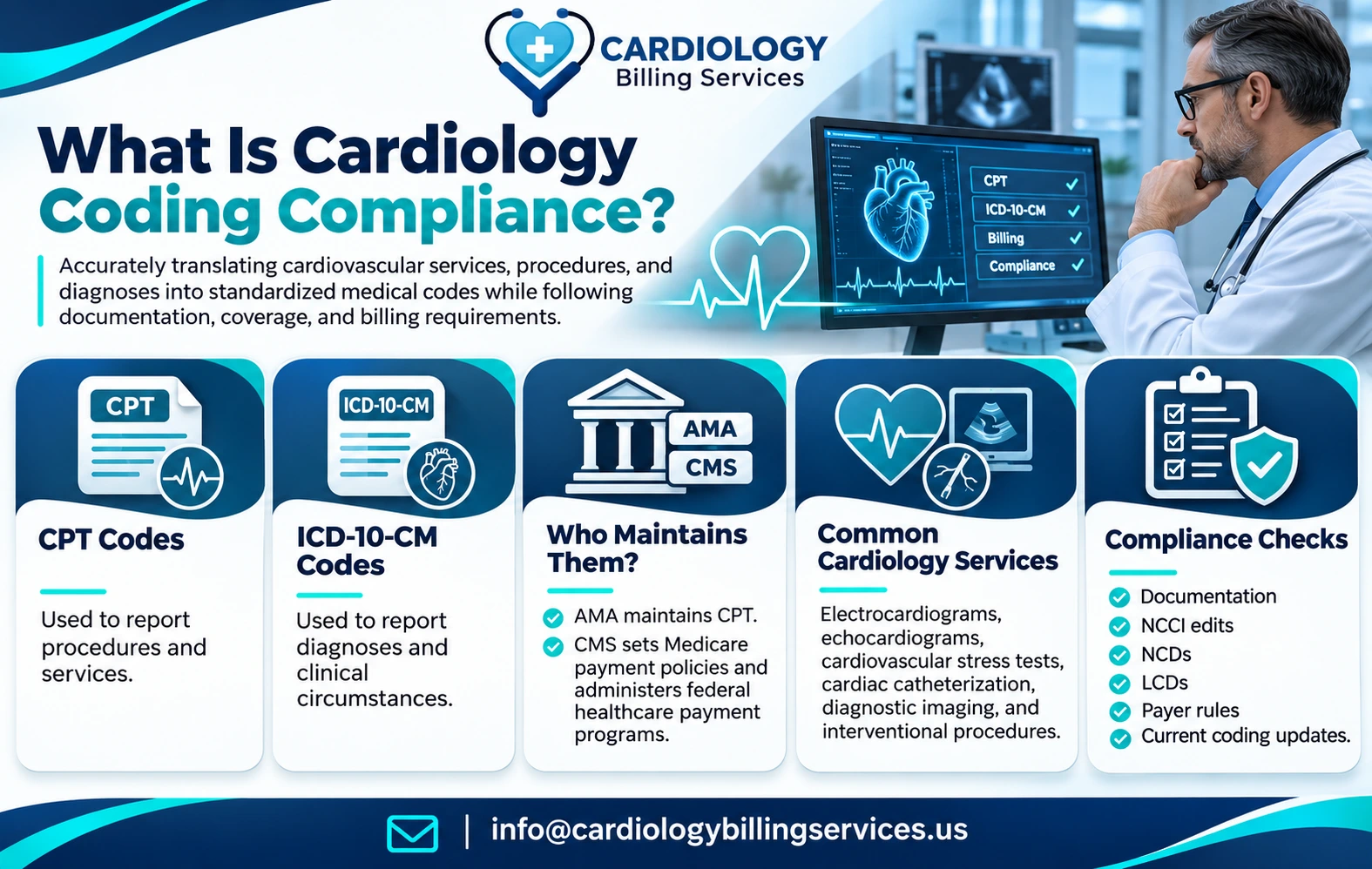
Cardiology coding compliance refers to accurately translating cardiovascular services, procedures, and diagnoses into standardized medical codes while following applicable documentation, coverage, and billing requirements.
Healthcare organizations primarily use Current Procedural Terminology (CPT) codes to report medical procedures and ICD-10-CM codes to identify diagnoses and other clinical circumstances.
The American Medical Association (AMA) maintains the CPT code set, while the Centers for Medicare & Medicaid Services (CMS) establishes Medicare payment policies and administers federal healthcare payment programs.
Cardiology services covered by these coding systems include electrocardiograms, echocardiograms, cardiovascular stress tests, cardiac catheterization, diagnostic imaging, and interventional procedures.
Each service has specific coding requirements. A diagnostic test may involve technical equipment, clinical supervision, interpretation, and documentation, while an interventional procedure may require additional information about the technique, anatomical location, and treatment performed.
Accurate coding depends on the actual services delivered and the documentation supporting them.
Compliance also requires reviewing current coding updates, Medicare National Correct Coding Initiative (NCCI) edits, applicable National Coverage Determinations (NCDs), Local Coverage Determinations (LCDs), and individual payer requirements.
Understanding CPT Code 93015 in cardiology coding
What is CPT Code 93015?
CPT Code 93015 identifies a complete cardiovascular stress test performed using exercise or pharmacological stress, with the required supervision, electrocardiographic tracing, interpretation, and report.
The procedure evaluates cardiovascular responses to increased physiological demand. Patients may undergo treadmill exercise, stationary bicycle exercise, or medication-induced stress, depending on the clinical circumstances.
During the examination, healthcare professionals monitor cardiac electrical activity and relevant physiological measurements, including heart rate and blood pressure.
The supervising physician oversees the required clinical elements, and the results are evaluated to identify findings such as exercise-related electrical changes, abnormal heart rhythms, or reduced exercise capacity.
CPT 93015 applies when the complete service is furnished and the billing entity meets the applicable reporting requirements.
The code does not independently describe cardiac imaging. If stress echocardiography or myocardial perfusion imaging is performed, the additional services require evaluation under their respective coding instructions and payer policies.
The AMA’s CPT code structure distinguishes the complete service from its individual components, allowing appropriate reporting when different entities perform different portions of the examination.
CPT 93015 vs. 93016, 93017, and 93018
Cardiovascular stress testing may involve several participating healthcare professionals or organizations. Correct coding depends on identifying which party furnished each component.
The following table explains the distinctions.
| CPT code | Service description | Reporting purpose |
|---|---|---|
| 93015 | Complete cardiovascular stress test | Supervision, tracing, interpretation, and report |
| 93016 | Supervision component only | Required physician supervision without interpretation and report |
| 93017 | Technical tracing component only | Recording and monitoring associated with the stress test |
| 93018 | Interpretation and report only | Physician evaluation of the results and preparation of the report |
These codes represent related portions of the same diagnostic service. They are not automatically reportable together by every provider.
For example, a cardiology office that performs the complete test and satisfies the applicable billing conditions may report 93015.
Alternatively, when the technical portion and physician services are provided by separate organizations, the corresponding component codes may be appropriate.
Reporting CPT 93015 together with its component codes for the same work can create duplicate billing.
Coders must establish who performed each service and which organization is entitled to submit the associated claim.
Global and component billing requirements for CPT Code 93015
Global reporting means the claim represents the complete diagnostic examination rather than an individual component.
For CPT 93015, the global service includes physician supervision, the technical tracing, and interpretation with a report.
Unlike certain diagnostic procedures that use modifiers 26 and TC to distinguish professional and technical services, the cardiovascular stress test code family provides separate component codes.
Consequently, modifiers 26 and TC are not the appropriate method for splitting CPT 93015. The applicable component codes should be considered instead.
How billing differs by healthcare setting
In a physician-owned office, a complete cardiovascular stress test may be reported using 93015 when all components are provided under an appropriate billing arrangement.
In a hospital outpatient department, professional services and facility services may be billed separately according to the relevant Medicare or commercial payer payment system.
For example, a cardiologist may provide supervision and interpretation while the hospital supplies the equipment and technical personnel. The respective parties must determine the correct component reporting and billing arrangements.
Ownership of equipment, physician employment, reassignment arrangements, billing privileges, and applicable Medicare rules can affect claim submission.
The CMS Medicare Claims Processing Manual distinguishes global diagnostic codes from services with separately identifiable professional and technical codes. These distinctions should be reviewed before selecting the claim format.
Documentation requirements for accurate cardiovascular stress test coding
Proper claim documentation establishes what procedure was performed, why it was necessary, and whether the billed services were completed.
A cardiovascular stress test record should contain enough information for another qualified reviewer to understand the clinical reason for the examination and the results obtained.
Clinical indication and physician order
The medical record should identify the patient’s relevant symptoms, medical history, and reason for testing.
Potential clinical indications may include suspected coronary artery disease, exertional chest discomfort, certain rhythm abnormalities, or evaluation of exercise capacity.
The ordering documentation should establish why testing was requested and how the examination relates to the patient’s clinical assessment.
A diagnosis listed on the claim without supporting clinical documentation may be insufficient during a medical review.
Procedure details and monitoring
The examination record should identify the stress method, relevant protocol information, physiological responses, and significant findings.
Useful documentation may include the exercise duration, achieved workload, heart rate, blood pressure response, electrocardiographic changes, symptoms experienced during testing, and reason for terminating the procedure.
For pharmacological testing, the record should identify the medication protocol and relevant clinical justification.
Interpretation and signed report
When billing for interpretation, the physician’s report should document the findings and clinical assessment rather than merely confirm that the test occurred.
The report should address pertinent ECG findings, patient response, any relevant limitations, and the resulting interpretation.
Applicable physician supervision requirements must also be supported.
For Medicare services, contractor policies may require records to demonstrate the clinical indication, relevant orders, completed services, interpretation, and required authentication.
Noridian’s cardiovascular stress testing LCD, L34324, specifically addresses documentation supporting medical necessity, physician orders, interpretation, and supervision.
Medical necessity and diagnosis coding for CPT 93015
Medical necessity is a major consideration in cardiovascular stress test reimbursement.
A procedure may be performed correctly and assigned the appropriate CPT code but still fail coverage review when the documentation does not establish a covered clinical indication.
Medicare generally requires diagnostic services to be reasonable and necessary for the diagnosis or treatment of an illness or injury.
For cardiovascular stress testing, coverage decisions may consider the patient’s symptoms, medical history, previous diagnostic findings, and the expected clinical value of the examination.
For example, a patient experiencing new exertional chest discomfort may require cardiovascular evaluation. However, coverage depends on the patient’s complete clinical circumstances and the applicable policy.
Routine testing of an asymptomatic patient solely because the patient has cardiovascular risk factors may not meet Medicare coverage requirements.
Novitas Solutions’ LCD L35083 identifies covered indications and limitations for nonemergent outpatient cardiac stress testing, including restrictions on certain routine screening and repetitive examinations.
Selecting appropriate ICD-10-CM codes
Diagnosis codes must reflect conditions or symptoms documented by the treating provider.
Coders should not assign a confirmed cardiovascular disease diagnosis solely because the physician ordered a diagnostic stress test to investigate possible disease.
When a definitive diagnosis has not been established, an appropriate documented symptom or finding may support the examination, subject to outpatient coding rules and payer coverage requirements.
The relationship between the diagnosis and the procedure should be clear in the patient’s medical record.
Coverage lists are also contractor-specific. A diagnosis accepted under one Medicare LCD does not automatically establish coverage under every Medicare jurisdiction or commercial insurance policy.
CPT Code 93015 reimbursement considerations
CPT 93015 reimbursement varies according to the payer, service date, geographic locality, billing setting, and applicable payment methodology.
Medicare Physician Fee Schedule (MPFS) payments incorporate relative value units associated with physician work, practice expense, and malpractice expense, adjusted through applicable geographic factors and conversion factors.
The amount payable for a complete cardiovascular stress test may differ from the amounts associated with individual component codes.
Payment also depends on whether the service is billed in a nonfacility setting or through an arrangement involving a hospital or another healthcare facility.
Commercial insurers may apply negotiated reimbursement rates, separate coverage policies, or different claim-processing requirements.
Healthcare organizations should verify the applicable fee schedule rather than rely on a single national reimbursement estimate.
CMS provides a Physician Fee Schedule Look-Up Tool that allows users to examine pricing information, payment policy indicators, and geographic payment variations.
For accurate reimbursement analysis, billing professionals should confirm the service date, payer, location, facility status, procedure code, and applicable billing arrangement.
Common cardiology coding compliance errors
Cardiology claims often experience avoidable problems when procedure documentation and billing records do not agree.
One frequent error is reporting CPT 93015 while also submitting CPT 93016, 93017, or 93018 for components already represented by the complete service.
Another involves reporting interpretation services without an adequate physician report. A tracing alone does not establish that a separately billable interpretation was completed.
Incorrect diagnosis selection can also create payment problems. Assigning a cardiovascular condition that has not been established in the medical record may result in coding inaccuracies and compliance exposure.
Billing departments should also review claims involving cardiovascular stress testing and additional imaging. Depending on the services performed, coding instructions and NCCI edits may restrict overlapping reporting.
Repeated diagnostic testing without a documented clinical reason presents another audit concern.
Finally, outdated CPT descriptions, diagnosis codes, or payer requirements can cause claims to be submitted incorrectly even when the underlying medical service was appropriate.
Preparing cardiology claims for payer audits
Audit readiness begins with maintaining accurate records throughout the clinical and billing process.
Healthcare organizations should establish consistent documentation procedures and periodically examine a sample of completed cardiology claims.
During an internal review, the coding team should confirm that the medical record supports the procedure, diagnosis, and billed components.
A practical cardiology coding audit should examine:
- Whether the procedure code matches the documented service.
- Whether the medical record establishes medical necessity.
- Whether physician supervision and interpretation requirements are supported.
- Whether global and component services have been reported without duplication.
- Whether the correct payer, date-of-service coding rules, and payment policies were applied.
- Whether physician orders, reports, and authentication are available.
Reviewers should also compare billing records with clinical documentation to identify inconsistencies before claims are submitted or during scheduled compliance audits.
When an error is identified, the practice should determine whether a corrected claim, refund, documentation improvement, or additional staff training is appropriate.
Audit findings are most useful when organizations investigate the underlying cause rather than correct only an individual claim.
How 2026 coding updates affect cardiology compliance
Cardiology coding professionals must consider the effective dates of coding and coverage updates.
For 2026, CMS contractor billing guidance reflects updates to the published descriptions associated with CPT Codes 93015, 93016, 93017, and 93018, effective January 1, 2026.
Additionally, the Novitas billing article A56423 was revised for the October 1, 2026 ICD-10-CM update, with changes to diagnosis-code groups used in cardiac stress testing coverage guidance.
These changes reinforce the need to use the code set and applicable coverage guidance for the actual date of service.
A claim associated with an earlier date should be reviewed against the policies effective at that time, rather than automatically applying the latest version of every rule.
Because Medicare contractor policies vary geographically, practices should identify the MAC responsible for the patient’s coverage jurisdiction and review the applicable LCD and billing article.
Commercial payer policies must be verified independently.
Key takeaways for cardiology coding compliance
Accurate cardiology coding depends on selecting the correct procedure code, maintaining complete clinical documentation, and applying the appropriate payer requirements.
CPT Code 93015 represents a complete cardiovascular stress test that includes supervision, tracing, interpretation, and a report. When different entities provide individual components, CPT 93016, 93017, and 93018 may apply instead.
Claims should demonstrate medical necessity, document the examination performed, and contain the required physician interpretation and supporting records.
Reimbursement must be evaluated using the applicable payer fee schedule, geographic locality, healthcare setting, and date-of-service rules.
For healthcare providers and medical billing students, the most useful compliance practice is to verify the documentation, identify who furnished each component, and confirm current coding and coverage requirements before submitting the claim.