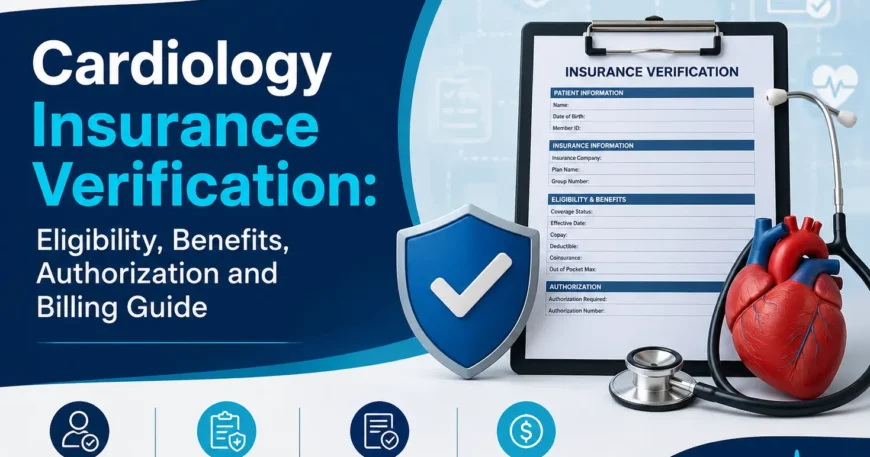
Cardiology Insurance Verification: Eligibility, Benefits, Authorization and Billing Guide

Cardiology practices run more insurance verification volume than almost any other specialty in outpatient medicine. A single patient can generate eligibility questions for an office visit, an echocardiogram, a stress test and a device check within the same quarter and each of those services can carry its own benefit structure, authorization rule and payer-specific documentation requirement. When verification is rushed or incomplete, the consequences show up weeks later as denied claims, unexpected patient balances and accounts receivable that sits longer than it should.
This guide walks through cardiology insurance verification from the ground up: what it actually is, how it differs from benefits verification and prior authorization, what front-office and billing staff need to check before a cardiology service is performed and how verification connects to denial prevention and revenue cycle performance. It also covers where Medicare and commercial payer rules diverge, including changes that took effect during 2026.
One point comes up throughout this guide because it matters more than any single checklist item: verifying insurance is not the same as guaranteeing payment. Eligibility, benefits, network status and even an approved prior authorization all describe conditions that exist before a claim is filed. Final reimbursement depends on coding accuracy, clinical documentation, medical necessity as determined by the payer, timely and correct claim submission and the payer’s own adjudication process. A practice that treats verification as a formality skips a step that prevents a large share of avoidable denials. A practice that treats verification as a payment guarantee sets itself up for disputes with patients over balances that were never certain in the first place.
What Is Cardiology Insurance Verification?
Cardiology insurance verification is the process of confirming a patient’s active coverage, plan benefits, network status, cost-sharing responsibility and any authorization or referral requirements before a cardiology office visit, diagnostic test, or procedure is performed or billed. It typically happens before the appointment, though certain elements may need to be rechecked closer to the actual date of service.
Verification answers a specific set of questions: Is the patient’s coverage active? What does the plan cover for this type of service? Is the cardiologist or facility in-network? What will the patient owe? Does this service need prior approval or a referral? None of those questions, on their own or together, confirms that a claim will be paid. They confirm the conditions under which a claim can reasonably be expected to move through the payer’s adjudication process without an easily preventable rejection.
Why Insurance Verification Matters in Cardiology
Cardiology carries more verification complexity than primary care or many other specialties because of how its services are structured. A cardiac catheterization involves separate professional and facility components that may be billed to different network arrangements. An echocardiogram can be read by one provider and performed in a facility with a different network status. Device interrogations, nuclear imaging and electrophysiology procedures frequently sit on payer-specific prior authorization lists that primary care visits never touch.
Because of this layering, a verification gap that would cause a minor issue in a lower-acuity specialty can cause a full claim denial in cardiology medical billing. A missed authorization on a stress test is not just an administrative oversight; it is a service that may need to be rescheduled, appealed, or written off. Getting verification right at the front end reduces how much staff time later goes into claim rework, patient balance disputes and appeals.
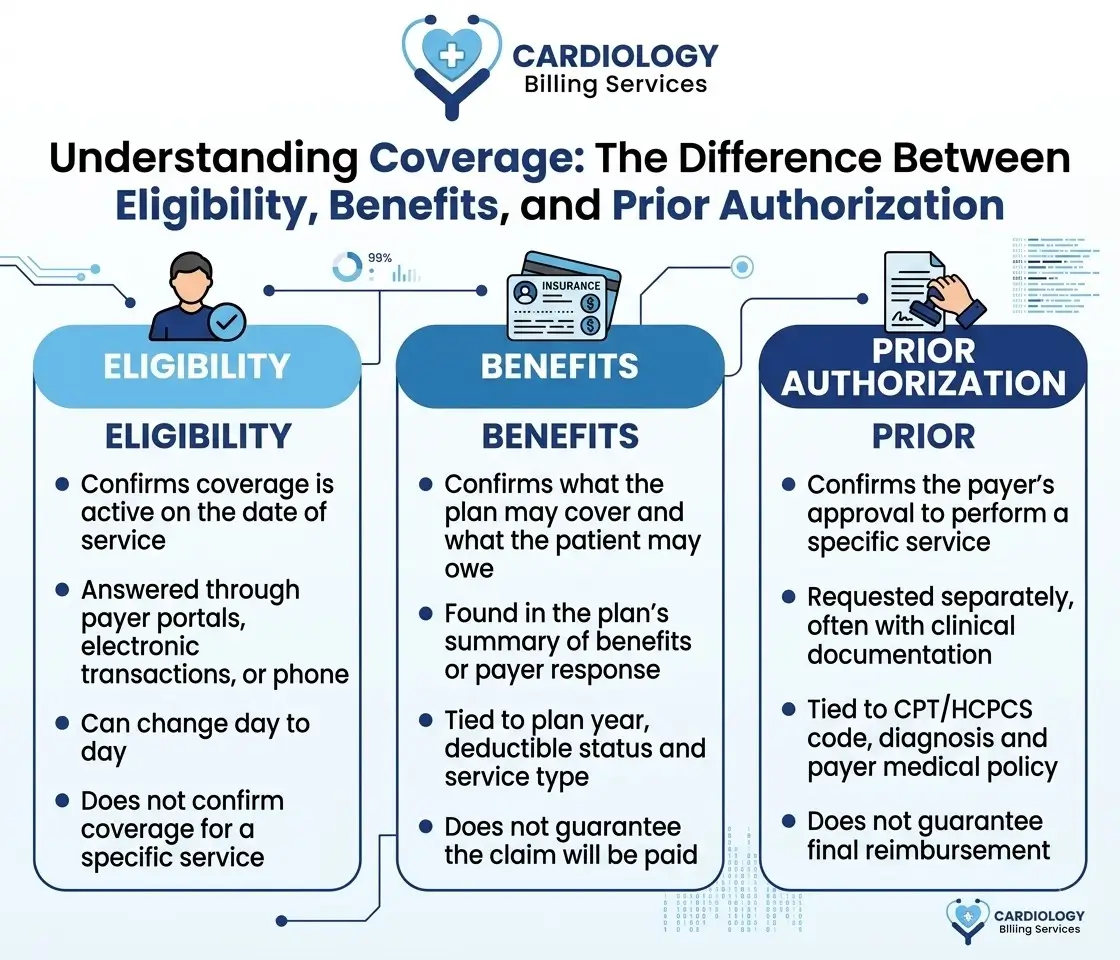
Eligibility vs. Benefits vs. Authorization vs. Referral vs. Medical Necessity
These five terms get used loosely in everyday conversation, but they describe different things and confusing them is one of the most common sources of downstream billing problems.
Eligibility
Eligibility answers a yes-or-no question: is the patient’s insurance coverage active for the specific date of service. Eligibility can change between the time an appointment is scheduled and the day it happens, so an eligibility check performed weeks in advance is not a substitute for confirming coverage closer to the visit.
Benefits
Benefits describe what a plan may pay for and what the patient may owe. This includes deductible status, copayment and coinsurance amounts, whether a specialist visit or diagnostic test is covered and whether any frequency or quantity limits apply. A patient can be eligible (active coverage) while a specific service is excluded or limited under their plan’s benefit structure.
Prior Authorization
Prior authorization is a payer’s requirement that a provider obtain approval before performing a specific service. Authorization is granted or denied based on the payer’s own medical policy criteria, not on eligibility or benefits data. A patient can have active coverage and strong benefits and still need authorization before a nuclear stress test or an electrophysiology procedure will be considered for payment.
Referral
A referral is a plan requirement, most common in HMO and some POS products, that a primary care provider or another treating provider direct the patient to a specialist for the visit to be considered in-network or covered. A referral is not the same as an authorization and having one does not eliminate a separate authorization requirement if the plan has one.
Medical Necessity
Medical necessity is the payer’s determination, based on diagnosis, documentation and its own coverage policy, that a service was appropriate for the patient’s condition. Medical necessity can still be reviewed at the claim adjudication stage even after a service has been authorized, which is why an approved prior authorization is not an absolute guarantee that the claim will be paid as billed.
What Information Should Be Verified Before a Cardiology Visit
Not every payer portal or phone call will return every data element below, but a complete verification touches each of these categories where the information is available.
Patient and insurance identifiers: full legal name, date of birth, insurance company, member ID, group number, subscriber name and relationship to the patient, effective date and termination date if applicable.
Coverage and network details: primary and secondary payer order, plan type, whether the cardiologist and the facility are in-network and whether professional and facility benefits differ.
Cost-sharing: deductible status and remaining amount where available, copayment, coinsurance percentage and out-of-pocket maximum progress.
Service-specific requirements: whether the office visit, diagnostic test, or procedure requires prior authorization or a referral, any frequency or quantity limitations and any documented exclusions relevant to the planned service.
| Information to verify | Why it matters | Potential problem if missed |
| Member ID and group number | Ensures the claim matches the payer’s records | Claim rejection or delay at the clearinghouse or payer level |
| Effective and termination dates | Confirms coverage is active for the specific date of service | Claim denial for inactive coverage |
| In-network status (provider and facility) | Determines patient cost-sharing and whether out-of-network rules apply | Unexpected patient balance or claim processed at a lower benefit level |
| Deductible and coinsurance status | Allows an accurate patient responsibility estimate | Inaccurate patient billing and collection disputes |
| Authorization requirement | Confirms whether payer approval is needed before the service | Claim denial for missing or invalid authorization |
| Referral requirement | Confirms whether a referring provider must be on file | Denial or reduced benefit under HMO/POS plan rules |
| Secondary insurance | Supports correct coordination of benefits | Claims sent to the wrong payer or delayed secondary processing |
How to Verify Insurance for Cardiology Services
- Collect accurate patient and insurance information at scheduling, including a copy or photo of the current insurance card whenever possible.
- Confirm the correct payer, since patients sometimes present an outdated card or confuse a supplemental plan with their primary coverage.
- Verify eligibility for the specific date of service, not just at some point earlier in the plan year.
- Confirm plan type and network status for both the cardiologist and, where relevant, the facility.
- Review applicable benefits, including whether the planned service (office visit, diagnostic test, or procedure) is covered under the patient’s plan.
- Determine patient cost-sharing, using the most current deductible and out-of-pocket information the payer will provide.
- Check authorization requirements specific to the CPT or HCPCS code being scheduled, not a general assumption based on a similar past case.
- Check referral requirements if the plan type requires one.
- Review coverage limitations, such as frequency restrictions on diagnostic testing or device-related services.
- Document the verification, including the method used, the date and time and any reference number provided.
- Escalate unresolved issues before the date of service whenever there is enough lead time to do so.
- Reverify when circumstances change, such as a rescheduled appointment, a new plan year, or a gap between scheduling and the actual visit.
This is not a one-time administrative task performed once per patient per year. Coverage can lapse, plans can change at renewal and authorization approvals carry their own expiration dates, which is why the cardiology billing process treats verification as a recurring checkpoint rather than a single event.
Cardiology-Specific Insurance Verification Considerations
Requirements vary by service, CPT/HCPCS code, diagnosis, payer, plan, network status and place of service. No two payers apply identical rules across the board, so the categories below describe common points of attention rather than universal requirements.
Office visits and evaluation and management services generally carry standard specialist benefit rules, though some plans apply a higher specialist copay than a primary care visit.
ECG/EKG is usually a lower-friction verification item, but it can still be affected by frequency limitations tied to a patient’s diagnosis history.
Echocardiography and stress testing more frequently require prior authorization, particularly for stress echo and nuclear stress testing and benefits should be checked separately from the office visit that may accompany them. Practices handling a high volume of imaging orders often coordinate this closely with cardiac imaging billing services to keep authorization tracking aligned with scheduling.
Nuclear cardiology commonly sits on payer prior authorization and imaging-management lists and nuclear cardiology billing services often involve a separate radiopharmaceutical benefit check in addition to the procedure itself.
Cardiac monitoring, including Holter and event monitors, can carry supply and rental benefit distinctions depending on whether the device is billed globally or split between technical and professional components.
Cardiac catheterization and interventional procedures typically involve separate facility and professional benefit verification and authorization requirements are common for elective, non-emergent catheterization. This is an area where invasive cardiology billing services frequently intersect with prior authorization tracking, since facility scheduling and payer approval need to stay in sync.
Electrophysiology and device services, including pacemaker and implantable device procedures, tend to carry some of the strictest authorization requirements in cardiology, along with device-specific medical policy criteria that go beyond a standard eligibility check. Coordinating this with electrophysiology billing services helps keep authorization numbers matched to the exact device and procedure code performed.
Not every payer applies these patterns the same way and plan-level variation is common even within the same insurance company. A verification process built around “cardiology services generally need authorization” is less reliable than one built around checking the specific code against the specific payer’s current requirements.
Common Cardiology Insurance Verification Errors
| Verification mistake | Potential consequence | Prevention |
| Incorrect member ID | Eligibility cannot be confirmed, or the claim rejects or denies | Verify against the physical or digital insurance card and the payer’s returned data |
| Wrong payer selected | Claim is sent to the wrong insurer | Confirm which plan is primary before scheduling the service |
| Coverage not active on date of service | Claim may not be payable | Verify eligibility close to the actual appointment date, not only at initial scheduling |
| Network status not checked | Unexpected patient responsibility or a claim processed out-of-network | Confirm both provider and facility network status separately |
| Authorization not checked | Service may be denied outright | Check payer-specific authorization requirements for the exact CPT/HCPCS code |
| Referral requirement missed | Claim denial or reduced benefit under plan rules | Confirm referral requirements for the specific plan type |
| Deductible not reviewed | Patient cost estimate is inaccurate | Pull current deductible and out-of-pocket status before quoting the patient |
| Secondary insurance missed | Coordination-of-benefits delays or misdirected claims | Ask about additional coverage at every registration, not only at intake |
| Service-specific limitation missed | Claim may deny for frequency or quantity reasons | Review applicable benefit limitations tied to the specific service |
| Verification not documented | Difficult to investigate later or defend in an appeal | Maintain a consistent verification record for every patient encounter |
Beyond these general mistakes, cardiology practices see a recurring set of problems tied to their own service mix: authorization numbers issued for the wrong CPT code, device-related services performed before an authorization’s effective date and demographic mismatches between the referring provider’s paperwork and what the payer has on file. These issues rarely surface until a claim comes back denied, which is why they are worth checking deliberately rather than assuming they will not occur.
Patient Responsibility and Cost-Sharing
Deductibles are the amount a patient must pay out of pocket before the plan begins paying its share for most services. Copayments are fixed dollar amounts owed at the time of a covered service. Coinsurance is a percentage of the allowed amount the patient owes after the deductible has been met. Out-of-pocket maximums cap the total the patient will pay in a given plan year, after which the plan generally covers 100% of allowed charges for covered services.
Estimates generated during verification are exactly that: estimates. Deductible and out-of-pocket figures reported by a payer can change if other claims process between the time of verification and the time the cardiology claim is adjudicated. Final patient responsibility is determined by the claim adjudication process and the specific terms of the patient’s plan, not by the numbers pulled during a pre-visit check. Practices that communicate this clearly to patients avoid disputes when the final statement differs from an earlier estimate.
In-Network vs. Out-of-Network Cardiology Care
Network participation affects how much a patient owes and how a claim is processed, but it does not determine coverage in a strictly binary way. Out-of-network services are not automatically excluded from coverage and in-network status does not guarantee that a claim will be paid as billed.
Facility and professional network status can differ on the same date of service. A cardiologist may be in-network with a payer while performing a procedure at a facility that is not, or the reverse. Referral requirements can also interact with network status, since some HMO plans provide no out-of-network benefit at all outside of emergencies, while PPO plans typically apply a reduced, rather than eliminated, benefit. Checking both the provider’s and the facility’s network status separately, for the specific plan in question, avoids surprises that surface only after the claim has processed.
Prior Authorization for Cardiology Services
Prior authorization is a payer’s utilization management requirement that a provider obtain approval, based on the payer’s own medical policy criteria, before certain services are performed. It is not the same process as eligibility verification and completing an eligibility check does not fulfill an authorization requirement.
A complete authorization record includes the authorization number, the specific approved service and CPT/HCPCS code, the approved provider and facility, the number of approved units or visits where applicable and the effective and expiration dates. Before the service is performed, staff should confirm that what was actually scheduled matches what the authorization approved. A mismatch between the authorized code and the code ultimately billed is one of the more preventable reasons a cardiology claim denies after an authorization was already on file.
Regulatory context for 2026. The CMS Interoperability and Prior Authorization Final Rule (CMS-0057-F) requires Medicare Advantage organizations, state Medicaid and CHIP fee-for-service and managed care programs and Qualified Health Plan issuers on the federally-facilitated exchanges to issue decisions on standard prior authorization requests within seven calendar days and expedited requests within 72 hours, with the non-technical provisions of the rule in effect as of January 1, 2026 and related interoperability API requirements following on January 1, 2027. This timeline applies to the payer types covered by the rule; it does not standardize authorization turnaround times across every commercial plan.
Separately, CMS launched the Wasteful and Inappropriate Service Reduction (WISeR) Model on January 1, 2026, a six-year pilot that applies prior authorization or prepayment review to a defined list of Original Medicare Part B services in six states (Arizona, New Jersey, Ohio, Oklahoma, Texas and Washington). The initial WISeR service list is centered on items such as skin and tissue substitutes, electrical nerve stimulators and knee arthroscopy rather than core cardiology diagnostic or interventional codes and it does not apply to Medicare Advantage. Cardiology practices outside the six pilot states, or performing services not on the current list, are not directly affected, but the model is a useful example of how Original Medicare prior authorization requirements can expand and it is worth monitoring for future updates through the applicable Medicare Administrative Contractor.
Referrals
Referral requirements depend entirely on the patient’s specific plan, most commonly appearing in HMO and some POS products where a primary care provider or another treating provider must direct the patient to the cardiologist for the visit to be processed at the in-network benefit level. A referral typically has its own validity window and may be limited to a specific number of visits or a specific service type, so a referral issued for a cardiology consultation does not automatically extend to a follow-up procedure. Referral status should be checked separately from authorization status, since a plan can require one, both, or neither depending on the service.
Medical Necessity in Cardiology Billing
Medical necessity refers to a payer’s determination, based on diagnosis, clinical documentation and its own coverage policy, that a service was appropriate for the patient’s condition. Active insurance and even an approved prior authorization do not automatically mean every cardiology service will be considered medically necessary once a claim reaches adjudication; payers can and do apply their coverage policies at that later stage as well. Diagnosis coding and documentation quality play a direct role here, which is why accurate coding through medical coding services works alongside verification rather than as a separate, unrelated function. None of this involves clinical judgment on Claude’s part about whether a specific patient’s care was appropriate; that determination sits with the treating physician and, ultimately, the payer’s medical policy.
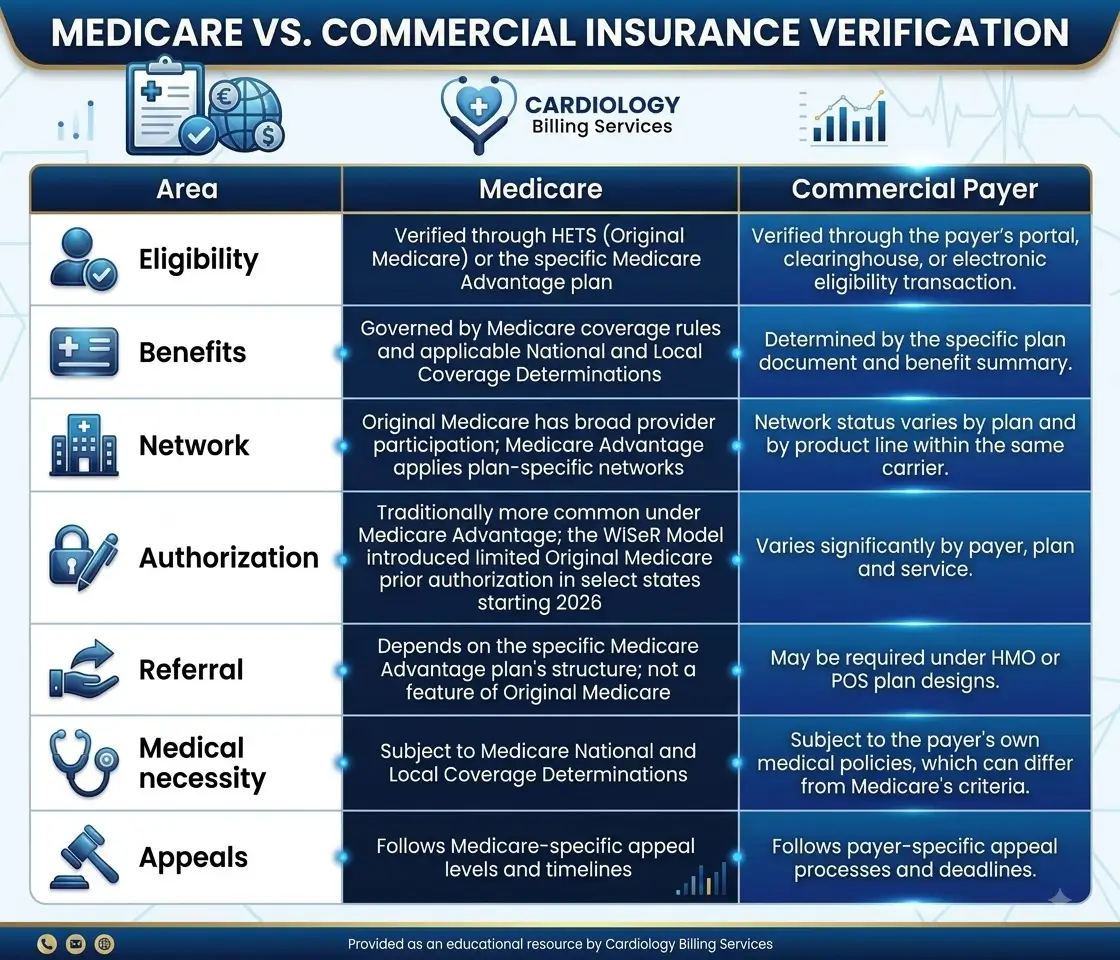
Medicare Insurance Verification for Cardiology Practices
Medicare verification differs enough from commercial payer verification that it deserves separate handling in a practice’s workflow.
Original Medicare (Parts A and B) eligibility is most commonly checked through the HIPAA Eligibility Transaction System (HETS), a CMS system that supports real-time 270 eligibility requests and 271 responses. According to CMS, HETS is intended for Medicare providers, suppliers and their authorized billing agents to obtain eligibility data for preparing accurate Medicare fee-for-service claims. As of May 11, 2026, CMS requires a valid HETS EDI enrollment on file for every NPI submitted for eligibility verification and providers using a clearinghouse or vendor to run these transactions need that relationship properly enrolled and attested. Practices that have not completed this enrollment can still check eligibility through their Medicare Administrative Contractor’s secure provider portal while resolving access issues.
HETS has a specific limitation worth building into any Medicare verification workflow: according to CMS, HETS does not cover eligibility or coverage information for Medicare Advantage (Part C) or Medicare drug (Part D) plans. Part C eligibility inquiries need to go to the specific Medicare Advantage plan and Part D inquiries use a separate E1 transaction.
Medicare Advantage plans are administered by private insurers under contract with CMS and each plan can apply its own network, authorization and referral rules on top of the baseline Medicare Advantage requirements. Treating Medicare Advantage verification the same as Original Medicare verification is a common source of avoidable denials, since the two are checked through different systems and can carry different authorization requirements for the same cardiology service.
Medicare Secondary Payer situations, where another source of coverage is primary to Medicare, require confirming the correct payer order before a claim is submitted, since billing Medicare as primary when another payer should be billed first creates delays and rework.
Prior authorization under Medicare has traditionally applied more to Medicare Advantage than to Original Medicare, though this is shifting. As described above, the WISeR Model introduced prior authorization and prepayment review for a defined list of services in Original Medicare fee-for-service, in six pilot states, starting in 2026. This is a meaningful development for practices in or near those states to track, even though the current WISeR list does not center on cardiology-specific codes.
Commercial Insurance Verification
Commercial payer requirements vary significantly by carrier and by individual plan, which makes generalized rules risky to rely on. Differences commonly show up in network participation criteria, specialist benefit structures, prior authorization lists, referral requirements, timely filing deadlines and appeal processes. A requirement confirmed for one commercial payer, or even one plan within that payer’s portfolio, should not be assumed to apply to another plan from the same company. Verifying against the specific plan’s current medical policy, rather than a general assumption based on past experience with that carrier, reduces the risk of an authorization or benefit mistake.
Medicare vs. Commercial Insurance Verification
Coordination of Benefits and Secondary Insurance
When a patient has more than one active insurance plan, coordination of benefits (COB) rules determine which payer is billed first. Getting this order wrong is a common and avoidable source of delay: claims sent to the wrong payer as primary are typically denied or require additional processing before the secondary payer will consider its portion.
Verification should confirm whether the patient has any additional coverage beyond the plan listed as primary, including retiree or supplemental coverage that is common among older cardiology patients on Medicare. Asking this question at every visit, not only at initial intake, catches situations where a patient gained or lost secondary coverage since their last appointment.
Verification vs. Claim Adjudication
Insurance verification happens before or around the time of service. Claim adjudication happens after a claim has been submitted, when the payer reviews it against the patient’s actual benefits, the provider’s contract, coding accuracy, documentation and its own medical policy at that point in time. These are sequential but distinct processes and information obtained during verification describes conditions that existed at the time of the check, not a binding commitment about how a specific claim will ultimately be paid.
How Insurance Verification Connects to Denial Prevention and Revenue Cycle Performance
Verification sits at the front end of the revenue cycle, but its effects show up throughout the process: in whether a claim is clean on first submission, how much rework staff spend on eligibility-related denials, how accurate patient collections estimates are and how quickly accounts receivable clears. Not every denial traces back to verification. Coding errors, documentation gaps, incorrect claim submission and payer policy changes all contribute independently and denial management work typically involves tracing a denial back to its actual root cause rather than assuming verification is always the culprit. That said, eligibility and authorization-related denials are among the more preventable categories, which is why they are worth tracking separately from clinical or coding denials, as covered in more detail in this guide’s companion piece on cardiology claim denials.
Strong verification also supports the broader revenue cycle management for cardiology process, since accurate front-end data reduces how much correction is needed at claim submission and payment posting.
Documenting Insurance Verification
A complete verification record should include the date and time of verification, the payer, the patient and subscriber information checked, eligibility status, benefit details reviewed, network status, authorization status, referral requirements, any applicable limitations, the reference or confirmation number provided, the verification method used, the representative name or ID if obtained by phone and the staff member who performed the check.
This documentation supports internal accountability, gives front-desk and billing staff a consistent record to reference during patient conversations and provides the paper trail needed if a claim is later denied and needs investigation or appeal. Documentation does not, on its own, guarantee that a claim will be paid; it simply preserves an accurate record of what was confirmed and when. Practices that pair this with clear clinical and coding documentation, as outlined in this site’s guide to cardiology documentation requirements, tend to have an easier time defending claims that are questioned or denied.
HIPAA and Privacy Considerations in Insurance Verification
Insurance verification involves protected health information and it should be handled with the same privacy and security discipline applied to any other PHI-related workflow. The HIPAA Privacy Rule’s minimum necessary standard, as described by the U.S. Department of Health and Human Services, generally requires covered entities to limit the use, disclosure and request of PHI to the amount reasonably needed to accomplish the specific purpose at hand. Verification calls, portal lookups and eligibility transactions should be limited to the data actually needed to confirm coverage and benefits for the service being scheduled.
Practical steps include restricting verification system access to authorized staff, using secure payer portals and connections rather than unsecured channels, avoiding unnecessary disclosure of clinical details during eligibility calls and following the organization’s own HIPAA policies for documentation and staff training. This is general background, not legal advice and practices with specific compliance questions should confirm their workflows with qualified legal or compliance counsel rather than relying on a general guide.
Technology and Automation in Insurance Verification
Electronic eligibility transactions, payer portals and clearinghouse or practice management system integrations can meaningfully reduce the manual workload involved in verification, particularly for high-volume practices checking eligibility across many payers. These tools support tasks like batch eligibility checks, authorization tracking, work queues for unresolved verifications and reporting on verification-related denial trends.
Automation has real limitations, though. Payer responses vary in completeness, some portals do not return full benefit detail, authorization requirements often require more clinical context than an automated eligibility check can capture and exceptions still need a person to review them. Technology can reduce the volume of routine verification work; it does not eliminate the need for staff to review exceptions, confirm authorization details against the actual scheduled service and catch mismatches that automated systems are not built to flag.
Insurance Verification Metrics Worth Tracking
Operational metrics help a practice see whether its verification process is actually working, rather than assuming it is based on anecdote. Useful metrics include:
- Verification completion rate: the percentage of scheduled visits with a completed verification prior to the date of service.
- Eligibility error rate: the percentage of verified encounters that still resulted in an eligibility-related claim denial.
- Authorization error rate: the percentage of authorization-required services that denied due to a missing, expired, or mismatched authorization.
- Insurance-related denial volume and dollar value: tracked separately from coding- or documentation-related denials so root causes can be addressed distinctly.
- Reverification rate: how often previously verified encounters required a second check due to a schedule change or a gap before the date of service.
Formulas should be defined consistently and applied to a fixed denominator (for example, total scheduled encounters in a period) so results are comparable over time. There is no universal industry benchmark for these figures that applies evenly across specialties, payer mixes and practice sizes, so a practice is generally better served by tracking its own trend over time than by chasing an externally quoted target.
Root-Cause Analysis for Recurring Verification Problems
When insurance-related denials or verification errors recur, breaking the data down by payer, plan, provider, location, service, CPT/HCPCS code, date of service and verification method usually reveals a pattern faster than reviewing denials one at a time. A spike in denials tied to a specific payer’s stress test authorization requirement points to a different fix than a spike tied to demographic data entry errors at a specific location. Reviewing this data on a regular cadence, rather than only after a denial trend becomes obvious, gives staff a chance to correct a workflow issue before it accumulates into a larger AR problem.
Quality Control and Auditing
Periodic auditing keeps a verification process accurate as payer rules change. This can include random sampling of completed verifications for accuracy, reviewing documentation completeness, checking authorization and referral records against what was actually billed and updating payer-specific workflows when a carrier changes its requirements. Payer policies are not static and a workflow that was accurate a year ago may no longer reflect current authorization lists or portal capabilities.
Practical Cardiology Verification Scenarios
The following scenarios are hypothetical examples used to illustrate common verification failure points. They do not describe actual patients and should not be read as clinical guidance.
Scenario 1: Echocardiography eligibility issue. A patient is scheduled for a transthoracic echocardiogram three weeks after their insurance was verified at a prior visit. Between that verification and the echo appointment, the patient’s employer changed insurance carriers. Because eligibility was not rechecked closer to the date of service, the claim denies for inactive coverage. Staff should have reverified eligibility within a shorter window of the actual appointment, particularly for a service scheduled weeks out from the original check.
Scenario 2: Stress testing authorization issue. A nuclear stress test is scheduled based on the referring provider’s order, but the authorization obtained covers a standard exercise stress test rather than the nuclear component. The mismatch is not caught before the service is performed and the claim denies because the authorized code does not match the billed code. Confirming that the authorization matches the exact CPT code scheduled, not just the general category of test, would have caught this before the appointment.
Scenario 3: Out-of-network cardiology consultation. A patient schedules a consultation with a cardiologist believed to be in-network based on an older provider directory listing. The cardiologist had recently left that payer’s network. The patient’s cost-sharing is significantly higher than expected once the claim processes. Checking current network status directly with the payer at the time of scheduling, rather than relying on a directory that may not be current, would have surfaced this before the visit.
Scenario 4: Secondary insurance coordination issue. A Medicare patient with a retiree supplemental plan is registered with only their Medicare information on file, because the front desk did not ask about additional coverage at a recent visit. The claim processes correctly with Medicare as primary, but the secondary claim is never generated, leaving a patient balance that should have been covered by the supplemental plan. Asking about additional coverage at every encounter, not only at initial registration, would have prevented the gap.
Cardiology Insurance Verification Checklist
Before the appointment
- Confirm patient demographics
- Confirm current insurance information
- Verify eligibility for the scheduled date of service
- Confirm network status for the provider and, where relevant, the facility
- Review applicable benefits and cost-sharing
- Check authorization requirements for the specific service
- Check referral requirements
- Document the verification, including reference numbers
Before the cardiology service
- Confirm the planned service matches what was verified and authorized
- Confirm authorization and referral details are still valid
- Resolve any discrepancies before the patient is seen
- Update the patient record with any changes
After verification
- Record reference and confirmation information
- Document any unresolved issues and follow-up needed
- Communicate patient responsibility information clearly, noting it is an estimate
- Reverify when circumstances change before the service is performed
How to Strengthen Your Practice’s Insurance Verification Workflow
Standardizing data collection at scheduling reduces the number of downstream corrections needed later. Verifying close to the actual date of service, rather than only at the point of scheduling, catches coverage changes that happen in between. Keeping eligibility, benefits and authorization as distinct checks, rather than treating one as a stand-in for the others, avoids the most common source of confusion in this process. Documenting every verification consistently gives staff something to reference during patient conversations and something to point to during an appeal.
Training front-office and billing staff on payer-specific quirks, monitoring recurring errors through the metrics and root-cause review described above and connecting verification findings to actual denial data closes the loop between what is checked upfront and what happens once a claim is submitted. Periodic auditing keeps the whole process current as payers update their requirements throughout the year.
When Professional Cardiology Insurance Verification Support May Help
Some practices manage verification entirely in-house without difficulty. Others reach a point where the volume or complexity outpaces what front-office staff can reliably keep up with: high patient volume, a wide payer mix, frequent authorization requirements across imaging, interventional and device services, staff turnover or shortages, recurring eligibility errors, a rising rate of insurance-related denials, or multiple locations each managing their own payer relationships.
In those situations, professional support can assist with eligibility and benefits verification, authorization tracking, referral confirmation, verification documentation and connecting verification data to denial prevention and claim follow-up as part of a broader revenue cycle management approach. This is not a guarantee of fewer denials or higher collections; it is a way to apply dedicated staff time and payer-specific workflow knowledge to a function that is easy to underresource inside a busy clinical practice. Practices weighing this option can review their current verification volume and denial patterns as a starting point for deciding whether outside support would address an actual bottleneck.
Frequently Asked Questions
What is cardiology insurance verification? It is the process of confirming a patient’s active coverage, benefits, network status, cost-sharing and authorization or referral requirements before a cardiology service is performed or billed.
Why is insurance verification important for cardiology practices? Cardiology services often involve separate professional and facility billing, frequent prior authorization requirements and higher-cost diagnostic and interventional procedures, all of which increase the number of details that can cause a claim denial if left unchecked.
What information should be verified before a cardiology appointment? Patient and insurance identifiers, eligibility status, benefit details, network status, patient cost-sharing and any authorization or referral requirements specific to the scheduled service.
What is the difference between eligibility and benefits verification? Eligibility confirms whether coverage is active on a specific date of service. Benefits verification confirms what the plan may cover and what the patient may owe for a specific service.
Does insurance verification guarantee payment? No. Verification confirms conditions that exist before a claim is filed. Final payment depends on coding accuracy, documentation, medical necessity as determined by the payer and the claim adjudication process.
How does prior authorization differ from insurance verification? Insurance verification confirms eligibility and benefits. Prior authorization is a separate payer approval, based on the payer’s own medical policy, required before certain services will be considered for payment.
Can insurance verification help prevent cardiology claim denials? It can prevent eligibility- and authorization-related denials, which are among the more common and avoidable denial categories, though coding, documentation and payer policy issues can cause denials independent of verification.
What should be checked for cardiology diagnostic testing? Confirm whether the specific test requires prior authorization, whether frequency or quantity limitations apply and whether professional and facility components carry different benefit or network status.
How do deductibles and coinsurance affect cardiology patients? Deductibles must generally be met before the plan pays its share and coinsurance is a percentage the patient owes after that point. Estimates provided during verification can change before the claim is finally adjudicated.
How do you verify whether a cardiologist is in-network? Confirm current network status directly with the payer for the specific plan, rather than relying solely on a provider directory, since directory listings are not always current.
What happens if a patient’s insurance is inactive? The claim is generally not payable for that date of service. Confirming eligibility close to the actual appointment date, rather than only at initial scheduling, reduces the chance of this happening unnoticed.
How should secondary insurance be verified? Ask about any additional coverage at every visit, confirm the correct order of primary and secondary payers and document the coordination of benefits information for claim submission.
How does Medicare insurance verification work? Original Medicare eligibility is typically checked through the HETS system, which supports real-time 270/271 transactions but does not cover Medicare Advantage or Part D plans. Those require separate checks with the specific plan or, for Part D, a separate transaction.
Do commercial insurers have different verification requirements? Yes and requirements can vary even between plans offered by the same commercial carrier, which is why verification should be based on the specific plan rather than general assumptions about a payer.
When should a cardiology practice reverify insurance? Reverification is worth doing when there is a gap of more than a few weeks between the original check and the date of service, when an appointment is rescheduled, at the start of a new plan year, or whenever a patient reports a change in coverage.
Key Takeaways
- Cardiology insurance verification confirms eligibility, benefits, network status, cost-sharing and authorization or referral requirements before a service is performed or billed.
- Eligibility, benefits, prior authorization, referrals and medical necessity are related but distinct concepts and treating them as interchangeable creates avoidable denials.
- Verification is not a payment guarantee. Coding, documentation, medical necessity determinations and claim adjudication all happen after verification and affect the final outcome.
- Cardiology-specific services, particularly imaging, interventional procedures and electrophysiology and device services, carry more frequent authorization requirements than standard office visits.
- Medicare and commercial payer verification follow different systems and rules and Medicare Advantage should not be checked the same way as Original Medicare.
- Documenting every verification supports patient communication, denial investigation and appeals.
- Tracking verification metrics and reviewing root causes of recurring errors helps a practice improve its process over time rather than repeating the same avoidable mistakes.
Conclusion
Cardiology insurance verification is a front-end process with consequences that reach all the way through the revenue cycle. Getting it right does not mean every claim will be paid as expected, since coding, documentation, medical necessity and payer adjudication all play their own roles after verification is complete. It does mean a practice has done what it reasonably can, before the service is ever performed, to confirm coverage is active, benefits apply, network status is accurate and any required authorization or referral is on file. For cardiology practices managing a high volume of diagnostic and interventional services across a mix of Medicare and commercial payers, treating verification as a consistent, documented process rather than an afterthought is one of the more direct ways to reduce avoidable denials and give patients an accurate picture of what they will owe.