

Cardiology Claim Denials: Common Reasons, Prevention, and Appeals Guide

Cardiology claim denials create financial and administrative challenges for healthcare practices. Whether a claim involves an echocardiogram, cardiac stress test, diagnostic imaging procedure, or coronary intervention, even a minor billing error can delay reimbursement and increase the workload of billing staff.
Cardiology claim denials occur when an insurance payer refuses payment for a submitted cardiovascular service because of medical necessity requirements, coding errors, missing authorizations, coverage restrictions, or other billing issues. These denials can be especially difficult to resolve because cardiology services frequently involve multiple procedures, professional and technical components, and payer-specific documentation requirements.
Understanding why cardiology claims are denied, how to prevent avoidable errors, and when to file an appeal helps practices maintain accurate billing records, recover appropriate reimbursement, and reduce repeated claim processing problems.
What are cardiology claim denials?
A cardiology claim denial occurs when an insurance company processes a submitted medical claim but determines that some or all of the reported cardiovascular services are not payable under the applicable coverage and reimbursement rules. These denials may involve cardiac diagnostic testing, office consultations, interventional procedures, imaging services, or treatment-related expenses.
For example, a cardiology practice may submit a claim for a nuclear stress test performed to investigate suspected coronary artery disease. If the clinical documentation does not establish why the test was medically necessary, the insurer may deny payment. Similarly, an echocardiogram claim may be denied when the reported diagnosis does not satisfy the payer's coverage requirements or the documentation fails to explain the reason for the examination.
It is important to distinguish claim denials from claim rejections. A rejected claim generally fails preliminary processing because of missing, incomplete, or incorrect information. A denied claim has typically passed initial processing and received an adverse payment determination. This difference determines the appropriate response because rejected claims usually require correction and resubmission, while denied claims may require corrected billing information, reconsideration, or a formal appeal.
Common reasons for cardiology claim denials
Cardiology medical billing requires accurate coordination between clinical documentation, procedure coding, insurance coverage, and payer authorization requirements. Errors in any of these areas can prevent reimbursement, even when the healthcare provider performed a medically appropriate service.
Medical necessity documentation problems
Medical necessity is one of the most frequently encountered issues in cardiovascular claim reviews. Insurance payers evaluate whether the medical record establishes that a particular diagnostic test or procedure was appropriate for the patient's condition under the applicable coverage policy.
For example, a patient experiencing recurring chest discomfort may require further cardiac evaluation. The physician's documentation should identify the symptoms, relevant medical history, examination findings, and clinical reasons for ordering the selected diagnostic procedure. When these details are missing, the insurance company may be unable to determine whether the service satisfies its medical necessity criteria.
Medicare coverage policies for cardiovascular diagnostic procedures identify clinical circumstances in which particular tests may be considered reasonable and necessary. Some policies also limit routine screening and repeated examinations when there is insufficient evidence supporting additional testing.
Cardiology providers should therefore ensure that their documentation supports the medical reason for each examination. The reported diagnosis, physician's order, procedure report, and clinical notes should present a consistent explanation of the patient's condition and the services performed.
Incorrect CPT and ICD-10-CM coding
Cardiology claims may be denied when CPT codes do not accurately describe the performed procedure or when ICD-10-CM diagnosis codes do not support the medical necessity of the service.
Cardiac stress testing provides a common example. CPT codes 93015, 93016, 93017, and 93018 represent different reporting arrangements for cardiovascular stress testing. Their appropriate use depends on whether the billing provider furnished the complete service or individual components such as supervision, tracing, or interpretation and reporting.
An incorrect code may cause the insurer to process the claim under the wrong reimbursement rules. Similar problems occur when providers report an unspecified diagnosis even though the documentation supports a more precise condition.
Coding staff should review the complete clinical record before assigning diagnosis and procedure codes. They must also use code sets applicable to the date of service because CPT and ICD-10-CM classifications are updated regularly.
Missing or invalid prior authorization
Prior authorization requirements create additional challenges for cardiology practices, particularly those performing advanced imaging and selected interventional procedures. Depending on the insurance plan, services such as cardiac CT angiography, cardiac MRI, and nuclear myocardial perfusion imaging may require approval before treatment.
A claim may be denied because authorization was not obtained, expired before the service date, or covered a different procedure from the one actually performed.
For example, a patient may receive approval for a particular cardiac imaging examination, but the physician subsequently changes the procedure based on updated clinical findings. If the revised service requires a different authorization, the original approval may not satisfy the insurer's requirements.
Billing personnel should verify authorization requirements before scheduling applicable cardiovascular procedures. They should also confirm that the authorization matches the approved procedure, service date, provider, facility, and any relevant limitations. Prior authorization does not guarantee reimbursement because other coverage and billing conditions must still be satisfied.
Incorrect modifier usage
Modifiers provide additional information about how a medical service was performed and which components should be billed. Cardiology practices commonly encounter modifier-related problems involving diagnostic interpretations, technical services, and multiple procedures performed during the same encounter.
For eligible diagnostic services, modifier 26 identifies the professional component, while modifier TC identifies the technical component. Incorrectly reporting these components can create duplicate billing or improper reimbursement.
Modifiers 59 and the applicable X modifiers may indicate distinct procedural services when the clinical circumstances and coding requirements support separate reporting. However, these modifiers cannot be used simply to bypass a National Correct Coding Initiative edit.
A billing specialist should examine the documented services, current procedure-to-procedure edits, and modifier indicators before submitting a claim. The medical record must support the reported circumstances rather than relying on modifiers added solely to obtain payment.
Duplicate claims and procedure bundling
Duplicate billing can occur when the same cardiology service is submitted more than once without a valid reason. These errors sometimes arise when several billing employees manage the same patient account or when a previously submitted claim is resent before its processing status has been confirmed.
Procedure bundling presents another concern. Medicare's National Correct Coding Initiative establishes coding edits that restrict separate payment for certain procedure combinations. Some services are considered included in a more extensive procedure and are therefore not independently reimbursable under the applicable coding rules.
Before challenging a bundling denial, the coding team should determine whether the services qualify for separate reporting. If the payer's decision is correct under the relevant coding policy, an appeal generally will not change the reimbursement outcome.
Insurance eligibility and timely filing issues
Not every cardiology denial originates from a clinical or coding problem. Incorrect patient demographics, inactive insurance coverage, outdated payer information, and provider enrollment discrepancies can also prevent payment.
Insurance eligibility may change between the appointment scheduling date and the actual date of service. A practice that verifies coverage only when the appointment is booked may discover that the patient's benefits were terminated before the procedure.
Timely filing is another important requirement. Original Medicare generally requires claims to be submitted within 12 months of the date of service, subject to limited exceptions. Medicaid programs and commercial insurance plans may establish different submission deadlines.
Cardiology practices should maintain updated payer records, confirm coverage for each relevant encounter, and monitor claims before filing deadlines expire.
Common cardiology denial codes and their meanings
Claim Adjustment Reason Codes, commonly called CARCs, help billing personnel understand why an insurer adjusted or denied a medical claim. These standardized codes appear on electronic remittance advice and should be reviewed together with applicable remark codes and payment information.
CARC 16 identifies a claim or service with missing information or a submission or billing error. The billing team should examine the accompanying remark codes to determine which information requires correction. CARC 18 indicates an exact duplicate claim or service and requires verification of the original claim's processing status before any further submission.
CARC 50 indicates that the payer considers the billed service medically unnecessary under its applicable criteria. In cardiology billing, this adjustment may involve diagnostic testing that does not satisfy coverage requirements. The practice should examine the relevant medical records and policy provisions before requesting reconsideration.
CARC 197 generally identifies the absence of required precertification, authorization, or notification, while CARC 198 indicates that authorization or notification limits have been exceeded. CARC 22 concerns a service that may be covered by another payer under coordination-of-benefits rules.
The appropriate response depends on the complete explanation provided by the insurer. Billing personnel should avoid automatically resubmitting every denied claim because a duplicate submission may create another adjustment without resolving the original problem.
How to prevent cardiology claim denials
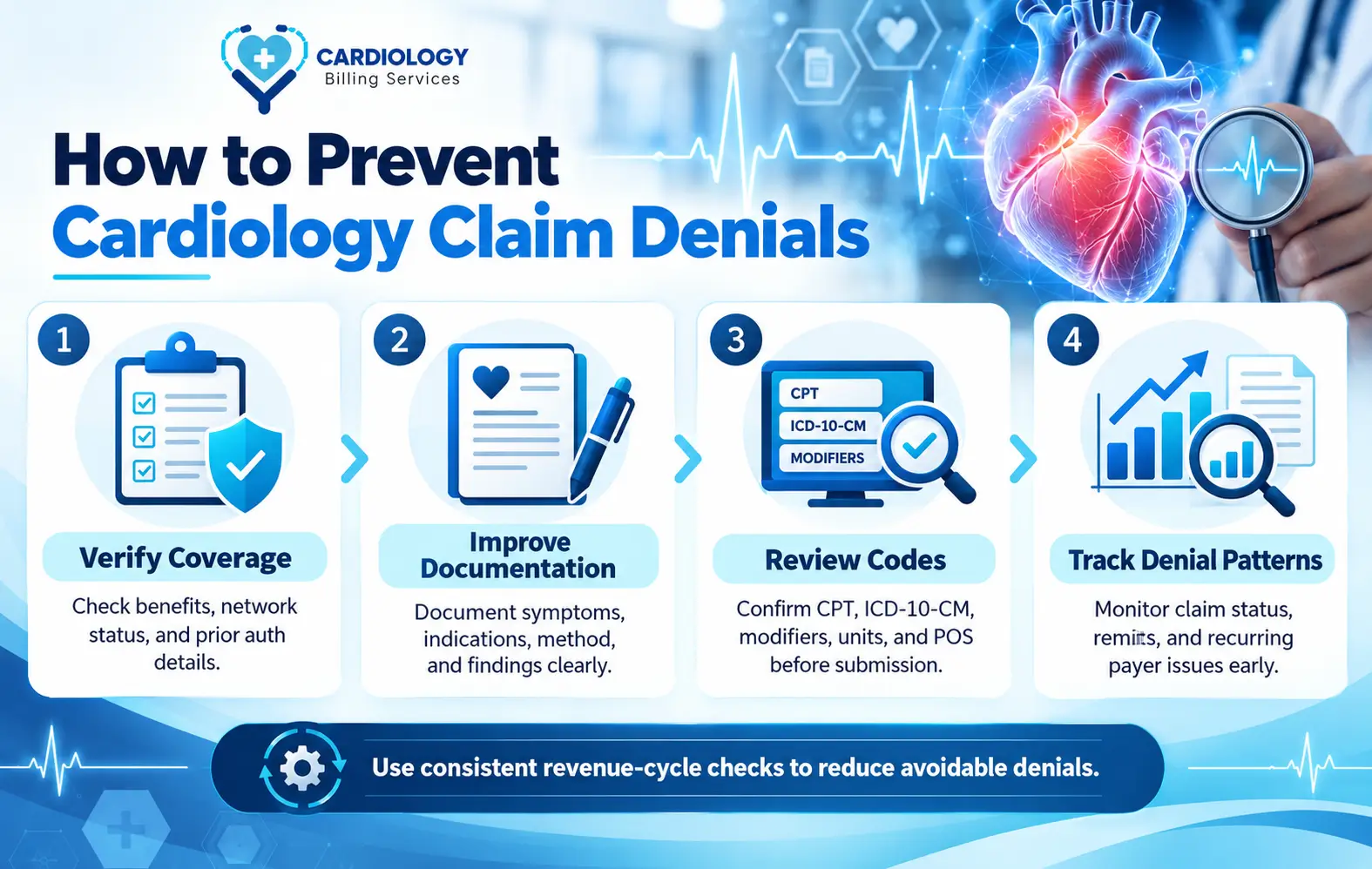
Reducing avoidable cardiology denials requires consistent procedures throughout the revenue cycle, beginning before the patient receives treatment and continuing until the claim is fully processed.
Verify insurance coverage before cardiac procedures
Insurance verification should confirm the patient's active benefits, applicable network participation, and coverage restrictions for the intended service. For procedures requiring prior authorization, the practice should document the approval number, validity period, approved procedure, and relevant limitations.
If the physician changes the planned examination or intervention, billing personnel should determine whether the existing authorization remains valid. This additional verification can prevent authorization mismatches that otherwise become apparent only after claim adjudication.
Improve clinical documentation accuracy
Clinical documentation must establish the medical reason for the billed cardiovascular procedure. For a cardiac stress test, the medical record may need to identify the patient's symptoms, relevant history, testing indications, selected stress method, and interpretation of the findings.
The specific requirements depend on the examination and payer policy. Documentation templates can help physicians capture required details, but automatically populated information must accurately reflect the actual encounter.
Providers should also ensure that procedure reports, physician orders, and diagnosis codes remain consistent. Conflicting information can complicate medical necessity reviews and make subsequent appeals more difficult.
Review cardiology codes before claim submission
A pre-submission coding review should compare the medical documentation against the selected CPT codes, ICD-10-CM diagnoses, modifiers, units, and place-of-service information.
Cardiology coding teams should pay particular attention to services involving professional and technical components, multiple cardiovascular procedures, and potentially bundled services.
Because CMS updates NCCI procedure-to-procedure edits quarterly, billing teams must use the edit files applicable to the service date. Applying outdated coding rules can produce avoidable errors even when the documentation itself is accurate.
Monitor claims and identify repeated denial patterns
Electronic claim acceptance confirms that the claim passed an initial processing stage. It does not establish that the insurance company will approve payment.
Billing personnel should routinely monitor claim status, payer requests for additional documentation, remittance advice, and unpaid accounts receivable. Early follow-up allows practices to investigate outstanding claims before filing or appeal deadlines become a problem.
Tracking denials by payer, procedure, adjustment reason, and responsible workflow can reveal repeated administrative weaknesses. A cardiology practice experiencing frequent authorization denials for advanced imaging, for example, may need to review its scheduling and authorization verification procedures.
How to appeal denied cardiology claims
A successful cardiology appeal requires a clear understanding of the payer's denial reason and documentation that directly addresses the disputed payment decision. Repeatedly submitting the original claim without identifying the underlying issue is unlikely to resolve a medical necessity or coverage dispute.
Review the insurance denial explanation
The billing team should begin by examining the electronic remittance advice or Explanation of Benefits. These records identify the affected service, claim details, adjustment reasons, and sometimes the instructions for further review.
Staff should determine whether the issue requires a corrected claim, an administrative reconsideration, or a formal appeal. Missing billing information may be corrected through the payer's established claim correction process, while a disputed medical necessity determination may require physician involvement and clinical evidence.
Gather supporting medical documentation
The appeal should contain records that demonstrate why the cardiology service was performed and why it meets the relevant coverage requirements.
Depending on the disputed procedure, supporting evidence may include physician orders, office visit documentation, diagnostic findings, procedure reports, authorization information, and relevant treatment history.
For example, an appeal involving a denied echocardiogram should explain the patient's cardiovascular symptoms or clinical findings and why the examination was appropriate. Merely providing evidence that the procedure occurred does not necessarily establish medical necessity.
Prepare a detailed cardiology appeal letter
An appeal letter should identify the patient, insurance claim number, date of service, denied CPT code, and stated reason for nonpayment. It should then explain why the medical record supports reimbursement under the applicable coverage provisions.
For a denied stress echocardiogram, the physician's supporting statement may address the documented symptoms, relevant cardiovascular findings, and reasons for choosing the particular examination.
Appeals should rely on existing medical records and applicable payer policies. Clinical facts should not be added or changed simply to support a payment request.
Submit the appeal before the deadline
Appeal deadlines depend on the insurance program and the type of payment dispute.
For Original Medicare, a first-level redetermination generally must be requested within 120 days of receipt of the initial determination. If the decision remains unfavorable, a reconsideration request generally must be filed within 180 days of receipt of the redetermination decision.
Many non-grandfathered private health plans subject to federal internal appeal protections provide at least 180 days to request an internal appeal after an adverse benefit determination. Provider payment disputes governed by contractual arrangements may follow different deadlines.
The billing department should confirm which rules apply to the specific claim rather than assuming that all insurers use the same appeals process.
Track the appeal decision and payment
After submitting an appeal, staff should document the submission date, supporting records, acknowledgment, decision deadline, and final determination.
If the insurer reverses the denial, the practice should verify that the expected payment has been issued and posted correctly. If the appeal is unsuccessful, the billing department should evaluate whether an additional review level is available and whether further action is justified.
Maintaining organized appeal records also helps identify recurring payer problems and improve future submissions.
Important cardiology billing changes in 2026
Certain prior authorization requirements changed in 2026 under the CMS Interoperability and Prior Authorization Final Rule, CMS-0057-F.
Beginning in 2026, affected payers generally must issue standard prior authorization decisions within seven calendar days and expedited decisions within 72 hours. The rule also requires affected payers to provide specific reasons for certain prior authorization denials involving covered medical items and services, excluding drugs.
These requirements apply to specified payer categories, including Medicare Advantage organizations and certain Medicaid and Children's Health Insurance Program arrangements. They do not automatically apply to every commercial insurance plan or Original Medicare fee-for-service claim.
For cardiology practices, more specific authorization denial explanations may help staff identify missing records, unsupported indications, or other deficiencies before a procedure is performed.
However, prior authorization decision deadlines differ from post-service claim payment and appeal deadlines. Billing teams should maintain separate procedures for authorization reviews and denied claims.
How cardiology practices can measure denial performance
Monitoring denial performance helps cardiology practices identify financial problems that may remain hidden within total collections.
The initial denial rate measures the percentage of submitted claims receiving an initial denial. Practices should define their calculation consistently and track rejected claims separately to avoid misleading comparisons.
The denial overturn rate measures the proportion of appealed denials reversed in the practice's favor. This metric helps determine whether the appeals team is selecting appropriate cases and supplying adequate supporting documentation.
Days in accounts receivable and denial-related aging reports provide additional information about outstanding reimbursement. Older denied balances may indicate delayed follow-up, unresolved payer disputes, or missed appeal opportunities.
These measurements are particularly useful when separated by payer and cardiovascular procedure category. A practice may find that medical necessity denials occur primarily in stress testing while authorization problems are concentrated in advanced cardiac imaging.
Reviewing those differences allows management to address specific workflow problems instead of applying the same corrective process to every denial.
Reducing cardiology claim denials through accurate billing
Cardiology claim denials frequently involve medical necessity documentation, CPT and ICD-10-CM coding, authorization requirements, modifier usage, procedure bundling, and insurance coverage limitations. Many administrative errors can be identified before submission through careful eligibility verification, documentation review, and coding validation.
When an insurance company denies a cardiovascular service, the billing team should investigate the exact adjustment reason and determine whether correction, reconsideration, or formal appeal is appropriate. Medical necessity appeals should explain how the documented clinical findings satisfy the relevant coverage criteria, while administrative errors should be addressed through the payer's established correction procedures.
Regular denial analysis also helps practices identify which procedures, payers, and internal processes generate repeated problems. Accurate coding, timely claim monitoring, and well-supported appeals can reduce unnecessary administrative work while helping cardiology providers recover reimbursement for appropriately documented and covered services.