

Cardiac Catheterization Billing Guide: CPT Codes, Billing & Reimbursement

Cardiac catheterization is a diagnostic and therapeutic procedure used to evaluate cardiovascular conditions, including coronary artery disease, structural heart abnormalities, and pulmonary hypertension. Although the procedure is widely performed in cardiology, accurate reimbursement requires careful attention to CPT codes, clinical documentation, medical necessity, and payer-specific billing requirements.
Billing errors frequently occur when diagnostic catheterization, coronary angiography, and percutaneous coronary interventions are reported together without considering coding restrictions. Incorrect procedure combinations, missing modifiers, and insufficient documentation can result in denied claims or reimbursement adjustments.
This cardiac catheterization billing guide explains commonly used CPT codes, billing guidelines, documentation requirements, modifiers, and Medicare reimbursement policies for 2026.
What is cardiac catheterization?
Cardiac catheterization is an invasive cardiovascular procedure in which a physician inserts a catheter through a blood vessel, commonly using radial or femoral arterial access or venous access, depending on the examination.
The catheter is advanced toward the heart to measure intracardiac pressures, assess blood flow, evaluate coronary arteries, or perform certain therapeutic interventions.
Diagnostic catheterization generally involves right heart catheterization, left heart catheterization, coronary angiography, or combinations of these procedures. Therapeutic catheter-based procedures may include balloon angioplasty, coronary stent placement, and other interventions.
From a medical billing perspective, the distinction between diagnostic and therapeutic services determines which CPT codes are appropriate and whether additional procedures can be reported separately.
Cardiac catheterization CPT codes in 2026
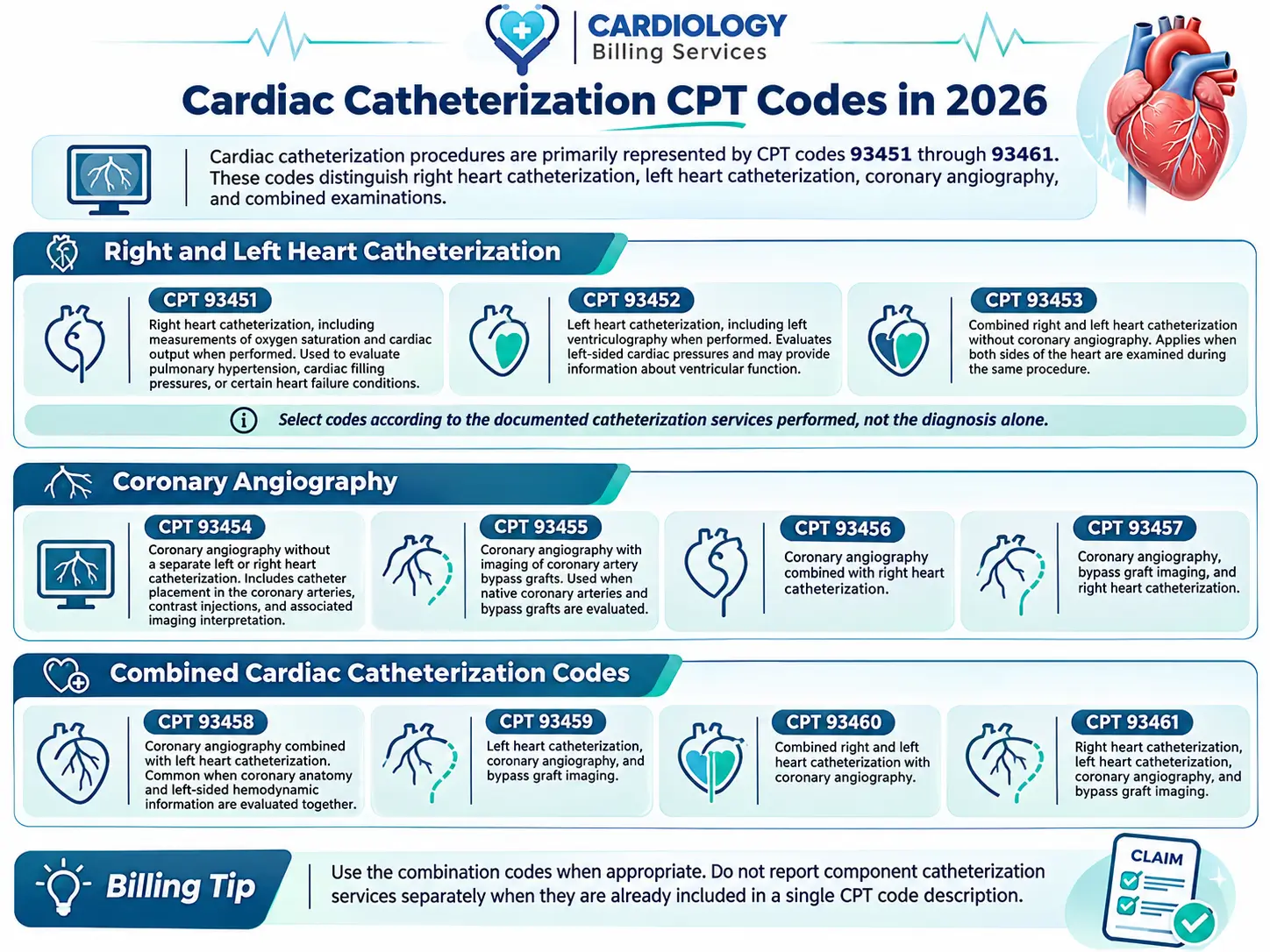
Cardiac catheterization procedures are primarily represented by CPT codes 93451 through 93461. These codes distinguish right heart catheterization, left heart catheterization, coronary angiography, and combined examinations.
Right and left heart catheterization CPT codes
CPT 93451 describes right heart catheterization, including measurements of oxygen saturation and cardiac output when performed. Physicians may use this procedure to evaluate pulmonary hypertension, cardiac filling pressures, or certain heart failure conditions.
CPT 93452 represents left heart catheterization, including left ventriculography when performed. The procedure involves evaluating left-sided cardiac pressures and may provide information about ventricular function.
CPT 93453 describes combined right and left heart catheterization without coronary angiography. It applies when both sides of the heart are examined during the same procedure.
These codes should be selected according to the actual catheterization services documented rather than the patient’s diagnosis alone.
Coronary angiography CPT codes
CPT 93454 describes coronary angiography without a separate left or right heart catheterization. It includes catheter placement in the coronary arteries, contrast injections, and associated imaging interpretation.
CPT 93455 includes coronary angiography and imaging of coronary artery bypass grafts. It may apply when a patient with previous coronary bypass surgery undergoes diagnostic evaluation of native coronary arteries and bypass grafts.
CPT 93456 represents coronary angiography combined with right heart catheterization, while CPT 93457 includes coronary angiography, bypass graft imaging, and right heart catheterization.
Combined cardiac catheterization codes
CPT 93458 describes coronary angiography combined with left heart catheterization. It is commonly encountered when physicians evaluate coronary anatomy and obtain left-sided hemodynamic information during the same examination.
CPT 93459 includes left heart catheterization, coronary angiography, and bypass graft imaging.
CPT 93460 represents combined right and left heart catheterization with coronary angiography.
CPT 93461 includes right heart catheterization, left heart catheterization, coronary angiography, and bypass graft imaging.
The selection of these combination codes prevents separate reporting of services already included within a single procedure description.
Cardiac catheterization billing guidelines
Accurate cardiac catheterization billing begins with identifying whether the examination was diagnostic, therapeutic, or a combination of both.
The Centers for Medicare & Medicaid Services provides billing instructions through Medicare coverage policies and the cardiac catheterization and coronary angiography billing article A52850, with a revision effective October 1, 2026.
These instructions require appropriate diagnosis coding, proper reporting of procedures, and compliance with Medicare National Correct Coding Initiative edits.
For example, when coronary angiography and left heart catheterization are performed during the same encounter, CPT 93458 may describe the combined service. Reporting separate codes for included components can create duplicate billing.
Similarly, catheter placement, routine contrast injections, pressure measurements, and imaging interpretation may already be incorporated into the reported catheterization code.
Billing personnel must review the complete operative report before assigning procedure codes.
Diagnostic catheterization versus coronary intervention billing
Diagnostic cardiac catheterization evaluates cardiovascular anatomy and physiology. Percutaneous coronary intervention, commonly called PCI, treats coronary artery narrowing or obstruction.
Common interventional codes include CPT 92920 for balloon angioplasty, CPT 92928 for coronary stent placement in a qualifying single-lesion procedure, and CPT 92933 for coronary atherectomy with stenting.
The 2026 CPT revisions introduced changes to PCI coding. The American College of Cardiology discussed these changes in its December 4, 2025, Coding Corner publication.
Several previous additional-branch codes, including 92921, 92925, 92929, and 92934, were deleted for 2026. The revised code structure incorporates procedures involving a major coronary artery and its branches.
CPT 92930 was introduced for certain more complex stenting situations, including qualifying bifurcation lesions or multiple lesions treated with stents.
These changes affect how interventions involving multiple coronary lesions and branches are reported. Coders must use the code descriptions effective on the service date rather than applying older branch-based reporting methods.
Can diagnostic catheterization and PCI be billed together?
Diagnostic coronary angiography may be separately reportable when performed before PCI under specific circumstances.
For example, a patient may undergo an initial diagnostic coronary angiogram that identifies a significant coronary obstruction. If the physician subsequently decides to perform PCI based on those findings, separate diagnostic reporting may be appropriate.
However, angiographic imaging performed solely to guide an already planned intervention is generally included in PCI and cannot be billed as another diagnostic examination.
The Society for Cardiovascular Angiography and Interventions addressed these distinctions in its updated PCI coding guidance for 2026.
Separate reporting may be justified when no previous diagnostic examination exists or when earlier imaging is inadequate and a documented clinical change requires additional evaluation.
The physician’s report must support the medical necessity and independent diagnostic purpose of the examination.
Modifiers used in cardiac catheterization billing
Modifiers provide additional information about procedures, anatomical locations, and circumstances affecting reimbursement.
Modifier 59: Distinct procedural service
Modifier 59 may apply when a separately reportable diagnostic cardiac catheterization or coronary angiography is performed during the same session as PCI.
The modifier must be supported by documentation establishing that the diagnostic examination satisfies separate reporting requirements.
It should never be used simply to bypass a coding edit.
Coronary artery modifiers
Coronary artery modifiers identify the vessel involved in certain cardiovascular procedures.
Modifier LD identifies the left anterior descending coronary artery, while LC identifies the left circumflex coronary artery.
Modifier RC represents the right coronary artery, LM identifies the left main coronary artery, and RI identifies the ramus intermedius artery.
These modifiers are particularly relevant when reporting certain coronary interventions, intravascular imaging procedures, and coronary physiological assessments.
The applicable payer’s reporting instructions should determine how the modifiers are submitted.
Modifier 26 and modifier TC
Modifier 26 identifies professional components of eligible diagnostic procedures, while modifier TC identifies technical components.
However, cardiac catheterization codes generally incorporate the physician’s procedural work and interpretation. These modifiers should not be added automatically.
Billing personnel should confirm whether a particular code permits professional and technical component reporting before applying either modifier.
Documentation requirements for cardiac catheterization
Complete documentation supports medical necessity, accurate coding, and reimbursement.
The medical record should contain the clinical indication, relevant symptoms, physician orders, diagnostic findings, and justification for the procedure.
A cardiac catheterization report should identify the vascular access site, catheters used, cardiac chambers or coronary arteries examined, hemodynamic measurements, and relevant angiographic findings.
For right heart catheterization, documentation may include pulmonary artery pressure, pulmonary capillary wedge pressure, right atrial pressure, oxygen saturation measurements, and cardiac output.
Coronary angiography reports should describe the arteries examined, lesion locations, degree of stenosis, and clinically significant abnormalities.
When PCI is performed, additional documentation should identify the treated vessel, lesion characteristics, intervention technique, devices used, and procedural outcome.
The record should distinguish diagnostic findings from imaging performed to guide treatment.
ICD-10-CM codes for cardiac catheterization
Diagnosis coding must accurately represent the patient’s documented cardiovascular condition and support the medical necessity of catheterization.
Common ICD-10-CM codes include I25.10 for atherosclerotic heart disease of a native coronary artery without angina pectoris, I21.4 for non-ST elevation myocardial infarction, I20.9 for unspecified angina pectoris, and I27.20 for unspecified pulmonary hypertension.
Additional codes may apply to heart failure, structural heart disease, or other documented conditions requiring invasive cardiovascular evaluation.
These diagnoses do not automatically establish coverage. Medicare contractors and commercial insurers evaluate whether catheterization is medically appropriate under the applicable coverage policy.
Coders should assign the most specific supported diagnosis and avoid using presumed conditions that have not been established in the medical record.
Medicare cardiac catheterization reimbursement in 2026
Medicare reimbursement for cardiac catheterization depends on the procedure performed, physician services, geographic location, and healthcare setting.
The 2026 Medicare Physician Fee Schedule established a conversion factor of approximately $33.57 for qualifying Alternative Payment Model participants and $33.40 for other practitioners.
These conversion factors are used with relative value units and geographic adjustments to calculate physician payment. They do not represent the reimbursement amount for an individual catheterization procedure.
Hospital outpatient catheterization services generally follow the Medicare Outpatient Prospective Payment System. Physician services are reimbursed separately under the applicable professional payment methodology.
For inpatient procedures, hospital reimbursement may depend on the assigned Medicare Severity Diagnosis Related Group, which reflects the patient’s condition, treatment, and other classification requirements.
Commercial insurance payments depend on contracted rates, authorization policies, and network participation.
Practices should verify reimbursement using the applicable fee schedule and payment system for the date of service.
Common cardiac catheterization billing denials
Incorrect CPT code selection
Claims may be denied when the reported code does not match the documented catheterization procedure.
For example, selecting CPT 93458 when only coronary angiography was performed without left heart catheterization may result in inaccurate billing.
Duplicate or bundled procedures
Billing separate component codes for services already included in a combined catheterization code can trigger coding edits.
Routine catheter manipulation, pressure recordings, and other included procedural activities generally should not be reported independently.
Missing medical necessity
A claim may be denied when documentation does not adequately explain why invasive catheterization was necessary.
The clinical record should establish the diagnostic question, relevant cardiovascular findings, and the medical reasoning supporting the procedure.
Authorization and modifier errors
Commercial insurers and Medicare Advantage plans may require prior authorization for certain catheterization services, depending on the clinical circumstances and plan requirements.
Incorrect coronary artery modifiers or unsupported modifier 59 reporting can also result in claim rejections and denials.
How to improve cardiac catheterization billing accuracy
Cardiology practices should review catheterization claims against the operative report before submission.
The review should confirm the catheterization type, coronary vessels examined, intervention performed, diagnosis codes, modifiers, and medical necessity documentation.
Billing teams should also verify current CPT instructions, Medicare coding edits, and payer-specific reimbursement policies.
Regular analysis of denied claims helps identify recurring errors involving incomplete documentation, incorrect combination codes, and separately reported bundled procedures.
Conclusion: Cardiac catheterization billing guide
Accurate cardiac catheterization billing requires careful selection of CPT codes, complete clinical documentation, and adherence to applicable reimbursement policies.
Codes 93451–93461 describe common diagnostic catheterization procedures, while separate interventional codes apply when coronary treatment is performed.
The 2026 PCI coding revisions also require billing personnel to review updated coronary artery and branch reporting rules.
By maintaining accurate procedure reports, verifying medical necessity, and applying current coding instructions, healthcare providers can reduce preventable denials and support appropriate reimbursement.