Loop Recorder Billing: CPT Codes, Coding Rules, Documentation and Denial Prevention

Loop recorder claims sit at an awkward intersection of a high-cost implanted device, a small set of easily confused CPT codes and payer medical-necessity rules that reject the service more often than most cardiology procedures. A single subcutaneous cardiac rhythm monitor generates several distinct billable events over its life the insertion, the eventual removal, in-person device checks and remote interrogation across 30-day windows and each one follows its own coding logic, frequency limit and documentation expectation. Treat them as interchangeable and the denials follow quickly.
This guide walks through loop recorder billing the way a cardiology revenue cycle team actually handles it: which codes apply to which service, how diagnosis coding and medical necessity drive payment, what documentation holds up under audit and where these claims most often break down. Coding and payer rules change, so every code and coverage point below should be confirmed against the current AMA CPT code set and the specific payer’s policy before you submit.
What is loop recorder billing?
Loop recorder billing is the process of coding, submitting and getting paid for the services tied to an implantable loop recorder (ILR) also called an insertable cardiac monitor (ICM) or subcutaneous cardiac rhythm monitor. It covers the device insertion, its removal, in-person device evaluations and remote monitoring, plus the diagnosis coding and documentation that support medical necessity for each.
The reason it deserves its own workflow is that one device produces a sequence of separate claims over months or years, submitted by potentially different entities (the implanting physician, the monitoring practice, the facility). Getting paid depends on matching the correct code to the exact service performed, linking a diagnosis the payer recognizes and documenting why the monitoring was warranted.
What is an implantable loop recorder?
An implantable loop recorder is a small subcutaneous device typically placed in the left parasternal area under local anesthesia that continuously monitors cardiac rhythm for an extended period, often up to about three years depending on the model. It captures arrhythmic events automatically and can be triggered by the patient, storing electrocardiographic data that a physician later reviews.
From a billing standpoint, the clinical detail that matters is that these devices are used when symptoms recur too infrequently to be caught on short-term external monitoring. Payers generally cover them for indications such as recurrent unexplained syncope or presyncope after other causes are addressed, suspected paroxysmal atrial fibrillation in the setting of cryptogenic stroke, suspected or known ventricular arrhythmia and select structural or infiltrative heart disease scenarios always tied to what the record documents. Nothing in this article recommends when a patient should receive one; that is a clinical decision. The billing question is narrower: given that the device was placed, how is the service coded and supported so the claim is paid?
Implantable loop recorder vs external cardiac monitoring
The distinction between an implantable loop recorder and external monitoring is not cosmetic it changes the entire code family. External options such as Holter monitors, event monitors and mobile cardiac telemetry are worn on the body and billed under a different set of CPT codes, with their own hookup, recording, scanning and interpretation components. (If you handle those services too, our Holter monitor billing guide covers that code family in detail.)
An implantable loop recorder is surgically inserted, so it carries a procedure code for insertion, a separate code for removal and its own in-person and remote device-evaluation codes. A coder who reaches for an external-monitor code on an implanted device or the reverse produces a claim that does not match the documentation and that mismatch is a leading denial driver. Confirm what device was actually placed and monitored before selecting anything.
Loop recorder CPT codes and billing
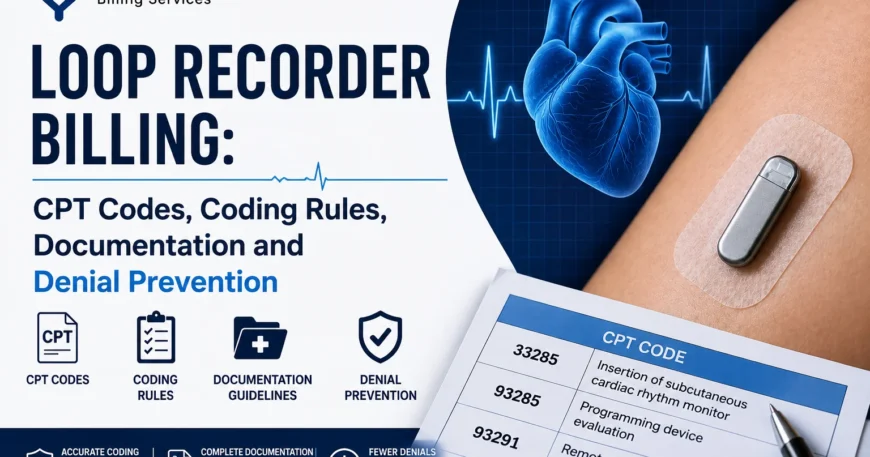
The core loop recorder codes fall into four buckets: insertion, removal, in-person device evaluation and remote device evaluation. There is also a device supply code that applies on the facility side. The table below summarizes the current structure; verify descriptors and parentheticals against the current AMA CPT code set, because these are maintained and updated by the AMA and CMS updates its edits quarterly.
Service | Code(s) | What is being billed | Common billing consideration |
Insertion / implantation | 33285 | Insertion of a subcutaneous cardiac rhythm monitor, including programming | Device supply is billed separately on the facility claim; medical necessity must be documented |
Removal | 33286 | Removal of a subcutaneous cardiac rhythm monitor | A procedure-to-procedure edit exists with 33285; a modifier is appropriate only when insertion and removal are genuinely separate (separate site/encounter) |
In-person programming evaluation | 93285 | In-person programming device evaluation of the monitor system | Watch same-period reporting rules with the remote programming code |
In-person interrogation evaluation | 93291 | In-person interrogation device evaluation with analysis, review and report | Reflects a distinct in-person check, not remote data review |
Remote interrogation | 93298 | Remote interrogation device evaluation, up to a 30-day period | Frequency-limited to once per 30-day monitoring period |
Remote programming evaluation | 0650T | Remote programming device evaluation of the monitor system (Category III) | Category III code; coverage varies by payer and often requires a crosswalk and supporting letter |
Device supply (facility) | C1764 / E0616 | The implanted device itself | C1764 is for facility reporting and should not appear on a professional claim; E0616 is a device HCPCS |
Loop recorder insertion / implantation
The insertion of a subcutaneous cardiac rhythm monitor is reported with 33285 and that code already includes the intraoperative programming so programming is not billed again separately on the day of insertion. On the professional claim, you report the physician’s insertion. On the facility side, the device itself is captured with the appropriate device HCPCS (C1764 for facility reporting), which should not be duplicated onto the professional claim.
Payment here turns almost entirely on medical necessity. The insertion code needs a diagnosis that reflects a documented, payer-recognized indication and the note should establish why longer-term implantable monitoring was warranted frequently that shorter external monitoring was non-diagnostic, inconclusive, or contraindicated and that symptoms are infrequent. Place of service, prior authorization requirements and the diagnosis-to-procedure linkage all vary by payer, so none of that can be assumed to be identical across Medicare and commercial plans.
Loop recorder removal
Removal is reported with 33286 when the device is explanted. Two situations trip up billers most often. First, when a device is removed and a new one placed through the same incision, the accepted guidance is to report the insertion of the new device only (33285) not both. Second, 33285 and 33286 carry a National Correct Coding Initiative procedure-to-procedure edit, so billing them on the same date without a supporting basis will bundle the pair.
A modifier to report both on the same day is defensible only when the services are genuinely distinct for example, the old device removed through one incision and a new one inserted at a separate anatomic site, or the two performed at separate encounters on the same day. In those cases an X{EPSU}-modifier (such as XS for a separate structure or XE for a separate encounter) is generally more precise than modifier 59. Appending a modifier simply to unbundle a same-incision replacement is not supported and invites recoupment.
Device interrogation and in-person evaluation
In-person device evaluation splits into two codes with different meanings. 93285 is the in-person programming device evaluation, where parameters are tested and optimal values are selected. 93291 is the in-person interrogation device evaluation, where stored and current data are analyzed, reviewed and reported without the programming/parameter-selection element. Choosing between them depends on what the physician actually did and documented, not on which pays better.
These are professional-and-technical services and the way the professional and technical work is split or whether a global service is reported depends on the site of service and who owns the equipment and interpretation. A frequent error is reporting an in-person evaluation code for what was actually a remote data review, or vice versa. The two settings are not interchangeable and the documentation has to match the code’s setting.
Remote monitoring
Remote services for a loop recorder run on 30-day monitoring windows. 93298 is the remote interrogation device evaluation covering up to a 30-day period and it is frequency-limited reported once per 30-day window, not per transmission. 0650T is the Category III code for remote programming device evaluation of the monitor system.
Because 0650T is a Category III code, several commercial payers do not reimburse it under a standard fee schedule; Category III codes often require a crosswalk to a comparable Category I service (93285 is commonly cited as the reference) plus a letter describing the service and coverage should be confirmed at the plan level. Current CPT parenthetical instructions also restrict reporting 0650T alongside certain same-day in-person device codes, so check the active parentheticals before combining codes. For Medicare beneficiaries, remote services are generally subject to standard coinsurance and patient consent for remote monitoring typically must be obtained and refreshed periodically confirm the current consent cadence in payer guidance.
Related services and E/M considerations
An evaluation and management service is sometimes performed on the same day as a loop recorder procedure or device check. A separately reportable, significant E/M can be appropriate but only when it is distinct from the work inherent in the procedure and it must carry modifier 25. Medicare’s Global Surgery rules specifically prevent reporting a separate E/M for the work associated with the decision to perform a minor procedure, so the decision-to-implant visit is generally not a separately billable E/M on the procedure date. When the encounter genuinely includes a separate, documented evaluation of an unrelated or significant problem, modifier 25 supports it; when it does not, adding the modifier is not a workaround.
How to select the correct CPT code for loop recorder services
Start from the documented service, then map it to the code never the other way around. Four questions resolve most selections:
- Was the device inserted or removed on this date? Insertion is 33285 (programming included); removal is 33286.
- Was the device check in person or remote? In-person maps to 93285 or 93291; remote maps to 93298 or 0650T.
- If in person, did the physician program/adjust parameters (93285) or interrogate and report without reprogramming (93291)?
- If remote, was it a remote interrogation across a 30-day window (93298) or remote programming (0650T)?
Layer the frequency rules on top remote interrogation is once per 30-day period and confirm the current CPT parentheticals for any codes you intend to report together. When the record is ambiguous about what was actually done, the fix is a documentation query, not a coding guess.
ICD-10-CM diagnosis coding for loop recorder claims
The diagnosis code tells the payer why the service was reasonable and necessary and for loop recorders it is usually the deciding factor in payment. The code has to reflect the documented reason for the monitoring, coded to the highest specificity the record supports.
Diagnoses that commonly support loop recorder services depending entirely on what is documented include:
- R55 Syncope and collapse
- R00.2 Palpitations; R00.0 Tachycardia, unspecified; R00.1 Bradycardia, unspecified
- R42 Dizziness and giddiness
- I48.0 / I48.91 Paroxysmal / unspecified atrial fibrillation (and the specific I48 subcodes as documented)
- I49.5 Sick sinus syndrome; I49.8 / I49.9 Other specified / unspecified cardiac arrhythmia
- I47.- Paroxysmal tachycardia (as documented)
- Cryptogenic stroke / TIA workup context, coded from the cerebrovascular event or its history/sequela codes (for example the appropriate I63.-, G45.-, or personal-history/sequela codes) as the record supports
Two cautions matter here. A diagnosis appearing in the patient’s history does not, by itself, justify the service the code must reflect the documented indication for this encounter. And a code that is technically valid but not linked to the service, or not supported by the note, still fails. Sequencing also counts: when more than one indication exists, the primary diagnosis should be the one the physician documents as driving the decision. Follow-up interrogation and remote monitoring encounters may carry the relevant symptom/finding code or a device-management code depending on the visit and the payer’s policy, so confirm the payer’s preference rather than defaulting.
Medical necessity for loop recorder billing
Medical necessity is the standard a payer uses to decide whether a covered service was reasonable and necessary for this patient. For loop recorders it is where most denied claims are actually lost not on the code itself, but on whether the record demonstrates a recognized indication.
A valid diagnosis code is necessary but not sufficient. The clinical note has to connect the dots: the symptom or condition prompting monitoring, what prior evaluation was done and why long-term implantable monitoring fit the situation. Medicare has covered these monitors for years under its National Coverage Determination for electrocardiographic services (NCD 20.15), but the operational coverage detail lives in Local Coverage Determinations and payer medical policies, which spell out accepted indications and sometimes required diagnosis linkages. Those policies are not uniform a commercial plan may recognize indications a given Medicare Administrative Contractor handles differently and vice versa. Because coverage criteria and any diagnosis lists are set by each payer and can change, the practical rule is to check the governing LCD or medical policy for the specific payer before the device is placed, not after the claim is denied.
Documentation requirements for loop recorder billing
Documentation is what converts a clinically appropriate service into a payable claim and an audit-defensible record. Requirements vary by service and payer, but the elements below carry most loop recorder claims:
- The reason for the service and the relevant clinical history as documented, establishing the indication
- The specific device placed or evaluated and, for procedures, the operative details incision site, subcutaneous pocket, device placement, closure and that programming occurred during the insertion encounter
- For removal, the explant details and, where a replacement occurred, whether it was through the same or a separate incision
- For in-person evaluations, the interrogation and/or programming findings, analysis and a signed interpretation
- For remote monitoring, the transmission/device report, the monitoring-period dates confirming the 30-day window and a physician-signed interpretation of the rhythm findings
- The assessment, diagnostic findings and monitoring/treatment plan, plus provider authentication (signature) where required
The distinction worth keeping in view: some documentation supports the service (what makes it codeable and medically necessary) and some documentation is required by a specific payer or policy (consent records, monitoring-period proof, particular report elements). Both need to be present. Building this into a standing checklist is one of the highest-yield habits a device-heavy practice can adopt our cardiology audit checklist is a useful starting point for structuring that review.
Common loop recorder billing and coding errors
Most loop recorder denials trace back to a short list of recurring mistakes. Recognizing them by pattern is how a billing team stops re-making them.
Incorrect or outdated CPT code
Reporting a service with the wrong code an external-monitor code on an implanted device, an in-person code for a remote review, or a retired code carried over from an old template produces a claim that does not match the record. Historical codes for these devices have changed (older insertion/removal codes were replaced), so any code pulled from a dated reference has to be re-verified against the current code set.
Incorrect ICD-10-CM code
A diagnosis that lacks specificity, does not match the documented indication, is pulled from history rather than the current reason for the service, or is sequenced incorrectly can defeat medical necessity even when the procedure code is right. Coding a condition the note does not actually support is both a denial risk and a compliance problem.
Modifier errors
Modifiers describe real circumstances; they are not tools to force payment. The ones most relevant to loop recorder and device billing:
Modifier | Typical use in this context |
25 | A significant, separately identifiable E/M on the same day as a procedure or device check only when genuinely distinct |
26 | Professional component, when the professional and technical components are billed separately |
59 (or XE/XS/XP/XU) | A distinct procedural service (e.g., insertion and removal at separate sites/encounters); the X{EPSU} modifiers are more specific and preferred |
76 / 77 | A repeat procedure by the same (76) or a different (77) physician, when applicable |
91 | A repeat clinical diagnostic test when repetition is medically necessary |
Applying any of these without the underlying circumstance to support it is a frequent audit finding. Modifier 59 in particular is a modifier of last resort used only when no more specific modifier fits and blanket use to clear edits (“modifier stacking”) is flagged as a high-risk pattern in federal oversight work plans.
NCCI and bundling issues
The 33285/33286 pair is the classic example: an edit exists and same-day reporting bundles unless a specific, documented circumstance supports a bypass modifier. The presence of an edit with a modifier indicator of 1 means a bypass may be allowed with the right modifier and documentation; an indicator of 0 means no modifier will unbundle it. Verifying the current edit and its indicator before submission rather than reflexively appending 59 is the correct step.
Incorrect units or frequency
Remote interrogation is a once-per-30-day service; billing it per transmission, or exceeding a Medically Unlikely Edit (MUE) limit, triggers automatic denial of the excess. Frequency and unit rules differ by code and payer, so the monitoring-period dates in the record have to line up with what is billed.
Duplicate billing
Duplicate loop recorder claims arise when a corrected claim is submitted as a brand-new claim, when a resubmission goes out without checking the original’s status, or when a monitoring charge is reported twice for overlapping periods. A legitimate correction is tied to the original claim (as a corrected claim, with the appropriate resubmission indicator); a duplicate simply repeats it. Checking claim status before any resubmission prevents most of these.
Missing documentation
A procedure note that omits operative detail, an evaluation without a signed interpretation, or a remote service without a transmission report and monitoring dates leaves the claim unsupportable. The service may have been perfect; if the record does not show it, the claim cannot stand.
Authorization problems
Missing authorization, an authorization for a different service or site, an expired authorization, or one obtained under the wrong provider are all preventable at the front end. Authorization is a separate matter from medical necessity more on that below.
Loop recorder claim rejection vs denial vs underpayment
These three outcomes are often lumped together, but the correct response differs for each. Confusing them wastes days of follow-up and can blow a filing or appeal deadline.
Claim rejection | Claim denial | Underpayment | |
What it is | Claim never entered adjudication stopped at the clearinghouse or front-end edits | Claim was adjudicated and payment was refused (fully or partially) | Claim was adjudicated and paid, but for less than the contracted/expected amount |
Typical cause | Format, demographic, or eligibility data errors; invalid identifiers | Coding, medical necessity, authorization, or coverage issues | Incorrect fee-schedule application, downcoding, bundling, or contractual misapplication |
How you learn of it | Clearinghouse/payer rejection report | Remittance advice (ERA/EOB) with a denial reason/remark code | Remittance showing paid amount below expected |
Correct response | Fix the data and resubmit (usually not an appeal) | Determine if correctable → corrected claim or appeal with support | Compare to contract; request adjustment/reprocessing or appeal the underpayment |
Because payer systems label statuses inconsistently, read the actual reason and remark codes rather than the headline status word. A “rejection” in one portal may be an adjudicated denial in another and the two demand different actions.
The loop recorder billing workflow
A repeatable, front-loaded workflow prevents far more denials than back-end appeals recover. The sequence a well-run cardiology billing operation follows:
- Verify the patient’s eligibility and active benefits.
- Confirm whether prior authorization is required for the specific service and payer and obtain it.
- Review the documented service against what will be billed.
- Confirm exactly which device and which service (insertion, removal, in-person, remote) occurred.
- Select the CPT code that matches the documentation.
- Verify the ICD-10-CM diagnosis and its linkage to the service.
- Review any modifiers for a supporting circumstance.
- Check current NCCI edits and bundling relationships.
- Confirm units and frequency (especially the 30-day remote window).
- Confirm place of service and the correct billing/rendering provider.
- Validate the full claim (demographics, payer, identifiers).
- Submit the claim.
- Monitor for rejections and correct them promptly.
- Review the remittance advice on adjudication.
- Correct or appeal where appropriate.
- Track the outcome to resolution.
- Record the root cause so the same error is designed out next time.
Resubmitting an identical claim without addressing why it failed is the single most common way practices turn one denial into a recurring one. Every correction should change something the payer flagged.
Loop recorder billing root-cause analysis
Isolated denials are noise; patterns are signal. Root-cause analysis means capturing enough detail on each denied loop recorder claim to see where the same failure repeats. Track, at minimum: the denial reason/remark code, payer, CPT code, ICD-10-CM code, rendering provider, location, procedure vs monitoring service type, date of service, dollar amount, frequency context, authorization status, the monitoring period, current claim status and the eventual appeal outcome.
When those fields are aggregated, the story usually becomes obvious one payer denying every 0650T, one provider’s insertions failing on medical necessity, remote charges denying whenever the 30-day dates are missing. Each pattern points to a specific upstream fix: a template change, a front-end authorization step, a documentation prompt. That is the difference between working denials and preventing them and it is a core part of structured denial management.
Denial metrics cardiology practices should track
Metrics turn a pile of denials into something you can manage and trend. Useful measures include the overall denial rate, denied claim volume, denied dollar value, the top denial reasons, payer-specific denial rates and category breakdowns coding-related, authorization-related, medical-necessity, documentation-related and remote-monitoring denials specifically. On the recovery side, track the appeal overturn rate, days to resolution and which denial categories recur.
A common formula:
Denial rate = denied claims ÷ applicable adjudicated claims × 100
The denominator matters and should be defined explicitly, because organizations calculate it differently some against total claims submitted, some against adjudicated claims, some by line rather than by claim. Whatever definition you adopt, apply it consistently so the trend is meaningful. There is no single universal industry benchmark that applies to every practice and payer mix, so compare your numbers to your own baseline over time rather than to a figure of unknown origin.
How to prevent loop recorder billing denials
Prevention works best when it is distributed across the whole timeline of the service rather than concentrated at claim submission.
Before the procedure or service. Verify eligibility and benefits, confirm network status, check any referral requirement, secure prior authorization where required and review the governing coverage policy and any frequency limitations for the specific payer.
During the service. Ensure the clinical documentation establishes the indication and medical necessity, records the specific device, captures the operative or evaluation detail and for remote services documents the transmission and monitoring period.
During coding. Match the CPT code to the documented service, code the diagnosis to full specificity and link it, apply modifiers only where supported, confirm units and frequency, check NCCI edits, account for global-period considerations and keep the insertion-vs-evaluation and in-person-vs-remote distinctions straight.
Before claim submission. Validate demographics and payer information, confirm the authorization matches the service and provider, run coding edits, verify the diagnosis-to-service linkage and confirm place of service and provider details.
After submission. Track the claim, monitor rejections and denials separately, follow up on aging accounts receivable, appeal or correct as appropriate, post payments accurately and feed every root cause back into the front end.
How to handle a denied loop recorder claim
When a denial lands, resist the reflex to resubmit. Read the remittance advice and identify the specific reason and remark codes first. Determine whether the denial is correctable (a coding or data error that a corrected claim fixes) or appealable (a medical-necessity, bundling, or coverage determination you believe is wrong). Those are different paths: a corrected claim goes back with the fix and the proper resubmission indicator; an appeal argues the determination with supporting documentation. Sending a fresh claim when the payer expected a corrected one just generates a duplicate.
How to appeal a loop recorder billing denial
An appeal is an argument backed by the record. The workflow:
- Read the denial reason carefully and identify precisely what the payer refused and why.
- Determine whether the denial is correctable or genuinely requires an appeal.
- Review the payer’s medical policy or LCD for the exact coverage criteria at issue.
- Compare the claim line by line against the documentation.
- Verify the CPT code against current coding guidance.
- Verify the diagnosis coding and its linkage.
- Locate the authorization information, if the denial concerns authorization.
- Identify the documentation that supports the billed service and medical necessity.
- Gather the relevant records.
- Write a concise appeal that states what was billed, why it was necessary and which policy criteria are met.
- Attach the supporting documentation.
- Submit through the payer’s required method.
- Meet the applicable deadline.
- Track the appeal to a decision.
Appeal rights, formats, levels and deadlines vary by payer and by denial type, so confirm each payer’s process rather than assuming one procedure applies everywhere.
Documentation needed for a loop recorder claim appeal
What to include depends on the denial reason not every appeal needs every document. Depending on what is being contested, relevant records may include the claim and remittance advice, the medical records establishing the indication, the procedure/implantation or removal report, the device interrogation report, remote monitoring documentation and monitoring-period dates, the physician’s signed interpretation, diagnostic results, authorization or referral information, the coding rationale, the applicable payer policy and the documentation supporting medical necessity. Send what actually rebuts the stated reason; padding an appeal with irrelevant records slows it down.
Prior authorization for loop recorder services
Prior authorization is a payer’s advance approval of a service and it is distinct from proving medical necessity. Authorization confirms the payer agreed in advance to consider the service; medical necessity is whether the documented clinical picture supports it. A service can be authorized and still denied for medical necessity if the record does not hold up and a medically necessary service can be denied outright if a required authorization was never obtained.
The preventable failures cluster tightly: no authorization when one was required, an authorization for a different service or a different site/provider than what was billed, or an authorization that expired before the service. Medicare frequently does not require prior authorization for these procedures, while many commercial payers do so the requirement has to be checked per payer, per service, before the device is placed. Front-end eligibility and authorization work is handled as part of cardiology medical billing precisely because catching this before the procedure is far cheaper than appealing it after.
Eligibility and coverage
A large share of loop recorder rejections and denials are eligibility and coverage problems that surface only after submission: inactive coverage on the date of service, transposed or outdated insurance information, unresolved coordination of benefits, a non-covered service under the plan, benefit or frequency limitations, out-of-network status, or the claim simply routed to the wrong payer. Verifying active coverage and the relevant coverage policy up front including any frequency limits on monitoring removes a category of denials that no amount of clean coding can prevent.
Timely filing
Timely filing is the payer’s deadline for receiving the initial claim and it is unforgiving once missed. Deadlines vary widely by payer and plan, so there is no single universal number to rely on. The operational safeguard is claim-submission tracking knowing when each claim went out and confirming acceptance so a rejected claim gets corrected and resubmitted while there is still time. This is one reason claims submission and tracking is treated as an active step rather than a fire-and-forget one; a rejection caught at day three is fixable, while the same rejection discovered at day ninety may not be.
Global-period considerations
Loop recorder procedures are minor surgical procedures and the global-period assignment affects what else can be billed around them. The specific global indicator for 33285 and 33286 should be confirmed in the current Medicare Physician Fee Schedule, because that indicator governs how related same-day and follow-up services are treated. The general principle from Medicare’s Global Surgery rules is that minor procedures include the pre-, intra- and post-procedure work inherent in the service, so a separate E/M for the decision to perform the procedure is generally not separately reportable. Not every loop recorder service carries the same global treatment, so the rule cannot be applied uniformly across insertion, removal and device evaluations verify each.
Provider enrollment and credentialing
Even flawless coding fails if the rendering provider is not correctly enrolled and credentialed with the payer. Enrollment status, the NPI, taxonomy/specialty designation, network participation and facility enrollment all feed claim adjudication. A physician billing under the wrong enrollment, an out-of-network rendering provider, or a taxonomy mismatch can cause denials that look like coding problems but are really credentialing problems. When device-service denials cluster around a particular provider or location, enrollment is worth ruling out early.
Medicare considerations for loop recorder billing
Medicare has long recognized these monitors coverage traces to the National Coverage Determination for electrocardiographic services (NCD 20.15) but the working rules that decide day-to-day claims live in NCCI edits, MUEs, Local Coverage Determinations and MAC-specific guidance. Several Medicare-specific points recur with loop recorders: the 33285/33286 procedure-to-procedure edit and its modifier rules; frequency limits on remote interrogation; standard coinsurance on remote services; and consent expectations for remote monitoring. Because coverage criteria and any diagnosis specifications are set in LCDs that differ by MAC, the correct source is always the LCD or article governing the specific jurisdiction and date of service Medicare rules here are not a template you can paste onto commercial plans and they can vary from one MAC to another. Confirm the current CMS and MAC guidance rather than relying on a prior year’s summary.
Commercial payer considerations
Commercial payers set their own medical policies and those often differ from Medicare in ways that directly affect loop recorder claims. Expect variation in prior authorization requirements (commercial plans require it far more often), referral requirements, covered indications and diagnosis linkages, network participation rules, timely filing windows, corrected-claim and appeal deadlines, documentation expectations, monitoring frequency allowances and how a Category III code like 0650T is handled. The dependable approach is to read the specific plan’s current medical policy for the service before the procedure, since naming a blanket commercial rule would be inaccurate each payer publishes its own and they change.
Loop recorder remote monitoring billing considerations
Remote monitoring is where device billing gets both lucrative and error-prone, so it deserves a focused pass. The 30-day monitoring window defines the billable unit for remote interrogation (93298) report it once per window, keyed to documented start and end dates, not per data transmission. Remote programming (0650T) is a separate Category III service with its own coverage caveats. The documentation has to include the transmission/device report, the monitoring-period dates that prove the window and a physician-signed interpretation of the rhythm findings; missing dates or an unsigned interpretation are common denial reasons. For Medicare, factor in coinsurance and the consent expectation. And because current CPT parentheticals restrict combining certain remote and in-person codes on the same day, verify the active edits before reporting more than one device service in a period. High remote-monitoring volume is exactly the kind of recurring, detail-dense billing where a structured revenue cycle management process pays off, because a single overlooked date field, repeated across dozens of patients monthly, becomes a meaningful denial trend fast.
Realistic loop recorder billing scenarios
The following are illustrative, hypothetical examples not real patient cases to show how these rules play out. Each identifies the potential problem, what to review and how the denial could have been prevented.
Scenario 1 Insertion denied for medical necessity. A device is inserted for palpitations, coded 33285 with R00.2. The claim denies for medical necessity. The problem: the note documents palpitations but not that external monitoring was non-diagnostic or that symptoms were infrequent the payer’s policy required that context. Review: the operative note and the preceding workup against the payer’s LCD/medical policy. Prevention: document the prior evaluation and rationale for long-term implantable monitoring before the procedure and confirm the indication is one the payer recognizes.
Scenario 2 Same-day insertion and removal bundled. A device is replaced through the same incision; the biller reports 33285 and 33286 with modifier 59. The 33285 line denies as bundled. The problem: a same-incision replacement should be reported as 33285 only and the edit was not satisfied by an unsupported modifier. Review: whether removal and insertion were truly separate sites/encounters. Prevention: report insertion only for same-incision replacement; reserve a bypass modifier (preferably an X{EPSU} modifier) for genuinely separate procedures.
Scenario 3 Remote interrogation billed per transmission. Remote interrogation (93298) is billed three times in one month for multiple transmissions. Two lines deny. The problem: 93298 is a once-per-30-day service. Review: the monitoring-period dates and the number of windows actually covered. Prevention: bill one remote interrogation per 30-day window keyed to documented dates.
Scenario 4 In-person code used for a remote review. Data is reviewed remotely, but the practice reports 93291 (in-person interrogation). The claim is later flagged on audit. The problem: the code’s setting does not match the service performed. Review: whether the encounter was in person or a remote data review. Prevention: map remote reviews to 93298/0650T and reserve 93285/93291 for documented in-person checks.
Scenario 5 Diagnosis pulled from history. A follow-up interrogation is coded with a historical AFib code the patient no longer has documented as active and it denies. The problem: the diagnosis did not reflect the documented reason for this encounter. Review: the current note’s assessment and the actual indication for the check. Prevention: code the documented reason for the present service, not a condition carried from history.
Scenario 6 Missing authorization on a commercial plan. A commercial payer required prior authorization for the insertion; none was obtained and the claim denies. The problem: authorization was required and skipped. Review: the payer’s authorization requirement for 33285 and the date of service. Prevention: verify and obtain authorization per payer before the procedure and confirm it matches the service, site and provider billed.
Scenario 7 Remote service missing monitoring dates. A remote interrogation is billed without documented start/end dates and denies on audit review. The problem: the record did not prove the 30-day window. Review: the transmission report and monitoring-period documentation. Prevention: record the monitoring-period dates and a signed interpretation for every remote service.
Scenario 8 Wrong place of service. An insertion is submitted with a place-of-service code that does not match where it was performed, causing a denial. The problem: place of service was miscoded. Review: the actual site of service against the claim. Prevention: confirm place of service at claim validation.
Common loop recorder billing mistakes
Billing mistake | Why it can cause a denial | Prevention |
Wrong CPT code (external vs implanted; in-person vs remote) | Claim doesn’t match the documented service | Map the code to the documented device and setting |
Outdated CPT code from a dated template | Retired codes no longer adjudicate correctly | Re-verify every code against the current AMA CPT set |
Non-specific or unsupported ICD-10-CM code | Fails medical necessity or diagnosis linkage | Code to full specificity from the current note |
Unsupported modifier (e.g., 59 to force unbundling) | Modifier not backed by circumstance; audit risk | Apply modifiers only when the record supports them; prefer X{EPSU} modifiers |
Missing prior authorization | Required approval absent | Verify and obtain authorization per payer before the service |
Eligibility not verified | Inactive/incorrect coverage on the date of service | Confirm active benefits up front |
Claim sent to the wrong payer | No coverage relationship for that claim | Verify the correct payer and coordination of benefits |
Duplicate claim (correction sent as new) | Payer reads it as a repeat | Check status; submit corrections as corrected claims |
Remote interrogation billed per transmission | Exceeds the once-per-30-day rule | Bill one remote interrogation per 30-day window |
Missing procedure or device documentation | Service is unsupportable | Capture operative/device detail at the encounter |
Missing remote monitoring dates or signed interpretation | Can’t prove the window or the review | Document monitoring dates and a signed interpretation |
NCCI conflict ignored (33285/33286) | Bundled without a supported bypass | Check the edit and indicator before submission |
How professional cardiology billing services can help
Loop recorder billing is manageable in isolation and punishing at volume. A practice placing devices and running monthly remote windows across a full patient panel is juggling frequency limits, per-payer authorization rules, a Category III code that not every plan pays, medical-necessity documentation that decides most insertions and NCCI edits that bundle the two most-used codes. The failure modes are individually small and collectively expensive.
Where a specialized cardiology billing team earns its place is in the front-loaded, repetitive work: verifying eligibility and authorization before procedures, keeping code selection current as descriptors and edits change, catching the diagnosis-linkage and documentation gaps that drive medical-necessity denials, tracking the 30-day remote windows so nothing is billed twice or missed and when denials do occur running root-cause analysis so the same error is designed out instead of re-appealed. That includes disciplined denial management, accurate payment posting that flags underpayments rather than absorbing them and medical coding built around cardiology’s device-billing rules. Because loop recorder implants and monitoring frequently sit within electrophysiology workflows, electrophysiology billing support tends to touch these codes directly. No billing partner can guarantee a specific reimbursement or denial outcome anyone who promises that is overstating what any team can control but consistent, cardiology-specific process is what keeps clean-claim rates up and denial trends visible.
Frequently asked questions
What is loop recorder billing? Loop recorder billing is the coding and claim process for services tied to an implantable loop recorder (also called an insertable cardiac monitor) the insertion, removal, in-person device evaluations and remote monitoring along with the diagnosis coding and documentation that support medical necessity for each.
What CPT codes are used for loop recorder implantation? Insertion of a subcutaneous cardiac rhythm monitor is reported with 33285, which includes the intraoperative programming. On the facility side, the device itself is captured with a device HCPCS such as C1764. Verify the current descriptor against the AMA CPT code set before billing.
How is loop recorder removal billed? Removal is reported with 33286. When a device is removed and replaced through the same incision, report the insertion only (33285). A procedure-to-procedure edit links 33285 and 33286, so same-day reporting of both requires a genuinely separate site or encounter and an appropriate modifier.
How is loop recorder interrogation billed? In-person interrogation of the monitor is reported with 93291 and in-person programming evaluation with 93285. The choice depends on what the physician documented whether parameters were programmed or the device was interrogated, analyzed and reported.
How is remote loop recorder monitoring billed? Remote interrogation is reported with 93298 for up to a 30-day monitoring window, billed once per window rather than per transmission. Remote programming evaluation uses the Category III code 0650T, whose coverage varies by payer. Documentation must include the transmission report, the monitoring-period dates and a signed interpretation.
What diagnosis codes support loop recorder billing? It depends entirely on the documented indication. Common examples include R55 (syncope), R00.2 (palpitations), R42 (dizziness), atrial fibrillation codes in the I48 family and I49.5 (sick sinus syndrome), among others tied to the clinical reason. The diagnosis must match the current note and the payer’s recognized indications.
Can loop recorder claims require prior authorization? Yes many commercial payers require prior authorization for the insertion, while Medicare frequently does not. The requirement varies by payer and service, so it has to be verified before the procedure. Authorization is separate from medical necessity; both must be satisfied.
What documentation is needed for loop recorder billing? At a minimum, the indication and relevant history, the specific device, the operative or evaluation detail, a signed interpretation for device checks and for remote services the transmission report and monitoring-period dates. Exact requirements vary by service and payer.
Why are loop recorder claims denied? Most often for medical necessity (the record doesn’t establish a recognized indication), diagnosis or CPT coding errors, missing or mismatched authorization, bundling/NCCI conflicts, frequency violations on remote monitoring, or incomplete documentation.
Can incorrect CPT coding cause a loop recorder billing denial? Yes. Using an external-monitor code on an implanted device, an in-person code for a remote review, a retired code, or the wrong insertion/removal handling all produce claims that don’t match the documentation and get denied.
Can ICD-10-CM coding affect loop recorder reimbursement? Yes. A non-specific diagnosis, one that doesn’t match the documented indication, one pulled from history, or incorrect sequencing can defeat medical necessity even when the procedure code is correct.
How does Medicare handle loop recorder billing? Medicare recognizes these monitors under NCD 20.15, with the operational rules in NCCI edits, MUEs and Local Coverage Determinations that vary by MAC. Expect the 33285/33286 edit, remote-monitoring frequency limits, coinsurance on remote services and consent expectations. Always check the LCD for the specific jurisdiction and date of service.
Do commercial insurers use the same loop recorder billing rules as Medicare? No. Commercial payers publish their own medical policies, which often differ on prior authorization, covered indications, timely filing, appeal deadlines, monitoring frequency and handling of the Category III remote code. Verify each payer’s current policy rather than assuming Medicare’s rules apply.
How can cardiology practices prevent loop recorder billing denials? Front-load the work: verify eligibility and authorization before the procedure, document medical necessity thoroughly, match codes to the documented service, respect the 30-day remote window, check NCCI edits and validate the claim before submission. Then track denials by root cause so recurring errors are fixed upstream.
How can denial management improve loop recorder revenue cycle performance? Structured denial management traces each denial to a root cause, corrects and appeals where appropriate and most importantly addresses the underlying pattern so the same denial stops recurring. Over time that lifts clean-claim rates, shortens days to resolution and reduces the appeal workload.
Key takeaways
- One loop recorder produces several distinct billable services insertion (33285), removal (33286), in-person evaluation (93285/93291) and remote monitoring (93298/0650T) each with its own rules.
- 33285 includes programming; same-incision replacements are reported as 33285 only and the 33285/33286 pair carries an NCCI edit.
- Remote interrogation (93298) is a once-per-30-day service; 0650T is a Category III remote programming code with variable coverage.
- Medical necessity not the code alone decides most loop recorder claims and it lives in the documentation and the payer’s LCD/medical policy.
- Prior authorization is separate from medical necessity, is more common on commercial plans and must match the service, site and provider.
- Rejections, denials and underpayments require different responses; read the reason and remark codes, not the headline status.
- Track denials by root cause and define your denial-rate denominator explicitly; prevention upstream beats appeals downstream.
- Verify every code, edit and coverage rule against current AMA CPT and payer sources before billing these change and this article is educational, not payer-specific coding authority.
Conclusion
Getting paid for loop recorder services is less about knowing a handful of codes and more about keeping four separate service types, their frequency rules and each payer’s medical-necessity and authorization requirements straight across the life of a device. The practices that do this well build the checks into the front of the process eligibility, authorization, documentation and code selection verified before the claim goes out and treat every denial as data about what to fix upstream. Codes and coverage policies will keep shifting, so the durable advantage is a workflow that catches the detail before submission and confirms the current rule with the payer rather than assuming last year’s still holds.