TEE Billing Guide: CPT Coding, Reimbursement, Denials and Billing Rules

Transesophageal echocardiography sits in an awkward spot for billing teams. It looks like a standard echo on the schedule, but the coding branches in several directions depending on who placed the probe, who interpreted the study, whether the exam was diagnostic or used to guide a structural procedure and whether the practice or the facility owns the equipment. Get one of those variables wrong and the claim either underpays or comes back denied.
This TEE billing guide walks through how transesophageal echocardiography is coded and reimbursed, where the common denials come from and how a cardiology practice can build a claim that holds up on the first submission. The coding references here reflect current Medicare Administrative Contractor guidance and American Society of Echocardiography (ASE) coding material, but coverage, documentation and payment rules shift by payer, setting, provider role and date of service. Treat this as a working framework, not a substitute for the current-year CPT code set or your specific payer’s medical policy.
What Is TEE Billing?
TEE billing is the process of translating a transesophageal echocardiogram into a clean, payable claim: selecting the CPT code that matches the exact service performed, attaching a diagnosis that supports medical necessity, applying the correct professional or technical component, clearing any bundling edits and submitting the claim in line with the payer’s rules.
What is transesophageal echocardiography?
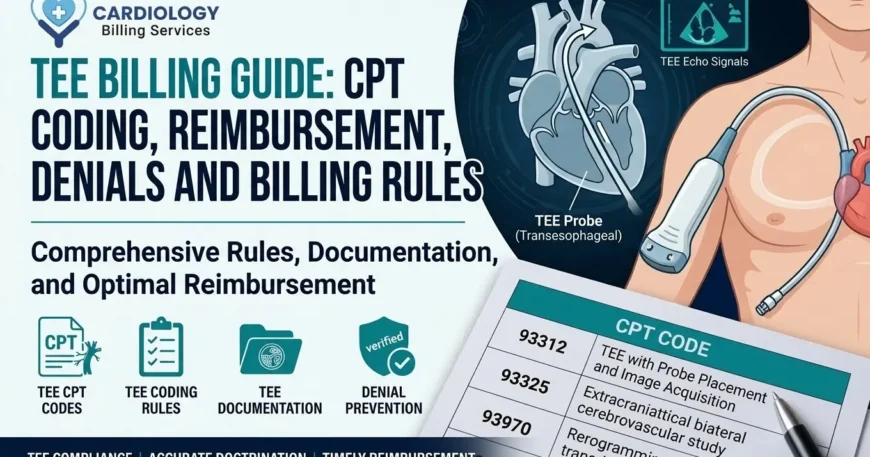
Transesophageal echocardiography (TEE) is an ultrasound study of the heart performed with a probe passed into the esophagus rather than placed on the chest wall. Because the transducer sits directly behind the heart, TEE produces sharper images of structures that a transthoracic echo (TTE) can struggle to visualize clearly, such as the left atrial appendage, the mitral valve apparatus and prosthetic valves. From a billing standpoint, the clinical detail matters only insofar as it drives code selection, medical necessity and documentation.
Why TEE has specific billing considerations
A transthoracic echo is usually one provider, one place of service, one code family. TEE fragments more easily. The probe may be placed by an anesthesiologist while a cardiologist acquires and interprets the images. The study may be purely diagnostic, or it may be guiding a transcatheter valve replacement in a hybrid OR. It may be done in a hospital that owns the equipment, which changes whether the practice can bill a technical component at all.
Each of those forks points to a different code, a different modifier, or a different billing party. The reported code has to reflect the service that was actually performed and documented, not a default that the practice bills for every TEE. That single principle prevents a large share of transesophageal echocardiography billing denials.
How Is TEE Coded?
TEE CPT coding is organized around three questions: Was the study diagnostic, monitoring, or guiding a structural intervention? Did one provider do the whole thing, or was the work split? Was the heart anatomy congenital or acquired? Answer those and the correct code usually falls out.
The diagnostic TEE code family
Standard diagnostic TEE for acquired (non-congenital) heart disease is reported with a small group of related CPT codes maintained by the American Medical Association (AMA):
CPT code | What it represents | Typical billing party |
93312 | Complete diagnostic TEE probe placement, image acquisition and interpretation/report performed by the same provider | Cardiologist performing the entire study |
93313 | Probe placement only | Provider who inserts the probe but does not interpret |
93314 | Image acquisition, interpretation and report only | Provider who reads the study but did not place the probe |
The split codes exist for the split-work scenario. When an anesthesiologist places the probe and a cardiologist acquires and interprets, 93313 goes to the provider who placed the probe and 93314 to the provider who performed the interpretation. When a single cardiologist does the placement, acquisition and report, that is the complete study and is reported with 93312 not 93313 and 93314 stacked together. Reporting the placement and interpretation codes side by side for the same provider on the same session is a coding error, not a way to capture more work.
For congenital cardiac anomalies, a parallel set applies regardless of the patient’s age: 93315 for the complete study, 93316 for placement only and 93317 for acquisition and interpretation only. ASE coding guidance is explicit that the congenital series is reserved for congenital indications, so using 93315 for a routine adult diagnostic TEE is a mismatch that can trigger review.
Monitoring TEE
When TEE is used to monitor a patient under anesthesia during surgery, the monitoring code (93318) describes that service. Medicare Administrative Contractor billing articles note that intraoperative monitoring TEE is treated as part of the anesthesia service, so the anesthesiologist providing anesthesia generally should not report it as a separate, separately paid TEE. This is a frequent source of confusion when the same physician is both administering anesthesia and manipulating the probe.
TEE for structural intervention guidance
TEE used to guide a transcatheter structural heart procedure TAVR, transcatheter mitral valve repair, left atrial appendage occlusion or closure, paravalvular leak repair and similar interventions is reported with 93355. This code was created because the diagnostic and monitoring TEE codes did not capture the intensity and intra-procedural decision-making of guiding a structural case. According to coding analysis published in the Journal of the American Society of Echocardiography, 93355 carries roughly double the physician work value of a standard diagnostic TEE, reflecting the substantial pre-, intra- and post-procedural work involved.
Two rules on 93355 cause most of the denials:
- It bundles almost everything. Doppler, color flow and 3D imaging performed as part of the structural guidance are included in 93355 and are not separately reportable. To report it, the provider generally must both place the probe and perform the interpretive study.
- It cannot be billed by the interventionalist or, in many cases, the anesthesiologist on the case. The imaging physician reporting 93355 should not be the one performing the structural intervention. National Correct Coding Initiative (NCCI) edits also bundle 93355 into the primary cardiac anesthesia service and that edit carries a modifier indicator that does not allow the two to be separated so an anesthesiologist providing anesthesia for the case has no compliant path to report 93355 on top of the anesthesia code.
Add-on Doppler and 3D services
For diagnostic (not structural-guidance) TEE, spectral and color Doppler are reported as add-on services alongside the base study: 93320 for complete Doppler, 93321 for a limited or follow-up Doppler study and 93325 for color flow mapping. Three-dimensional imaging has its own add-on reporting. When these add-ons are billed, MAC guidance instructs coders to use the same diagnosis code as the base TEE code they attach to. Remember that these are add-ons they are reported with a base echo code, never alone.
Verify the current-year code set
CPT is updated annually and echo codes have changed before. HCPCS equivalents also come into play in the outpatient facility setting; for example, when contrast is used, hospital outpatient (OPPS) and ambulatory surgery center billing may require the C-code counterparts to certain TEE codes. Confirm the exact descriptor, add-on relationships and any facility-specific HCPCS crosswalk in the current AMA CPT code set and your MAC’s active guidance before you build the charge. Do not bill from a code list carried over from a prior year.
Professional Component vs Technical Component
Most diagnostic TEE codes split into two parts. The professional component is the physician’s work interpreting the images and producing the report and is reported with modifier 26. The technical component is the equipment, supplies and technologist time, reported with modifier TC. When one entity performs and owns both, the code is billed globally with no component modifier.
The setting usually decides which applies. In a physician office that owns the echo equipment and employs the sonographer, the practice typically bills the global service. In a hospital where the facility owns the equipment and the cardiologist only reads the study, the physician reports the professional component with modifier 26 and the hospital bills the technical side. If an anesthesiologist performs a diagnostic TEE but does not own the equipment, coding guidance points to reporting the professional component only.
Modifier 26 is not a formality you add to every TEE to make a claim go through. It reflects a specific fact that you are billing interpretation only. Appending it when you actually performed and own the global service understates the claim; omitting it when you only read a hospital-owned study overstates it. Either way, the component has to match reality and the ownership of the resources.
ICD-10-CM Diagnosis Coding for TEE
A correctly chosen CPT code still fails if the diagnosis does not support it. ICD-10-CM coding, maintained through the CDC’s National Center for Health Statistics (NCHS) and CMS, is where medical necessity is expressed on the claim.
Matching diagnosis coding to documentation
The diagnosis codes on a TEE claim should come from the medical record and describe the clinical reason the study was ordered suspected endocarditis, a cardiac source of embolism, valvular disease, a mass and so on coded to the highest level of specificity the documentation supports. MAC billing articles give specific sequencing instructions for common TEE scenarios. When a TEE is performed because the transthoracic study could not adequately visualize the anatomy, the codes describing that inadequate visualization are sequenced first, with the underlying cardiac abnormality reported secondarily. When TEE is performed during an open-chest procedure, the encounter/examination codes are sequenced first, with the reason for surgery following.
Medical necessity considerations
CMS guidance is blunt on this point: correct use of an ICD-10-CM code does not by itself assure coverage. The service still has to be reasonable and necessary for the individual patient and meet the payer’s criteria. A diagnosis that appears on a Local Coverage Determination’s covered list supports the claim; it does not guarantee payment if the documentation does not show why the study was needed. Choosing a code purely because it is “on the list,” rather than because it reflects the patient’s condition, is exactly the pattern that surfaces in audits.
TEE Documentation Requirements
Documentation is what connects the code to the payment. For a defensible transesophageal echocardiography claim, the record generally should establish:
- The clinical indication and relevant history the specific reason the TEE was ordered
- The order itself and the medical decision-making behind it
- Procedure documentation, including probe placement and the structures examined
- The findings and a complete interpretation and written report
- Physician or qualified provider authentication and signature where required
- The date of service and the site where the study was performed
The report is the heart of the professional component. If you are billing 93314 or the professional side of 93312, the interpretation and report need to stand on their own as the physician’s work product. For structural guidance billed under 93355, the report should reflect the intra-procedural guidance, quantitative measurements and decision-making a monitoring-style note usually is not enough to support that higher-intensity code.
Keep the distinction between two kinds of documentation clear. Some documentation supports the service clinically. Other documentation is required by a specific payer or policy a signed order, a particular indication statement, prior imaging results. Both can matter on the same claim and a study can be clinically appropriate yet still denied for missing a payer-required element.
Modifier Considerations for TEE
Modifiers on a TEE claim describe circumstances; they are not tools for prying a payment loose. The ones that come up most:
- Modifier 26 / TC professional versus technical component, as described above.
- Modifier 25 a significant, separately identifiable evaluation and management (E/M) service by the same physician on the same day as the TEE, when that E/M is genuinely distinct from the procedure.
- Modifier 59 a distinct procedural service. This appears, for example, when an anesthesiologist performs a diagnostic TEE that is separate and independent from the anesthesia service. It should identify a true distinct service, not defeat an edit that reflects correct bundling.
- Modifier 76 / 77 a repeat procedure by the same physician (76) or by another physician (77). If a second TEE is performed later in the same encounter, or a different physician repeats the study, the repeat modifier documents that the duplicate is intentional and not a billing error.
The governing rule for all of them: the modifier has to be supported by the actual circumstances of the service and by current coding guidance. Adding a modifier solely to get around a denial, without a factual basis, is a compliance problem.
NCCI and Bundling
The National Correct Coding Initiative defines which code combinations Medicare (and most payers who adopt NCCI logic) consider bundled. For TEE, the edits that matter most include the structural-guidance bundling already discussed Doppler, color flow and 3D folded into 93355 and 93355 folded into the primary anesthesia service plus the internal logic of the diagnostic family, where the complete study (93312) already includes the work described by the placement and interpretation codes.
Two ideas keep bundling clean. First, when the work truly is a single comprehensive service, report the comprehensive code rather than its components. Second, an NCCI edit carries a modifier indicator that tells you whether a modifier may ever override it. Some edits allow an override with an appropriate modifier when the services really were distinct; others carry an indicator of “0,” meaning no modifier can unbundle them. Applying modifier 59 to an edit that does not permit it will not produce payment and can draw scrutiny. Check the indicator before you reach for a modifier.
Common TEE Billing and Coding Errors
Most denied transesophageal echocardiogram claims trace back to a short list of avoidable mistakes.
Billing mistake | Why it can cause a denial | Prevention |
Reporting placement (93313) and interpretation (93314) for the same provider who did the whole study | The complete study (93312) already includes both; the split is only for split-work | Confirm who did what before coding; use the complete code when one provider performs it all |
Using the congenital series (93315–93317) for an acquired-disease TEE | Congenital codes are reserved for congenital anomalies | Match the code series to the documented indication |
Appending modifier 26 when the practice owns the equipment and performed the global service | Understates the claim and misstates the component | Base component on who owns the equipment and what was performed |
Omitting modifier 26 when reading a hospital-owned study | Bills a global service the practice did not fully provide | Verify equipment ownership and site of service before billing |
Diagnosis that does not support medical necessity | Payer coverage policy is not met | Code the documented clinical reason to full specificity; check the applicable LCD/medical policy |
Reporting Doppler add-ons alone or without the base code | Add-on codes require a base echo service | Report add-ons only with their base code, using the same diagnosis |
Billing 93355 by the physician performing the intervention or the case anesthesiologist | Not compliant; NCCI edits bundle it into anesthesia | Report 93355 only for an imaging physician not doing the intervention or anesthesia |
Missing prior authorization where the payer requires it | Service not authorized | Verify auth requirements and obtain/track auth before the study |
Eligibility not verified | Coverage inactive or patient not eligible | Run eligibility before the date of service |
Wrong payer or wrong plan on the claim | Claim routed to a plan that does not cover the patient | Confirm active plan and coordination of benefits at check-in |
Incorrect units or duplicate submission | Payer flags overbilling or a duplicate | Reconcile units to the documentation; track submissions to avoid true duplicates |
Filing after the deadline | Claim past timely filing | Track submission dates against each payer’s filing limit |
Common TEE Claim Denials
The same errors show up on remittance advice under a handful of recurring denial themes. What follows are the categories, not a promise that every payer treats them identically.
Medical necessity denials occur when the diagnosis or documentation does not establish that the TEE was reasonable and necessary under the payer’s policy. These are the most common and often the most appealable, because the supporting clinical detail is usually in the record even when it was not captured on the claim.
CPT coding denials come from a code that does not match the service a complete code where components were appropriate, a congenital code on an acquired study, or a structural-guidance code billed by the wrong provider.
Diagnosis (ICD-10-CM) denials arise from a nonspecific code, a code that is not on the payer’s covered list, or incorrect sequencing relative to MAC instructions.
Modifier denials result from a missing 26 when only the professional component was performed, an unsupported 59, or a repeat study without a 76/77 to explain the duplication.
Documentation denials follow when the report, order, signature, or indication is missing or insufficient the clinical work happened but was not adequately recorded.
Prior authorization denials occur when required authorization was missing, expired, or issued for a different service or provider.
Eligibility and coverage denials stem from inactive coverage, the wrong plan, benefit limits, or a non-covered service.
NCCI and bundling denials appear when a component was reported that the payer considers included in another code, or a modifier was used on an edit that does not allow one.
Duplicate claim denials flag a claim the payer reads as already submitted sometimes a true duplicate, sometimes a corrected claim that was not submitted as a correction.
Timely filing denials simply mean the claim arrived after the deadline.
Provider enrollment denials result from an NPI, taxonomy, or enrollment problem with the billing or rendering provider.
Prior authorization is not medical necessity
These two get conflated constantly. Prior authorization is the payer’s advance permission to perform a service; medical necessity is whether the service was clinically justified and adequately documented. Obtaining authorization does not guarantee the claim will pay the study still has to be documented as necessary and coded correctly. Conversely, a perfectly necessary study can be denied for no authorization. Track authorization requirements per payer, match the authorization to the exact service and provider and confirm it has not expired before the date of service.
Eligibility and coverage
Eligibility problems are among the cheapest denials to prevent, because verification happens before the study. Confirm active coverage, the correct plan, network status, coordination of benefits when more than one payer is involved and any benefit limitations or non-covered indications. A study billed to a terminated plan or the wrong payer will not pay no matter how clean the coding is.
Timely filing
Every payer sets its own filing deadline and they are not the same. Medicare fee-for-service generally requires claims within one calendar year of the date of service; commercial plans may allow more or considerably less. Do not assume one deadline applies across your payer mix and track submission dates so a coding or authorization delay does not quietly push a claim past its limit.
Duplicate claims
Duplicate denials often are not duplicates at all they are corrected claims submitted as if they were new. When you resubmit to fix an error, follow the payer’s process for a corrected claim (the appropriate resubmission or claim frequency indicator and reference to the original) rather than sending a fresh claim. That distinction is how billing teams separate a legitimate correction from actual duplicate billing and it keeps the payer from rejecting the fix.
Provider enrollment and credentialing
Claims can be clinically and technically perfect and still deny over provider data. The billing and rendering provider’s NPI, taxonomy, enrollment status and participation with the specific payer all have to be correct and active. A cardiologist who is not yet enrolled with a plan, or whose taxonomy does not align with the service, can generate denials that look like coding problems but are really enrollment problems.
TEE Billing vs Other Echocardiography Services
TEE does not share codes, documentation expectations, or coverage rules with the other echo studies a cardiology practice performs. The reported code must reflect the actual study.
TEE vs transthoracic echocardiography (TTE). TTE is imaged through the chest wall and reported with the transthoracic echo code family (commonly 93306, 93307 and 93308, depending on whether Doppler and color flow are included). TEE uses the esophageal-probe codes discussed above. They are different services with different work and one cannot substitute for the other on a claim. Practices that also bill transthoracic studies can find a fuller treatment of that family in the echocardiography billing guide.
TEE vs stress echocardiography. Stress echo evaluates cardiac function under exercise or pharmacologic stress and is reported with its own codes (such as 93350 and 93351), with documentation centered on the stress protocol, the imaging at rest and stress and supervision. It has little in common with TEE from a coding standpoint. Our stress test billing guide covers that service in detail.
The takeaway for coders is not the specific numbers but the discipline: verify the current descriptor for whichever echo service was actually performed and never carry a code family from one study type to another.
How to Prevent TEE Billing Denials
Prevention is cheaper than appeal and TEE denials are largely preventable at four points in the workflow.
Before the TEE. Verify eligibility and benefits, confirm network status, check whether the payer requires a referral or prior authorization and obtain and record any authorization tied to the exact service and provider. This is where eligibility and prior authorization steps built into cardiology medical billing prevent the denials that are hardest to recover later.
During the service. Capture the indication, the order, procedure documentation, the findings and a complete interpretation and report. The record made in real time is what supports the code and any appeal.
During coding. Select the CPT code that matches who did what and whether the study was diagnostic, monitoring, or structural guidance; code the diagnosis to full specificity; apply the correct professional or technical component; add only supported modifiers; confirm units; and clear NCCI edits. Practices without a dedicated coder often route this to cardiology medical coding support precisely because the component and bundling logic is where errors concentrate.
Before claim submission. Validate demographics and payer information, match the authorization to the claim, run coding edits, confirm provider data and place of service and scrub for the duplicate and unit errors that generate automatic denials.
After submission. Track the claim, monitor for rejections and denials, work accounts receivable, appeal where appropriate, post payments accurately and record the root cause of every denial so the same one does not recur.
How to Handle a Denied TEE Claim
Resubmitting a denied claim unchanged usually produces the same denial. A structured workflow gets to the actual cause:
- Identify the denial and pull the claim.
- Read the denial code and message carefully it points to the category.
- Review the original TEE claim as submitted.
- Verify the CPT code against what was actually performed and documented.
- Review the ICD-10-CM diagnosis coding and sequencing.
- Check the medical record for the indication, report and signature.
- Review authorization and eligibility information.
- Check the payer’s coverage policy or the applicable LCD.
- Identify the root cause rather than the symptom.
- Decide whether the fix is a corrected claim or an appeal.
- Correct the claim information when correction is appropriate.
- Assemble the supporting documentation.
- Submit the correction or appeal by the payer’s method and deadline.
- Track the response.
- Post the payment or adjustment accurately.
- Log the root cause so the pattern can be addressed.
That last step is what separates one-off recovery from real improvement. High denial volume across a payer or a code is a workflow signal and denial management that traces each denial to a root cause is what keeps the same error from repeating on the next batch of claims.
How to Appeal a TEE Claim Denial
An appeal is an argument backed by evidence, not a resubmission. To build one that has a chance:
- Read the denial reason and determine whether it is even correctable by appeal.
- Review the payer’s policy for the service.
- Compare the claim line by line against the documentation.
- Verify the CPT and ICD-10-CM coding and the modifiers used.
- Confirm authorization information where the denial is authorization-related.
- Locate the documentation that supports medical necessity.
- Gather the relevant records.
- Write a concise argument that ties the documentation to the payer’s own coverage criteria.
- Include the supporting documentation.
- Submit by the payer’s required method and within its deadline.
- Track the outcome.
Appeal rights, methods and deadlines vary by payer and by denial type. A medical necessity denial and a timely filing denial are not appealed the same way and a commercial plan’s internal appeal levels differ from Medicare’s process. Confirm the specific requirements before you file.
Documentation Needed for a TEE Claim Appeal
Which documents matter depends on why the claim denied not every appeal needs every item. Depending on the denial, an appeal may draw on the claim information and remittance advice, the medical records, the TEE procedure report, physician documentation and diagnostic findings, authorization or referral information, the coding rationale, the applicable payer policy and the specific documentation that establishes medical necessity. For a medical necessity denial, the report and indication carry the argument. For an authorization denial, the authorization record and its match to the service are the point. Send what actually rebuts the stated reason.
Medicare Considerations for TEE Billing
Medicare coverage for TEE is shaped substantially at the Medicare Administrative Contractor level. Rather than a single national rule for most indications, MACs publish Local Coverage Determinations and companion billing and coding articles that list covered diagnoses, sequencing instructions and documentation expectations for transesophageal echocardiography. Several MACs maintain active TEE articles that specify which ICD-10-CM codes support medical necessity for the diagnostic codes and how to sequence them in common scenarios.
Key Medicare points for TEE:
- NCCI edits apply, including the structural-guidance and anesthesia bundling already covered.
- The monitoring code is treated as part of the anesthesia service and is not separately paid to the anesthesiologist providing anesthesia.
- Correct diagnosis coding is necessary but not sufficient the service must still be reasonable and necessary and documented as such.
- In the hospital outpatient and ASC setting, HCPCS C-code counterparts may apply when contrast is used, which is an OPPS/facility consideration distinct from physician billing.
- LCD content varies by MAC and can be updated, so the article that governs a claim depends on the contractor for the service area and the date of service.
Because these determinations are local and change, verify the current LCD and billing article for your MAC rather than assuming one contractor’s policy applies everywhere. National and local coverage can both come into play depending on the indication.
Commercial Payer Considerations
Commercial payers do not have to follow Medicare and many maintain their own medical policies for cardiac imaging. Where they commonly differ:
- Prior authorization. Many commercial plans require authorization for TEE or for the structural procedures TEE guides; some route imaging through a radiology or cardiology benefit manager with its own criteria.
- Referral requirements. Some plans require a referral that Medicare would not.
- Medical policy and medical necessity criteria. A payer’s covered indications may be narrower or broader than a Medicare LCD.
- Network participation. Out-of-network status changes coverage and payment entirely.
- Timely filing, corrected claims and appeal deadlines. These are payer-specific and often shorter than Medicare’s.
- Documentation. A plan may require specific elements prior TTE results, a particular indication statement as a condition of payment.
Do not treat a commercial claim as a Medicare claim with a different address. Confirm the individual insurer’s current policy for the service.
Medicare vs commercial payer: where TEE billing differs
Area | Medicare | Commercial payer |
Coverage source | LCDs and MAC billing/coding articles, plus any applicable NCDs | Insurer-specific medical policies; may vary by plan |
Medical necessity | Reasonable-and-necessary standard defined by MAC policy | Plan’s own criteria; may be narrower or broader |
Prior authorization | Generally not required for diagnostic TEE itself; applies to some services | Frequently required; may use a benefit manager |
Documentation | MAC-specified indications, sequencing, signature | Plan-specific; may require prior imaging or specific statements |
NCCI/bundling | NCCI applies | Often adopts NCCI logic; may add proprietary edits |
Timely filing | Generally one calendar year | Payer-specific; often shorter |
Appeals | Defined Medicare appeal levels | Plan-specific internal (and sometimes external) levels |
Provider participation | Medicare enrollment required | Plan-specific credentialing and contracting |
Commercial rules vary by insurer and plan and should be verified with the specific payer for the specific patient.
How to Analyze TEE Denial Trends
A single denial is a claim to fix. A pattern of denials is a process to fix. Root-cause analysis means capturing enough detail on each denied TEE claim to see the pattern: the denial reason, the payer, the CPT code, the ICD-10-CM code, the rendering provider, the location, the procedure type, the date of service, the dollar amount, the frequency, the authorization status and the appeal outcome.
Sorting on those fields turns anecdotes into signals. If several TEE claims from the same payer deny for missing authorization, the problem is probably an authorization workflow gap, not a coding gap and fixing the coding will not help. If denials cluster on one provider, the issue may be enrollment or documentation for that provider. If a specific diagnosis-to-CPT combination keeps failing at one plan, the plan’s medical policy may not cover that indication. The categorization is what tells you whether to retrain a front-desk workflow, correct a coding habit, or challenge a payer policy.
TEE Denial Metrics to Track
A few metrics make TEE denial performance visible. Define the denominator clearly, because organizations calculate these differently.
- Denial rate = denied claims ÷ applicable adjudicated claims × 100. Whether the denominator is all adjudicated claims or only clean submitted claims changes the number, so state it.
- Denied TEE claim volume the count of denied transesophageal echocardiography claims in a period.
- Denied dollar value the billed or expected dollars tied to those denials.
- Top denial reasons the categories driving the most denials, ranked.
- Payer-specific denial rate denial rate broken out by payer, to isolate where the problem sits.
- Coding-related, authorization-related and medical necessity denial shares the mix by cause.
- Appeal overturn rate the share of appealed denials that are reversed.
- Days to resolution how long denied claims take to close.
- Recurring denial categories the causes that keep reappearing after they were supposedly fixed.
Track these over time rather than as one-off snapshots. Benchmarks vary widely by practice, payer mix and how each metric is defined, so measure your own trend rather than chasing a generic industry number.
Realistic TEE Billing Scenarios
The following are hypothetical illustrations, not real patient cases and are meant to show how the coding logic plays out.
Split-work diagnostic TEE. An anesthesiologist places the probe and a cardiologist acquires and interprets the images for a diagnostic study. Potential problem: billing 93312 (complete) for one of them when the work was split. Review: confirm who performed each part. Prevention: report 93313 for placement and 93314 for the interpretation/report, to the appropriate providers.
Unsupported modifier 26. A practice that owns its echo equipment and performs the full study appends modifier 26 out of habit. Potential problem: the component does not match the global service performed. Review: check equipment ownership and what was actually done. Prevention: bill the global service with no component modifier when the practice performs and owns both parts.
Congenital code on an acquired study. A routine adult diagnostic TEE is coded 93315. Potential problem: the congenital series was used for a non-congenital indication. Review: the documented indication. Prevention: use the acquired-disease series (93312/93313/93314) unless the study evaluates a congenital anomaly.
Diagnosis that does not support necessity. A TEE is billed with a vague or noncovered diagnosis. Potential problem: the payer’s medical necessity criteria are not met. Review: the record for the true clinical reason and the applicable LCD or medical policy. Prevention: code the documented indication to full specificity and sequence per MAC guidance.
Structural guidance billed by the wrong provider. The interventionalist performing a TAVR also reports 93355 for the guiding TEE. Potential problem: 93355 should be reported by an imaging physician who is not performing the intervention and is bundled into anesthesia when the anesthesiologist provides it. Review: who performed the imaging versus the intervention and anesthesia. Prevention: report 93355 only for a qualifying independent imaging physician.
Add-on Doppler without a base. Color flow (93325) is submitted without a base echo code. Potential problem: add-on codes cannot stand alone. Review: whether a base study was performed and coded. Prevention: report add-ons only with their base code, using the same diagnosis.
Missing authorization. A commercial plan required authorization that was never obtained. Potential problem: the service was not authorized. Review: the plan’s authorization requirement and any authorization on file. Prevention: verify and obtain authorization tied to the exact service and provider before the study.
Duplicate versus corrected claim. A biller resubmits a denied claim to fix a diagnosis and it denies as a duplicate. Potential problem: the correction was sent as a new claim. Review: the payer’s corrected-claim process. Prevention: resubmit with the correct claim frequency indicator and reference to the original.
How Professional Cardiology Billing Services Can Help
TEE creates work that generalist billing setups tend to underestimate. The component and split-work logic invites coding errors, structural-guidance rules are easy to get wrong, authorization requirements vary by payer and denials once they start take time to appeal correctly and even more time to prevent at the source. For a practice running a meaningful TEE volume alongside catheterizations, device work and imaging, the administrative load is real.
A cardiology-focused billing partner helps mainly by concentrating that specialized knowledge in one place: coders who know the difference between 93312, 93314 and 93355 and when each applies; eligibility and authorization checks handled before the study; claim scrubbing that catches component and bundling errors before submission; and denial management that treats recurring denials as workflow problems to fix rather than claims to keep reworking. Practices dealing with structural heart volume can find that context in structural heart disease billing support and broader cardiac imaging billing, while the end-to-end side charge capture through payment posting and accounts receivable follow-up runs through cardiology revenue cycle management.
Support like this does not guarantee a specific payment or a specific denial rate; no honest billing operation can promise that. What it does is reduce the preventable errors and give a practice a clearer view of where its TEE revenue actually stands.
Frequently Asked Questions
What is TEE billing? TEE billing is the process of coding and submitting a claim for a transesophageal echocardiogram selecting the CPT code that matches the service performed, attaching a diagnosis that supports medical necessity, applying the correct professional or technical component, clearing bundling edits and filing per the payer’s rules.
What is the CPT code for TEE? There is no single code. Diagnostic TEE for acquired disease uses 93312 (complete), 93313 (probe placement only), or 93314 (acquisition and interpretation only); congenital studies use 93315–93317; monitoring uses 93318; and TEE guiding a structural intervention uses 93355. Confirm the current descriptor in the AMA CPT code set before billing.
How is transesophageal echocardiography billed? By matching the code to who performed which part of the study and why it was done, adding Doppler or 3D add-ons where separately reportable, applying modifier 26 or TC based on equipment ownership and site, supporting the claim with a specific diagnosis and complete report and submitting within the payer’s requirements.
What is the difference between the professional and technical components of TEE? The professional component (modifier 26) is the physician’s interpretation and report. The technical component (modifier TC) is the equipment, supplies and technologist time. When one entity performs and owns both, the study is billed globally with no component modifier.
When is modifier 26 used for TEE? When the physician performs only the interpretation and does not own the equipment typically reading a hospital-owned study. It should not be appended when the practice owns the equipment and performs the complete global service.
What diagnosis codes support TEE medical necessity? The codes that describe the documented clinical reason for the study, coded to full specificity. MAC billing articles list covered diagnoses and specific sequencing for example, when TEE follows inadequate TTE visualization, or is performed during an open-chest procedure. A covered diagnosis supports the claim but does not by itself guarantee payment.
Can a TEE claim be denied for lack of medical necessity? Yes. If the diagnosis or documentation does not establish that the study was reasonable and necessary under the payer’s policy, the claim can deny even when a covered diagnosis appears on the claim because coverage depends on the documented clinical justification.
Does TEE require prior authorization? It depends on the payer. Medicare generally does not require authorization for the diagnostic study itself, while many commercial plans do, sometimes through a benefit manager. Verify each payer’s requirement and remember that authorization is not the same as medical necessity.
What documentation is required for TEE billing? Generally the indication and relevant history, the order, procedure documentation, the findings, a complete interpretation and report, provider signature where required and the date and site of service. Structural-guidance claims (93355) need documentation reflecting the intra-procedural guidance and measurements.
What are the most common TEE billing errors? Reporting split-work codes for a single-provider complete study, using congenital codes on acquired studies, misapplying modifier 26, weak or noncovered diagnoses, billing add-ons without a base code, reporting 93355 by the wrong provider and missing authorization or eligibility checks.
How can cardiology practices prevent TEE claim denials? Verify eligibility and authorization before the study, document the indication and report completely, code the component and diagnosis correctly, clear NCCI edits, scrub claims before submission and analyze denials by root cause so the same error does not recur.
How do you appeal a TEE claim denial? Read the denial reason, confirm it is correctable, compare the claim against the documentation and payer policy, verify coding and modifiers, gather the records that rebut the stated reason, write a concise argument tied to the payer’s criteria and submit by the payer’s method and deadline.
How does Medicare handle TEE billing? Largely through Medicare Administrative Contractor Local Coverage Determinations and billing articles that define covered diagnoses, sequencing and documentation, with NCCI edits applied and the monitoring code treated as part of anesthesia. Policy varies by MAC and date of service.
Do commercial insurers use the same TEE billing rules as Medicare? Not necessarily. Commercial payers maintain their own medical policies, authorization and referral rules, timely filing limits and appeal processes, which can differ from Medicare. Verify the specific insurer’s current policy.
How can professional cardiology billing services help with TEE claims? By concentrating cardiology-specific coding knowledge, handling eligibility and authorization before the study, scrubbing claims for component and bundling errors and managing denials by root cause reducing preventable errors, though without guaranteeing a specific payment result.
Key Takeaways
- TEE has no single CPT code; the correct code depends on whether the study was diagnostic, monitoring, or structural guidance, whether the work was split and whether the anatomy was congenital or acquired.
- Report the complete study (93312) when one provider does everything; use the placement (93313) and interpretation (93314) codes only for split work.
- Modifier 26 versus TC follows equipment ownership and site of service it is not a formality added to every claim.
- Code 93355 for structural guidance bundles Doppler, color and 3D, must be reported by an imaging physician who is not performing the intervention and is bundled into anesthesia when the anesthesiologist provides it.
- A covered diagnosis supports but does not guarantee payment; medical necessity still has to be documented.
- Prior authorization and medical necessity are different requirements and one does not substitute for the other.
- Medicare TEE rules are largely set by MAC Local Coverage Determinations and commercial payer rules vary verify both for the specific claim.
- Analyze denials by root cause; recurring TEE denials usually point to a workflow problem, not a one-off mistake.
Conclusion
Transesophageal echocardiography rewards precise coding and punishes shortcuts. The claim that pays on the first pass is the one where the code reflects exactly who performed which part of the study, the component matches the equipment and setting, the diagnosis carries genuine medical necessity from the record and the authorization and filing rules of that specific payer were followed. None of that is exotic, but it does require attention to detail that shifts with every payer, provider role and date of service. Verify current CPT and ICD-10-CM guidance, confirm your MAC’s coverage article and each commercial plan’s policy and treat every denial as information about where the process can be tightened.