

Peripheral Angiography Coding: CPT Codes, Modifiers, and Billing Guide

Peripheral angiography coding trips up experienced coders for one reason: a single procedure is reported with two separate code families, and each follows its own logic. One family describes where the catheter went. The other describes what the physician imaged and interpreted. Add a same-day intervention and a third set of rules applies, and those rules were rewritten on January 1, 2026.
This guide covers catheter-based diagnostic angiography of the abdominal aorta and extremities, the modifiers that payers expect, and the documentation that supports each code.
How component coding works
Catheter-based peripheral angiograms use component coding. The surgical component (catheter placement) comes from the 36000 series. The radiological supervision and interpretation (S&I) component comes from the 75000 series. A complete claim normally carries at least one code from each.
CT and MR angiography sit outside this system. A CT angiogram of the abdominal aorta with bilateral iliofemoral runoff is 75635, a CTA of one lower extremity is 73706, and an MRA of a lower extremity is 73725. None of these is reported with catheter codes.
Catheter placement codes
Catheter coding is based on the final catheter position, counted from the access site. Vessels the catheter passes through on the way are not coded.
- 36140: introduction of needle or intracatheter, upper or lower extremity artery
- 36200: catheter introduced into the aorta (nonselective)
- 36245: selective placement, first-order abdominal, pelvic, or lower extremity branch
- 36246: initial second-order branch
- 36247: initial third-order or more selective branch
- +36248: each additional second-order, third-order, and beyond branch within the same vascular family
A catheter resting in the aorta is nonselective regardless of how many injections are made from it. Selective coding begins only when the catheter is steered out of the aorta, or out of the punctured vessel, into a branch.
Counting vessel order from the access site
Take the most common approach: retrograde puncture of the right common femoral artery, with the catheter taken up and over the aortic bifurcation into the left leg. The left common iliac is first order (36245). The left external iliac and common femoral are second order (36246). The superficial femoral, profunda, popliteal, and tibial arteries are third order or beyond (36247).
Each vascular family is coded to its highest order reached. Because order is counted from the puncture, an ipsilateral antegrade stick changes the count entirely, so the operative note has to state the access vessel and direction. Upper extremity studies use the thoracic and brachiocephalic catheter family (36215 to 36218) with the same extremity imaging codes.
A nonselective code is not reported with a selective code from the same access. Two punctures are different: selective work from one groin and a nonselective sheath injection from the other can both be coded, one from 36245 to 36247 and 36140.
Imaging codes: where the catheter sits decides the code
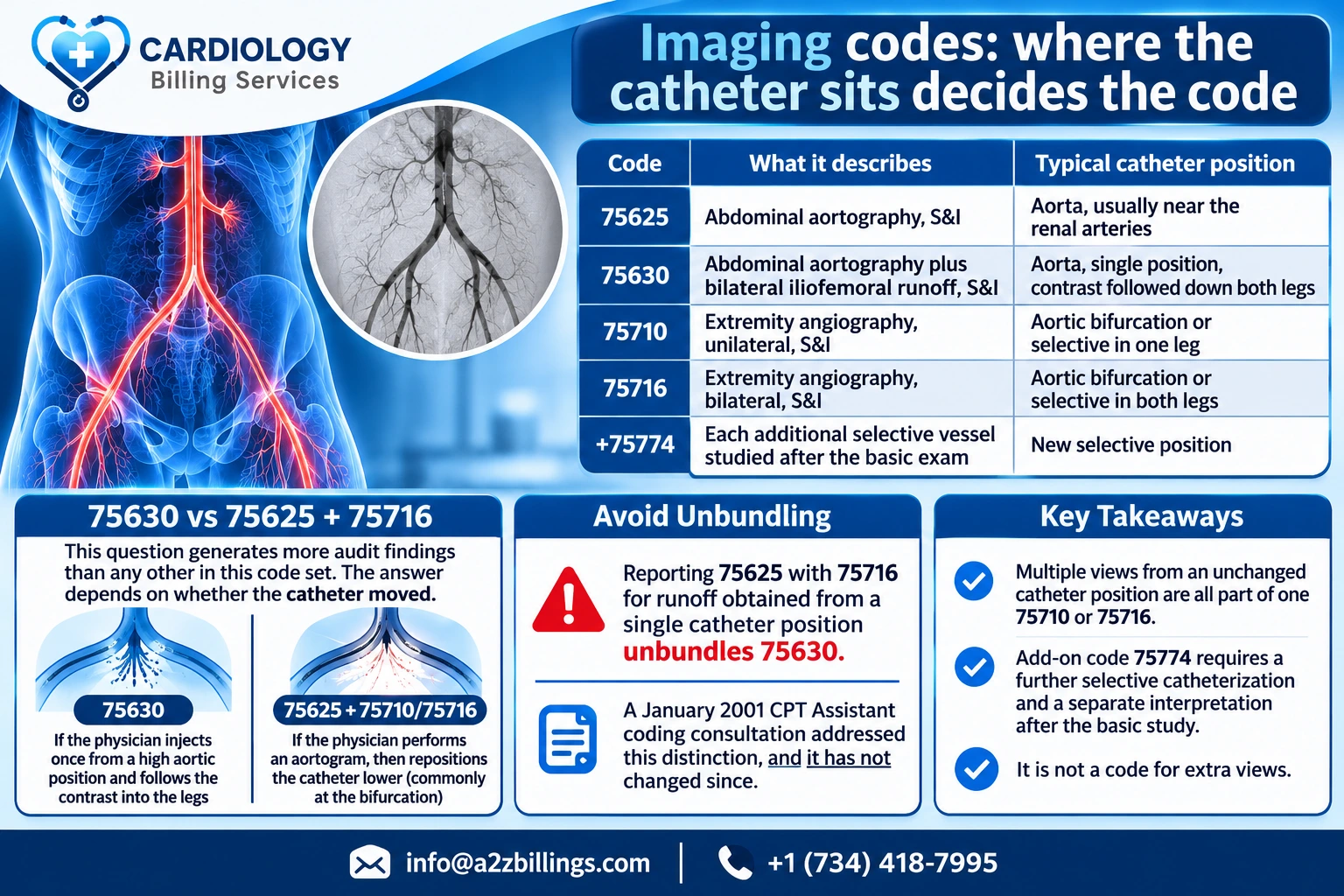
| Code | What it describes | Typical catheter position |
|---|---|---|
| 75625 | Abdominal aortography, S&I | Aorta, usually near the renal arteries |
| 75630 | Abdominal aortography plus bilateral iliofemoral runoff, S&I | Aorta, single position, contrast followed down both legs |
| 75710 | Extremity angiography, unilateral, S&I | Aortic bifurcation or selective in one leg |
| 75716 | Extremity angiography, bilateral, S&I | Aortic bifurcation or selective in both legs |
| +75774 | Each additional selective vessel studied after the basic exam | New selective position |
The 75630 versus 75625 plus 75716 question generates more audit findings than any other in this code set. The answer depends on whether the catheter moved. If the physician injects once from a high aortic position and follows the contrast into the legs, the claim is 75630. If the physician performs an aortogram, then repositions the catheter lower (commonly at the bifurcation) and runs a separate extremity study, the claim is 75625 with 75710 or 75716.
Reporting 75625 with 75716 for runoff obtained from a single catheter position unbundles 75630. A January 2001 CPT Assistant coding consultation addressed this distinction, and it has not changed since. Multiple views from an unchanged catheter position are all part of one 75710 or 75716.
Add-on code 75774 requires a further selective catheterization and a separate interpretation after the basic study. It is not a code for extra views.
Modifiers that apply
26 and TC
S&I codes split into professional and technical components. A physician working in a hospital reports the imaging codes with modifier 26, and the facility bills the technical portion. An office-based lab that owns its equipment bills globally with no modifier. Catheter placement codes have no component split, so 26 never belongs on 36245.
RT and LT
These identify the side on unilateral code 75710. Code 75716 is bilateral by definition and takes no modifier 50.
59 and XU
These identify a diagnostic angiogram as distinct from an intervention performed in the same session. The CMS MLN fact sheet “Proper Use of Modifiers 59, XE, XP, XS, and XU” (MLN1783722, February 2024) instructs providers to choose the more specific X modifier whenever one fits and to use 59 only when none does.
52
The NCCI Policy Manual, Chapter 5, states that if only a portion of a diagnostic angiogram needs repeating, modifier 52 is appended along with 59 or XU.
Policies on a second selective catheter code for the opposite leg differ by payer. Some want 59 or XS, others accept RT and LT. Check the payer’s policy before the first claim goes out.
Diagnostic angiography on the same day as an intervention
Imaging used to guide an angioplasty or stent is included in the intervention. A true diagnostic study is separately reportable only when CPT’s criteria are met:
- No prior catheter-based angiographic study is available, a full diagnostic study is performed, and the decision to intervene is based on it; or
- A prior study exists, but the record documents that the patient’s condition has changed, that the earlier study visualized the anatomy inadequately, or that a clinical change during the procedure required evaluation outside the target area.
Medicare applies a stricter reading. ICD10monitor’s 2026 analysis of the new revascularization codes points out that under the NCCI Policy Manual, a previous CT angiogram counts as a prior study as well. A patient who arrives with a complete, recent CTA and unchanged symptoms does not qualify for a separately billed catheter angiogram.
The physician’s note has to say that the decision to treat came from the diagnostic images. Coders cannot infer it.
What changed on January 1, 2026
The 2026 CPT code set contains 288 new codes, 84 deletions, and 46 revisions, according to Erin Stephens’ radiology coding update published by AuntMinnie. For peripheral vascular work, the largest change is the deletion of lower extremity revascularization codes 37220 to 37235, in use since 2011, and their replacement with 46 codes, 37254 to 37299.
Three changes affect anyone coding angiograms alongside interventions:
Four territories instead of three
Iliac, femoral and popliteal, tibial and peroneal, and a new inframalleolar territory.
Lesion complexity
CPT defines a straightforward lesion as a stenosis and a complex lesion as an occlusion, judged immediately before treatment. Stephanie Smith, RHIA, writing for the University of Texas Medical Branch faculty group practice newsletter on February 9, 2026, noted that operative notes must now state this explicitly.
Catheterization is bundled
Radiology Today’s 2026 coding update confirms that the new codes include catheterization of the treated vessel through the same access and all intraprocedural imaging guidance. Qualifying diagnostic angiograms, intravascular ultrasound (37252, 37253), and catheterization through a different puncture remain separately reportable.
One rule deserves attention because it converts an intended intervention into a diagnostic claim. If the wire never crosses the lesion, no revascularization code applies. RACmonitor’s January 2026 guidance gives the example of a failed attempt on an anterior tibial occlusion from contralateral access: report 36247 and 75710.
Three coding scenarios
Documentation checklist
A note that supports clean peripheral angiography coding states:
- ✓
Access site, side, and direction (retrograde or antegrade) - ✓
Final catheter position for every injection - ✓
Each vessel imaged and interpreted, with findings - ✓
Whether a prior catheter angiogram, CTA, or MRA exists, and why it was insufficient - ✓
For interventions: territory, vessel, stenosis or occlusion, and the therapy delivered
Medical necessity is carried by the diagnosis code. For atherosclerotic disease of native leg arteries, the ICD-10-CM I70.2 subcategory separates claudication (I70.21-), rest pain (I70.22-), ulceration (I70.23- to I70.25), and gangrene (I70.26-), and each requires laterality. An unspecified I73.9 on an angiogram claim invites a records request.
Final thoughts
Accurate peripheral angiography coding comes down to four documented facts: where the access was, where the catheter stopped, what was imaged from each position, and whether an earlier study already answered the clinical question. With the 2026 revascularization codes absorbing same-access catheterization, the diagnostic imaging line is often the only separately payable service besides the intervention, and it is paid only when the note proves the study was diagnostic.