

How to Increase Revenue in a Cardiology Practice Without Increasing Patient Volume

Adding visits is the slowest way for a cardiology group to grow its income. Schedules are booked weeks out, and every new slot needs a clinician, an exam room and support staff. A faster route exists. The practice can collect in full for work it already performs, and it can bill for clinical work that currently goes unbilled.
This guide explains how to increase revenue in a cardiology practice without increasing patient volume, based on the Medicare rules that take effect on January 1, 2027. It is written for physicians, practice managers, and medical billing and coding students who want to see where the money sits. Dollar amounts are national Medicare figures; local payments vary by geographic adjustment.
Why each visit will pay less in 2027
The Centers for Medicare & Medicaid Services (CMS) released the CY 2027 Physician Fee Schedule final rule on November 4, 2026. The conversion factor for clinicians who are not qualifying APM participants falls to $32.63, a 2.31% cut from $33.40. For qualifying participants in advanced alternative payment models, it falls 1.83% to $32.95. Most of the decline comes from the expiration of a one-year 2.5% increase that Congress enacted for 2026 in Public Law 119-21.
Cardiology was already absorbing a second cut. Starting in 2026, CMS applied a 2.5% "efficiency adjustment" to work RVUs and intraservice time for non-time-based services. Time-based services, including E/M visits and care management, were exempt, according to the National Rural Health Association's summary of the rule.
For revenue planning, that exemption tells you where to look. Imaging and procedural income took the reduction. The services covered in the next three sections did not.
Capture the visit complexity add-on (modifier B1 in 2027)
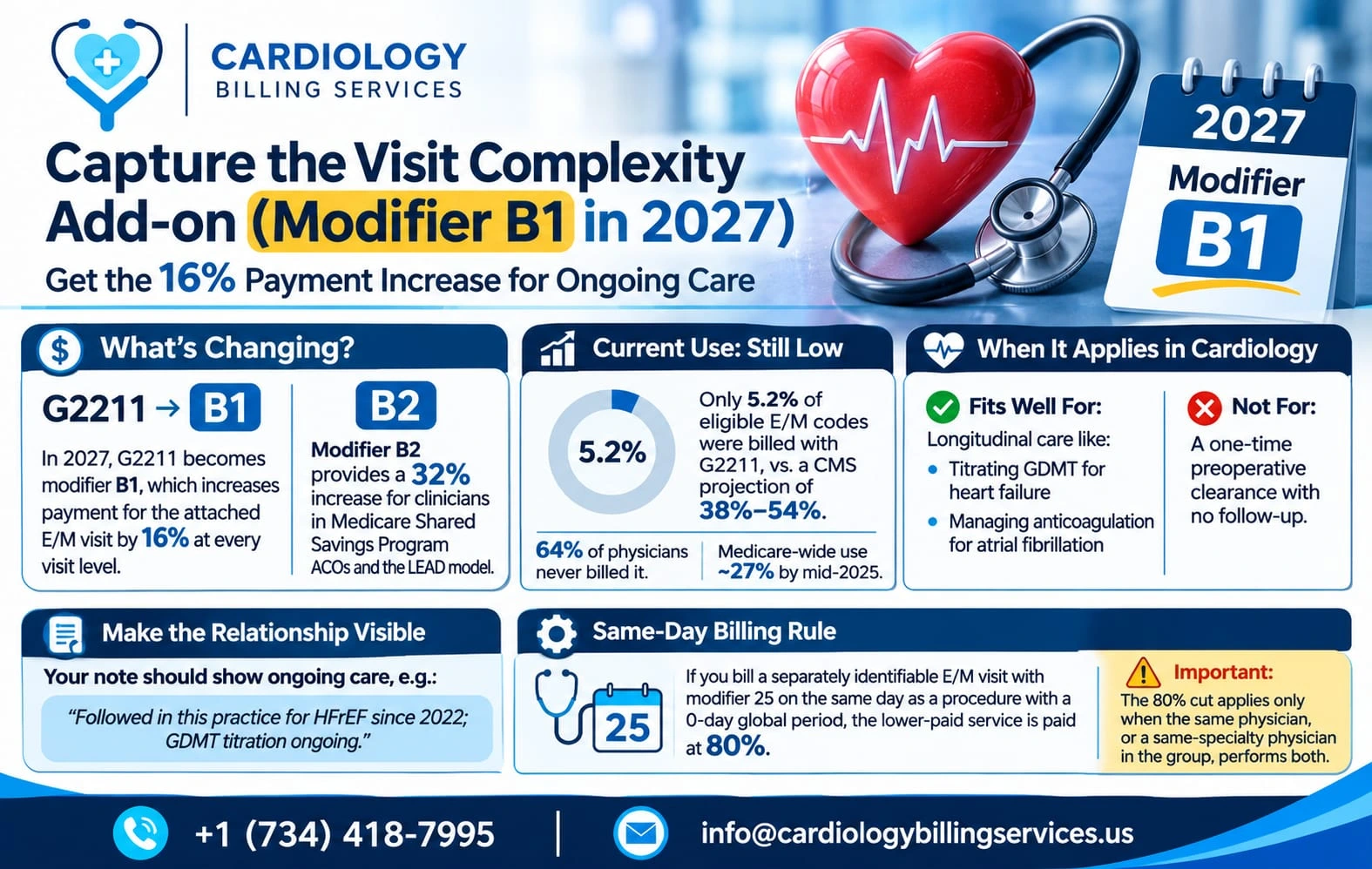
HCPCS code G2211 became payable on January 1, 2024. It pays roughly $16 nationally on top of an office or outpatient E/M visit when the clinician is the continuing focal point for a patient's care or for a serious or complex condition.
Many practices still skip it. ECG Management Consultants examined CPT data from more than 20,000 physicians in its 2025 Physician and APP Compensation Survey and found G2211 on only 5.2% of eligible E/M codes, against a CMS projection of 38% to 54%. Sixty-four percent of those physicians never billed it. A separate analysis reported by HealthDay put Medicare-wide use near 27% by mid-2025, which still leaves most eligible visits without the add-on.
The 2027 rule changes the mechanics. G2211 becomes modifier B1f, which raises payment for the attached E/M visit by 16% at every visit level. A second modifier, B2, raises it by 32% for clinicians in Medicare Shared Savings Program ACOs and the LEAD model.
General cardiology fits the definition well. A cardiologist who titrates guideline-directed therapy for a heart failure patient every few months, or manages anticoagulation for atrial fibrillation year after year, holds exactly the longitudinal relationship CMS describes. A one-time preoperative clearance with no follow-up does not. The note should make the relationship visible, for example: "Followed in this practice for HFrEF since 2022; GDMT titration ongoing."
Coders should also review same-day billing. Under the final rule, when a separately identifiable E/M visit is billed with modifier 25 on the same day as a procedure carrying a 0-day global period, the lower-paid service is paid at 80%. The cut applies when the same physician, or a same-specialty physician in the group, performs both. CMS had proposed a 50% reduction that would also have reached 10- and 90-day global procedures, and dropped both ideas. Many noninvasive cardiac tests, such as transthoracic echocardiography, carry an XXX global indicator rather than a 0-day global, so check each code's global period before assuming the reduction applies.
Bill for care delivered between visits
Heart failure patients generate phone calls, medication adjustments, lab reviews and coordination with primary care every month. Much of that time goes unbilled. Medicare's care management codes pay for it.
Principal care management (PCM) suits cardiology best, because it covers one high-risk condition rather than requiring two or more. Chronic care management (CCM) applies when the practice manages multiple chronic conditions.
| Code | Service | 2026 national (office) | 2027 national (office) |
|---|---|---|---|
| 99424 | PCM, first 30 min, physician/QHP time | $87.51 | $84.40 |
| 99490 | CCM, first 20 min, clinical staff time | $66.13 | $64.04 |
| 99491 | CCM, first 30 min, physician/QHP time | $89.18 | $86.04 |
Source: American Urological Association tables built from the CMS 2026 and 2027 final rules.
As an illustration of scale (not a case study): a practice that keeps 120 heart failure patients enrolled in 99424 for an average of 10 months a year would bill about $101,280 at the 2027 rate, before staff costs and denials. The arithmetic is 120 × 10 × $84.40.
These programs have conditions. The patient must give documented consent, and Part B coinsurance applies, so some patients will decline once they learn they owe a share each month. Time must be tracked against the code's threshold, and a practice cannot count the same minutes toward two services.
Use the 2026 remote monitoring codes
Until 2026, the device supply code 99454 required at least 16 days of readings in a 30-day period. Patients who sent 12 days of weights generated no device payment at all. The 2026 fee schedule added two codes:
- 99445: device supply for 2 to 15 days of readings, about $47 nationally, according to Prevounce Health's summary of the final rule.
- 99470: the first 10 minutes of treatment management in a month, about $26.
The older codes remain: 99454 for 16 to 30 days and 99457 for the first 20 minutes of management (about $52 in 2026). For a cardiology practice, the obvious uses are daily weights and blood pressure for heart failure patients and home blood pressure for resistant hypertension.
Two 2027 changes affect program design. Practitioners must now furnish a separately reportable initiating visit when RPM or remote therapeutic monitoring begins. CMS also finalized a requirement that RPM be performed by clinical staff employed by the practice rather than by contractors, but delayed it to January 1, 2029. Groups that rely on an outside monitoring vendor have two years to decide whether to bring the work in-house.
Device clinics deserve the same audit. Practices that follow pacemaker, ICD and implantable loop recorder patients should confirm that every scheduled remote transmission is billed under the remote interrogation codes (93294 through 93298) and not lost between the device portal and the billing system.
Recover money that is already earned
A denied claim is revenue the practice has already spent clinical time producing. Experian Health's fourth annual State of Claims survey, fielded August 5 to 23, 2026, with 204 revenue cycle respondents, found:
- 40% of respondents reported that 10% or more of their claims are denied, and 14% reported denial rates above 15%.
- "Services not covered" was the most-cited denial reason (53% placed it in their top three), the first time it ranked first since the survey began in 2022.
- Frequent payer policy changes followed at 31%, with coding errors and prior authorization tied at 25%.
- 86% resubmit denied claims at least half the time, yet only 30% recover 80% to 100% of denied revenue.
Those figures come from Todd Shryock's October 30, 2026 report in Medical Economics. In an April commentary for the same publication, Wael Khouli, M.D., a former health system chief medical officer, estimated that about 70% of appealed claims can be overturned, and attributed most missed appeals to lack of staff time and closed filing windows.
Cardiology denials cluster around prior authorization for nuclear stress tests, cardiac CT and cardiac MRI, plus medical necessity edits tied to diagnosis codes on echocardiograms. Three habits recover the most money: verify authorization before the test is scheduled, track denials by claim adjustment reason code so recurring causes get fixed at the front end, and keep a calendar of each payer's appeal deadline.
Close the cardiac rehabilitation gap
Cardiac rehabilitation is one of the most underused benefits Medicare covers. Matthew D. Ritchey of the CDC and colleagues, writing in Circulation: Cardiovascular Quality and Outcomes in January 2020, studied 366,103 eligible Medicare beneficiaries from 2016. Only 24.4% attended a single session, and 26.9% of those who started completed the program. A later analysis of 2017 Medicare claims found a participation rate of 28.6%. The Million Hearts Cardiac Rehabilitation Collaborative had set a goal of 70%.
Who collects the rehab payment depends on where the program runs. A hospital outpatient department bills the facility fee for hospital-based programs. A physician-directed program in an office setting bills under the fee schedule. Even without owning the program, a practice benefits from consistent referral at discharge, because rehab participants are the patients least likely to return through the emergency department, which brings us to the model that now scores cardiologists on exactly that.
Protect Part B income under the Ambulatory Specialty Model
The Ambulatory Specialty Model (ASM) is a mandatory CMS Innovation Center model that runs from January 1, 2027, through December 31, 2031. It applies to general cardiologists in selected geographic areas who have historically treated at least 20 Original Medicare beneficiaries with heart failure. Interventional cardiologists, electrophysiologists and advanced heart failure and transplant specialists are excluded, according to the American College of Cardiology (ACC).
About 2,600 cardiologists appear on the participant list. Performance on cost, quality and care coordination will adjust all Part B payments by up to plus or minus 9% in the first payment years, which begin in 2029. For a cardiologist with $500,000 in annual Part B allowed charges, that range is $45,000 in either direction.
The ACC reported that roughly 500 physicians on the list appear to be specialists who should have been excluded. Any practice with general cardiologists should check the list first. For those correctly included, the same tools described above (PCM, RPM, timely rehab referral) also lower avoidable heart failure admissions, which is what the model measures.
What the numbers add up to
A cardiology practice billing Medicare in 2027 will earn 2.31% less per RVU than in 2026, on top of the 2.5% efficiency cut to procedures. The levers that offset it involve no new patients: the 16% modifier B1 uplift on qualifying E/M visits, $84.40 per enrolled patient per month for PCM, RPM payments for patients who send fewer than 16 days of readings, and appeals for denials that 70% of surveyed organizations fail to fully recover. Starting in 2029, ASM scoring can move a general cardiologist's Part B income by 9% either way, and the work that improves that score is the same between-visit care that already pays.