

Holter Monitor Billing: CPT Codes, Documentation, Reimbursement & Denials

Holter monitor billing requires accurate CPT code selection, complete clinical documentation, and an understanding of how insurance companies reimburse ambulatory electrocardiographic monitoring. Although Holter monitoring is a routine diagnostic service in cardiology, billing errors can occur when providers report incorrect monitoring durations, duplicate service components, or submit claims without sufficient evidence of medical necessity.
A Holter monitor continuously records the heart's electrical activity while a patient performs normal daily activities. Physicians use these recordings to investigate suspected arrhythmias, unexplained palpitations, dizziness, syncope, and other symptoms potentially associated with abnormal cardiac rhythms.
For medical billers and coders, the principal distinction involves the monitoring duration and the responsibilities of each organization participating in the service. Traditional Holter monitoring generally uses CPT codes 93224 through 93227, while longer continuous recordings require different codes.
This guide explains Holter monitor CPT codes, billing requirements, Medicare reimbursement, documentation standards, and common claim denials, with practical examples based on current coding and coverage guidance.
What is Holter monitoring in cardiology?
Holter monitoring is a noninvasive diagnostic procedure that records electrocardiographic activity continuously over a prescribed period, traditionally 24 to 48 hours.
Unlike a standard resting electrocardiogram, which captures a short recording of the heart's electrical activity, a Holter monitor collects information during normal activities, sleep, exercise, and periods when symptoms occur.
Patients generally wear a portable recording device connected to electrodes or another compatible continuous recording system. The collected information is subsequently analyzed to identify abnormal heart rhythms, changes in heart rate, and possible relationships between reported symptoms and electrocardiographic findings.
Physicians may order Holter monitoring to investigate suspected atrial fibrillation, premature ventricular contractions, intermittent bradycardia, or other rhythm disturbances.
The 2017 expert consensus statement from the International Society for Holter and Noninvasive Electrocardiology and the Heart Rhythm Society recommends 24- to 48-hour Holter monitoring when symptomatic events are expected to occur within that recording period.
Patients experiencing symptoms less frequently may require extended ambulatory monitoring.
This distinction is relevant to billing because the clinical purpose and actual monitoring period determine which CPT code family applies.
Holter monitor billing CPT codes
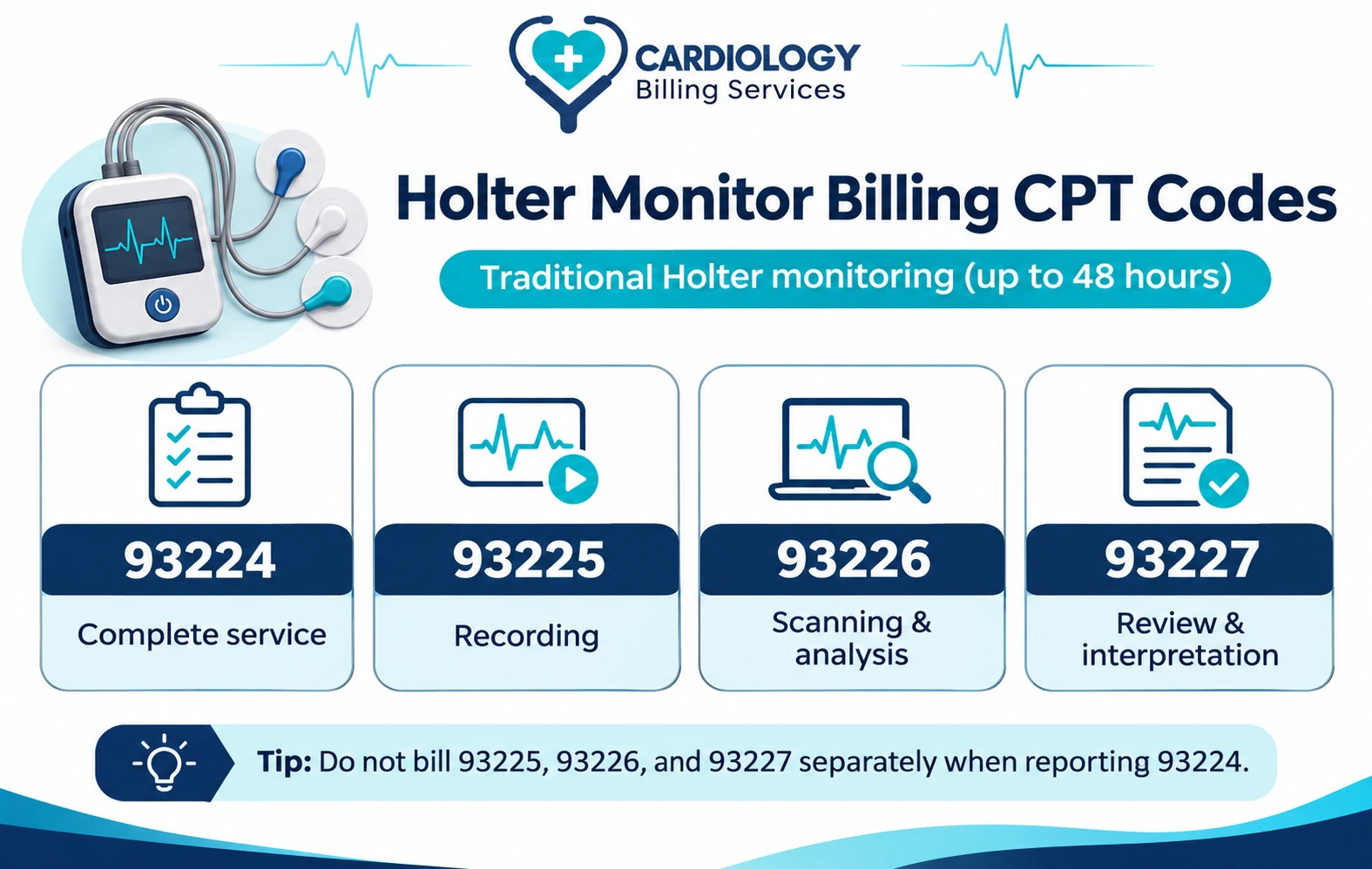
Traditional Holter monitoring is reported using CPT codes 93224, 93225, 93226, and 93227. These codes describe continuous external electrocardiographic recording for up to 48 hours.
The correct code depends on whether a provider delivers the complete diagnostic service or performs an individual component.
| CPT code | Service description | Billing component |
|---|---|---|
| 93224 | Continuous ECG recording, analysis, report, review, and interpretation | Complete service |
| 93225 | Recording, including connection and initial recording | Recording component |
| 93226 | Scanning analysis with report | Analysis component |
| 93227 | Physician or qualified professional review and interpretation | Interpretation component |
CPT code 93224: Complete Holter monitoring service
CPT 93224 applies when the reporting organization provides the complete Holter monitoring service.
This includes recording the patient's electrocardiographic activity, performing the required analysis, preparing the technical report, and completing the professional interpretation.
For example, a cardiology practice that handles recording, analysis, and interpretation may qualify to report CPT 93224 when all requirements are satisfied.
The practice should not separately bill CPT codes 93225, 93226, and 93227 for the same completed service because those components are already represented by the complete-service code.
CPT code 93225: Holter monitor recording
CPT 93225 identifies the recording portion of Holter monitoring.
This component includes connecting the patient to the monitoring equipment and initiating the electrocardiographic recording.
A facility or organization responsible only for recording may report this code when permitted by the payer and applicable billing arrangements.
Documentation should establish that the recording component was performed, including the relevant service date and monitoring information.
CPT code 93226: Scanning and analysis
CPT 93226 describes the technical analysis of recorded electrocardiographic information and preparation of the associated report.
During this process, recorded data are evaluated for heart rate patterns, rhythm abnormalities, and other findings requiring physician review.
An independent diagnostic testing facility may perform this component when it meets applicable enrollment, operational, and coverage requirements.
Technical analysis alone does not represent the physician's final interpretation.
CPT code 93227: Review and interpretation
CPT 93227 represents the professional review and interpretation of the Holter recording.
The interpreting physician or other appropriately qualified professional reviews the findings, assesses their clinical relevance, and produces an interpretation.
The completed report should identify the interpreting professional and document the findings.
An unsigned automated analysis generally cannot substitute for a required professional interpretation.
Holter monitor versus extended cardiac monitoring CPT codes
Not every ambulatory cardiac monitor should be billed using traditional Holter codes.
Continuous ECG monitoring lasting longer than 48 hours is represented by separate CPT code families. Coding must reflect the service performed rather than the brand, appearance, or commercial name of the monitoring device.
| Monitoring duration | Complete-service code | Individual component codes |
|---|---|---|
| Up to 48 hours | 93224 | 93225, 93226, 93227 |
| More than 48 hours through 7 days | 93241 | 93242, 93243, 93244 |
| More than 7 days through 15 days | 93245 | 93246, 93247, 93248 |
For example, a patient prescribed a 10-day continuous ECG patch would generally fall within the 93245–93248 code family, provided the actual service meets the code requirements.
Other monitoring technologies follow different coding rules. Mobile cardiac telemetry uses CPT codes 93228 and 93229, while certain external event-recording services use codes in the 93268–93272 family.
A device that continuously stores ECG data is not necessarily equivalent to a system transmitting events to an attended monitoring center.
The billing department should verify the recording method, monitoring period, analysis performed, and interpretation before selecting a code.
Documentation requirements for Holter monitor billing
Accurate documentation supports both CPT code selection and the medical necessity of the test.
Medicare coverage policies require the medical record to explain why ambulatory ECG monitoring was appropriate for the patient's clinical condition.
Physician order and medical necessity
The medical record should include an order from the treating physician or another authorized ordering professional, consistent with applicable diagnostic testing requirements.
The order and supporting clinical notes should establish the reason for monitoring.
A statement such as "Holter ordered" provides limited information. Documentation describing recurring palpitations, symptom frequency, relevant examination findings, and the suspected rhythm disorder offers a clearer basis for the diagnostic service.
Medicare coverage policies recognize indications that may include palpitations, syncope, dizziness, dyspnea, suspected arrhythmias, and assessment of certain responses to antiarrhythmic treatment.
However, an indication must meet the applicable coverage criteria. The presence of a symptom alone does not guarantee payment.
Recording details and monitoring duration
The technical documentation should identify the patient, recording period, device information, and completion of the monitoring service.
Useful records include the recording start and end times, interruptions, available analyzable data, and significant technical problems.
Monitoring duration deserves particular attention because a service lasting longer than 48 hours may require a different code family from traditional Holter monitoring.
Incomplete recordings also require review before billing. For example, CMS contractor guidance for traditional Holter services specifies reduced-services modifier 52 when continuous recording lasts less than 12 hours.
Billing teams should review the applicable contractor guidance and the circumstances of the interrupted recording rather than assuming that every incomplete test qualifies for full reimbursement.
Interpretation and diagnostic report
A completed Holter report ordinarily documents the predominant rhythm, heart rate measurements, relevant arrhythmias, ectopic activity, and any relationship between recorded findings and patient-reported symptoms.
The report should also identify the interpreting professional and contain the required authentication.
A technical report may contain automated rhythm classifications, but those findings should be reviewed as appropriate before the professional interpretation is completed.
Retaining the final report and supporting records also assists with payment disputes and post-payment reviews.
How Holter monitor reimbursement works
Holter monitor reimbursement depends on the CPT code, payer contract, geographic location, billing entity, and applicable payment rules.
Under the Medicare Physician Fee Schedule, payment calculations consider relative value units associated with physician work, practice expenses, and professional liability expenses. Geographic adjustments also affect the resulting amount.
For calendar year 2026, CMS established separate Physician Fee Schedule conversion factors of $33.57 for qualifying advanced alternative payment model participants and $33.40 for other practitioners.
These figures are conversion factors, not reimbursement amounts for a Holter monitoring procedure.
Actual allowed amounts must be determined using the applicable CPT code, payment locality, fee schedule, and billing circumstances.
Complete-service versus component reimbursement
When a cardiology practice performs the entire monitoring service, CPT 93224 may be applicable.
If responsibilities are divided among separate organizations, the appropriate component codes may be reported by the parties that actually furnished those services.
Billing teams should verify provider enrollment, contractual arrangements, and payer-specific restrictions before submitting component claims.
Certain Medicare contractor instructions prohibit appending modifiers 26 or TC to Holter codes 93224–93227 because the code structure already separates the relevant services.
Commercial insurance reimbursement
Commercial insurers may establish their own contracted rates, utilization requirements, and coverage policies.
A service payable under one health plan may require additional documentation or authorization under another.
Before submitting claims, practices should verify the patient's coverage, applicable network arrangements, coding requirements, and any prior authorization rules.
Where prior authorization is required, obtaining it does not eliminate the need to demonstrate medical necessity or submit a correctly coded claim.
Common Holter monitor billing denials
Holter monitoring claims can be rejected or denied because of incorrect coding, insufficient documentation, duplicate services, or coverage limitations.
Medical necessity denials
A payer may deny monitoring when the clinical record does not establish why the test was required.
For example, a claim submitted for palpitations may encounter a medical necessity denial if the supporting documentation fails to describe the clinical evaluation or reasons for selecting ambulatory monitoring.
The billing team should compare the physician's documentation with the applicable coverage policy before submitting an appeal.
Incorrect CPT code selection
Using CPT 93224 for a service that meets the requirements of extended continuous ECG monitoring may result in a coding discrepancy.
Similarly, reporting a complete-service code when only the recording component was performed can produce an incorrect claim.
A review of monitoring duration, device functionality, and performed services helps identify the correct code.
Duplicate billing and bundled services
Duplicate claims may arise when an organization bills CPT 93224 while separate components of the same complete service are also reported.
Medicare contractor guidance also restricts simultaneous billing of certain different ambulatory ECG monitoring services for overlapping monitoring periods.
Before submission, billing specialists should check the episode of care, service dates, applicable National Correct Coding Initiative edits, and previously submitted claims.
Missing interpretation or incomplete documentation
Claims may be challenged when the final diagnostic report is missing, the interpretation is not properly authenticated, or the available record cannot establish that the billed service occurred.
The appropriate correction depends on the actual problem.
An omitted document may support a corrected submission or appeal, while a service that was never completed cannot be made payable simply by changing the code.
How to reduce Holter monitoring claim denials
A consistent pre-submission review can identify many preventable billing problems.
Billing departments should verify that the order supports the test, the reported monitoring duration matches the technical record, and the selected CPT code corresponds to the services performed.
The final report should be available before billing any component that requires completed interpretation.
Practices using outside monitoring vendors should establish written responsibilities for recording, technical analysis, professional interpretation, and claim submission. This reduces uncertainty about which organization should report each component.
Denial trends also deserve review. Repeated medical necessity denials may indicate weaknesses in clinical documentation, while duplicate-service denials may reveal problems in communication between the practice and the monitoring vendor.
Correcting the underlying workflow is generally more effective than repeatedly resubmitting claims with the same defects.
Frequently asked questions about Holter monitor billing
What is the CPT code for a 24-hour Holter monitor?
CPT 93224 represents the complete traditional Holter monitoring service for up to 48 hours, including recording, analysis, report, and interpretation. Codes 93225–93227 describe individual components when billed separately by the appropriate parties.
What CPT code is used for a 7-day Holter monitor?
CPT 93241 represents the complete continuous recording service for more than 48 hours through 7 days. Component codes 93242, 93243, and 93244 may apply when those services are furnished separately.
Does Medicare cover Holter monitoring?
Medicare may cover medically necessary Holter monitoring when the service meets applicable national and local coverage requirements. Coverage depends on the clinical indication, documentation, monitoring type, and other relevant policy conditions.
Does Holter monitoring require prior authorization?
Requirements vary by insurer and health plan. Practices should verify authorization rules before providing the service, particularly for extended monitoring and specialized diagnostic arrangements.
Can CPT 93224 and 93227 be billed together?
CPT 93224 already includes the review and interpretation component represented by CPT 93227. Reporting both for the same completed monitoring service would generally duplicate that work.
Holter monitor billing: Key considerations
Accurate Holter monitor billing depends on three verifiable elements: the type and duration of electrocardiographic monitoring, the services actually performed, and the clinical documentation supporting the procedure.
Traditional Holter monitoring uses CPT codes 93224–93227 for continuous recording up to 48 hours. Extended monitoring uses separate code families, and complete-service billing must not duplicate individually reported components.
Before submitting a claim, providers and billing teams should verify the physician order, monitoring record, diagnostic report, applicable payer policy, and coding requirements. Maintaining these records supports accurate reimbursement and provides the evidence needed to resolve legitimate payment disputes.