

Cardiology AR Follow-Up A Complete Guide to Accounts Receivable Management

Cardiology practices handle a wide range of medical services, from routine consultations and diagnostic testing to complex cardiovascular procedures. Each service creates a billing responsibility that must be managed until the correct payment is received. However, submitting an insurance claim does not guarantee reimbursement.
Unpaid claims, delayed insurance payments, coding discrepancies, and incomplete documentation can create significant financial pressure for cardiology providers. These problems become increasingly difficult to resolve when outstanding balances remain unattended for several months.
Cardiology AR follow-up is the process of monitoring unpaid insurance claims and patient balances, identifying payment delays, resolving denials, and recovering reimbursement owed for cardiovascular services.
Effective accounts receivable management requires a clear understanding of cardiology procedures, payer requirements, claim documentation, and reimbursement policies. It also requires consistent communication between billing specialists, clinical teams, insurance companies, and patients.
This guide explains how cardiology accounts receivable management works, why claims remain unpaid, and which practices help reduce outstanding balances and improve revenue collection.
What is cardiology AR follow-up?
Cardiology accounts receivable (AR) follow-up refers to the activities performed after a medical claim has been submitted but before its financial balance is correctly resolved.
When a cardiology practice provides a service, the billing department submits a claim to the patient’s insurance company. The payer evaluates the claim according to coverage requirements, coding rules, contractual agreements, and medical necessity standards.
If the claim is processed correctly, the insurer issues payment or an explanation of the remaining financial responsibility. However, some claims require additional review because of processing delays, missing information, denials, or reimbursement discrepancies.
The AR follow-up team investigates these unresolved claims and determines what action is necessary.
For example, a cardiology practice may submit a claim for a cardiovascular stress test using CPT Code 93015. If the insurance company denies the service because the diagnosis does not satisfy its medical necessity policy, the billing specialist must review the documentation, confirm the applicable coverage requirements, and determine whether a correction or appeal is appropriate.
The claim remains part of accounts receivable until the outstanding balance has been appropriately paid, adjusted, transferred, or otherwise resolved.
Why is accounts receivable management important in cardiology?
Cardiology billing involves procedures with different coding structures, documentation requirements, and reimbursement methods. Electrocardiograms, echocardiograms, cardiovascular stress tests, cardiac catheterizations, and interventional procedures may each follow different payer rules.
These differences can create billing problems when charges are submitted without checking the services performed or the contractual responsibilities of the billing entity.
For instance, a hospital may own the diagnostic equipment while an independent cardiologist provides the professional interpretation. Reporting the complete service instead of the appropriate component can result in an incorrect claim.
Cardiology AR management helps identify these issues before unpaid balances become difficult to recover.
It also provides financial visibility. By reviewing outstanding claims regularly, practice administrators can determine which insurance companies are delaying payments, which procedures generate recurring denials, and which balances require immediate attention.
Without structured AR follow-up, unresolved claims may remain in billing systems until filing or appeal deadlines have passed.
How does the cardiology AR follow-up process work?
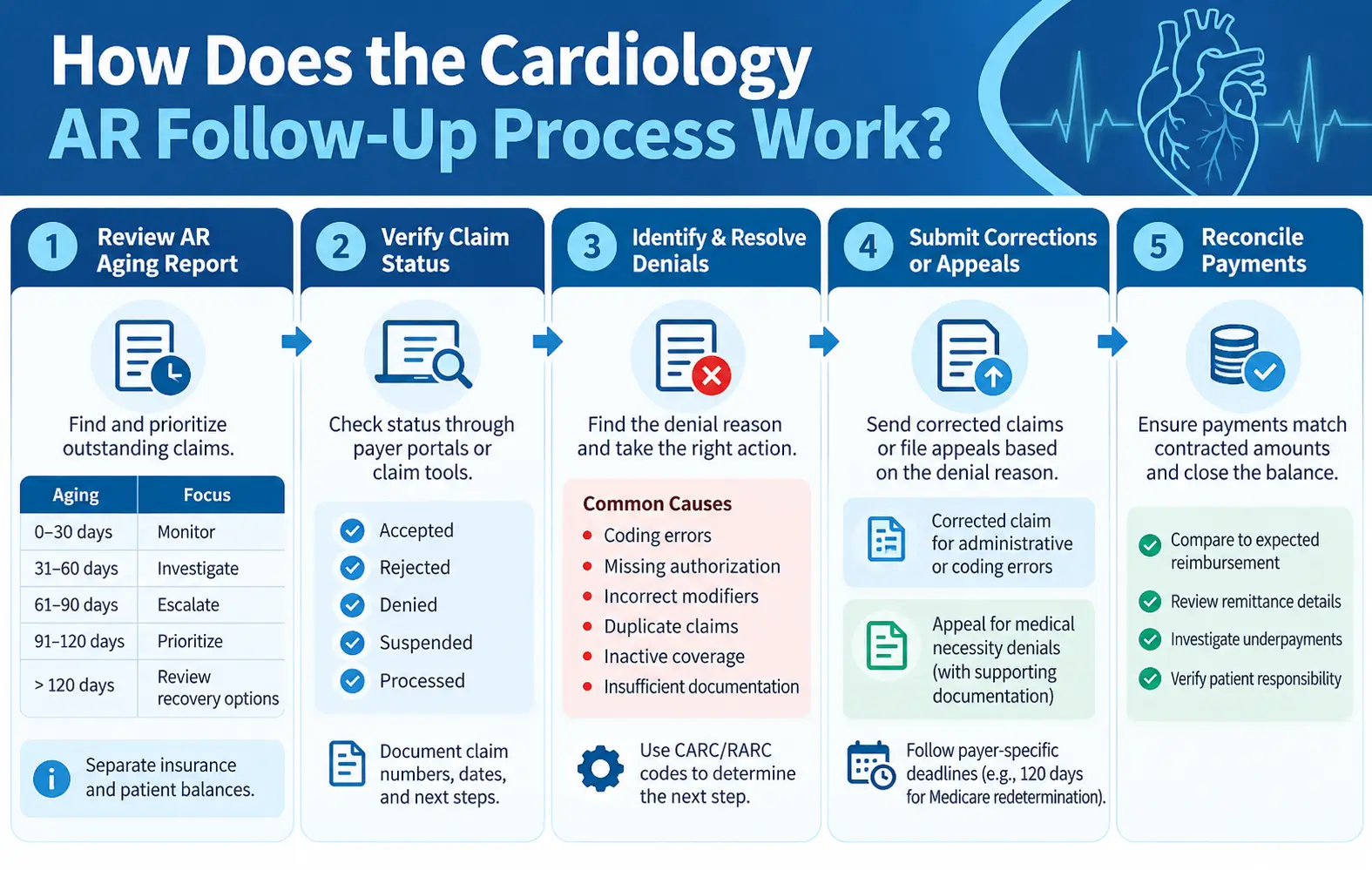
A reliable AR management process begins with accurate claims information and continues through payment reconciliation.
1. Review the cardiology accounts receivable aging report
An AR aging report organizes unpaid claims according to the time they have remained outstanding. It helps billing teams identify older claims and determine where follow-up efforts should be concentrated.
| AR aging category | Recommended follow-up approach |
|---|---|
| 0–30 days | Confirm claim acceptance and monitor normal processing |
| 31–60 days | Investigate claims exceeding expected payer processing times |
| 61–90 days | Escalate unresolved claims and address documentation or denial issues |
| 91–120 days | Prioritize claims approaching payer-specific deadlines |
| Over 120 days | Review recovery opportunities, appeal eligibility, and adjustment requirements |
These categories are operational examples rather than universal payer deadlines.
Aging reports should distinguish insurance balances from patient responsibilities because the collection procedures and applicable rules are different.
2. Verify claim status with the insurance payer
After reviewing the aging report, billing specialists should investigate claims that have exceeded the expected processing period.
Claim status can be checked through payer portals, electronic claim status transactions, or direct communication with an insurance representative.
During the review, the specialist should determine whether the claim was accepted, rejected, denied, suspended, or processed for payment.
These statuses require different responses.
A clearinghouse rejection may mean the claim never reached the insurer for adjudication. A denial generally indicates that the payer processed the claim but did not approve payment for some or all services.
Recording claim numbers, payer reference numbers, response dates, and the next required action helps prevent repeated investigations.
3. Identify and resolve cardiology claim denials
Denial management is one of the most demanding parts of cardiology AR follow-up because payment problems may involve both administrative errors and clinical coverage requirements.
Common denial causes include inaccurate diagnosis coding, missing authorization, incorrect modifiers, duplicate submissions, inactive coverage, and insufficient documentation.
A denied echocardiogram claim, for example, may require confirmation that the patient’s medical record supports the indication for the examination.
Billing teams should investigate the actual denial reason rather than automatically resubmitting the same information.
The Centers for Medicare & Medicaid Services (CMS) explains that electronic remittance advice uses Claim Adjustment Reason Codes (CARCs) and Remittance Advice Remark Codes (RARCs) to communicate payment adjustments and additional details. These codes help billing specialists identify the reason for an unpaid balance.
Once the reason is confirmed, the team can determine whether to correct the claim, request reconsideration, submit an appeal, or make an authorized adjustment.
4. Submit corrected claims and insurance appeals
When a denial results from an administrative or coding error, the claim may need correction through the payer’s designated process.
A claim denied for medical necessity may require a formal appeal supported by the physician’s documentation, depending on the circumstances and payer rules.
Corrected claims and appeals should never be treated as interchangeable because they can follow different submission procedures and deadlines.
For Original Medicare fee-for-service claims, CMS generally allows 120 days from receipt of the initial determination notice to request the first appeal level, called redetermination. Commercial insurance and Medicare Advantage plans may have different requirements.
The AR team should maintain a record of every submission and monitor whether the payer has acknowledged the request.
5. Reconcile insurance payments and remaining balances
A claim should not be considered resolved merely because a payment appears in the billing system.
The payment must be compared with the expected reimbursement, the payer’s remittance information, and the applicable contractual adjustment.
If an insurance company pays less than the expected contracted amount, the billing team should investigate whether the difference reflects a valid payment rule or an underpayment.
Any remaining patient responsibility should be verified before transfer to patient accounts receivable.
This final reconciliation step helps prevent lost revenue and inappropriate patient billing.
How CPT Code 93015 affects cardiology AR follow-up
Cardiovascular stress testing provides a practical example of how coding errors can create accounts receivable problems.
CPT Code 93015 describes a complete cardiovascular stress test involving exercise or pharmacological stress with electrocardiographic monitoring, including the applicable physician supervision, tracing, interpretation, and report.
The cardiovascular stress test code family separates these responsibilities when different billing entities perform the services.
| CPT code | Service reported |
|---|---|
| 93015 | Complete cardiovascular stress test, including supervision, tracing, interpretation, and report |
| 93016 | Physician supervision component |
| 93017 | Technical tracing component |
| 93018 | Interpretation and written report |
These distinctions matter when investigating denied or underpaid cardiology claims.
A practice that furnishes and is entitled to bill all components may appropriately report the complete service under CPT 93015. When the responsibilities are divided between different providers or facilities, component reporting may be necessary.
Billing CPT 93015 alongside overlapping components for the same service can create duplicate or incorrect billing. Likewise, reporting the global service when the practice performed only one component may produce a payment discrepancy.
Documentation and medical necessity requirements
For stress testing claims, documentation should support the clinical reason for the examination, the testing method, the service performed, the supervision provided, and the interpretation findings.
Cardiology practices should also verify that the diagnosis codes accurately reflect the patient’s documented condition.
CMS Medicare Administrative Contractor billing articles for cardiovascular stress testing identify applicable ICD-10-CM codes and coverage conditions. These requirements are jurisdiction-specific and should be reviewed for the relevant date of service.
A denied stress test claim should therefore be reviewed for both coding accuracy and medical necessity before the AR team decides on corrective action.
Common cardiology AR follow-up challenges
Delayed payments for diagnostic and interventional procedures
Cardiology claims may involve several professional and technical services performed during one encounter.
When claims contain multiple procedures, incorrect billing details or payer edits may require additional investigation.
Billing teams should review the individual service lines to determine whether payment delays affect the entire claim or only particular procedures.
Missing or incomplete clinical documentation
Cardiovascular services often depend on documented clinical indications and properly completed procedure reports.
Missing interpretation reports, unsupported diagnoses, or inconsistent medical records can delay reimbursement and complicate appeals.
Close communication between physicians, coding specialists, and the AR department can help resolve these discrepancies.
Incorrect coordination of benefits
Patients may have Medicare, commercial insurance, supplemental coverage, or other applicable health plans.
Submitting a claim to the incorrect primary insurer can cause payment delays and additional administrative work.
CMS identifies coordination of benefits as the process used to establish payment responsibilities when more than one insurance plan covers a patient.
Cardiology billing teams should verify payer order and ensure that secondary claims include the required primary payer information.
Missed timely filing deadlines
Filing deadlines are particularly important when older cardiology claims remain unresolved.
For Original Medicare, claims generally must reach the appropriate Medicare Administrative Contractor within one calendar year after the date of service, subject to limited exceptions. Claims denied solely because they were filed late generally cannot be appealed through the normal Medicare claims appeal process.
Commercial payer deadlines depend on the relevant agreement and policy.
AR specialists should track these dates separately from denial appeal deadlines.
Best practices for improving cardiology AR collections
Cardiology practices can improve revenue recovery by establishing consistent follow-up procedures and assigning clear responsibility for unresolved claims.
Prioritize claims according to financial and operational risk
High-dollar unpaid claims deserve attention, but the largest balance should not automatically receive priority.
A smaller claim approaching an appeal deadline may require more urgent action than a recent claim with a higher value.
An effective work queue considers aging, outstanding balance, denial type, payer processing time, and filing deadlines.
Maintain accurate follow-up documentation
Every insurance follow-up should have a recorded outcome and a specific next action.
Rather than entering a general note that the payer was contacted, billing specialists should document the claim reference number, payer response, outstanding issue, requested information, and planned follow-up date.
This approach reduces repeated work and allows another specialist to continue the claim investigation without starting over.
Monitor recurring denial patterns
Practices should review whether denials frequently occur for the same cardiology service, insurance company, or provider.
If multiple stress test claims are denied for similar documentation issues, the underlying charge capture or clinical documentation process may need correction.
Addressing the recurring cause can prevent future claims from entering accounts receivable unnecessarily.
Review AR performance indicators
Several measurements help practice administrators evaluate the effectiveness of their collections process.
Days in AR estimates how long receivables remain outstanding relative to average daily net charges. The percentage of AR over 90 days shows how much of the unpaid balance has aged beyond three months.
Other useful indicators include denial rates, first-pass claim acceptance, underpayment recovery, and the percentage of appeals successfully resolved.
These indicators should be analyzed by payer and service category rather than relying exclusively on practice-wide averages.
How reimbursement policies affect cardiology AR management
Cardiology reimbursement depends on more than the CPT code submitted.
The amount paid may vary according to the insurance contract, date of service, practice location, place of service, and whether the provider bills a complete procedure or an individual component.
For Medicare Physician Fee Schedule services, CMS uses relative value units, geographic adjustments, and conversion factors when determining payment rates. The 2026 Medicare Physician Fee Schedule also applies different conversion factors based on qualifying Alternative Payment Model participation status.
Therefore, cardiology billing specialists should compare the actual payment against the correct fee schedule and applicable policy rather than assuming one reimbursement amount applies to every practice.
This is particularly important when evaluating underpaid claims involving CPT 93015 and related diagnostic services.
How can cardiology practices reduce AR aging?
Reducing outstanding cardiology receivables requires improvements throughout the billing cycle, beginning before claim submission.
Accurate insurance verification, authorization checks, clinical documentation, and charge capture can prevent administrative errors that would otherwise require later AR follow-up.
Once a claim is submitted, the practice should monitor acceptance and adjudication, investigate unexpected delays, and respond to denials before the relevant deadlines expire.
Regular communication between clinical and billing departments also helps resolve documentation-related problems.
Practices should review their oldest unpaid claims regularly while continuing to monitor newly submitted claims. Focusing only on historical balances can allow fresh accounts receivable problems to accumulate.
An organized process creates greater visibility into outstanding revenue and helps staff resolve claims while recovery options remain available.
Conclusion
Cardiology AR follow-up is an essential part of maintaining accurate reimbursement and financial stability in cardiovascular practices. Effective accounts receivable management requires timely claim monitoring, detailed denial investigation, accurate payment posting, and consistent communication with insurance companies.
Understanding cardiology coding requirements is equally important. For example, CPT Code 93015 must be reported according to the services actually provided, with appropriate documentation, medical necessity, and payer-specific reimbursement rules.
For healthcare providers and medical billing professionals, the most practical approach is to review outstanding claims systematically, prioritize time-sensitive accounts, investigate recurring denials, and confirm that every balance receives the correct financial resolution.