August 20, 2026
Cardiology Coding Compliance: A Complete Guide to Accurate Coding, Documentation and Audit Readiness

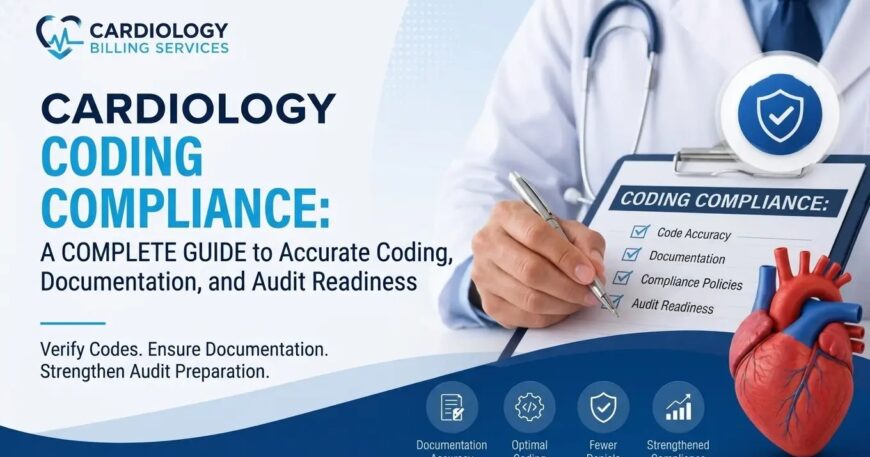
A cardiology claim can be paid quickly and still be wrong. It can also be coded to the letter of the record and still be denied. Those two facts sit at the center of cardiology coding compliance and they explain why compliance is a larger idea than picking the right CPT code. Compliance is about whether the codes, diagnoses, modifiers, units and supporting documentation on a claim hold together and stand up to review, whether that review comes from a payer edit, a Medicare Administrative Contractor, or an external auditor months after the money arrived.
Cardiology is a high-risk specialty for this kind of scrutiny. Encounters generate multiple reportable services, imaging and device work splits into professional and technical components and procedures carry bundling and global-period rules that shift by service and by payer. This guide explains what cardiology coding compliance requires in practice, where the risk concentrates, how audits and compliance programs work and how Medicare and commercial expectations diverge. It is written for the people who own these decisions: cardiologists and practice owners, coders and billers, certified professional coders, RCM and compliance staff and students learning the specialty.
Not every row applies to every practice or service. Use denial and audit history to focus attention where the specific practice carries the most exposure.
The right path depends on the outcome. A rejection is corrected and resubmitted; a denial is investigated and either corrected, appealed, or accepted; an underpayment is checked against the contracted rate. Corrected claims, appeals, resubmissions, payment reviews and contractual analysis are distinct processes and payer-specific status language should be read carefully rather than assumed.
Treat this as a menu to prioritize against the practice’s own error history, not a list that applies uniformly everywhere.
What is cardiology coding compliance?
Cardiology coding compliance is the practice of reporting services, diagnoses, procedures, modifiers, units and other claim data accurately and in line with the documentation, applicable coding rules, coverage requirements, payer policies and federal or contractual obligations. It means the claim reflects what was actually done, that the record supports it and that the reporting follows the rules that govern it. The compliance chain runs in one direction and a weakness at any link travels downstream: Clinical documentation → Code selection → Claim submission → Adjudication → Reimbursement → Audit or compliance review Selecting an accurate code is necessary but not sufficient. A perfectly chosen CPT code attached to a diagnosis the record does not support, or reported with a modifier the circumstances do not justify, is still a compliance problem. The claim has to be right and defensible, not merely accepted.Why coding compliance matters in cardiology
Compliant coding protects a practice on two fronts at once: it supports correct payment now and it reduces exposure later. When coding falls out of compliance, the consequences follow a familiar sequence: denials and rework, delayed or reduced payment, post-payment recoupments, audits and in serious patterns, compliance investigations and repayment demands. The financial stakes are real, but so is the timing risk. An error caught by a pre-bill edit costs a moment of attention. The same error discovered in a post-payment audit can trigger a demand to return money already spent, sometimes extrapolated across a larger population of claims. Cardiology’s mix of high-value procedures and repetitive diagnostic services means small, patterned coding problems can accumulate into large exposure before anyone notices.The difference between coding accuracy and coding compliance
These terms are used interchangeably and the difference matters. Coding accuracy asks whether the code correctly describes the service. Coding compliance asks a broader question: whether the entire claim, including the diagnosis, modifiers, units and documentation, follows the applicable rules and coverage requirements. A claim can be accurate and non-compliant. Reporting a diagnostic study with the correct procedure code is accurate, but if the linked diagnosis does not meet the payer’s coverage policy, the claim is not compliant. Compliance also draws a line against reimbursement optimization that crosses into misrepresentation. Choosing codes to increase payment beyond what the documentation supports is not optimization; it is a compliance failure regardless of intent.Core elements of cardiology coding compliance
Compliant cardiology coding depends on several decisions working together rather than in isolation. Each element below carries its own risk and each is a place auditors look.CPT and HCPCS coding
CPT and HCPCS Level II codes have to match the service actually documented. That means the procedure note supports the code descriptor, the correct code is chosen among similar options, units reflect what was performed and component or bundled services are reported according to the rules. CPT is maintained by the American Medical Association and revised annually, so coding to the current-year codebook is part of compliance; a code valid last year may have been revised or deleted. HCPCS Level II is maintained by CMS and also updated annually. When the documentation and the code disagree, the documentation controls and the code should change to match it, not the reverse.ICD-10-CM diagnosis coding
Diagnosis coding establishes why a service was clinically indicated. Compliance here turns on specificity supported by the record, correct sequencing and a genuine relationship between the diagnosis and the service billed. ICD-10-CM is maintained by the CDC’s National Center for Health Statistics together with CMS and updated each year effective October 1. A more specific code should be reported only when the documentation supports that level of detail. Coding a higher-specificity diagnosis the record does not establish, or attaching a diagnosis that does not reflect the provider’s documentation, both create compliance risk. An ICD-10-CM code, however precise, does not by itself guarantee medical necessity or payment.Modifier compliance
Modifiers change how a code is interpreted, so using the wrong one, or omitting a needed one, misrepresents the service. The modifiers that recur in cardiology include:- Modifier 25, appended to a significant, separately identifiable E/M service performed on the same day as a procedure or other service by the same provider.
- Modifier 26, for the professional component of a service that has both professional and technical parts, such as an echo interpretation when the facility owns the equipment.
- Modifier 59 (and the more specific X{EPSU} modifiers), for a distinct procedural service that is separate from another non-E/M service on the same day.
- Modifier 76 for a repeat procedure by the same provider and Modifier 77 for a repeat by a different provider.
- Modifier 91 for a repeat clinical diagnostic laboratory test performed to obtain subsequent results, not to rerun a test because of a problem with the original.
NCCI and bundling
The National Correct Coding Initiative, developed by CMS to promote correct coding and reduce improper payments, defines procedure-to-procedure (PTP) edits for code pairs that should not normally be reported together and medically unlikely edits (MUEs) that cap the units of a code. CMS updates these edits quarterly. Each PTP edit carries a modifier indicator: an indicator of 0 means no modifier can bypass the edit, while an indicator of 1 means a modifier may be appropriate when the clinical circumstances genuinely support separate reporting. The compliance principle is straightforward. When two cardiology services hit an edit, the coder determines whether separate reporting is truly justified and documented, rather than reflexively adding a modifier to override the edit.Medical necessity
Medical necessity is the payer’s determination that a service was reasonable and necessary for the patient’s condition. Documentation and diagnosis coding support it, but neither guarantees it, because coverage is governed by policy. Under Medicare, coverage can be defined nationally through National Coverage Determinations (NCDs) or locally through Local Coverage Determinations (LCDs) issued by Medicare Administrative Contractors, which means a cardiology service covered under one MAC’s LCD may be handled differently in another jurisdiction. Commercial payers apply their own medical policies. A service can be performed, coded correctly and still be non-covered under the applicable policy.Documentation
Documentation is the evidence every code stands on. It supports CPT selection, the E/M level, diagnosis coding, modifier use, unit reporting, appeals and audit defense. Records that commonly matter include the reason for the encounter, relevant history, examination findings, the assessment, diagnostic findings and test results, procedure documentation, the treatment plan and provider authentication where required. Exact requirements vary by service, payer, regulation and policy, so no single documentation standard applies to every cardiology service.E/M coding
Evaluation and management coding is among the most audited areas across all specialties, cardiology included. Since January 1, 2021, office and outpatient E/M codes (99202 through 99215) are selected by either the level of medical decision making (MDM) or total time on the date of the encounter and history and examination no longer drive the code level. The AMA extended the MDM-or-time framework to most other E/M categories in 2023, including hospital inpatient and observation services, consultations and home or residence visits and that framework remains in effect for 2026. Code 99201 was deleted in 2021. Compliance means the selected level is supported by the documented MDM or time, not by habit or template. Both upcoding (billing a higher level than supported) and persistent downcoding (undercoding supported work) are patterns worth watching, the first for repayment and audit risk and the second for lost, legitimate revenue.Units and duplicate reporting
Units have to correspond to the documented service and stay within applicable MUE limits. Reporting more units than the record supports overstates the service; duplicate reporting submits the same service more than once without a legitimate coding reason. Both create claim and compliance problems and both are frequent findings when charges flow from more than one source into the billing system.Global surgery considerations
Some procedures carry a global surgical package, a period during which related preoperative, intraoperative and typical postoperative services are not separately billable. CMS assigns global-period indicators (for example 000, 010, 090, or XXX where the concept does not apply) and the indicator differs by procedure. Modifiers such as 24 (an unrelated E/M during a postoperative period), 25 and 57 (an E/M that led to the decision for major surgery) come into play around these rules. Not every cardiology procedure carries the same global period and many diagnostic services carry an XXX indicator, so the rule for one service does not transfer automatically to another.Common cardiology coding compliance errors
| Coding compliance risk | Why it creates risk | What to review |
| Incorrect CPT code | Reported service may not match the documentation | Procedure note and code descriptor |
| Unsupported modifier | Modifier may incorrectly alter claim processing | Clinical circumstances and coding guidance |
| Incorrect ICD-10-CM code | Diagnosis may not be supported | Medical record and current ICD-10-CM guidelines |
| Upcoding | Higher-level service may not be supported | Documentation and applicable code rules |
| Unbundling | Components reported separately when bundled | NCCI edits and coding guidance |
| Incorrect units | Claim may report more than was documented | Procedure record and unit calculation |
| Missing authorization | Payer may require prior approval | Authorization record and payer policy |
| Duplicate reporting | Same service submitted more than once | Claim history and billing system |
| Inadequate documentation | Code cannot be supported | Medical record |
| Incorrect payer information | Claim may be submitted incorrectly | Eligibility and insurance information |
| Global-period error | Included service billed separately in error | Procedure and global-period rules |
| Unsupported diagnosis | Diagnosis may not reflect the documented condition | Provider documentation |
Cardiology services with specific coding compliance considerations
Coding risk is not evenly distributed. It concentrates around the services cardiology performs most and the rules differ by service, code, documentation, payer, coverage policy, date, place of service and provider type.Echocardiography
Transthoracic and stress echocardiography often split into professional and technical components, which raises the modifier 26 question when the physician interprets a study performed on facility-owned equipment. Compliance turns on documenting the indication, selecting the correct code (including complete versus limited studies), supporting medical necessity and reporting components correctly. Component coding is where echo claims most often slip. Practices with heavy imaging volume sometimes address this through dedicated cardiac imaging billing support.Stress testing
Stress tests combine supervision, tracing and interpretation elements and each part billed has to be documented and, where performed separately, reported to reflect who did what. Frequency and coverage requirements vary by payer and units must match the service.ECG/EKG
ECGs are high-volume and easy to misreport. The distinction among the global service, the tracing only and the interpretation and report only depends on what was performed and documented and repeat ECGs on the same day require attention to modifier and documentation rules rather than automatic reporting.Cardiac monitoring
Holter, event and longer-term ambulatory monitoring involve service duration, technical and professional elements and interpretation that may fall on a different date from the recording. Frequency restrictions apply under some policies. Reporting the correct components on the correct dates, with units that match the record, is the recurring compliance task.Cardiac catheterization and coronary angiography
Diagnostic catheterization and angiography require detailed procedure documentation and careful code selection that reflects exactly what was performed, with attention to bundling and to modifiers only where the circumstances support them. Because these procedures are complex and higher in value, documentation-to-code alignment carries more weight here.Electrophysiology and cardiac device services
Device interrogations, programming and EP procedures generate services that recur over time and split across professional and technical work and some carry global-period considerations. Documentation of the device and the specific service performed drives compliant reporting and payer-specific requirements are common. Groups with significant device volume sometimes lean on specialized electrophysiology billing support to keep this reporting consistent.Upcoding, unbundling and unsupported coding
Several coding problems carry heightened compliance weight because they can look like patterns of improper billing rather than isolated mistakes. Upcoding is reporting a higher-level or more extensive service than the documentation supports, such as billing a higher E/M level or a more complex procedure than was performed. Unbundling is separately reporting services that applicable coding rules require to be reported together, often by splitting a bundled procedure into its components. Unsupported modifiers are modifiers appended without documentation of the circumstances the modifier requires, for example using a modifier to bypass an NCCI edit that the clinical facts do not justify. Unsupported diagnoses are diagnosis codes the medical record does not establish. Duplicate billing is submitting the same service more than once without a legitimate coding or billing reason. Incorrect units are units that do not match the documented service. These problems can produce denials, payment delays, recoupments, audits, compliance investigations and refund obligations, along with the administrative cost of untangling them. Whether any specific pattern rises to a legal violation depends on facts and authorities beyond coding alone and those determinations belong to qualified compliance and legal professionals rather than to coders or billers.Rejection versus denial versus underpayment
These three outcomes are often lumped together and treating them the same leads to the wrong fix. Payer systems use varying terminology, but the working distinctions are useful.| Outcome | What it usually means | Typical response |
| Claim rejection | The claim could not proceed through adjudication because of an identified submission or data problem | Correct the data and resubmit |
| Claim denial | The payer adjudicated the claim or line and did not pay it as billed | Determine the cause, then correct, appeal, or write off |
| Underpayment | The claim was paid, but below the expected contractual or otherwise applicable amount | Review the contract and pursue a payment review |
How documentation supports coding compliance
Documentation is the connective tissue of compliant coding. It supports CPT selection, the E/M level, medical necessity, diagnosis coding, procedure reporting, modifier use, unit reporting, appeals and audit defense. A claim without documentation behind it is a claim without a defense. Two ideas are worth separating. Documentation that supports a service establishes that the service was performed and clinically appropriate. Documentation specifically required by a payer, regulation, or policy may add elements a particular payer demands as a condition of coverage. A record can support the clinical service and still fall short of a specific payer’s documentation requirement, which is why compliance means documenting both to the clinical reality and to the applicable policy. Practices that struggle here often benefit from tightening their cardiology documentation standards before the coding step.Cardiology coding audits
A coding audit tests whether the codes on claims are supported by the record and the rules. A practical audit follows a defined sequence:- Define the audit objective, whether it is a broad review or a focus on a specific service, provider, or denial pattern.
- Select an appropriate sample.
- Review the clinical documentation for each encounter.
- Compare the documentation with the CPT reporting.
- Review the ICD-10-CM coding.
- Review the modifiers.
- Review NCCI and bundling issues.
- Review units.
- Review medical necessity against applicable coverage policy.
- Review payer-specific requirements.
- Document the findings.
- Identify root causes rather than only individual errors.
- Educate the staff and providers involved.
- Implement corrective actions.
- Conduct follow-up monitoring to confirm the fix held.
How to build a cardiology coding compliance program
A coding compliance program turns one-off corrections into a system that reduces risk over time. The framework most healthcare organizations use follows the seven elements of an effective compliance program, which the HHS Office of Inspector General reaffirmed in its General Compliance Program Guidance published November 6, 2023. OIG describes these as voluntary and scalable rather than one-size-fits-all and it began issuing industry-specific guidance for different healthcare sectors in 2024. Adapted to cardiology coding, the seven elements look like this:- Written policies and procedures, including a code of conduct and documented coding and billing standards the team actually follows.
- Compliance leadership and oversight, with a designated compliance officer or committee accountable for the program.
- Training and education for coders, billers, providers, clinical staff and compliance personnel, refreshed as rules change.
- Effective lines of communication, including a way for staff to raise concerns without fear of retaliation.
- Enforcing standards through consistent consequences and incentives.
- Risk assessment, auditing and monitoring, including pre-bill and post-bill review.
- Responding to detected problems with prompt corrective action.
Cardiology coding compliance workflow
Compliance works best as a defined sequence with ownership at each step rather than a check performed at the end.- Verify patient and payer information.
- Confirm applicable authorization and referral requirements.
- Review the clinical documentation.
- Identify the services performed.
- Assign appropriate CPT and HCPCS codes.
- Assign supported ICD-10-CM diagnoses.
- Review modifiers.
- Check NCCI and other applicable edits.
- Verify units.
- Review medical necessity.
- Check payer-specific requirements.
- Perform pre-bill validation.
- Submit the claim.
- Monitor rejection and denial responses.
- Audit recurring problems.
- Educate staff and providers.
- Update the workflow when rules change.
Medicare coding compliance considerations
Medicare has its own rules and treating them as universal is a frequent source of error. Several CMS concepts shape cardiology coding compliance directly. The National Correct Coding Initiative applies PTP and MUE edits that CMS updates quarterly and the NCCI Policy Manual, which explains the rationale MACs use, is updated annually, with the current edition effective January 1, 2026. The Medicare Claims Processing Manual sets out claim requirements and Medicare enforces a filing deadline of 12 months from the date of service under 42 CFR 424.44. Coverage and medical necessity are governed by NCDs and by LCDs that can vary by MAC jurisdiction, so the applicable contractor’s policies are the reference that matters for a given practice. Medicare rules are not automatically commercial payer rules and applying one to the other is itself a compliance risk.Commercial payer coding compliance considerations
Commercial payers set their own requirements, which can differ from Medicare and from each other. Differences commonly appear in prior authorization, referral requirements, medical policies that define coverage and necessity, network participation, timely filing windows (often shorter than Medicare’s and defined by contract), coding edits, claim correction procedures, appeal requirements, documentation expectations, coverage policies and modifier policies. Because these terms live in each payer’s policies and in the practice’s contracts, compliant coding for commercial claims means verifying requirements against current official payer sources rather than assuming they mirror Medicare.Cardiology coding compliance and prior authorization
Prior authorization and coding compliance are related but distinct. Authorization is a payer’s advance approval of a service; compliance is about how the service is coded and documented. Both can stop payment independently. Compliant handling means confirming that authorization exists for the correct service, that it has not expired, that it matches the service actually billed, that site-of-service and referral requirements are met where applicable and that the documentation supports medical necessity. One point is worth stating plainly: prior authorization does not guarantee claim payment. An authorized service can still be denied on medical necessity, coding, or other grounds. Practices with heavy authorization volume often manage this through a dedicated cardiology prior authorization workflow, supported upstream by insurance verification.Credentialing and provider enrollment
Coding compliance and payment can both be affected by issues that have nothing to do with the codes. A clinically correct, well-coded claim can still be denied if the rendering provider is not properly enrolled or credentialed with the payer, if the NPI or taxonomy is wrong, or if the billing and rendering provider information is inconsistent. Group enrollment status and network participation matter too. These are enrollment and credentialing problems, distinct from coding errors and they call for a different fix, verifying provider data and enrollment rather than re-examining the codes.Coding compliance and claim denials
Denials are a signal and coding compliance is one of several things they can point to. Denials arrive for many reasons: coding, medical necessity, modifiers, bundling, documentation, authorization, eligibility and timely filing among them. Not every denial reflects a coding compliance failure. The disciplined response is to investigate each denial to determine whether the cause was coding, documentation, authorization, eligibility, payer processing, claim submission, a contractual issue, a coverage limitation, or an administrative error. Read across denials and patterns appear. When denials cluster around specific codes, providers, modifiers, or reason codes, they often point back to an upstream coding or documentation problem that can be fixed at the source instead of appealed one claim at a time. Working denials without analyzing them treats symptoms; analyzing them fixes causes. Structured denial management is where these patterns should surface and route back into the coding workflow.Cardiology coding compliance metrics
Compliance improves when it is measured. Useful metrics include the coding error rate, audit error rate, overall denial rate and denial rates broken out by cause (coding-related, medical necessity, modifier-related, NCCI-related and documentation-related), along with the corrected claim rate, appeal overturn rate, recoupment amounts and audit findings segmented by provider, CPT code and payer. Where a formula is used, define the denominator so the number means the same thing every time. For example: Denial rate = denied claims ÷ applicable adjudicated claims × 100 Organizations define these measures differently, so the denominator should always be documented. Compare results against the practice’s own baseline over time rather than against an invented industry benchmark and let the recurring error categories direct where education and auditing go next.How to improve cardiology coding compliance
Prevention works best when it is spread across the encounter rather than concentrated at coding. The checks below sit where they are cheapest to perform.Before the patient visit
- Verify eligibility and benefits.
- Confirm referral and authorization requirements.
- Check network status.
During the encounter
- Document the clinical findings, diagnoses and procedures performed.
- Establish and document medical necessity.
- Meet authentication requirements.
During coding
- Assign CPT, HCPCS and ICD-10-CM codes supported by the record.
- Review modifiers and units.
- Check NCCI edits and global-period considerations.
- Apply current E/M rules.
Before claim submission
- Validate the claim and demographics.
- Confirm payer information and authorization matching.
- Run coding edits and a medical necessity review.
After submission
- Monitor rejections and denials.
- Follow up on accounts receivable.
- Pursue appropriate appeals.
- Analyze coding trends, audit recurring problems and educate staff and providers.
Realistic hypothetical cardiology coding scenarios
The examples below are hypothetical illustrations, not real patient cases and they show how a compliance question develops and how it can be resolved. They do not provide code-specific instructions that would override current official guidance. Example 1 — Modifier 25. A cardiologist performs an E/M service and a minor procedure during the same encounter. What to review: whether the E/M was significant and separately identifiable from the procedure and whether the documentation supports it as distinct work. The takeaway: modifier 25 should be applied only when the record supports a separately identifiable E/M, not automatically whenever a visit and a procedure occur on the same day. Example 2 — Medical necessity. A diagnostic cardiovascular test is billed, but the diagnosis and documentation do not meet the payer’s coverage requirements. What to review: the clinical documentation, the ICD-10-CM selection, the applicable payer policy or LCD and the medical necessity criteria. The takeaway: correct coding alone does not establish coverage; the record has to meet the policy. Example 3 — NCCI edit. Two procedure codes are reported together and a PTP edit applies. What to review: what the edit means, the edit’s modifier indicator and whether the services were genuinely distinct and documented as such. The takeaway: a modifier should be used only when the circumstances support separate reporting, never simply to bypass the edit. Example 4 — Incorrect ICD-10-CM coding. The billed diagnosis does not accurately reflect the provider’s documentation. What to review: the medical record, current ICD-10-CM guidance and whether the code matches the documented condition. The takeaway: code from the documentation and correct the claim when the diagnosis does not match. Example 5 — Incorrect units. A monitoring or diagnostic service is billed with units that do not correspond to the documented service. What to review: the procedure record against the units billed and how the units were generated. The takeaway: reconcile units with the record before submission and address the source, such as an interface or template, so the error does not repeat.Common cardiology coding compliance mistakes
| Coding mistake | Compliance risk | Prevention |
| Incorrect CPT selection | Service may not be accurately reported | Compare documentation with current code guidance |
| Unsupported modifier | May misrepresent the circumstances of service | Review modifier requirements against the record |
| Unsupported diagnosis | Claim may lack coding support | Code from provider documentation |
| Upcoding | May create repayment and audit risk | Perform documentation-based audits |
| Unbundling | May violate coding rules | Review NCCI and applicable guidance |
| Incorrect units | Claim may overstate services | Reconcile units with records |
| Duplicate billing | May create duplicate payment risk | Review claim history |
| Missing documentation | Code cannot be adequately supported | Improve documentation workflows |
| Ignoring payer policy | Claim may not meet coverage rules | Verify current payer requirements |
| Global-period error | Included services may be reported incorrectly | Review applicable global rules |
How professional cardiology coding and billing support can help
Some practices maintain coding compliance well in-house. Others reach a point where volume and complexity outrun the available staff time and outside support earns its place. The pressure points are recognizable: high coding error volume, repeated denials, complex cardiovascular procedures, frequent payer policy changes, a heavy audit workload, documentation inconsistencies, AR backlogs, appeal volume, authorization tracking problems and limited internal coding resources. Specialized support can take on coding review, documentation guidance, claim validation, denial and appeal work and the monitoring that makes recurring problems visible, drawing on cardiology-specific coding depth. Where it fits the reader’s situation, that maps to services such as cardiology medical billing, medical coding services, revenue cycle management and claims submission and tracking. What outside support cannot do is promise a specific outcome. Any provider guaranteeing reimbursement, denial reduction, or compliance is overstating what is possible; the honest value is a tighter, better-monitored process.Frequently asked questions
What is cardiology coding compliance? Cardiology coding compliance is reporting services, diagnoses, procedures, modifiers and units accurately and in line with the documentation, applicable coding rules, coverage requirements and payer or federal obligations. It means the claim reflects what was done, the record supports it and the reporting follows the rules that govern it. Why is coding compliance important in cardiology? Because cardiology generates high-value procedures and repetitive diagnostic services, small patterned errors can accumulate into large exposure. Compliant coding supports correct payment now and reduces the risk of denials, recoupments, audits and repayment demands later. What are the most common cardiology coding compliance errors? Frequent issues include incorrect CPT selection, unsupported modifiers, unsupported or nonspecific diagnoses, incorrect units, duplicate reporting, upcoding, unbundling, inadequate documentation and billing that ignores payer coverage policy. Can incorrect CPT coding create compliance problems? Yes. A CPT code that does not match the documentation, or that reports a more extensive service than was performed, misrepresents the service and can lead to denials, recoupments and audit findings. The documentation should drive the code, not the reverse. Can incorrect ICD-10-CM coding affect cardiology claim compliance? Yes. Diagnosis codes establish why a service was indicated. A diagnosis that is unsupported, nonspecific, or unrelated to the service can create medical necessity and compliance problems and a diagnosis code alone never guarantees payment. How do modifiers affect cardiology coding compliance? Modifiers change how a code is read, so the wrong modifier, or one without supporting circumstances, misrepresents the service. Modifiers such as 25, 26, 59, 76, 77 and 91 must reflect documented circumstances and should never be appended solely to bypass an edit or obtain payment. What is the role of NCCI edits in cardiology coding? NCCI procedure-to-procedure edits identify code pairs that should not normally be billed together and medically unlikely edits cap units. CMS updates them quarterly. When an edit applies, the coder determines whether separate reporting is genuinely justified rather than automatically overriding the edit with a modifier. How does documentation support cardiology coding compliance? Documentation is the evidence for every code and the basis for any appeal or audit defense. It supports CPT selection, the E/M level, medical necessity, diagnosis coding, procedure reporting, modifiers and units. Requirements vary by service and payer, so one standard does not fit all. What is the difference between coding accuracy and coding compliance? Coding accuracy asks whether the code correctly describes the service. Coding compliance asks whether the whole claim, including the diagnosis, modifiers, units and documentation, follows the applicable rules and coverage requirements. A claim can be accurate and still non-compliant. How can cardiology practices prepare for a coding audit? Review documentation against the codes billed across a sample, check modifiers, units, NCCI issues, medical necessity and payer requirements, document findings, identify root causes, educate staff and monitor whether corrections hold. Regular internal reviews reduce surprises in external audits. What is upcoding in cardiology? Upcoding is reporting a higher-level or more extensive service than the documentation supports, such as billing a higher E/M level or a more complex procedure than was performed. It carries repayment and audit risk. What is unbundling in cardiology billing? Unbundling is separately reporting services that applicable coding rules require to be reported together, often by splitting a bundled procedure into components. NCCI edits are designed to catch many of these situations. How does medical necessity affect cardiology coding compliance? Medical necessity is the payer’s determination that a service was reasonable and necessary. It depends on documentation and on coverage policy, including Medicare NCDs and LCDs or commercial medical policies. Correct coding does not by itself establish medical necessity. How do Medicare coding rules differ from commercial payer rules? Medicare applies its own coverage determinations, NCCI edits, documentation expectations and a 12-month filing limit. Commercial payers set their own authorization, medical policy, timely filing and appeal rules, which vary by payer and contract. Medicare rules should not be assumed to apply to commercial claims. Can coding compliance help reduce cardiology claim denials? It can. Many denials trace to coding, documentation, or medical necessity problems that compliant coding and pre-bill review address before submission. Compliance does not eliminate denials or guarantee payment, but it removes a large share of preventable ones.Key takeaways
- Cardiology coding compliance starts with documentation-supported code selection, not with the code itself.
- CPT and ICD-10-CM codes must accurately reflect the documented services and conditions.
- Modifiers should be reported only when their requirements are met and documented.
- NCCI edits should be reviewed, not bypassed automatically with a modifier.
- Medical necessity depends on applicable coverage policy and documentation and a diagnosis code alone does not guarantee payment.
- Medicare and commercial payer rules are not interchangeable.
- Regular coding audits and denial trend analysis reveal recurring compliance problems.
- Ongoing education, monitoring and corrective action are what keep a compliance program working.
Conclusion
Cardiology coding compliance is the connection between what happened in the encounter and what a claim can defend later. It depends on documentation that supports the codes, code selection that follows current CPT and ICD-10-CM guidance, modifiers and units that reflect the actual service, NCCI and global-period rules applied rather than bypassed, medical necessity met under the applicable coverage policy and a clear-eyed distinction between Medicare and commercial requirements. None of that is a one-time task. Practices that document accurately, code to the record, audit for patterns and turn findings into education and workflow changes are the ones whose claims hold up, both when they are paid and when they are reviewed.