Syncope ICD-10: Complete Coding Guide for Syncope and Collapse (2026)

Fainting sends a large share of adults to the emergency department, and it produces one of the most frequently misassigned symptom codes on the claim. A January 2018 ACEP Now summary of the 2017 ACC/AHA/HRS syncope guideline, written by Benjamin Sun, MD, put the U.S. figures at more than 1.2 million syncope-related ED visits a year, about 440,000 admissions and $2.4 billion in annual hospital costs.
Every one of those encounters needs a diagnosis code. Which one depends on how much the provider actually knows about why the patient lost consciousness.
This guide covers the syncope ICD-10 code R55, the conditions it excludes, the cause-specific codes that replace it, and the official guideline rules that decide when a symptom code belongs on a claim. It reflects the FY2027 ICD-10-CM code set, effective October 1, 2026.
What ICD-10 Code R55 Covers
R55, Syncope and collapse, sits in Chapter 18 of ICD-10-CM (R00-R99, symptoms, signs and abnormal findings), inside the general symptoms and signs block, R50-R69. It is a billable three-character code. No fourth character exists, so R55 is complete as written.
The Tabular List gives three inclusion terms:
- Blackout
- Fainting
- Vasovagal attack
The Alphabetic Index goes further. As AAPC's ICD-10 Coding Alert pointed out when the code set was introduced, "near syncope" and "presyncope" index to R55 even though the Tabular does not list them. Coders who search only the Tabular sometimes reach for R42 (dizziness and giddiness) instead, which is wrong when the provider documents presyncope.
The 2017 ACC/AHA/HRS guideline (Shen et al., published in Circulation and JACC) defines syncope as an abrupt, brief, complete loss of consciousness with loss of postural tone and spontaneous recovery. That definition has a coding consequence. A patient who remains unresponsive, or whose episode is attributed to a seizure, does not belong under R55.
R55 replaced ICD-9-CM 780.2 in a one-to-one mapping in 2015. On the inpatient side, a principal diagnosis of R55 groups to MS-DRG 312, Syncope and collapse, in MDC 05 (circulatory system).
Did the FY2027 Update Change R55?
No. The FY2027 ICD-10-CM release added 190 codes, deleted 30 and revised four code titles, according to an August 4, 2026 summary by Leigh Poland of AGS Health. R55 and its instructional notes carried over unchanged. Encoders and EHR pick lists still need the October 2026 load, because several codes that replace R55 (covered below) sit in categories that have been revised in recent years.
R55 Excludes1 Notes: When Syncope Gets a Different Code
An Excludes1 note means the two codes are never reported together for the same condition. R55 carries one of the longer Excludes1 lists in Chapter 18, and most coding errors on syncope claims trace back to it.
| Documented Condition | Code Instead of R55 |
|---|---|
| Cardiogenic shock | R57.0 |
| Carotid sinus syncope | G90.01 |
| Heat syncope | T67.1XXA (initial encounter) |
| Neurocirculatory asthenia | F45.8 |
| Neurogenic orthostatic hypotension | G90.3 |
| Orthostatic hypotension | I95.1 |
| Postprocedural shock | T81.1- |
| Psychogenic syncope | F44.89 |
| Shock, unspecified | R57.9 |
| Shock with abortion, ectopic or molar pregnancy | O00-O07, O08.3 |
| Shock with labor and delivery | O75.1 |
| Stokes-Adams attack | I45.9 |
| Unconsciousness NOS | R40.2- |
Two entries cause the most trouble.
Orthostatic hypotension is the first. When a provider writes "syncope secondary to orthostatic hypotension," only I95.1 is reported. Adding R55 breaks the Excludes1 rule and will often trip a claim edit.
The second is unconsciousness. Prolonged loss of consciousness or coma codes to the R40.2- subcategory, not R55. When loss of consciousness follows a head injury, it is captured in the S06 injury code characters, and neither R55 nor R40.2- is added.
Section I.A.12.a of the Official Guidelines allows an exception: two Excludes1 conditions may both be coded when they are unrelated to each other. That situation is uncommon with syncope, and it needs explicit provider documentation that the two are independent.
Cause-Specific Syncope Codes
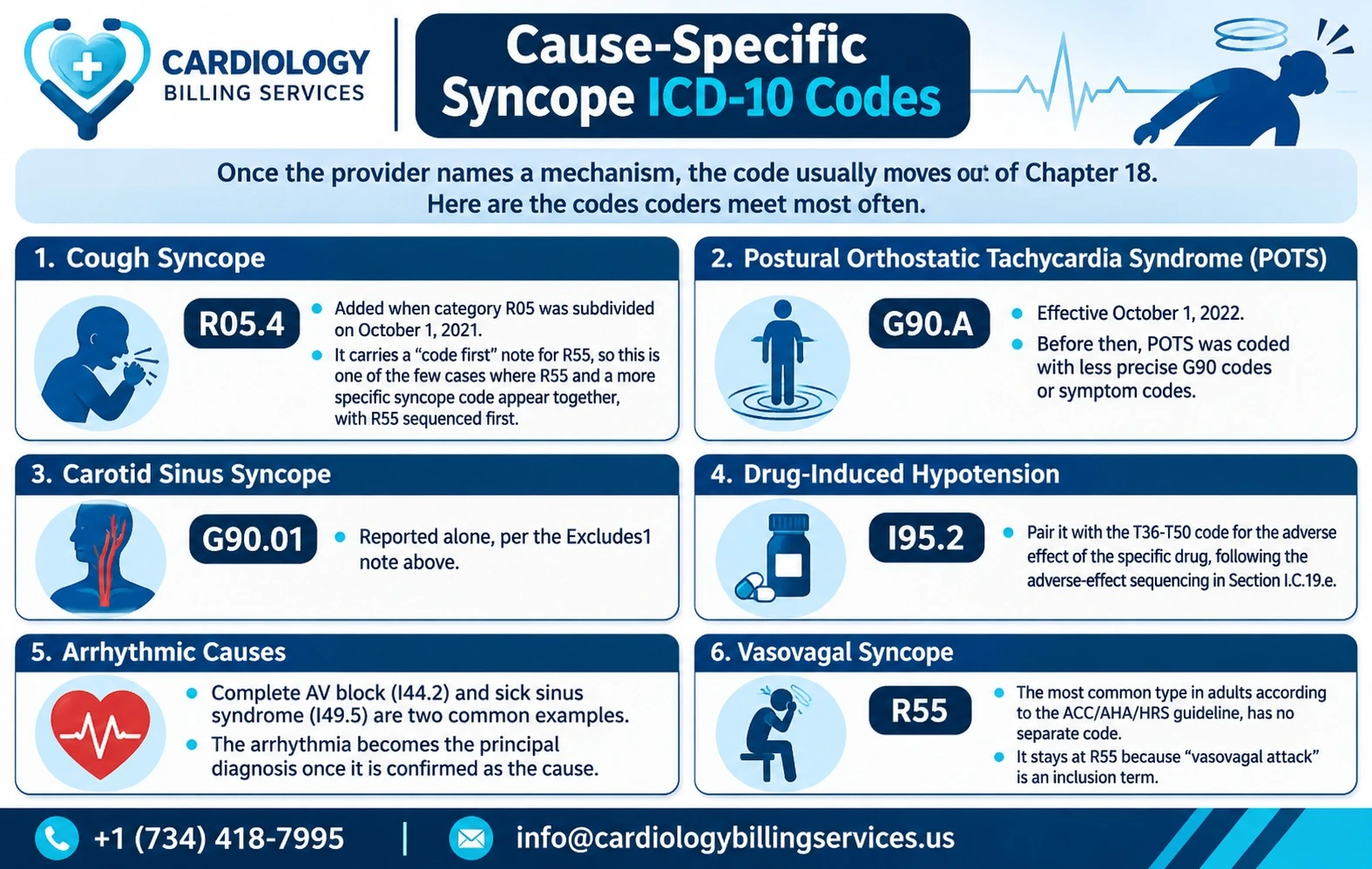
Once the provider names a mechanism, the code usually moves out of Chapter 18. These are the codes coders meet most often.
Cough syncope, R05.4. Added when category R05 was subdivided on October 1, 2021. It carries a "code first" note for R55, so this is one of the few cases where R55 and a more specific syncope code appear together, with R55 sequenced first.
Postural orthostatic tachycardia syndrome, G90.A. Effective October 1, 2022. Before then, POTS was coded with less precise G90 codes or symptom codes.
Carotid sinus syncope, G90.01. Reported alone, per the Excludes1 note above.
Drug-induced hypotension, I95.2. Pair it with the T36-T50 code for the adverse effect of the specific drug, following the adverse-effect sequencing in Section I.C.19.e.
Arrhythmic causes. Complete AV block (I44.2) and sick sinus syndrome (I49.5) are two common examples. The arrhythmia becomes the principal diagnosis once it is confirmed as the cause.
Vasovagal syncope, the most common type in adults according to the ACC/AHA/HRS guideline, has no separate code. It stays at R55 because "vasovagal attack" is an inclusion term.
Guideline Rules for Reporting R55
Three sections of the FY2027 ICD-10-CM Official Guidelines for Coding and Reporting govern most syncope decisions.
Section I.B.4 permits symptom codes when the provider has not established a related definitive diagnosis. An ED visit where syncope is evaluated and the workup is unrevealing is coded R55.
Sections I.B.5 and I.B.6 separate symptoms that are routinely part of a disease (not coded) from those that are not (coded when present). Syncope is not routinely associated with most conditions, so it can be reported alongside an unrelated confirmed diagnosis. When the confirmed diagnosis is the cause of the syncope, follow the Excludes1 notes and the Index first, then any applicable Coding Clinic advice and facility policy.
Uncertain diagnoses are where setting matters most. Section IV.H bars outpatient and professional coders from coding "probable," "suspected" or "rule out" conditions; the symptom is coded instead. Section II.H directs inpatient coders in short-term acute, long-term acute and psychiatric hospitals to code an uncertain diagnosis documented at discharge as though it were established.
The same note can produce different codes:
| Documentation | ED or Physician Claim | Inpatient Discharge |
|---|---|---|
| "Syncope, suspected sick sinus syndrome" | R55 | I49.5 |
| "Syncope, likely vasovagal" | R55 | R55 |
| "Syncope, probable orthostatic hypotension" | R55 | I95.1 |
For principal diagnosis selection, Section II.A says a symptom code is not principal when a related definitive diagnosis has been established. If the inpatient workup finds nothing, R55 is principal and the stay groups to MS-DRG 312.
Coding Falls and Injuries Caused by Syncope
Syncope frequently ends in a fall. When the injury is the reason for the encounter, the injury code goes first, followed by R55 to explain how it happened. A patient who faints, strikes the floor and fractures the nasal bones would be coded S02.2XXA, then R55.
External cause codes (W00-W19 for falls, Y92 for place of occurrence) add context. Section I.C.20 states there is no national requirement to report them, so their use depends on state mandates and payer or facility policy.
Documentation That Supports Accurate Syncope Coding
The clinical stakes explain why specificity matters. A 2019 review in Frontiers in Cardiovascular Medicine by researchers from the Universities of Alberta and Calgary reported that roughly 0.8% of ED syncope patients die and 10.3% have a non-fatal serious outcome within 30 days. A bare R55 tells payers, quality programs and future clinicians nothing about which group a patient fell into.
Providers can make the coder's job straightforward by recording:
- Whether consciousness was actually lost, as opposed to light-headedness (R42) or a mechanical fall
- The mechanism once identified: vasovagal, orthostatic, carotid sinus, cardiac arrhythmia or situational
- Explicit linkage, such as "syncope due to complete heart block"
- The drug name when hypotension is medication-related
- The status of the workup at discharge, including whether a suspected cause was confirmed, ruled out or left open
- Any injury sustained, with site and laterality
Coders should query when the record shows a likely cause in the results (an orthostatic vital sign drop, for example) but the provider never states the connection. A coder cannot assign I95.1 from vital signs alone.
Syncope ICD-10 Quick Reference
For FY2027, R55 remains the only ICD-10-CM code for unexplained syncope, fainting, blackout, vasovagal attack, near syncope and presyncope. It is replaced by a specific code whenever the provider documents orthostatic hypotension (I95.1), carotid sinus syncope (G90.01), heat syncope (T67.1XXA), Stokes-Adams attack (I45.9) or another Excludes1 condition. Cough syncope is the exception that keeps R55, sequenced before R05.4. Outpatient claims code the symptom when the cause is only suspected, inpatient records code the suspected cause at discharge, and an inpatient stay with a negative workup lands in MS-DRG 312.