

Modifier 25 in Cardiology: Complete Billing and Coding Guide (2026)

A cardiologist sees a pacemaker follow-up on the schedule, then finds during the visit that the patient has new chest pain unrelated to the device. An EKG gets pulled, an E/M service gets documented, and the claim goes out with modifier 25 attached. Whether that claim gets paid or flagged for a records request depends on documentation the coder never sees unless someone asks for it directly.
That's the core tension behind modifier 25 in cardiology: it's one of the most frequently misapplied modifiers in the specialty, and one of the most heavily audited. Same-day E/M billing in cardiology comes down to what the note supports, not what happened to occur on the calendar. This guide covers when modifier 25 applies, when it doesn't, and how it interacts with EKG billing, 99214 visits, and NCCI edits specific to cardiology.
What Is Modifier 25 in Medical Billing?
What is modifier 25? It identifies a significant, separately identifiable evaluation and management (E/M) service performed by the same physician or qualified health care professional on the same day as a procedure or other service. It's appended to the E/M code never the procedure code and tells the payer the visit involved more than the work already built into that other service.
In cardiology, this comes up constantly: an office visit paired with an EKG, a follow-up paired with a device check, or a new symptom evaluated the same day as a scheduled test. The modifier doesn't create a new service it clarifies that a service already documented in the chart stands on its own.
| Modifier 25 Is | Modifier 25 Is Not |
|---|---|
| A flag for a documented, separately identifiable E/M service | A guarantee of payment |
| Based on the actual clinical work performed | A way to bypass NCCI or payer edits |
| Applied to the E/M code only | Something to add automatically for any same-day service |
| Justified by the note | A substitute for medical necessity |
When to Use Modifier 25 in Cardiology
Same-day billing alone does not justify modifier 25 the single biggest misunderstanding in cardiology coding, and a driver of many denials and audit findings.
What Makes an E/M Service Separately Identifiable
The E/M service needs its own history, exam, and medical decision-making (or its own time-based justification) that goes beyond the pre- and post-service work already bundled into the other procedure. A different diagnosis code isn't required the same condition can prompt both services but the note must show two distinct pieces of clinical work, not one encounter described twice.
Quick Decision Guide
| Situation | Modifier 25 Likely Appropriate? |
|---|---|
| New or worsening symptom evaluated separately from a scheduled procedure | Likely yes, if documented separately |
| Routine pre-procedure assessment folded into the same note as the procedure | No |
| Established follow-up with no distinct new work beyond the diagnostic test | No |
| Physician documents separate HPI, exam, and MDM for the E/M | Likely yes |
| Modifier applied by habit on every visit that includes a same-day test | No audit risk |
Modifier 25 and EKG Billing
Office visit and EKG combinations generate the most modifier 25 questions in cardiology, and the answer is more nuanced than most articles suggest. CPT 93000 (routine ECG with at least 12 leads, with interpretation and report) doesn't carry a universal NCCI code-pair edit against standard E/M codes routine ECGs typically carry an XXX global period, not the 0- or 10-day global tied to the bundling rules that usually make modifier 25 necessary.
That doesn't make the modifier irrelevant to EKG billing. Many payers still expect it by policy whenever an E/M code and 93000 appear on the same claim, and Medicare contractors have historically assumed an EKG interpretation is part of the visit unless documentation shows otherwise. In practice:
- If the E/M exists only to justify ordering the EKG, don't append modifier 25 that's routine work tied to the test.
- If the physician evaluates a separate problem (chest pain, palpitations, unrelated medication management) and documents that work independently, modifier 25 is appropriate.
- Verify the payer's current policy and the quarterly NCCI Policy Manual before assuming either rule is universal code-pair edits update every January, April, July, and October.
The same logic applies to CPT 93010 (interpretation only) when an outside facility performs the tracing.
Modifier 25 With 99214 (and Other E/M Levels)
99214 is the E/M level most often paired with modifier 25 in cardiology, because established-patient visits at that level typically involve a chronic condition heart failure, atrial fibrillation, coronary disease managed alongside a same-day test or minor procedure. Whether 99213, 99214, or 99215 supports the modifier depends on whether the documented history, exam, and medical decision-making meet that level's own requirements. Modifier 25 doesn't change what's needed to bill 99214 in the first place.
A useful test: would the E/M service, on its own, have been billable and documented the same way if the procedure hadn't happened that day? If yes, 99214-25 is generally defensible. If the note is thin or largely restates the reason for the procedure, the modifier won't rescue an undercoded visit.
Modifier 25 Documentation Requirements for Cardiology
Documentation doesn't need a magic phrase to justify modifier 25 payers and auditors want evidence of actual, separate clinical work.
- ☐ A distinct reason for the E/M service, in the patient's complaint or the physician's assessment
- ☐ History and examination elements appropriate to the E/M level billed
- ☐ Medical decision-making (or time) reflecting work beyond the procedure itself
- ☐ An assessment and plan specific to the E/M problem, separate from the procedure note
- ☐ Clear separation between routine pre-/post-procedure work and the additional E/M work
- ☐ Diagnosis coding that reflects the actual reason for each service billed
- ☐ Consistency between what the note describes and what the claim reports
Notes structured with a clearly separated E/M section and procedure section tend to fare better under review than notes that blend both into one narrative it simply makes the separately identifiable work easier to find. For more on aligning chart documentation with claim accuracy, see our medical coding resources.
Modifier 25 and NCCI Edits
The National Correct Coding Initiative (NCCI) maintains code-pair edits that prevent certain services from being billed together without justification. Edits update quarterly, and not every E/M-plus-procedure combination in cardiology is subject to one.
An NCCI edit existing between two codes doesn't automatically mean modifier 25 should be appended it means the pairing needs review. If documentation doesn't support a separately identifiable E/M service, adding the modifier to bypass the edit is inappropriate, regardless of whether the claim happens to pay. The absence of an edit doesn't mean the modifier is never needed, either MACs and commercial insurers apply their own claim-editing logic on top of NCCI, and that logic changes. Verify current NCCI Policy Manual guidance and payer-specific edit behavior for each code pair rather than relying on an older rule.
Modifier 25 vs. Modifier 59
Modifier 25 and modifier 59 solve different coding problems. Using one in place of the other to force payment is a compliance risk, not a workaround.
| Modifier 25 | Modifier 59 | |
|---|---|---|
| Applies to | E/M service + procedure/service | Two distinct procedural services |
| Purpose | Flags separately identifiable E/M work | Flags a distinct procedural session, site, or lesion |
| Common cardiology use | Office visit + EKG or device check | Two diagnostic studies otherwise bundled by NCCI |
If a claim is denied for bundling, fix it by identifying which modifier actually reflects the documented circumstances not by substituting whichever one is more likely to pay.
Cardiology Modifier 25 Examples
The scenarios below are educational and illustrative; actual coding decisions should rest on the specific documentation and current payer policy.
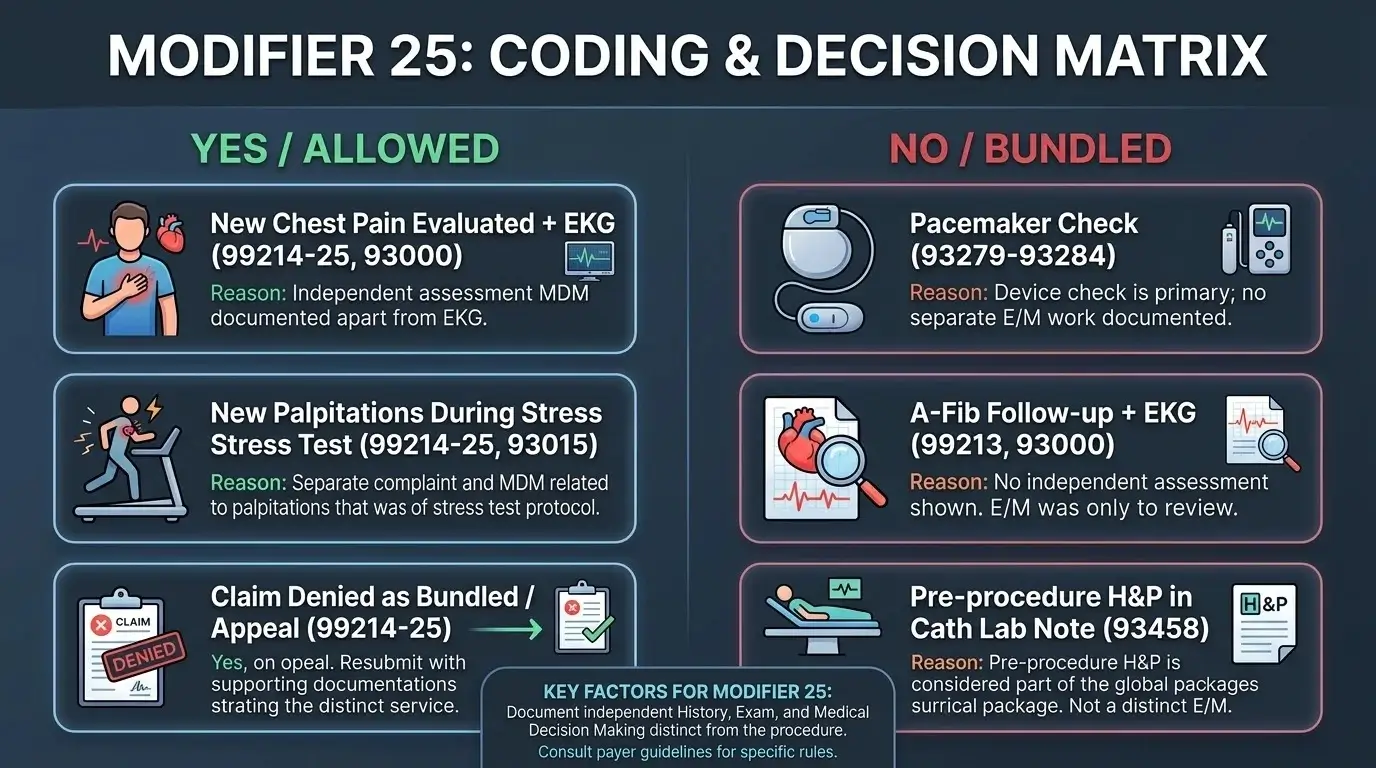
When Not to Use Modifier 25
- The E/M exists only to decide whether to perform a procedure that same day (modifier 57 may apply instead, for major procedures)
- The note describes one encounter, not two distinct pieces of work
- The modifier is applied automatically to every visit with a same-day test
- Documentation is thin, and modifier 25 is added to try to secure payment anyway
- The "separate" complaint is really routine follow-up on the condition prompting the procedure
Common Modifier 25 Denials in Cardiology
Most modifier 25 denials trace back to a handful of recurring issues rather than one payer rule.
| Denial Reason | Corrective Action |
|---|---|
| Unsupported or insufficient E/M documentation | Review the record before resubmitting; strengthen chart structure |
| Diagnosis doesn't match the E/M reason | Confirm ICD-10 coding reflects the actual E/M complaint |
| Habitual modifier use flagged by payer analytics | Audit modifier-25 frequency internally; correct the pattern |
| NCCI or payer bundling edit applied | Verify the current edit; append only if documentation supports it |
| Modifier attached to the procedure code instead of the E/M | Confirm the modifier sits on the E/M line only |
| Routine pre-/post-procedure work billed as a separate E/M | Coach providers on separately identifiable criteria |
Repeat denials on the same code pair signal a documentation or workflow issue, not a one-off coding fix.
Medicare and Commercial Payer Considerations
Medicare Administrative Contractors generally follow CMS and NCCI guidance, but retain discretion in claim review, record requests, and audit selection, and that varies by jurisdiction. Modifier 25 is also one of the more frequently reviewed modifiers in Medicare audit activity, so claim patterns matter as much as any single claim.
Commercial payers aren't bound to Medicare's rules. Some require modifier 25 on any same-day E/M regardless of NCCI status; others follow NCCI closely; others reduce payment for the lower-valued code in a pair, independent of the modifier. Verify each payer's current manual rather than assuming a rule carries over automatically.
A Practical Workflow for Reviewing Modifier 25
- Review the full encounter, not just the billing sheet.
- Identify every service actually performed.
- Confirm a genuine, separately identifiable E/M service was documented and medically necessary.
- Confirm the note supports the E/M level being billed.
- Check current NCCI edits and payer-specific policy for the code pair.
- Submit the claim with modifier 25 on the E/M code only.
- Track denials and payer responses by code pair.
- Periodically audit modifier-25 frequency for patterns that could draw scrutiny.
How Cardiology Billing Services Can Help
Modifier 25 sits at the intersection of documentation, coding judgment, and payer policy exactly where cardiology practices tend to lose revenue or attract audit attention. A coding review can catch documentation gaps before claims go out, rather than after a denial arrives.
Our cardiology billing services team reviews modifier-25 patterns as part of routine claims review and works with providers on documentation structure. When denials occur, our denial management process identifies whether the root cause is documentation, coding, or policy and corrects it. For a second opinion on a specific claim pattern, contact us.
FAQs About Modifier 25 in Cardiology
What qualifies for modifier 25?
A significant, separately identifiable E/M service one with its own documented history, exam, and medical decision-making beyond the work already included in the same-day service.
Do you need modifier 25 for an office visit and EKG?
Not automatically there's no blanket NCCI edit requiring it for routine ECG (93000) but many payers expect it by policy, and it's appropriate whenever the visit involves separately documented E/M work.
When should modifier 25 not be used?
When the note only describes routine work leading up to or following the procedure, or when it's applied automatically regardless of documentation.
Can modifier 25 be used with 99214?
Yes, when the visit independently meets 99214's requirements and that work is separately identifiable from the same-day procedure.
Can modifier 25 be used with 99213 or 99215?
Yes it applies to any E/M level, provided documentation supports both the level billed and its separate identifiability.
Does modifier 25 guarantee payment?
No. It flags a claim for consideration; documentation still has to support it, and payer-specific edits still apply.
How does modifier 25 relate to NCCI edits?
NCCI edits flag code pairs that need review before billing together. An edit's presence doesn't automatically justify modifier 25, and its absence doesn't mean the modifier is never needed.
What's the difference between modifier 25 and modifier 59?
Modifier 25 flags a separately identifiable E/M service; modifier 59 flags a distinct procedural service. They aren't interchangeable.
Why do modifier 25 claims get denied?
Usually insufficient E/M documentation, diagnosis mismatches, habitual use flagged by payer analytics, or bundling edits applied without a supporting justification.
Does Medicare treat modifier 25 the same as commercial payers?
Not always. MACs generally follow CMS and NCCI guidance, but commercial payers set their own policies always verify current payer policy.
Key Takeaways
- Same-day billing alone never justifies modifier 25 documentation does.
- Append modifier 25 to the E/M code only, never the procedure code.
- No universal NCCI edit ties routine EKG (93000) to E/M codes, but payer policy often still expects the modifier.
- 99214-25 is defensible only when the visit meets 99214's own requirements independent of the procedure.
- Modifier 25 and modifier 59 solve different problems and aren't interchangeable.
- Medicare and commercial payers can treat the same code pair differently verify current policy before assuming a rule applies universally.
Conclusion
Modifier 25 in cardiology rewards precise documentation and penalizes shortcuts. With EKGs, device checks, and diagnostic tests routinely sharing a visit with genuine E/M work, getting the distinction right protects both revenue and audit exposure. A claim pattern that keeps triggering denials or record requests is usually a sign to review the documentation workflow not just the modifier.




