
What Are EHR Billing Services?
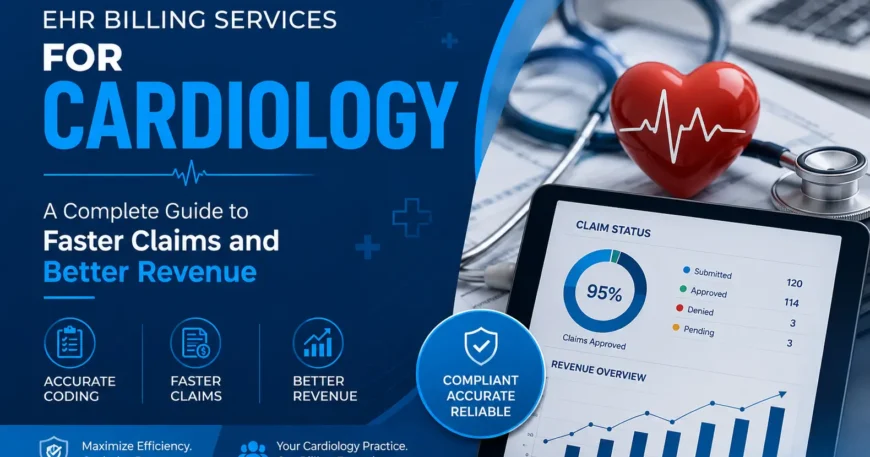
EHR billing services combine electronic health record data (patient demographics, clinical notes, diagnosis codes, and procedure documentation) with the billing workflow that turns that data into a submitted insurance claim. Instead of a biller manually re-entering information from a chart into a separate billing system, the EHR passes structured data straight into claim generation.
According to the Office of the National Coordinator for Health Information Technology (ONC), 91% of office-based physicians had adopted a certified EHR by 2024, up from about 4 in 10 in 2008. Certified EHR technology, as defined under the ONC Health IT Certification Program, must meet specific data-capture and interoperability standards set by the Department of Health and Human Services (HHS).
That certification matters for billing because it determines whether a system can reliably export the structured data that clean claims depend on.
For cardiology specifically, EHR billing services typically cover:
- Charge capture tied to clinical documentation, including echocardiograms, catheterizations, device checks, and stress tests
- ICD-10-CM diagnosis coding matched to cardiac conditions documented in the note
- CPT and HCPCS procedure coding reviewed against payer-specific edits
- Eligibility verification before the appointment
- Prior authorization tracking for cardiac procedures and imaging
- Electronic claim submission and payer response monitoring
- Denial identification, correction, and resubmission
Practices researching this topic often ask how EHR improves medical billing in practical terms. The honest answer is that EHR does not improve billing by itself. It improves billing when documentation templates, coding rules, and claim scrubbing logic are built around the specialty using the system.
A general-purpose EHR configured for primary care will not flag the same errors a cardiology-specific workflow catches, because the underlying charge rules are different.
Why Cardiology Billing Is Harder Than General Medical Billing
Cardiology combines cognitive visits, diagnostic testing, and procedural work under one roof. That mix creates coding challenges that do not exist in single-service specialties.
Bundling and Modifier Rules
Many cardiac procedures fall under CMS's National Correct Coding Initiative (NCCI) edits, which define when two procedure codes can be billed together and when one is considered bundled into the other.
Missing a required modifier, such as modifier 26 for the professional component of an interpreted test, is one of the common reasons cardiology claims are rejected before they even reach adjudication.
Global Periods
Cardiac procedures carry post-operative global periods set by CMS, ranging from 0 to 90 days depending on the procedure. Billing an unrelated evaluation and management visit during that window without the correct modifier commonly triggers a denial.
Device and Imaging Documentation
Codes for pacemaker and defibrillator interrogation, nuclear cardiology studies, and vascular ultrasound each require specific documentation elements. If the clinical note does not support medical necessity in the language the payer expects, the claim is vulnerable even when the code itself is correct.
Prior Authorization Volume
Cardiology relies heavily on imaging and interventional procedures, categories that payers frequently subject to prior authorization. According to the American Medical Association's 2024 prior authorization physician survey of 1,000 practicing physicians, 94% reported that prior authorization delays access to necessary care.
Physicians completed an average of 39 prior authorizations per week, spending roughly 13 hours on the process. For a cardiology practice ordering frequent stress tests, catheterizations, and structural heart procedures, that burden falls disproportionately on scheduling and billing staff.
Real-World Cardiology Billing Challenge
Our interventional cardiology billing team sees this pattern often: a clean clinical outcome followed by a denied claim because the authorization on file did not match the procedure code ultimately billed.
How EHR Integration Reduces Claim Denials
Claim denials are rising across the industry, not only in cardiology. Experian Health's State of Claims 2025 report, based on a survey of 250 healthcare professionals conducted in mid-2025, found that 41% of providers said at least one in ten claims is denied, up from 30% in 2022.
Separately, revenue cycle analysis published by OS Inc. in 2025 put the initial claim denial rate at 11.8% in 2024, up from 10.2% a few years earlier, with Medicare Advantage denials rising faster than commercial plan denials.
Eligibility Verification at Scheduling
When the EHR checks insurance eligibility electronically before the visit, staff catch coverage lapses, inactive policies, or referral requirements before the patient is seen rather than after the claim is denied.
Real-Time Coding Edits
Cardiology-specific claim scrubbing checks CPT and ICD-10 combinations against NCCI edits and payer-specific rules before submission, catching bundling conflicts and missing modifiers.
Structured Documentation Prompts
Templates built for cardiology encounters prompt the physician to document elements payers require for medical necessity, such as symptom duration, prior treatment, and test indications.
Fewer Manual Transcription Errors
When charge information flows from the clinical note into the claim without re-keying, transposed diagnosis codes and mismatched dates of service become less common.
Our denial management process works from the same principle: most denials trace back to a documentation or eligibility issue that existed before the claim was ever submitted, which means the more effective fix happens upstream in the EHR workflow, not after the payer rejects the claim.
The Role of EHR in Cardiology Revenue Cycle Management
Revenue cycle management covers every financial step from patient scheduling to final payment posting. In cardiology, EHR integration touches each stage differently.
| Revenue Cycle Stage | Role of EHR Integration |
|---|---|
| Patient scheduling and registration | Captures demographics and insurance details once, feeding both the clinical record and the billing system. |
| Eligibility and benefits verification | Electronic eligibility checks confirm active coverage and cardiology-specific benefit limits before the visit. |
| Clinical documentation | Cardiology-specific templates capture the elements needed to support CPT and ICD-10 code selection. |
| Coding and charge capture | Diagnosis and procedure codes are generated from documented clinical content rather than re-entered manually. |
| Claim scrubbing | Automated edits check for NCCI conflicts, missing modifiers, and payer-specific requirements before submission. |
| Electronic claim submission | Claims are transmitted through clearinghouses using HIPAA-standard electronic transaction formats. |
| Payment posting and reconciliation | Electronic remittance advice (ERA) is matched against expected contracted rates to flag underpayments. |
| Denial management | Denial reason codes are tracked back to the documentation or coding step that caused them. |
This structure is why cardiology practices researching revenue cycle management for cardiology tend to see the biggest gains not from any single tool, but from removing the handoff gaps between clinical documentation and billing steps.
Common Cardiology Billing Challenges and Practical Solutions
Challenge: Incomplete Documentation for Diagnostic Tests
Echocardiograms, stress tests, and Holter monitors each require specific interpretive elements to support medical necessity. Solution: Build structured note templates that prompt for indication, findings, and interpretation before the encounter can be closed, so incomplete documentation is caught before the claim is generated.
Challenge: Prior Authorization Delays for Interventional Procedures
Cardiac catheterizations, structural heart procedures, and advanced imaging frequently require authorization that must match the final billed code. Solution: Track authorization status inside the same system used for scheduling and coding, so any mismatch between the authorized code and the planned procedure is flagged before the patient arrives.
Challenge: Modifier Errors on Bundled Procedures
NCCI edits govern which cardiac procedure combinations require a modifier to be paid separately. Solution: Use claim scrubbing rules specific to cardiology CPT combinations rather than generic edit sets built for primary care.
Challenge: Device and Remote Monitoring Billing
Codes for pacemaker, implantable loop recorder, and defibrillator monitoring have specific frequency limits and require attestation of the data reviewed. Solution: Document monitoring review dates and clinical interpretation directly in the EHR at the time of review, not retrospectively at billing.
Challenge: Slow Claim Follow-Up
Practices that only review denials in batches lose time that could be spent on timely appeals, some of which have strict payer filing deadlines. Solution: Set automated alerts for denied and pending claims so follow-up starts within days rather than weeks.
Which EHR Features Improve Cardiology Billing Accuracy?
Not every EHR feature affects billing equally. The features that make the most measurable difference in cardiology include:
- Specialty-specific templates that prompt for cardiology documentation elements rather than generic fields
- Integrated eligibility verification that runs automatically ahead of scheduled visits
- CPT and ICD-10 crosswalk tools that suggest codes based on documented findings, reviewed by a certified coder before submission
- Claim scrubbing rules built around NCCI edits relevant to cardiac procedures
- Interoperability with hospital and lab systems so results and referral documentation transfer without manual re-entry
- Audit trail and access controls that satisfy HIPAA Security Rule requirements for protected health information
On interoperability specifically, ONC data shows steady growth in the share of physicians electronically sending, receiving, and integrating outside health information into their own EHR, a trend directly relevant to cardiology given how often care is coordinated between a cardiologist, a primary care physician, and hospital-based specialists.
Compliance Considerations: HIPAA and Documentation Standards
Any system that transmits patient billing information electronically must meet HIPAA's Privacy Rule and Security Rule requirements, including access controls, audit logging, and encryption standards for data in transit and at rest. Billing staff handling cardiology claims should also apply the AMA's CPT coding guidelines correctly, since CPT codes are proprietary to the AMA and updated annually, with cardiology-relevant changes typically affecting cardiac catheterization, electrophysiology, and structural heart procedure codes. Documentation retention requirements also matter for cardiology practices given the frequency of appeals on denied claims. Medicare generally requires supporting documentation to be retained for a minimum number of years following the claim, and specific requirements can vary by payer and claim type, so practices should confirm current retention rules with their Medicare Administrative Contractor or applicable payer before finalizing a records policy.
How Cardiology Practices Can Increase Reimbursement With EHR
Increasing reimbursement is less about any single software feature and more about closing gaps between clinical work and billed claims. Practices that see measurable improvement typically focus on:
- Verifying eligibility and benefits before every visit, not only for new patients
- Confirming prior authorization status matches the actual planned procedure, not just the initial request
- Using cardiology-specific coding edits rather than generic claim scrubbing
- Reviewing denial trends monthly to identify recurring root causes rather than treating each denial as an isolated event
- Posting payments against contracted rates to catch underpayments, not just confirming that a payment was received
Practices evaluating whether to manage this internally or bring in specialized support can review our cardiology medical billing and medical coding services pages, or read our related guide on cardiology CPT codes for a breakdown of commonly billed procedure codes.
Frequently Asked Questions
What are EHR billing services?
EHR billing services connect electronic health record documentation directly to the medical billing and claims process, reducing manual re-entry and supporting more accurate coding.
How does EHR improve medical billing?
It reduces transcription errors, prompts for documentation payers require, and allows claim scrubbing to run against the same data used for clinical care, provided the system is configured for the specialty using it.
What are the benefits of EHR billing services for cardiology practices?
Benefits include fewer coding errors on bundled procedures, better prior authorization tracking for interventional and imaging services, and faster identification of denial trends specific to cardiac claims.
How does EHR integration reduce claim denials?
By verifying eligibility before the visit, flagging missing modifiers or bundling conflicts before submission, and prompting documentation that supports medical necessity.
What is the role of EHR in revenue cycle management?
EHR data feeds every stage of the revenue cycle, from registration and eligibility verification through coding, claim submission, payment posting, and denial follow-up.
How does electronic claim submission work in cardiology?
Claims are generated from coded clinical data, scrubbed against payer and NCCI edit rules, then transmitted through a clearinghouse using HIPAA-standard electronic transaction formats, with responses tracked back into the same system.
What are common cardiology billing challenges?
Frequent challenges include modifier errors on bundled cardiac procedures, prior authorization mismatches for interventional and imaging services, and incomplete documentation for diagnostic tests like echocardiograms and stress tests.
Final Thoughts
Cardiology billing succeeds or fails on the accuracy of the documentation behind each claim. EHR systems configured with cardiology-specific templates, eligibility checks, and coding edits give practices a real chance at cleaner first-pass claims. Practices without the internal resources to build and maintain that configuration often turn to specialized billing partners who already carry the cardiology-specific rule sets in place. Anyone reviewing their own claim denial trends can start with a simple exercise: pull the last quarter of denials and sort them by root cause. The pattern that shows up most often is usually the first place worth fixing.