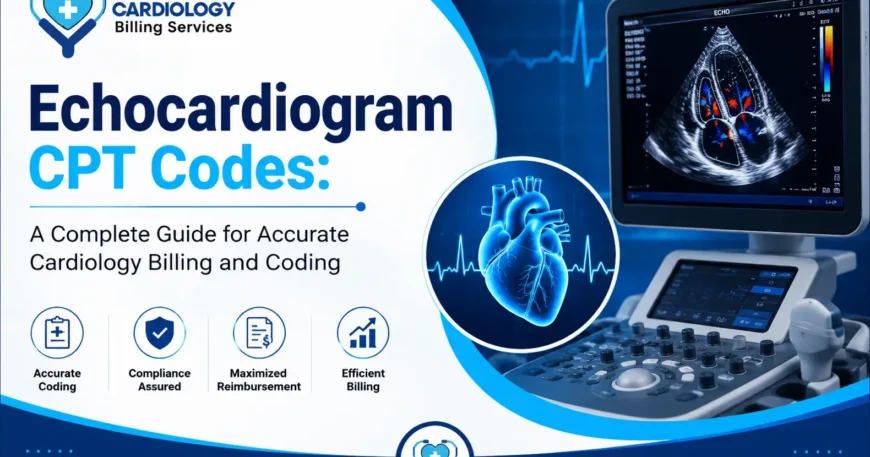
Echocardiogram CPT Codes: A Complete Guide for Accurate Cardiology Billing and Coding

Echocardiography is one of the most frequently ordered cardiac diagnostic tests in the United States and it is also one of the more commonly misbilled services on a cardiology superbill. A single missed component, an undocumented Doppler study, or a mismatched modifier can turn a properly performed exam into a denied claim. Getting the echocardiogram CPT codes right is not a formality. It determines whether a practice gets paid for the work it actually did.
This guide walks through the CPT codes used for transthoracic, transesophageal, stress and congenital echocardiography, along with the documentation each one requires and the mistakes that trigger the most denials.
Why echo CPT coding is harder than it looks
Echocardiography CPT coding isn’t a single code per test. The American Medical Association (AMA) built the code set around the specific components performed: whether the study is complete or limited, whether Doppler and color flow imaging were included, whether the approach was transthoracic or transesophageal and whether the exam was done at rest or under stress. Two cardiologists can perform what looks like “an echo” on two different patients and end up billing entirely different codes, because the scope of what was actually captured and interpreted differs.
Payers, including Medicare Administrative Contractors, publish Local Coverage Determinations that spell out which ICD-10-CM diagnosis codes support medical necessity for each echo CPT code. A claim that pairs the right procedure code with an unsupported diagnosis code gets denied just as fast as one with the wrong procedure code.
Transthoracic echocardiogram CPT codes (TTE)
A transthoracic echocardiogram, or TTE, is the standard cardiac ultrasound performed through the chest wall. It’s the test most people mean when they say “echocardiogram,” and it has three primary CPT codes depending on scope.
CPT code 93306 describes a complete transthoracic echocardiogram with 2D imaging, M-mode recording when performed, spectral Doppler and color flow Doppler. This is the most heavily billed echo code in cardiology because it captures the full standard exam: chamber size, wall motion, valve function and blood flow assessment in one service. To support 93306, the report needs documented 2D images, M-mode measurements where applicable, spectral Doppler tracings and color flow Doppler images, along with a signed physician interpretation. If any one of those components is missing from the documentation, the claim is vulnerable to downcoding.
CPT code 93307 covers a complete transthoracic echocardiogram without spectral or color Doppler. The exam still has to be complete in scope, meaning all standard cardiac structures are evaluated, but no Doppler flow data is captured. This code shows up less often in routine adult cardiology, since most complete studies do include Doppler, but it’s the correct choice for imaging-only complete exams.
CPT code 93308 is the follow-up or limited study code. It applies when a physician is reassessing a single known finding, such as tracking a previously identified pericardial effusion, rather than performing a full cardiac evaluation. Because 93308 pays less than 93306, some practices are tempted to bill 93306 for what was actually a focused follow-up. That’s one of the more common audit triggers cited in Medicare coverage articles and it’s worth building a documentation checklist specifically to catch it before claims go out.
| CPT code | Scope | Doppler included |
| 93306 | Complete TTE | Yes (spectral and color) |
| 93307 | Complete TTE | No |
| 93308 | Limited or follow-up TTE | Varies by case |
Doppler and color flow add-on codes
Doppler studies aren’t always bundled into the base echo code, which is where the add-on codes come in.
CPT code 93320 reports complete spectral Doppler echocardiography, listed separately in addition to the primary imaging code. CPT code 93321 is the limited version of the same service, used when only a portion of the Doppler evaluation was performed. CPT code 93325 reports color flow velocity mapping, again as an add-on to the base echocardiographic imaging code.
These three codes matter most when billing 93307 (complete TTE without Doppler) or a transesophageal study, since the base code alone doesn’t capture the flow assessment. Coders sometimes forget to append 93320 or 93325 when the base procedure code doesn’t already include Doppler in its own description, which quietly leaves reimbursable work off the claim.
Congenital echocardiogram CPT codes
Pediatric and congenital heart disease imaging uses its own set of codes because the anatomy and clinical questions differ substantially from adult acquired heart disease.
CPT code 93303 applies to a complete transthoracic echocardiogram for congenital cardiac anomalies. CPT code 93304 is the corresponding follow-up or limited study for congenital anomalies. Practices that see both adult and pediatric patients need to be careful not to default to 93306 out of habit when the clinical indication is a congenital defect; the 93303/93304 family exists specifically because congenital anatomy requires a different, more extensive protocol than a standard adult exam.
Transesophageal echocardiogram CPT codes (TEE)
A transesophageal echocardiogram involves passing a probe into the esophagus to get closer, higher-resolution images of the heart, typically when a transthoracic study doesn’t answer the clinical question or when the surgical team needs real-time intraoperative guidance. TEE coding is structured around who performs which part of the service, which is different from the TTE approach.
CPT code 93312 is the global TEE code: probe placement, image acquisition, interpretation and report, all performed by the same physician. This is the code used in the large majority of standard non-intraoperative TEE studies.
CPT code 93313 reports probe placement only, used when one physician places the probe and a different physician acquires the images and writes the report.
CPT code 93314 reports image acquisition, interpretation and report only, the counterpart to 93313 when the professional performing the exam and reporting is not the one who placed the probe.
This split matters most in hospital settings, where an anesthesiologist may place the TEE probe for a cardiac procedure while a cardiologist reads and reports the study. According to guidance published by the American College of Emergency Physicians’ emergency ultrasound section, this two-physician scenario is exactly when 93313 and 93314 apply instead of the bundled 93312.
For congenital cases, TEE has its own parallel codes: 93315 for the complete service (probe placement, image acquisition, interpretation and report) and 93317 for image acquisition, interpretation and report only, mirroring the split structure of 93312 through 93314.
There’s an important documentation gap worth flagging: unlike TTE, there is no separately defined “limited TEE” CPT code. When a TEE is abbreviated for clinical reasons, coders sometimes append modifier 52 (reduced services) to 93312 rather than searching for a code that doesn’t exist. That approach can reduce reimbursement, so it’s worth confirming payer-specific policy before defaulting to it on every abbreviated study.
Stress echocardiogram CPT codes
Stress echocardiography combines cardiac ultrasound with a cardiovascular stress test, either exercise on a treadmill or pharmacologic stress using dobutamine, adenosine, or regadenoson. The distinction between the two primary CPT codes comes down to a single question: who is running the ECG monitoring during the stress portion.
CPT code 93350 reports transthoracic echocardiography performed during rest and cardiovascular stress, with interpretation and report, when the physician billing the echo is not also billing for the continuous ECG monitoring component of the stress test. In this scenario, the stress test itself (using codes such as 93016 or 93018) is billed separately.
CPT code 93351 is the more complete, bundled code. It reports the stress echocardiogram along with continuous ECG monitoring performed by the same supervising physician, combining the imaging and the monitoring into a single global service. Because it folds more physician work into one code, 93351 carries a higher relative value than 93350.
CPT code 93352 is the add-on code for use of an echocardiographic contrast agent during stress echocardiography. It’s reported alongside 93350 or 93351, never billed on its own and it applies in both office and hospital settings according to guidance from the American Society of Echocardiography.
A practical scenario illustrates the distinction: if a cardiology group performs an exercise stress echo where the interpreting cardiologist personally supervises the treadmill portion and monitors the ECG throughout, 93351 is the correct code. If a separate provider or facility handles the ECG monitoring and the cardiologist only reads and reports the echo images, 93350 applies instead and the ECG monitoring is billed under its own code by whoever performed it.
Modifier 26 and modifier TC: professional versus technical component
Many echocardiogram CPT codes can be split into a professional component and a technical component, particularly relevant when the equipment and sonographer belong to one entity (often a hospital or imaging center) and the interpreting physician bills separately.
Modifier 26 reports the professional component only, meaning the physician’s interpretation and written report, without the equipment, supplies, or technologist time. Modifier TC reports the technical component only, covering the equipment, the sonographer’s work and the facility overhead, without the physician interpretation. When the same entity performs and bills both parts, no modifier is appended and the code is billed globally.
Getting this split wrong is a frequent source of denials in outpatient imaging centers that lease equipment or contract with independent sonographers, since payers will reject a global claim if the technical and professional components were actually performed by two different billing entities.
Documentation requirements that support medical necessity
Local Coverage Determinations published through the Medicare Coverage Database specify the components a complete transthoracic echocardiogram report needs at minimum: left ventricular end diastolic and end systolic diameters, left ventricular wall thickness, left atrial diameter, aortic valve excursion, a qualitative description of left ventricular function and a note of any technical limitations encountered during the study. Valid substitute measurements are accepted in some circumstances, but the report has to explain why a standard measurement wasn’t obtainable rather than simply omitting it.
For TEE specifically, coverage guidance from Medicare contractors states that CPT codes 93312 and 93314 require both image documentation and a written interpretation to satisfy billing requirements, whether the study was performed for a non-intraoperative diagnostic reason or for intraoperative monitoring.
Missing even one of these elements doesn’t necessarily mean the test wasn’t medically necessary. It means the claim can’t prove it was, which is a distinction auditors don’t treat the same way billers might.
Common coding errors and how they get flagged
A few patterns show up repeatedly in claim denials and post-payment audits for echocardiography:
- Billing 93306 when the documentation only supports a limited or follow-up study (93308).
- Omitting the Doppler add-on codes (93320, 93325) when billing 93307, which under-reports the work performed.
- Using the global TEE code (93312) when two different physicians actually split the probe placement and interpretation, which should be billed as 93313 and 93314.
- Reporting 93352 for stress echo contrast without a parent code (93350 or 93351) on the same claim, since it is not a standalone service.
- Applying modifier 26 or TC inconsistently with who actually owns the equipment and who performed the interpretation.
Every one of these errors is preventable with a documentation template that mirrors the payer’s coverage requirements rather than a generic exam note. Practices that route their coding through a dedicated cardiology billing team, such as the workflows described by Cardiology Billing Services, typically build that template once and apply it consistently across every echo study rather than leaving code selection to individual judgment call by call.
Putting it together
Echocardiogram CPT coding comes down to matching the code to exactly what was performed and documented, not to what the test is generally called. A complete TTE with Doppler is 93306. Without Doppler, it’s 93307. A focused follow-up is 93308. Congenital studies shift to 93303 and 93304. TEE splits by who placed the probe versus who interpreted the images, landing on 93312, 93313, or 93314. Stress echo comes down to who ran the ECG monitoring, separating 93350 from 93351, with 93352 layered on only when contrast was used. None of these codes are interchangeable and the documentation standard behind each one is specific enough that a coder can usually tell, from the report alone, whether the claim will hold up under review.