CPT Code for Cardiology Office Visit: Complete Billing Guide (2026)

INTRO
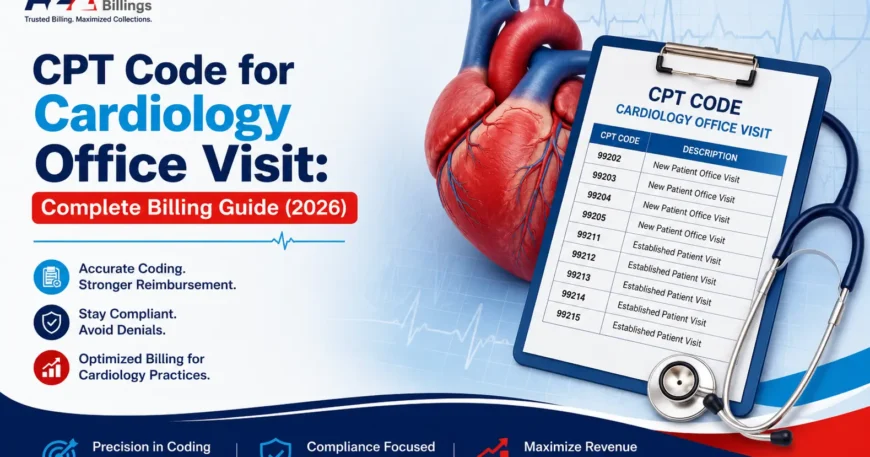
Cardiology practices bill more evaluation and management visits than almost any other specialty, yet the CPT code for a cardiology office visit is still widely misunderstood. Cardiologists don’t use a specialty-specific set of office visit codes. They use the same Evaluation and Management (E/M) codes as internal medicine, family practice, and most outpatient specialties: CPT 99202-99205 for new patients and CPT 99211-99215 for established patients. What sets cardiology billing apart isn’t the code set, it’s the clinical picture behind it: layered chronic disease, frequent medication titration, and diagnostic testing that often happens during the same visit.
Getting the code level right, and documenting it correctly, affects reimbursement, payer compliance, and audit exposure. This guide covers the cardiology coding guidelines behind CPT 99202-99215, how Medical Decision Making and time-based coding work under the framework CMS adopted in 2021 and continues to use in 2026, and the documentation habits that keep cardiology E/M claims clean.
What are CPT codes for cardiology office visits?
Evaluation and Management services, explained
Evaluation and Management (E/M) codes describe the cognitive work involved in assessing a patient and deciding how to manage their condition: taking a history, examining the patient, reviewing records, and reasoning through a diagnosis or treatment plan. The American Medical Association (AMA) maintains the CPT code set that defines these codes, and the Centers for Medicare & Medicaid Services (CMS) adopts them for Medicare billing.
Why cardiologists use standard office visit E/M codes
There’s no separate CPT series for cardiology visits. A cardiologist seeing a patient with atrial fibrillation reports the same 99202-99215 range a primary care physician uses for a routine follow-up. What differs is the clinical content behind the code: the number of chronic conditions addressed, the complexity of the data reviewed (echocardiogram reports, stress test results, prior hospitalization notes), and the risk tied to decisions like starting an anticoagulant or adjusting a heart failure regimen. Assuming that specialty complexity alone justifies a higher-level code, without documentation to match, is a common and avoidable source of audit risk.
E/M codes versus procedure codes
E/M codes cover the visit itself: the evaluation and the decision-making. Procedure codes, like those for an echocardiogram or an ECG, cover a specific diagnostic or therapeutic service. Cardiology visits frequently include both an E/M code for the encounter and one or more procedure codes for testing performed the same day, a distinction covered later in this guide.
Cardiology office visit CPT codes (2026)
Office and outpatient E/M codes split into two families depending on whether the patient is new or established. A patient is new if they haven’t received a professional service from that physician, or from another physician of the same specialty and subspecialty in the same group practice, within the past three years. Otherwise, the patient is established. CPT 99201 was deleted from the code set effective January 1, 2021, so 99202 is now the lowest-level new patient office visit code, and the core MDM-or-time structure introduced that year remains unchanged for 2026.
New patient CPT codes: 99202-99205
| CPT code | MDM level | Typical total time | Documentation expectations |
|---|---|---|---|
| 99202 | Straightforward | 15-29 minutes | One self-limited or minor problem; minimal data reviewed; minimal risk |
| 99203 | Low | 30-44 minutes | Two or more self-limited problems, one stable chronic illness, or one acute uncomplicated illness; limited data; low risk |
| 99204 | Moderate | 45-59 minutes | One or more chronic illnesses with exacerbation or progression, two or more stable chronic illnesses, or an undiagnosed problem with uncertain prognosis; moderate data; moderate risk, such as prescription drug management |
| 99205 | High | 60-74 minutes | One or more chronic illnesses with severe exacerbation or progression, or a problem posing a threat to life or bodily function; extensive data; high risk, such as drug therapy requiring intensive toxicity monitoring |
Established patient CPT codes: 99211-99215
| CPT code | MDM level | Typical total time | Appropriate usage |
|---|---|---|---|
| 99211 | Not MDM or time based | Typically brief | A visit that may not require the presence of a physician or other qualified health care professional, such as a nurse visit for a blood pressure check |
| 99212 | Straightforward | 10-19 minutes | A stable, minor issue in an existing patient |
| 99213 | Low | 20-29 minutes | One stable chronic condition, such as well-controlled hypertension, or a low-complexity acute problem |
| 99214 | Moderate | 30-39 minutes | A chronic condition with exacerbation or progression, or two or more stable chronic conditions, often involving prescription drug management |
| 99215 | High | 40-54 minutes | Severe exacerbation of a chronic condition, or a condition posing a threat to life or bodily function |
Understanding Medical Decision Making (MDM)
Since the 2021 overhaul of office and outpatient E/M guidelines, code selection for 99202-99215 depends on MDM or total time, not on the volume of history or exam documented. MDM has three elements, and a code level is supported when the encounter meets or exceeds the requirements of at least two of the three.
Number and complexity of problems addressed
This element counts the conditions actually evaluated, treated, or considered at the visit, not everything sitting on the patient’s problem list. A stable arrhythmia that isn’t discussed that day doesn’t count toward this element. A single new complaint, such as intermittent palpitations, may support straightforward or low complexity. A worsening chronic condition, such as heart failure with new lower-extremity edema, typically supports moderate complexity. Multiple unstable conditions, such as decompensated heart failure alongside new-onset atrial fibrillation with rapid ventricular response, can support high complexity.
Amount and complexity of data reviewed
This element covers records reviewed, tests ordered, independent interpretation of a test, and discussions with other treating clinicians. Ordering an echocardiogram or reviewing a recent lipid panel counts here, as does independently interpreting a tracing that isn’t separately billed. A phone discussion with a referring physician or an electrophysiologist about the patient’s management adds further weight toward a higher data category.
Risk of complications or treatment
Risk reflects the potential consequences of the decisions made at the visit, not the severity of the diagnosis by itself. Prescription drug management, such as starting or adjusting an antihypertensive, antiarrhythmic, or anticoagulant, typically supports moderate risk. Drug therapy requiring intensive toxicity monitoring, such as amiodarone or warfarin management, along with decisions about hospitalization, generally supports high risk.
MDM in practice: a cardiology example
An established patient on a stable beta-blocker dose for well-controlled hypertension returns for a routine follow-up with no new symptoms and no medication changes. That visit typically reflects low MDM (one stable chronic illness, limited data, low risk) and supports 99213. Now consider an established heart failure patient who presents with new dyspnea and weight gain, prompting a diuretic dose increase and a same-day BNP order. An exacerbating chronic illness, moderate data, and prescription drug management together typically support 99214.
Time-based coding for cardiology visits
Instead of MDM, a physician may select the code level based on total time personally spent on the date of the encounter. This is often useful in cardiology when a visit runs long because of counseling, such as walking a newly diagnosed heart failure patient through diet, weight monitoring, and medication adherence, even when the MDM complexity alone would land at a lower level.
Total time includes both face-to-face and non-face-to-face work performed on the date of the visit, such as:
- Preparing to see the patient, including review of outside records or prior results
- Obtaining a history and performing the examination
- Counseling the patient and family
- Ordering medications, tests, or procedures
- Independently interpreting results and documenting the encounter
- Care coordination that isn’t separately reported
Total time excludes work normally performed by clinical staff, time spent on a separately billed procedure (such as the physician’s time interpreting an ECG billed under its own CPT code), and travel time. Time counted toward code selection must fall on the calendar date of the encounter. There’s no requirement to itemize every minute, but the total time and the activities performed should be documented clearly enough for a reviewer to see that the level chosen is supported.
Documentation requirements for cardiology office visits
History and exam no longer determine the E/M code level, but a medically appropriate history and examination should still be documented at every visit, both for continuity of care and because payers still expect to see them. A well-documented cardiology office visit typically includes:
History
The reason for the visit, relevant symptoms, and changes since the last encounter
Examination
Findings relevant to the cardiovascular complaint, documented to the extent medically appropriate
Assessment
The conditions actually addressed at the visit, stated clearly enough to support the MDM level selected
Treatment plan
Medication changes, referrals, or procedures ordered as a result of the visit
Follow-up
When the patient should return, or what should prompt an earlier visit
Diagnostic testing reviewed
Which prior results were reviewed and how they shaped the assessment
Medication management
Any prescription started, stopped, or adjusted, and the reasoning behind it
The assessment and plan carry the most weight for coding purposes, since they show the reasoning behind the MDM level, or the activities that justify the total time claimed. A note that lists a diagnosis without explaining how it was addressed that day gives a coder little to work with, and an auditor even less.
Common cardiology services billed separately from the office visit
Cardiology visits often include diagnostic testing on the same day as the E/M service. When that happens, the visit and the test are typically billed separately, provided each service is medically necessary and properly documented.
ECG interpretation
A routine 12-lead ECG performed and interpreted in the office is reported separately from the E/M service. If the physician only interprets a tracing obtained elsewhere, a different interpretation-only code applies.
Echocardiography
A transthoracic echocardiogram ordered during a visit, such as for new or worsening heart failure symptoms, is billed under its own code in addition to the E/M service.
Stress testing
Cardiovascular stress testing has its own family of codes, split by whether the physician supervises the test, performs the tracing, or provides the interpretation and report.
Holter monitoring
Ambulatory ECG monitoring, ordered for symptoms suggestive of an intermittent arrhythmia, is reported under its own code and is separately billable from the visit that led to the order.
Pacemaker and device checks
In-person device interrogation has its own set of codes. When a device check happens at the same visit as an unrelated cardiac complaint, both may be reported if documentation supports two distinct pieces of work.
When modifier 25 applies
Modifier 25 is appended to the E/M code to show the visit was a significant, separately identifiable service, above and beyond the usual work surrounding that day’s procedure. It doesn’t require a different diagnosis code for the E/M and the procedure, but it does require documentation showing the physician evaluated something beyond the standard pre- and post-procedure work, such as a new symptom or a comorbid condition managed during the same encounter as a same-day echocardiogram or stress test. Without that documented, payers routinely bundle the E/M into the procedure and deny it.
Medicare and payer considerations
CMS E/M guidance
CMS adopted the AMA’s 2021 office and outpatient E/M framework for Medicare billing, and that MDM-or-time structure remains the basis for coding 99202-99215 through 2026. CMS publishes E/M billing guidance through the Medicare Learning Network (MLN), including a dedicated Evaluation and Management Services booklet that outlines documentation expectations under the Medicare Physician Fee Schedule.
National Correct Coding Initiative (NCCI)
The National Correct Coding Initiative (NCCI) is a CMS program built to prevent improper payment for services that shouldn’t be reported together. In cardiology, NCCI edits most often surface when an E/M code and a same-day diagnostic test are billed without modifier 25, or when component codes for a test, such as the tracing-only and interpretation-only portions of an ECG, are billed alongside the global code for the same study.
Medical necessity
Every service billed, whether the office visit or the diagnostic test performed alongside it, must be supported by medical necessity: a documented clinical reason tied to the patient’s signs, symptoms, or condition. A diagnosis code alone does not establish medical necessity; the note needs to connect the reason for the visit or test to the service billed.
Documentation audits
Higher-level E/M codes, particularly 99204, 99205, 99214, and 99215, are frequent audit targets for CMS contractors and commercial payers alike. Practices that regularly bill these levels should expect periodic documentation requests and should keep notes that clearly support the MDM or time claimed.
Commercial payer differences
Commercial payers generally follow the AMA’s CPT framework for E/M coding, but individual coverage policies, prior authorization requirements, and audit thresholds vary by payer and by plan. Practices should verify specific payer policies directly rather than assuming Medicare rules apply across the board.
Common cardiology coding mistakes
Selecting codes based on history alone
Some practices still default to older habits, choosing a level because the history section is long, even though history and exam no longer determine the level under the current framework.
Inadequate documentation
A code level that isn’t backed by a clear assessment and plan, or by a documented total time, is difficult to defend if the claim is reviewed.
Missing modifier 25
Billing an E/M service alongside a same-day procedure without modifier 25, or without documentation showing the visit was separately identifiable, is one of the most common reasons cardiology E/M claims get denied or bundled.
Upcoding
Billing a higher-level code than the documented MDM or time supports, often on the assumption that specialty complexity alone justifies it.
Downcoding
Consistently billing lower-level codes out of caution, which under-represents the actual work performed and leaves reimbursement unclaimed.
Billing duplicate services
Reporting both a global test code and its component codes for the same study on the same date, such as billing an ECG’s global code alongside its interpretation-only component.
Ignoring medical necessity
Ordering or billing a test or visit level without a documented clinical indication tied to the patient’s presentation.
Best practices for accurate cardiology E/M coding
Physicians should document the assessment and plan in enough detail to show which problems were addressed and how they shaped that day’s decisions, choosing MDM or time deliberately for each visit rather than defaulting to whichever seems easier.
Billers should confirm modifier 25 is appended whenever an E/M service is billed with a same-day procedure, verify the documentation actually supports it before the claim goes out, and run claims through NCCI edit checks before submission.
Coders should code to what the documentation actually supports, not to what the diagnosis or specialty might imply, and should query the physician when a note doesn’t clearly support the MDM elements or the time claimed.
Practice managers should build in periodic internal audits of E/M code distribution across providers. A pattern where nearly every visit lands at the same level, regardless of clinical complexity, is one of the most common triggers for a payer audit.
Frequently asked questions
Conclusion
The CPT code for a cardiology office visit isn’t a single, specialty-specific number. It’s a selection from the standard E/M code set, 99202-99205 for new patients and 99211-99215 for established patients, chosen based on the Medical Decision Making or the total time documented for that encounter. The framework CMS and the AMA introduced in 2021 remains the standard through 2026, and it rewards clear documentation of the problems addressed, the data reviewed, and the risk of the management decisions made, rather than the length of the history or exam.
Accurate coding protects a cardiology practice in two directions: it prevents leaving legitimate reimbursement on the table through habitual downcoding, and it prevents audit exposure from codes that outpace what the documentation supports. Physicians, coders, and billers who stay current with CMS and AMA guidance, and who document consistently with whichever method, MDM or time, they use to select the code, are the ones who keep cardiology E/M claims clean and compliant.