

CPT 92928: Complete Guide to Coronary Stent Placement Coding and Billing

CPT 92928 is the code most interventional cardiology coders reach for first, and in 2026 it is also the one most likely to be reported wrong. On January 1, 2026, the American Medical Association rewrote its descriptor, deleted the branch add-on codes that coders had used for more than a decade, and introduced a companion code, 92930, for complex stenting. A claim built on 2025 habits can now land on a deleted code or undercode a bifurcation case.
This guide explains what 92928 covers today, how it differs from 92930, which modifiers and add-ons travel with it, how hospitals bill drug-eluting stents to Medicare, and what the code pays under the 2026 Medicare Physician Fee Schedule. Worked scenarios at the end show the rules applied to real case patterns.
What CPT 92928 describes in 2026
CPT 92928 reports percutaneous transcatheter placement of intracoronary stent(s), with coronary angioplasty when performed, in a single major coronary artery and/or its branch(es), for one lesion. The lesion may involve one or more coronary segments. The code is a primary procedure code in the Medicine section, carries a 000-day global period, and applies to native coronary arteries only. Bypass graft work goes to 92937.
Three parts of that wording do most of the work for coders:
- Stent(s). One code covers the lesion regardless of how many stents were deployed in it. Two overlapping stents in one long lesion are still 92928 once.
- Angioplasty when performed. Pre-dilation and post-dilation balloon work in the same lesion is included. Do not add 92920 for it.
- One lesion. The Society for Cardiovascular Angiography and Interventions (SCAI), in its November 2025 General Coding Guidelines for PCI, defines a lesion as running from the proximal end to the distal end of the target narrowing. It can cross several segments, and it can extend from a major artery into a branch. Two lesions in the same artery count as distinct only when they are geographically separated.
Segment boundaries follow the NCDR CathPCI Registry segment map, so the operator's report should name segments in the same terms the registry uses (for example, proximal LAD, mid LAD, first diagonal).
How the code changed, and where 92930 fits
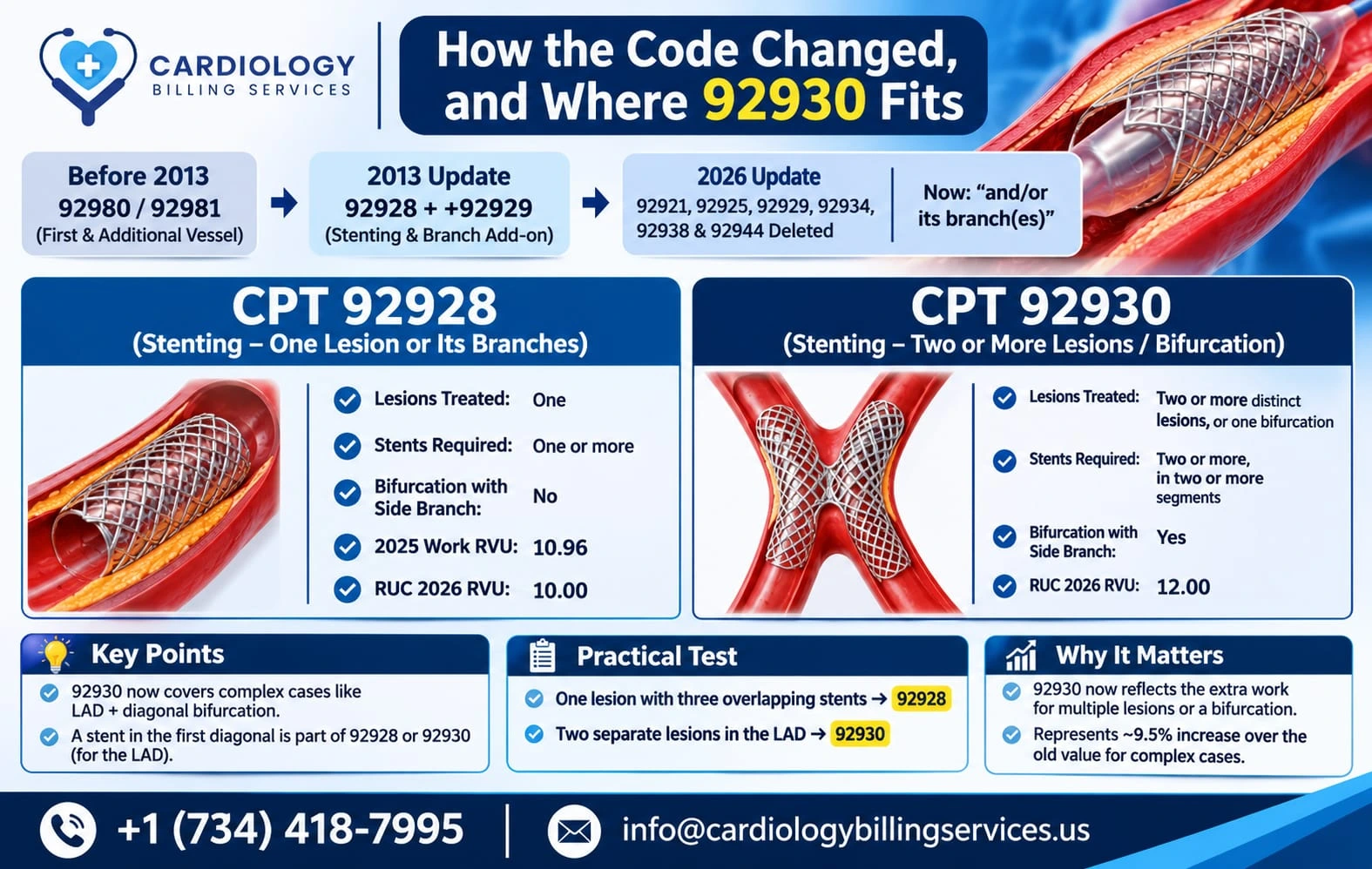
Coronary stenting was reported with 92980 (first vessel) and 92981 (each additional vessel) until 2013. That year the CPT Editorial Panel replaced the old structure with the 92920 to 92944 family, built around five major arteries and their recognized branches. Stenting became 92928, and stenting in an additional branch became add-on +92929.
That add-on never paid. Medicare bundled the branch add-ons and assigned them no relative value units, a point the American College of Cardiology (ACC) repeated in its August 13, 2025 summary of the 2026 proposed rule. For 2026 the CPT book deleted 92921, 92925, 92929, 92934, 92938 and 92944, and each primary code now reads "and/or its branch(es)." A stent in the first diagonal is therefore part of the same 92928 or 92930 reported for the LAD.
The second change answers a long-standing complaint from interventionalists. Under the old rules, a bifurcation case with stents in the LAD and a diagonal paid the same as a single short stent. New code 92930 now captures that extra work.
| Feature | 92928 | 92930 |
|---|---|---|
| Lesions treated in the artery and its branches | One | Two or more distinct lesions, or one bifurcation lesion |
| Stents required | One or more | Two or more, in two or more segments (distinct lesions) |
| Bifurcation with treatment of main vessel and side branch | No | Yes |
| 2025 work RVU | 10.96 | Did not exist |
| RUC-recommended 2026 work RVU | 10.00 | 12.00 |
RVU figures come from the ACC's 2026 proposed rule summary. Before 92930 existed, a complex case would have been billed as 92928 (plus an unpaid branch add-on), so the RUC's 12.00 represents about a 9.5% increase over the old value for that work.
A practical test separates the two codes: count stented lesions that are geographically separate, or confirm a true bifurcation where both limbs were treated. One lesion with three overlapping stents is still 92928. Two separate lesions in the LAD, each stented, is 92930.
Coronary artery modifiers for 92928
CPT recognizes five major coronary arteries, and each has a HCPCS Level II modifier. Every 92928 line should carry one of them, because Medicare uses the modifier to decide whether two PCI lines describe different vessels.
| Modifier | Major artery | Recognized branches (now included in the primary code) |
|---|---|---|
| LM | Left main | None |
| LD | Left anterior descending | Diagonals |
| LC | Left circumflex | Obtuse marginals |
| RC | Right coronary | Posterior descending, posterolateral |
| RI | Ramus intermedius | None |
SCAI's guidance limits recognized branches to two per major artery. Dominance matters here. In a left-dominant patient, the posterior descending artery arises from the circumflex, so a PDA stent in that patient takes modifier LC rather than RC.
Modifiers such as "PLV" or "OM1" sometimes appear in physician notes but are not valid HCPCS modifiers. Translate them to the parent artery before the claim goes out.
When a second major artery is treated in the same session, it receives its own primary code and its own artery modifier. Some Medicare contractors and commercial payers also want modifier 59 or XS on the second line to clear National Correct Coding Initiative edits, so check the payer's policy rather than appending it by habit.
Code hierarchy, bundled work and separately reportable services
Choosing the most intensive code
Only one primary PCI code is reported per major artery and its branches, and it must describe the most intensive service performed there. A stent placed after rotational atherectomy in the same artery is 92933, not 92928. A stent that opens an acute total or subtotal occlusion during a myocardial infarction is 92941. A chronic total occlusion goes to 92943 (antegrade) or 92945 (combined antegrade and retrograde). Coders should code from the final hierarchy, not from the order in which the operator worked.
What 92928 already includes
According to SCAI's November 2025 guidelines, every PCI code includes:
- Vessel access and selective catheterization of the target vessel
- Traversing the lesion and all balloon angioplasty in it
- Radiological supervision and interpretation
- Distal embolic protection, when used
- Closure of the arteriotomy through the sheath
- Angiography performed to document the final result
Add-ons and other codes billed with 92928
| Service | Code(s) | Note |
|---|---|---|
| IVUS or OCT imaging | +92978, +92979 | Initial vessel, then each additional vessel |
| Coronary flow reserve (FFR or Doppler) | +93571, +93572 | Pharmacologic stress no longer required in the 2026 descriptor |
| Intravascular lithotripsy | +92972 | Reported with the primary PCI code |
| Mechanical aspiration thrombectomy | +92973 | 2026 work RVU fell from 3.28 to 1.75 under the RUC recommendation |
| Moderate sedation by the operator | 99152, +99153 | Separately reportable since 2017 |
Same-day diagnostic catheterization
A diagnostic heart catheterization (93454 to 93461) on the day of the stent is payable only when the angiogram is what drove the decision to intervene. SCAI lists the accepted situations: no prior study exists; a prior study is inadequate; or the patient's condition or clinical indication has changed. Append modifier 59 or XU to the diagnostic code and make sure the report states which condition applies. A routine look at anatomy already defined at an earlier catheterization is bundled into 92928.
Billing CPT 92928: physician versus hospital claims
Physician claims
On the professional claim, 92928 is reported whether the stent was bare metal or drug eluting. CMS released the CY 2026 Physician Fee Schedule final rule on October 31, 2025. It adopted the RUC value of 10.00 work RVUs for 92928 and then applied a new 2.5% "efficiency adjustment" to most non-time-based services, leaving a final work RVU of 9.75.
With 13.89 total RVUs and the 2026 conversion factor of $33.4009, the national Medicare amount is about $463.94 before geographic (GPCI) adjustment, according to FastRVU's lookup of the CMS April 2026 RVU file. Practices tracking physician productivity should note the drop from 10.96 work RVUs in 2025, a cut of roughly 11% for the same single-lesion case.
Hospital outpatient claims to Medicare
Under the Outpatient Prospective Payment System, Medicare wants a HCPCS C-code when a drug-eluting stent is used, so the device cost is visible. C9600 replaces 92928 for a drug-eluting stent in a single major artery. CPT 92928 then stays on the hospital claim only for bare-metal stents.
Boston Scientific's 2026 coding guide for its SYNERGY stent lists C9600 in comprehensive APC 5193, with a national average payment of $11,794. The same guide places inpatient drug-eluting stent cases in MS-DRGs 321 and 322, at $19,799 and $12,829 respectively. The company's final-rule memo assigns new code 92930 to the higher-paying APC 5194.
Commercial payers vary. Many do not accept C-codes and expect 92928 on the facility claim, so contract language should decide which code goes out.
Diagnosis codes and worked scenarios
ICD-10-CM codes that commonly support 92928
- I25.10, atherosclerotic heart disease of native coronary artery without angina pectoris
- I25.110, the same disease with unstable angina, a frequent indication for elective or urgent PCI
- I25.84, coronary atherosclerosis due to calcified coronary lesion, coded in addition when calcium is documented
- T82.855A, stenosis of coronary artery stent, initial encounter, for in-stent restenosis treated with a new stent
An acute myocardial infarction (I21.-) does not automatically move the case to 92941. That code applies to the culprit occlusion. A non-culprit lesion stented in the same session, or on a later day, is still 92928 for its own artery.
Five scenarios coded under 2026 rules
Physician: 92928-LD. Medicare hospital outpatient: C9600-LD. One lesion means one code, however many stents.
Physician: 92930-LD. The diagonal is included under the LD modifier, and no branch add-on exists.
Physician: 92928-RC, 92920-LC, and 93458-59 (or XU), with the report stating that no prior angiogram was available.
Physician: 92928-LC. The branch takes the parent artery's modifier.
The add-on was deleted on January 1, 2026, so the line will reject. Review whether the case was a single lesion (92928-LD) or two distinct lesions or a bifurcation (92930-LD).
Documentation that supports a clean 92928 claim
Most 92928 denials trace back to the procedure note rather than the code choice. Before releasing the claim, a coder should be able to find each of these in the report:
- The treated artery and, for branches, the parent artery and dominance
- The start and end of each lesion by NCDR segment, with a statement that separate lesions were geographically distinct
- Stent count, type (drug eluting or bare metal) and segments covered
- Whether atherectomy, lithotripsy, thrombectomy or intravascular imaging was used
- For a same-day diagnostic study, the reason it was medically necessary
- Moderate sedation start and stop times if 99152 or 99153 is billed
The lesion description now carries more weight than it did before 2026. The difference between 92928 and 92930 is about two work RVUs, and an auditor will look for anatomy in the report that supports two distinct lesions or a treated bifurcation.
Summary
For 2026, CPT 92928 reports one stented lesion in one major coronary artery, with its branches included, at 9.75 work RVUs and roughly $464 nationally for the physician. Two distinct stented lesions or a treated bifurcation in the same artery belong to 92930. Branch add-ons such as 92929 no longer exist. Hospitals billing Medicare for a drug-eluting stent use C9600 instead of 92928. Each major artery still needs its own primary code and its LM, LD, LC, RC or RI modifier.