

Cardiology Revenue Cycle Management: A 2026 Practice Guide

Cardiology practices manage some of the most complicated billing processes in outpatient healthcare. A single patient may undergo an office consultation, electrocardiogram, echocardiogram, cardiac stress test, and additional diagnostic procedures. Each service has different coding, documentation, medical necessity, and reimbursement requirements.
Cardiology revenue cycle management (RCM) is the process of managing financial activities associated with cardiovascular care, beginning with patient scheduling and continuing through insurance reimbursement and final payment collection.
In 2026, cardiology practices must account for changes to Medicare physician payments, revised cardiovascular CPT codes, prior authorization requirements, and payer-specific coverage policies. These changes affect how claims are prepared, submitted, reviewed, and reimbursed.
Understanding the complete revenue cycle helps cardiologists, practice managers, and billing professionals reduce preventable errors, resolve unpaid claims, and maintain accurate financial records.
What is cardiology revenue cycle management?
Cardiology revenue cycle management refers to the administrative and financial processes used to collect payment for cardiovascular services. It includes patient registration, insurance verification, prior authorization, medical coding, charge capture, claim submission, payment posting, denial management, and accounts receivable follow-up.
Unlike many routine office visits, cardiology services frequently involve specialized diagnostic equipment, multiple healthcare professionals, and procedures performed across different care settings.
For example, a cardiologist may interpret an echocardiogram performed at a hospital. The hospital typically bills for the technical services, while the cardiologist may submit a separate claim for the professional interpretation. If the same diagnostic examination is performed and interpreted at a physician-owned office, global billing may be appropriate when the applicable requirements are satisfied.
These billing distinctions directly influence reimbursement. Reporting the wrong component, modifier, or place of service can result in payment delays, denials, or incorrect reimbursement.
Effective cardiology RCM depends on connecting the patient's clinical records with the services performed, the applicable insurance requirements, and the payments received.
What changed in cardiology revenue cycle management in 2026?
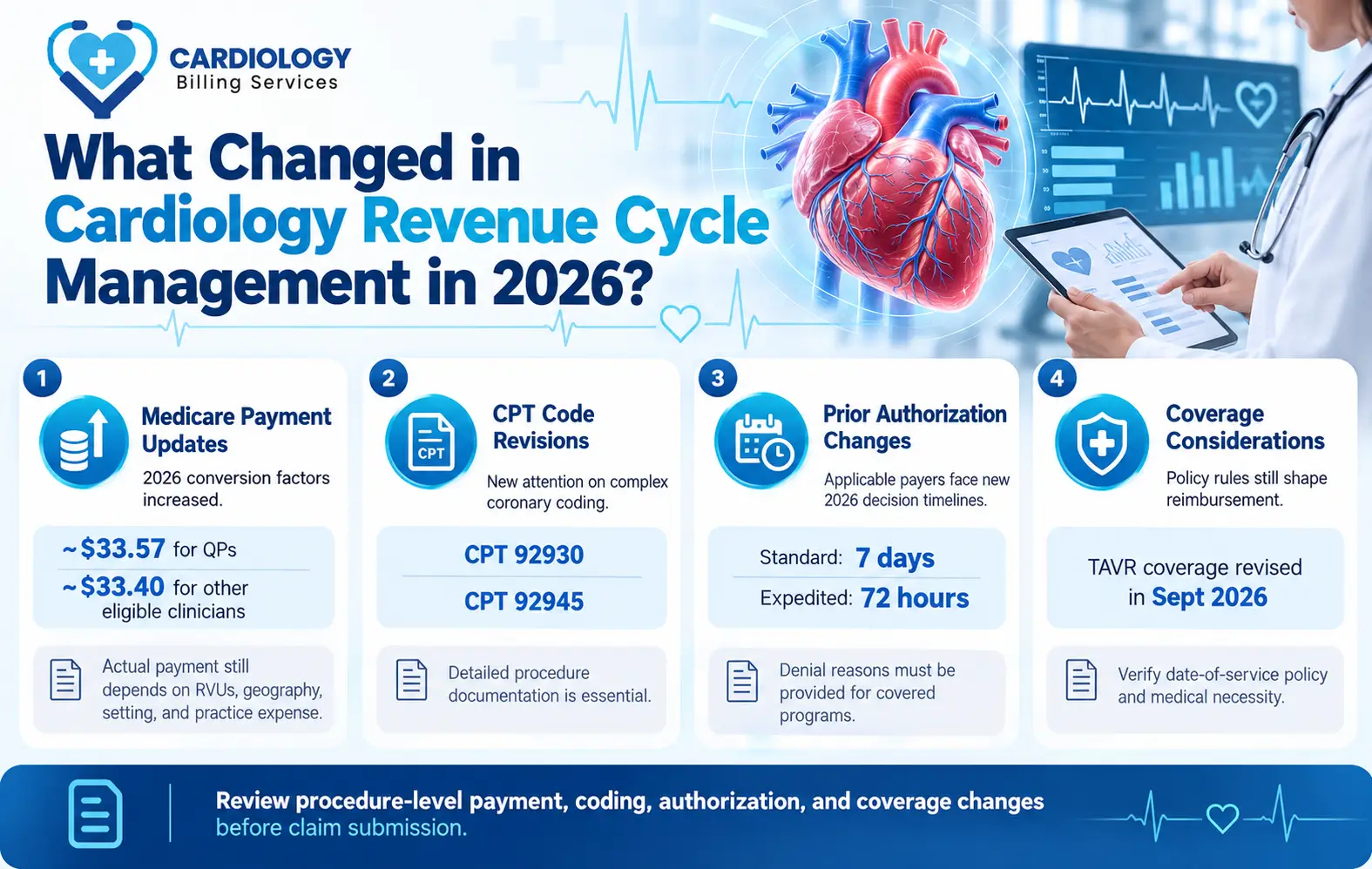
Medicare payment updates, cardiovascular procedure code revisions, and changes to prior authorization requirements have introduced additional considerations for cardiology billing departments in 2026.
Medicare physician payment updates for 2026
On October 31, 2025, the Centers for Medicare & Medicaid Services (CMS) released the final rule for the Calendar Year 2026 Medicare Physician Fee Schedule. The payment changes became effective January 1, 2026.
For 2026, Medicare established a conversion factor of approximately $33.57 for qualifying alternative payment model participants and $33.40 for other eligible physicians and practitioners.
These amounts represent increases of approximately 3.77% and 3.26%, respectively, compared with the previous year.
However, changes to the conversion factor do not mean every cardiovascular procedure receives an equivalent reimbursement increase. Medicare payments also depend on relative value units, geographic adjustments, practice expenses, and whether the service is performed in a facility or non-facility setting.
The 2026 rule also introduced an efficiency adjustment affecting work relative value units for certain services and revised aspects of practice expense calculations.
Cardiology billing professionals should therefore compare updated Medicare allowed amounts at the procedure level rather than assuming the same payment adjustment applies to every service.
Cardiovascular CPT code changes in 2026
The American College of Cardiology identified several important cardiovascular coding changes in its December 4, 2025 publication, Coding Corner: Overview of New CPT Codes For 2026.
Among these updates are CPT codes 92930 and 92945, which address specified complex coronary interventions.
CPT 92930 applies to qualifying complex coronary stent procedures involving multiple distinct lesions or bifurcation interventions. CPT 92945 describes chronic total occlusion revascularization using combined antegrade and retrograde techniques.
Changes to the coronary intervention coding structure also affect how procedures involving branches of major coronary arteries are reported.
These revisions make detailed procedural documentation particularly important. Physicians should identify the coronary arteries treated, number and location of lesions, techniques used, and relevant procedural findings.
Using an outdated CPT code or reporting services separately when they are included in another procedure can cause claim denials or incorrect payments.
Changes in prior authorization requirements
Prior authorization remains a common administrative challenge for cardiology practices, particularly when scheduling advanced cardiac imaging and certain cardiovascular interventions.
Under the CMS Interoperability and Prior Authorization Final Rule, published in January 2024, designated payers became subject to new authorization requirements beginning in 2026.
For applicable non-drug services, most affected payers must issue standard prior authorization decisions within seven calendar days and expedited decisions within 72 hours.
The rule also requires affected payers to provide specific reasons when authorization requests are denied.
These requirements cover specific programs, such as Medicare Advantage and certain Medicaid, CHIP, and Marketplace health plans. They do not establish identical authorization rules for all commercial insurance plans.
Cardiology practices should continue documenting authorization numbers, approved procedures, authorization periods, and participating facilities before providing services that require approval.
Medicare coverage considerations for cardiac procedures
Medicare coverage policies also affect reimbursement for advanced cardiovascular procedures.
For example, CMS revised its national coverage determination for transcatheter aortic valve replacement (TAVR) in September 2026. The revision changed coverage requirements for qualifying patients with symptomatic severe aortic stenosis while retaining additional requirements for certain asymptomatic patients.
Coverage decisions depend on applicable clinical criteria, including patient evaluation and procedural eligibility.
Practices performing structural heart interventions should verify the coverage policy applicable on the date of service and maintain documentation supporting medical necessity.
How does the cardiology revenue cycle management process work?
The cardiology revenue cycle begins before the patient arrives for treatment. Each administrative activity influences whether the practice can submit an accurate claim and receive the appropriate reimbursement.
Patient registration and insurance verification
Patient registration establishes the information required for billing. Staff collect patient demographics, insurance details, referring provider information, and other relevant administrative records.
Insurance verification confirms whether the patient's coverage is active, whether the cardiologist participates in the insurance network, and whether the planned service is subject to authorization or referral requirements.
For instance, a patient scheduled for coronary CT angiography may have active insurance coverage but still require prior authorization from the health plan.
Insurance eligibility alone does not establish that a particular procedure will be covered.
Reviewing these requirements before the appointment reduces avoidable administrative errors and helps patients understand their expected financial responsibilities.
Clinical documentation and charge capture
Clinical documentation supports the medical necessity and accuracy of a cardiology claim.
Physicians must document the patient's clinical condition, relevant symptoms, examination findings, procedures performed, and interpretation of diagnostic results.
For an echocardiogram, the medical record should support the examination performed and include an appropriate interpretation report. When a limited examination is performed, billing should reflect the actual scope of the service rather than automatically reporting a complete study.
Charge capture connects documented clinical services with the billing system.
If a diagnostic service is completed but never entered into the billing workflow, the practice may fail to submit a claim for that service. Conversely, duplicate charges can create overpayments or compliance concerns.
Reconciling daily procedure records with posted charges helps identify both problems.
Accurate cardiology medical coding
Medical coding translates cardiovascular services into standardized codes used for insurance claims.
CPT and HCPCS codes identify procedures and professional services, while ICD-10-CM codes describe diagnoses and clinical conditions.
Common cardiology codes include CPT 93000 for a routine 12-lead electrocardiogram with interpretation and report, CPT 93015 for a complete cardiovascular stress test, and CPT 93306 for a complete transthoracic echocardiogram with spectral and color Doppler.
Other codes apply to ambulatory cardiac monitoring, coronary interventions, diagnostic catheterization, and related procedures.
Correct code selection depends on what the physician actually performed, how the service was documented, and whether separate reporting is permitted.
For example, a routine ECG performed during an office visit does not automatically qualify for separate reimbursement. The service must be supported by the clinical record and satisfy applicable coding and payment rules.
Coding professionals must also distinguish between procedures that are separately reportable and services included in another billed procedure.
Professional and technical component billing
Many cardiac diagnostic tests include professional and technical components.
The professional component generally represents interpretation and reporting by a qualified healthcare professional. Modifier 26 is commonly used when reporting this component separately.
The technical component involves equipment, personnel, and other resources required to perform the diagnostic study. Modifier TC may be used when reporting an eligible technical service separately.
When a cardiologist interprets a diagnostic study performed at a hospital, professional component billing may be appropriate. A practice providing both the technical service and professional interpretation may qualify for global billing.
The appropriate billing method depends on the location, service, provider responsibilities, and applicable payer requirements.
Incorrectly reporting a complete service when only the interpretation was performed can lead to overpayment or denial.
Claim submission and payment posting
After coding and charge review, the billing department prepares the insurance claim.
Before submission, the claim should be checked for patient information, provider identifiers, diagnosis codes, procedure codes, modifiers, authorization details, and place-of-service accuracy.
Electronic claims are commonly submitted through a clearinghouse, which performs preliminary validation before forwarding accepted claims to insurers.
Claims that fail initial processing checks may be rejected and require correction. Even claims that pass these checks may still be denied during the payer’s adjudication process.
Once an insurer processes a claim, payment posting staff reconcile the remittance advice with the practice's expected reimbursement.
This review should identify insurance payments, contractual adjustments, patient responsibility, unpaid balances, and possible underpayments.
A claim marked as paid does not necessarily mean the insurer paid the correct contractual amount.
Common cardiology medical billing challenges
Cardiology practices frequently encounter billing problems involving medical necessity, prior authorization, procedure coding, and incomplete documentation.
Medical necessity denials can occur when the submitted diagnosis does not satisfy an insurer's coverage policy or the clinical record does not adequately support the examination performed.
For example, advanced cardiovascular imaging may be subject to specific coverage criteria involving symptoms, previous testing, or documented clinical indications.
Authorization-related denials can occur when a procedure is performed without required approval or when the authorization does not match the actual procedure, physician, or facility.
Coding errors create another source of reimbursement problems. Incorrect CPT combinations, unsupported modifiers, and reporting services already included in another procedure can trigger automated claim edits.
CMS maintains the National Correct Coding Initiative (NCCI), which includes procedure-to-procedure edits and medically unlikely edits. These edits help identify certain incorrect combinations and units of service.
Billing teams should review current coding edits and payer-specific rules when investigating denied cardiovascular claims.
An effective denial management process begins by determining why the claim was denied. Administrative errors may require corrected claims, while disputes involving medical necessity or reimbursement may require supporting documentation and an appeal.
Submitting the same claim repeatedly without addressing the underlying issue rarely resolves the denial.
How can cardiology practices enhance revenue cycle efficiency?
Improving cardiology revenue cycle management requires consistent monitoring of billing activities and the causes of delayed reimbursement.
One important measure is the clean claim rate, which evaluates the proportion of claims that meet defined accuracy and acceptance requirements without correction. Practices should use a consistent definition when measuring this result because claim acceptance and first-pass payment are different outcomes.
The initial denial rate helps identify how frequently insurers deny submitted claims. Reviewing this rate by payer and procedure category can reveal recurring authorization or coding problems.
Days in accounts receivable measures how long outstanding charges remain uncollected. An increase may indicate unresolved claims, delayed submissions, payment posting problems, or slow patient collections.
The net collection rate compares payments received with collectible amounts after contractual adjustments. It helps practices evaluate whether they are collecting revenue they are entitled to receive.
These measurements become more useful when separated by service type. For example, a cardiology group may collect office visit payments consistently while experiencing repeated underpayments for echocardiogram interpretations.
Reviewing the categories separately allows the billing team to investigate the affected payer contracts and payment records.
Improving documentation and coding accuracy
Cardiology practices should develop documentation review procedures for frequently performed services, including ECGs, echocardiograms, stress testing, ambulatory monitoring, and coronary interventions.
Coding reviews should confirm that documented findings support the procedure codes and that professional or technical components have been reported correctly.
High-value procedures and services associated with repeated denials may require additional review.
Internal audits can also identify outdated code selections, incorrect modifiers, and documentation deficiencies before those problems affect large numbers of claims.
Managing payer requirements and unpaid claims
Insurance policies change, and requirements may differ among traditional Medicare, Medicare Advantage, Medicaid, and commercial health plans.
Billing staff should review payer medical policies and authorization requirements for procedures frequently performed by the practice.
Unpaid claims also need regular follow-up. Accounts receivable reports should categorize claims by status, including those pending submission, under payer review, awaiting appeal outcomes, or requiring patient payment.
Claims approaching filing or appeal deadlines should receive particular attention because missing an applicable deadline may eliminate an opportunity for reimbursement.
Should cardiology practices outsource revenue cycle management?
Some cardiology practices manage billing internally, while others use external revenue cycle management companies.
The appropriate arrangement depends on procedure volume, staffing capacity, coding expertise, administrative costs, and the practice's ability to monitor performance.
In-house billing provides direct oversight of staff and daily operations, although maintaining expertise in specialized cardiovascular coding may require additional training and resources.
Outsourced billing may provide access to personnel familiar with cardiovascular procedures, denial management, and payer reimbursement rules. However, practices still need to evaluate the accuracy of the work performed and maintain appropriate compliance oversight.
Before choosing an external billing provider, cardiology practices should review its coding review procedures, denial management responsibilities, reporting methods, payment reconciliation processes, and information security practices.
Responsibilities for authorization verification, charge entry, appeals, and patient billing should be clearly documented.
Why is accurate cardiology revenue cycle management important?
Accurate billing allows practices to collect payment for appropriately documented cardiovascular services while reducing preventable administrative work.
Errors involving procedure codes, modifiers, medical necessity, or insurance authorization can delay reimbursement and require additional staff time to resolve.
Some mistakes also create compliance risks, particularly when claims contain unsupported services or incorrect billing components.
A structured revenue cycle process helps practices identify these issues before claims are submitted and investigate payment discrepancies after adjudication.
The financial benefits depend on the actual problems identified and corrected. Practices should evaluate improvements using documented denial rates, collection performance, accounts receivable trends, and coding audit results rather than relying on unsupported reimbursement estimates.
Conclusion
Cardiology revenue cycle management in 2026 requires attention to Medicare reimbursement changes, revised cardiovascular CPT codes, payer authorization policies, and accurate clinical documentation.
Successful billing depends on correctly identifying the services performed, verifying coverage, submitting properly coded claims, and reviewing payments against applicable reimbursement agreements.
Regular coding audits, denial analysis, and accounts receivable monitoring help cardiology practices identify specific problems affecting collections.
By maintaining accurate documentation and consistent billing procedures, cardiology practices can reduce avoidable claim errors, improve payment accuracy, and manage the financial requirements of cardiovascular care more effectively.