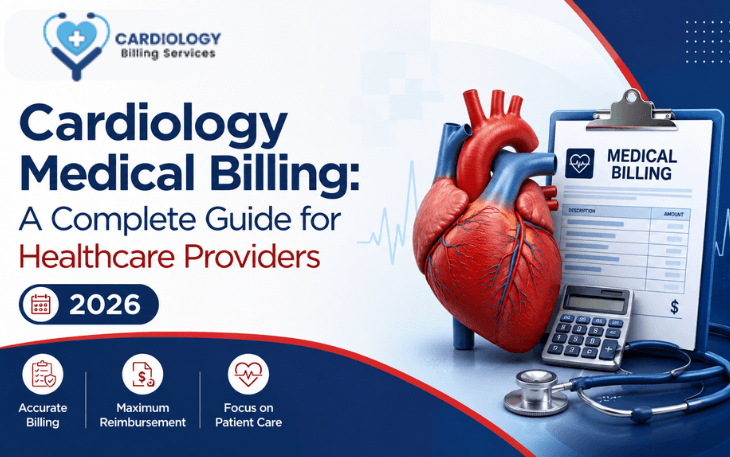
Cardiology Medical Billing: A Complete Guide for Healthcare Providers (2026)

Cardiology is one of the highest-revenue specialties in U.S. medicine. It is also one of the most complicated to bill correctly. The procedures are complex, the documentation requirements are demanding and payers scrutinize cardiology claims more aggressively than almost any other specialty. For a busy cardiovascular practice, that combination creates a real financial risk one that shows up not as dramatic billing failures but as quiet, consistent revenue erosion that’s easy to miss until the numbers are reviewed carefully.
This guide covers everything a cardiologist, practice manager, or revenue cycle professional needs to understand about cardiology medical billing how it works, where it breaks down and what a well-run billing operation actually looks like.
What Is Cardiology Medical Billing?
Cardiology medical billing is the process of translating cardiovascular clinical services into insurance claims and collecting reimbursement from payers on behalf of a cardiology practice. It covers everything from patient eligibility verification before a visit through final payment posting after a claim is adjudicated.
The process involves assigning accurate CPT codes to procedures, ICD-10 codes to diagnoses, applying the correct modifiers, submitting claims to insurance carriers, following up on payments and managing denials when payers push back.
What makes cardiology different from most other specialties is the sheer breadth of services involved. A cardiology practice might bill a routine hypertension follow-up visit, a nuclear stress test, a cardiac catheterization, a pacemaker implant and a remote monitoring interpretation all in the same week each one operating under completely different billing rules.
Why Cardiology Billing Is More Complex Than Other Medical Specialties
Most medical specialties have a relatively consistent set of procedures with predictable billing patterns. Cardiology doesn’t work that way.
Several factors make cardiology billing genuinely harder than the majority of other specialties:
Procedure variety. Cardiology spans diagnostic, therapeutic, imaging, surgical and monitoring services. The CPT code range used by a full-service cardiology practice is significantly wider than most other fields.
Technical and professional component billing. Many cardiac imaging studies echocardiograms, nuclear scans, cardiac CT bill separately for the technical component (equipment and staff) and the professional component (physician interpretation). Getting those splits wrong is one of the most common and most costly mistakes in cardiology billing.
High-value, high-scrutiny procedures. Cardiac catheterizations, TAVR procedures, ICD implantations and structural heart interventions generate significant reimbursements which is precisely why payers review them closely. Any documentation weakness on these claims creates real denial risk.
Bundling rules. CMS and commercial payers have specific rules about which cardiology procedures can be billed together and which get bundled into a single reimbursement. Missing those rules means either leaving money on the table by under-billing or triggering denials by billing services separately that payers consider inclusive.
Constant policy changes. Cardiology CPT codes, reimbursement rates, telehealth rules and remote monitoring billing requirements change regularly. Practices that aren’t actively tracking those changes find themselves billing under outdated frameworks and losing revenue as a result.
Step-by-Step Cardiology Billing Process
Understanding how each stage of the billing cycle works and where things go wrong is the starting point for fixing revenue problems in any cardiology practice.
Insurance Verification
Before any cardiology service is delivered, the patient’s insurance coverage needs to be confirmed. This means verifying active benefits, checking whether the specific procedure is covered under the patient’s plan and confirming whether a referral or prior authorization is required.
Skipping or rushing this step creates denials that are completely avoidable. A stress test performed without confirming prior authorization from a payer that requires it will come back denied and retroactive authorization approvals are difficult and time-consuming to secure.
Our team handles coverage verification and prior authorization as a standard first step for every cardiology encounter, including complex procedures like cardiac catheterizations, device implantations and structural heart interventions Claims Submission & Tracking
Medical Coding
This is where most cardiology billing errors originate. Accurate cardiology medical coding requires selecting the correct CPT procedure codes, ICD-10 diagnosis codes and modifiers for each service and understanding the clinical context well enough to know when codes need to be combined, when they should be billed separately and when payer-specific rules override standard coding guidelines.
Cardiology coders who aren’t trained specifically in cardiovascular medicine regularly undershoot on E/M levels, miss billable components of complex procedures, or apply the wrong modifier each of which quietly reduces what the practice collects per claim Medical Coding Services
Charge Entry
Charge entry is the point where coded services get entered into the billing system with the correct fees, service dates and provider information. Errors here wrong date of service, missing provider NPI, incorrect place of service trigger rejections that delay payment even when the clinical coding was done correctly.
Claim Submission
Clean claim submission means the claim goes out with everything the payer needs to process it no missing fields, no incorrect codes, no authorization number gaps. Electronic claims that pass internal scrubbing before submission have significantly higher first-pass acceptance rates than those submitted without that review step Claims Submission & Tracking
Payment Posting
When payers process cardiology claims, payments, adjustments and contractual write-offs need to be posted accurately against the right patient accounts. Incorrect payment posting distorts accounts receivable data and makes it harder to identify underpayments situations where a payer paid less than the contracted rate without a clear explanation Payment Posting
Denial Management
Cardiology claims get denied for a wide range of reasons missing documentation, authorization failures, bundling conflicts, medical necessity questions and coding errors. Effective denial management means analyzing each denial individually, identifying the actual cause and building an appeal that addresses what the payer needs to see not just resubmitting the same claim and expecting a different result of Denial Management
Accounts Receivable Follow-Up
AR follow-up is the difference between revenue that gets collected and revenue that ages out and gets written off. Cardiology practices with high-value claims in accounts receivable need active follow-up at the 30, 60 and 90-day marks escalating when payers are unresponsive and identifying when claims have crossed into the appeals window.
Common Cardiology Procedures That Require Accurate Billing
Cardiology CPT Codes Overview
Cardiology uses CPT codes across several families, each with its own billing rules:
- Echocardiography (93303–93352): Transthoracic, transesophageal and stress echo each billing with technical and professional components that must be split correctly based on where the study was performed.
- Cardiac Catheterization (93451–93572): Diagnostic and interventional caths bill differently and multi-vessel procedures require careful modifier application to capture the full reimbursement value.
- Electrophysiology (93600–93660): EP studies, ablations, pacemaker implantations and ICD placements each have distinct CPT codes with specific documentation requirements.
- Nuclear Cardiology (78451–78454): Myocardial perfusion imaging requires clear medical necessity documentation to survive payer scrutiny on these high-value claims.
- Remote Monitoring (99453–99458): Device setup, monthly monitoring and physician review time bill separately and all three components must be captured monthly to avoid leaving recurring revenue uncollected.
ICD-10 Coding Essentials
ICD-10 specificity matters more in cardiology than most people realize. The difference between coding coronary artery disease with and without angina, specifying laterality on peripheral arterial disease, or correctly coding a heart failure encounter as acute, chronic, or acute-on-chronic affects medical necessity determinations and therefore whether a claim gets paid.
Coders who default to unspecified codes because the specific code requires more documentation review are quietly triggering medical necessity denials that a more precise code would have avoided.
Documentation Best Practices
Strong cardiology documentation supports billing in ways that most providers underestimate. Time documentation for critical care encounters, clinical indication statements for imaging studies, procedure notes that clearly support the CPT codes billed and shared decision-making documentation for high-value interventions all directly affect whether claims pay on first submission.
The goal is documentation that tells the clinical story clearly enough that a payer reviewer who has no clinical background can understand why the service was medically necessary and what was actually done.
Most Common Billing Challenges
Top Reasons Cardiology Claims Get Denied
After reviewing cardiology billing accounts extensively, these are the denial reasons that appear most consistently:
- Missing or expired prior authorization particularly on stress tests, device implants and high-cost imaging studies.
- Incorrect technical/professional component split one of the most prevalent and consistently costly errors in cardiology billing.
- Bundling violations billing separately for services that payers consider inclusive to the primary procedure code.
- Medical necessity not supported documentation doesn’t clearly establish why the procedure was clinically indicated.
- Modifier errors missing Modifier 26 on a professional component claim, or using Modifier 59 when a different modifier family was required.
- Timely filing exceeded claims that sat in a work queue too long before submission and crossed the payer’s filing deadline.
[H3] How to Prevent Claim Denials
Denial prevention starts upstream before the claim is ever submitted. The most effective approach involves:
✓ Verifying insurance and authorization status before every procedure ✓ Coding reviews by cardiology-specialized coders before charge entry ✓ Pre-submission claim scrubbing against payer-specific edits ✓ Real-time tracking to catch stalled claims before they age ✓ Root cause analysis on every denial to prevent recurrence
Revenue Cycle Management Best Practices
Effective cardiology revenue cycle management isn’t just about submitting claims correctly. It’s about building a financial workflow that catches problems early, recovers money efficiently and generates the data a practice needs to make informed operational decisions.
The practices with the strongest financial performance share a few consistent characteristics: they know their clean claim rate by procedure type, they track denial rates by payer, they monitor AR aging actively and they have a billing team that brings those metrics to their attention rather than waiting to be asked Revenue Cycle Management for Cardiology
Technology & AI Trends in Cardiology Billing (2026)
The billing technology landscape for cardiology practices has changed considerably. A few trends are genuinely reshaping how revenue cycle management works:
AI-assisted coding. Machine learning tools are increasingly being used to flag coding inconsistencies, suggest more specific diagnosis codes and identify documentation gaps before claims go out. These tools work best when they’re paired with trained human coders who can interpret the suggestions in clinical context.
Remote patient monitoring expansion. The CPT code framework for remote cardiac monitoring (99453–99458) continues to evolve and payer coverage policies for RPM services are still being refined. Practices billing RPM services need to stay current on both CMS guidance and commercial payer coverage determinations.
Tele-cardiology billing maturity. Post-pandemic telehealth coverage has stabilized, but the rules around place-of-service codes, audio-only visit billing and originating site requirements continue to shift. Cardiology practices offering virtual services need a billing process that tracks those policy changes in real time.
Real-time eligibility verification. Automated insurance verification integrated directly into scheduling workflows is reducing authorization failures significantly for practices that have adopted it.
Benefits of Outsourcing Cardiology Medical Billing
Cardiology practices that outsource billing to specialized partners consistently outperform those managing billing in-house not because in-house billing teams aren’t capable, but because the subspecialty depth required to bill cardiology correctly at scale is difficult to build and maintain internally.
The measurable benefits of working with a specialized cardiology billing service include:
- Higher clean claim rates on first submission • Faster reimbursement cycles from major payers • Lower denial rates due to proactive coding review • Reduced administrative burden on clinical staff • Ongoing compliance with CMS and payer policy changes • Access to cardiology-specific billing expertise without the cost of hiring and training specialized coders internally
Why Healthcare Providers Choose Pro MBS
Pro MBS operating as Cardiology Billing Services was built specifically around cardiovascular medicine. We don’t distribute attention across multiple specialties and approximate the billing for cardiology. Every biller, coder and account manager on our team works exclusively in cardiovascular medicine billing.
That focus means we understand the procedures your providers perform, the payers who cover your patient population and the documentation standards that determine whether a complex cardiology claim pays or gets denied. We handle the full revenue cycle from eligibility verification and prior authorization through coding, claim submission, denial management and payment posting so your practice can focus on clinical care rather than chasing reimbursements. Cardiology Medical Billing
Frequently Asked Questions
1 What is cardiology medical billing?
Cardiology medical billing is the end-to-end process of coding cardiovascular services, submitting claims to insurance carriers and collecting reimbursement for cardiology practices. It covers everything from insurance verification before a visit through payment posting after a claim is processed, including denial management and accounts receivable follow-up for unpaid claims. (54 words)
2 Why is cardiology billing so complex compared to other specialties?
Cardiology billing involves a wider range of procedure types than most specialties from office visits and imaging studies to catheterizations, device implants and remote monitoring. Each service type has its own CPT coding rules, modifier requirements, documentation standards and payer policies. The combination of high-value claims and frequent policy changes makes cardiology one of the most technically demanding billing environments in U.S. healthcare.
3 What are the most common reasons cardiology claims get denied?
The most frequent cardiology claim denial reasons are missing or expired prior authorizations, incorrect technical and professional component billing on imaging studies, bundling violations, insufficient medical necessity documentation and modifier errors. Timely filing failures where claims sit too long before submission are also a consistent contributor to avoidable cardiology revenue loss.
4 How does a cardiology billing service reduce claim denials?
Effective denial reduction starts before the claim is submitted. A specialized cardiology billing service verifies insurance and authorization status upfront, reviews codes against payer-specific guidelines before submission, scrubs claims for errors and conducts root cause analysis on every denial to prevent the same issue from recurring on future claims.
5 Do you handle prior authorization for cardiology procedures?
Yes. Prior authorization management is part of our standard billing workflow for cardiology practices. We initiate authorization requests for stress tests, imaging studies, device implants and high-cost interventional procedures, compile the supporting clinical documentation payers require and track each authorization through to confirmation before the procedure is scheduled.
6 What cardiology subspecialties do you bill for?
We provide billing services across all major cardiology subspecialties, including clinical and interventional cardiology, cardiac imaging and structural heart disease, electrophysiology, heart failure management, preventive cardiology, sports cardiology, women’s cardiovascular health, cardio-oncology, critical care cardiology, cardiovascular genetics and emerging digital cardiology services including remote patient monitoring and tele-cardiology.
7 How do you stay current on cardiology billing code changes?
Our billing team tracks CMS quarterly updates, annual CPT code changes published by the AMA and payer-specific policy bulletins as part of standard operations. When cardiology billing rules change including remote monitoring code updates, new structural heart procedure codes, or revised telehealth billing requirements we update internal workflows and coder training before those changes affect claim submissions.
8 What is the difference between technical and professional component billing in cardiology?
Many cardiac imaging studies echocardiograms, nuclear stress tests, cardiac CT and cardiac MRI have two billable components. The technical component covers the equipment, supplies and clinical staff involved in performing the study. The professional component covers the physician’s interpretation and report. When these services are provided in different settings or by different entities, they need to be billed separately using Modifier TC and Modifier 26. Incorrect component billing is one of the most consistent sources of revenue loss in cardiology practices that don’t have subspecialty-trained billing oversight.
Closing
Cardiology billing done correctly requires more than software and a team that’s willing to learn on the job. The procedures are too complex, the payer rules too specific and the revenue stakes too high for a generalist approach to work reliably over time.
Practices that invest in specialized billing support whether by building internal expertise or partnering with a team that already has it collect more of what they earn, spend less time chasing denials and have cleaner financial data to make operational decisions from. That’s what a well-run cardiology revenue cycle actually looks like.