

Cardiology Claims Submission Process: A Complete Billing and Coding Guide

The cardiology claims submission process involves several important steps, including patient insurance verification, clinical documentation review, medical coding, claim preparation, electronic submission, and reimbursement follow-up. Each stage requires accuracy because cardiovascular services often involve multiple diagnostic procedures, technical components, and professional responsibilities.
Cardiology practices regularly submit insurance claims for electrocardiograms, cardiovascular stress testing, echocardiography, cardiac monitoring, and interventional procedures. These services must be coded correctly to avoid payment delays, claim rejections, and unnecessary denials.
One important example is CPT Code 93015, which represents a complete cardiovascular stress test involving supervision, electrocardiographic recording, interpretation, and reporting. Understanding its billing requirements helps healthcare professionals determine when a complete service or individual component should be reported.
This guide explains the cardiology claims submission process, including medical coding requirements, documentation standards, claim validation, common billing errors, and reimbursement considerations.
What is the cardiology claims submission process?
The cardiology claims submission process is the procedure through which healthcare providers prepare and submit insurance claims for cardiovascular services performed during patient care.
The process begins when a patient receives medical services and continues until the insurance company processes the claim and determines the appropriate payment.
Medical billing professionals translate the documented services into standardized codes. Current Procedural Terminology (CPT) codes identify medical procedures, while ICD-10-CM codes describe the patient's diagnoses and medical conditions.
For example, a cardiologist may order cardiovascular stress testing for a patient experiencing chest discomfort during physical activity. After the examination, the billing specialist reviews the medical documentation and determines which procedure code accurately represents the service.
The claim must also contain correct patient information, insurance details, provider identifiers, diagnosis codes, and other required information.
Proper coordination between healthcare providers, medical coders, and billing specialists helps ensure that claims accurately represent the treatment provided.
Understanding CPT Code 93015 in cardiology billing
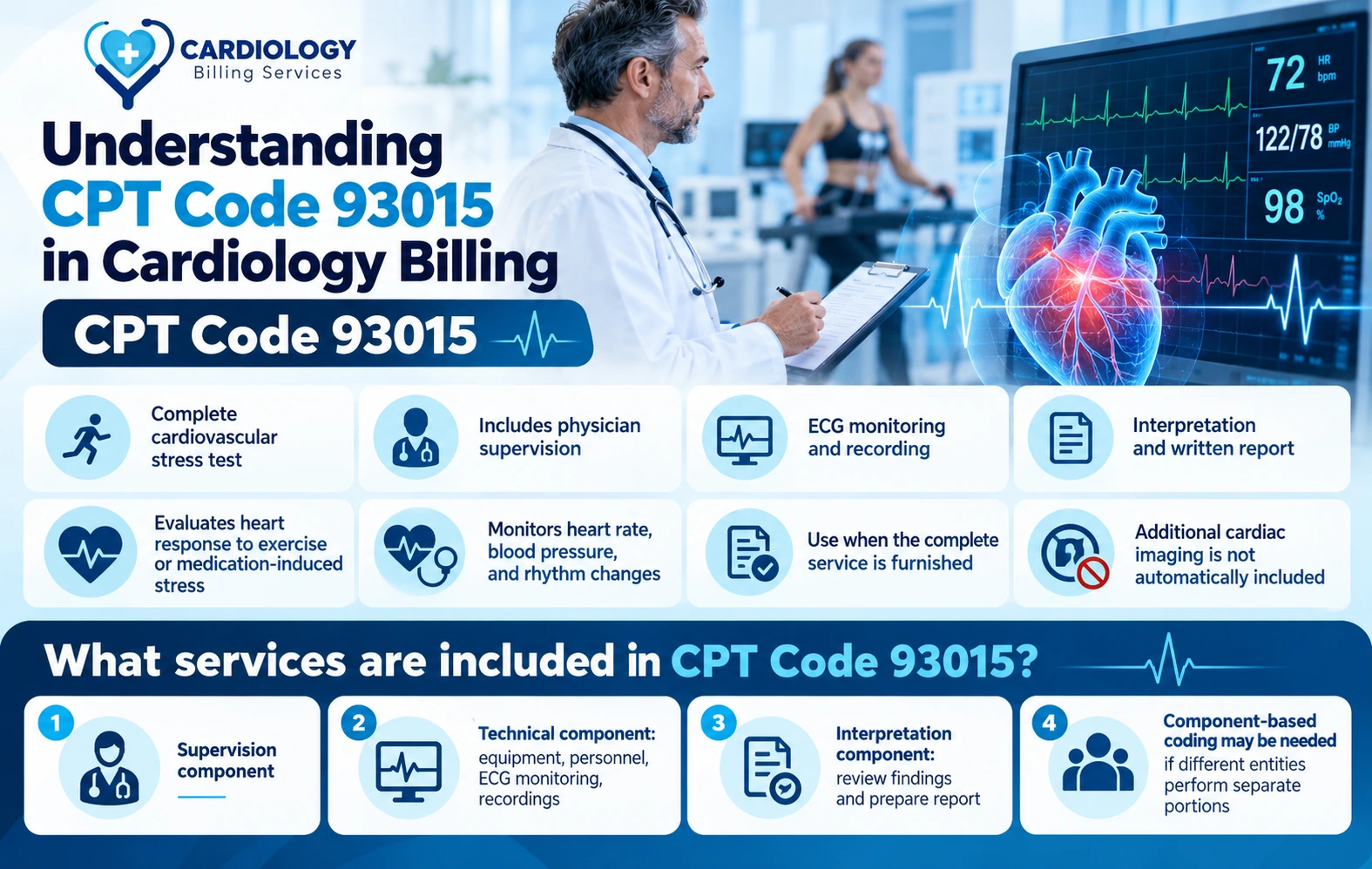
CPT Code 93015 identifies a complete cardiovascular stress test that includes physician supervision, electrocardiographic monitoring and recording, interpretation, and a written report.
Cardiovascular stress testing evaluates how the heart responds to increased physical activity or medication-induced stress. The examination may help physicians investigate symptoms associated with coronary artery disease or other cardiovascular conditions.
During the procedure, healthcare professionals monitor electrical activity in the heart while observing relevant physiological responses, such as changes in heart rate, blood pressure, and cardiac rhythm.
The physician reviews the recorded findings and prepares an interpretation describing the examination results.
CPT 93015 is appropriate when the complete service has been furnished and the reporting provider or organization meets the applicable billing requirements.
However, the code does not automatically include additional cardiac imaging procedures. Services such as stress echocardiography or myocardial perfusion imaging require separate coding evaluation under applicable reporting and bundling rules.
What services are included in CPT Code 93015?
CPT 93015 combines the professional and technical responsibilities associated with cardiovascular stress testing.
The supervision component involves physician oversight of the examination. The technical component includes the equipment, personnel, ECG monitoring, and recordings necessary to perform the procedure.
The interpretation component involves reviewing the examination findings and preparing a diagnostic report.
When all required components are furnished by the billing entity, reporting the complete service may be appropriate.
If different healthcare organizations perform separate portions of the examination, component-based coding may be necessary.
Difference between CPT 93015, 93016, 93017, and 93018
Cardiovascular stress testing uses several related CPT codes to distinguish complete services from individual components.
CPT 93015 represents the complete cardiovascular stress test, including supervision, tracing, interpretation, and reporting.
CPT 93016 identifies the physician supervision component. It may be reported when the physician performs the qualifying supervision without billing the complete examination.
CPT 93017 represents the technical tracing component. This includes the technical resources and ECG recording associated with the stress test.
CPT 93018 identifies the professional interpretation and written report.
These differences become important when separate providers or organizations participate in the same examination.
For example, a diagnostic facility may provide the technical portion while an independently billing physician performs the professional interpretation.
Billing professionals must determine which services each entity actually furnished before selecting the appropriate codes. Reporting the complete code together with overlapping component codes for the same services may result in duplicate billing.
Step-by-step cardiology claims submission process
Step 1: Verify patient insurance eligibility
Insurance verification is an important starting point in cardiology billing. Before performing scheduled cardiovascular services, the billing department should confirm that the patient's insurance coverage is active.
Verification includes reviewing the insurance policy, provider network participation, covered benefits, referral requirements, and applicable patient financial responsibilities.
Certain cardiovascular procedures may require prior authorization. These requirements depend on the insurance company, specific procedure, policy, and place of service.
For example, an insurer may apply different authorization requirements to routine exercise ECG testing and advanced cardiac imaging.
Confirming coverage requirements before treatment helps prevent administrative complications during claim processing.
Step 2: Review clinical documentation
After the cardiovascular procedure, the billing specialist reviews the medical record to confirm that the service was properly documented.
For CPT 93015, the documentation should identify the clinical reason for testing, the examination performed, relevant monitoring results, and the physician's interpretation.
The record should also describe important patient findings and any circumstances affecting the testing protocol.
If pharmacological stress testing was performed instead of exercise testing, the medical documentation should explain the clinical circumstances supporting that decision when required.
Incomplete documentation can create difficulties when insurance companies request records to evaluate medical necessity or verify the reported service.
Step 3: Assign appropriate CPT and ICD-10-CM codes
Medical coders examine the completed documentation and select procedure codes that accurately represent the services performed.
For cardiovascular stress testing, the coder must determine whether the complete examination was provided or whether separate components should be reported.
If all requirements are satisfied, CPT 93015 may represent the complete service. Otherwise, the applicable component codes may be more appropriate.
Diagnosis coding is equally important. The ICD-10-CM code must accurately describe the patient's documented condition, symptoms, or reason for testing.
For example, a patient undergoing stress testing because of documented chest discomfort should have diagnosis coding that accurately reflects the provider's assessment.
Coders should never select an unsupported diagnosis simply to satisfy an insurer's coverage requirements.
Step 4: Review and validate the insurance claim
Before submission, the billing department should examine the claim for coding and administrative errors.
Claim validation involves reviewing patient demographic information, provider identifiers, insurance details, diagnosis codes, procedure codes, and applicable modifiers.
For CPT 93015, the billing specialist should confirm that overlapping components have not been billed separately.
The review should also verify the correct place of service and any required authorization information.
Claim scrubbing software can help identify missing information, invalid coding combinations, and formatting problems.
However, automated validation cannot replace professional judgment when determining whether the clinical documentation supports the billed procedure.
Step 5: Submit the cardiology claim electronically
After validation, the completed claim is transmitted electronically to the insurance company.
Professional medical claims are generally submitted using the HIPAA-standard ASC X12 837 professional transaction. Institutional claims use the applicable institutional transaction.
Many healthcare practices transmit claims through electronic clearinghouses, which review transaction formatting before forwarding claims to insurance payers.
Electronic submission can improve administrative efficiency and help billing teams identify transmission problems.
However, successful transmission does not necessarily mean the claim has been accepted for insurance adjudication.
Billing personnel must review subsequent acknowledgment reports to determine whether the claim was accepted or rejected.
Step 6: Monitor claim status and resolve rejections
Following submission, the billing department monitors claim status through clearinghouse reports, insurance portals, or other available communication methods.
A rejected claim may contain missing information, invalid identifiers, formatting errors, or other problems preventing normal processing.
The billing specialist should identify the rejection reason, correct the information, and resubmit the claim appropriately.
Claims accepted for adjudication may later be paid, denied, or reviewed for additional documentation.
Regular monitoring helps identify unresolved claims before they become significantly overdue.
Step 7: Post payments and manage outstanding balances
When the insurance company processes the claim, the billing department reviews the remittance information and records the payment.
Payment posting includes identifying the amount reimbursed, applicable contractual adjustments, and any remaining patient responsibility.
If the claim is denied, the billing team should review the denial explanation and determine whether a correction, reconsideration, or appeal is appropriate.
Unresolved balances should remain in the accounts receivable workflow until the practice determines the appropriate resolution.
Documentation requirements for CPT Code 93015
Accurate documentation supports both the medical necessity and the services reported on a cardiovascular stress testing claim.
The medical record should identify the clinical indication for the examination and the relevant patient history. It should also contain information about the testing protocol and important findings.
During stress testing, documented information may include exercise duration, heart rate, blood pressure, electrocardiographic changes, patient symptoms, and recovery observations.
The physician's report should provide an interpretation of the findings and an appropriate clinical conclusion.
When the practice reports CPT 93015, the medical record must support the complete service, including the required professional and technical components.
Missing interpretations, incomplete procedure reports, or inconsistent documentation may lead to claim questions and payment delays.
Medical necessity requirements for cardiovascular stress testing
Medical necessity establishes whether a cardiovascular procedure is appropriate for a patient's documented clinical circumstances.
Physicians may order stress testing when evaluating certain symptoms, suspected coronary artery disease, or other cardiovascular conditions supported by applicable clinical criteria.
The medical record should clearly explain the reason for the examination.
Medicare Administrative Contractors may establish additional coverage guidance through Local Coverage Determinations and related billing articles.
Commercial insurers may apply their own medical necessity criteria, authorization procedures, and documentation requirements.
Therefore, practices should review the applicable payer policy rather than assuming that every insurance company uses identical coverage standards.
A diagnosis code alone does not guarantee reimbursement. The clinical record must support the service billed.
Common cardiology claims submission errors
Cardiology claims may be rejected or denied because of incorrect procedure coding, incomplete documentation, unsupported diagnoses, or missing insurance information.
One common CPT 93015 billing mistake involves reporting the complete stress test along with separate codes for services already included in the examination.
Another problem occurs when a practice reports the complete service even though it furnished only the technical or professional component.
Incorrect modifiers, inaccurate places of service, and unsupported additional procedure charges can also create payment problems.
Billing personnel should carefully evaluate any separately reported ECG recording or related service to determine whether it is integral to the stress test.
Regular coding audits and documentation reviews can help practices identify these errors before claims reach insurance companies.
CPT Code 93015 reimbursement considerations
Reimbursement for CPT 93015 varies according to the payer, geographic location, date of service, billing arrangement, and applicable payment policies.
Medicare physician reimbursement generally considers relative value units, geographic adjustments, and other payment rules established under the Medicare Physician Fee Schedule.
Commercial insurance companies may reimburse the procedure according to negotiated contracts and their own payment methodologies.
The setting in which the examination occurs can also affect the applicable reimbursement structure.
Because payment depends on several variables, there is no universal reimbursement amount for every CPT 93015 claim.
Billing professionals should verify current payer fee schedules and ensure that the reported service reflects the professional and technical responsibilities actually performed.
How to improve cardiology claims submission accuracy
Cardiology practices can improve claim quality by establishing consistent communication between physicians, medical coders, and billing personnel.
Clinical documentation should be completed promptly and reviewed before claim submission. Coding specialists should verify procedure descriptions, component reporting requirements, and applicable payer policies.
Billing departments should also monitor recurring rejections and denials to identify patterns requiring corrective action.
Periodic claim audits are particularly useful for stress testing procedures because multiple providers may participate in the same examination.
A consistent process for insurance verification, coding validation, electronic acknowledgment review, and payment follow-up can reduce avoidable billing errors.
Key takeaways for cardiology claims submission
The cardiology claims submission process requires accurate clinical documentation, appropriate medical coding, insurance verification, and consistent payment monitoring.
CPT Code 93015 represents a complete cardiovascular stress test when the required supervision, tracing, interpretation, and reporting components are furnished and applicable billing requirements are satisfied.
Related codes 93016, 93017, and 93018 identify individual components when separate reporting is appropriate.
Healthcare providers and medical billing professionals should verify medical necessity, confirm the services actually performed, and review payer-specific reimbursement policies before submitting claims.
Understanding these requirements helps cardiology practices submit accurate claims, reduce duplicate billing, and manage reimbursement more effectively.