
Cardiology Charge Capture: Complete Guide to Accurate Billing and Revenue

Cardiology charge capture is an essential part of medical billing that ensures healthcare providers receive appropriate reimbursement for the cardiovascular services they perform. From routine electrocardiograms to complex diagnostic procedures, every completed service must be accurately documented, coded, and entered into the billing system.
When cardiology practices fail to capture charges correctly, they may experience revenue losses, claim denials, delayed payments, and compliance concerns. Even a small coding mistake can affect reimbursement, particularly when multiple physicians or facilities participate in the same procedure.
For example, CPT Code 93015 represents a complete cardiovascular stress test, while related codes describe individual components of the procedure. Understanding these differences helps billing professionals prevent duplicate charges and select the correct codes.
This guide explains cardiology charge capture, its role in revenue cycle management, common billing challenges, CPT coding requirements, and practical methods for improving billing accuracy.
What is cardiology charge capture?
Cardiology charge capture is the process of identifying, documenting, and recording billable cardiovascular services provided during patient care. It ensures that completed procedures are represented by appropriate medical billing codes and submitted for reimbursement.
The process begins when a cardiology service is performed. Clinical documentation provides information about the examination, procedure, or treatment. Billing professionals then review the documentation, assign appropriate CPT or HCPCS codes, and record the corresponding charges.
For example, when a cardiologist performs an exercise stress test, the billing department must determine whether the practice provided the complete service or only certain components.
The selected code must reflect the work actually performed and the billing entity's responsibilities.
Accurate charge capture also helps practices identify completed procedures that have not yet been billed, reducing the risk of overlooked revenue.
How does cardiology charge capture work?
The cardiology charge capture process involves several connected activities, beginning with clinical documentation and ending with accurate charge entry.
Recording completed cardiovascular procedures
Healthcare providers document the diagnostic tests, evaluations, and procedures performed during patient encounters.
Cardiology services may include electrocardiograms, echocardiograms, cardiovascular stress tests, Holter monitoring, and cardiac catheterization.
The medical record should identify the service performed, relevant clinical findings, and responsible healthcare professionals.
Billing teams must distinguish completed procedures from ordered, canceled, or rescheduled services. A procedure order alone does not establish that a billable service occurred.
Assigning appropriate CPT codes
After confirming the completed service, medical coders select the procedure code that accurately represents the documented work.
Cardiology coding often requires distinguishing between technical services and professional responsibilities.
For example, diagnostic testing may involve equipment operation, physician supervision, and interpretation of test results. Depending on the procedure and billing arrangement, these components may be reported together or separately.
Entering and validating charges
Once coding is completed, charges are entered into the practice management or billing system.
Before claim submission, billing professionals verify patient information, procedure codes, diagnosis codes, rendering providers, and applicable payer requirements.
This verification helps identify missing charges, incorrect coding combinations, and documentation inconsistencies.
Understanding CPT Code 93015 in cardiology charge capture
CPT Code 93015 is used to report a complete cardiovascular stress test involving exercise or pharmacological stress, continuous electrocardiographic monitoring, supervision, interpretation, and a written report.
The examination evaluates cardiovascular responses under controlled stress conditions. Exercise testing commonly involves a treadmill or stationary bicycle, while certain patients may undergo pharmacological testing when clinically appropriate.
During the procedure, healthcare personnel monitor the patient's heart rate, blood pressure, ECG findings, symptoms, and response to stress.
After testing, the interpreting clinician evaluates the recorded information and prepares a report describing the findings.
What services are included in CPT 93015?
The complete service includes supervision of the cardiovascular stress test, technical performance and ECG recording, interpretation of the findings, and preparation of the report.
Because CPT 93015 represents these combined responsibilities, it is generally appropriate when the billing practice furnishes the complete procedure and satisfies the applicable billing requirements.
A physician who only interprets a stress test performed at another facility generally should not report the complete service.
The American Medical Association's CPT coding framework distinguishes complete cardiovascular stress testing from separately reportable supervision, tracing, and interpretation components.
AAPC
Differences between CPT Codes 93015, 93016, 93017, and 93018
Understanding related stress test codes is necessary for accurate cardiology charge capture.
| CPT code | Description | Billing component |
|---|---|---|
| 93015 | Complete cardiovascular stress test | Global service |
| 93016 | Supervision of cardiovascular stress testing | Supervision only |
| 93017 | Technical performance and ECG tracing | Technical component |
| 93018 | Interpretation and written report | Interpretation only |
These code distinctions are also reflected in Medicare's cardiovascular stress testing billing guidance, including its 2026 coding updates.
CMS
When is global billing appropriate?
Global billing may be appropriate when a physician practice provides the necessary equipment, performs the technical testing, furnishes supervision, and completes the interpretation and report.
For example, a cardiology clinic conducts an exercise stress test using its own equipment and personnel. A qualified professional supervises the examination, and the practice's physician completes the interpretation.
When all coding and billing requirements are satisfied, CPT 93015 may represent the complete service.
The practice should not additionally report component codes for services already included in the global charge.
When should component codes be reported separately?
Separate reporting may apply when different entities provide different portions of the procedure.
For instance, a hospital may perform the technical examination while a physician separately supervises the test and provides its interpretation.
Depending on the payment arrangement, the hospital may report CPT 93017, while the appropriate physician billing entity reports CPT 93016 and CPT 93018.
Billing professionals must confirm the actual responsibilities of each provider and follow the applicable payer rules.
Documentation requirements for cardiology charge capture
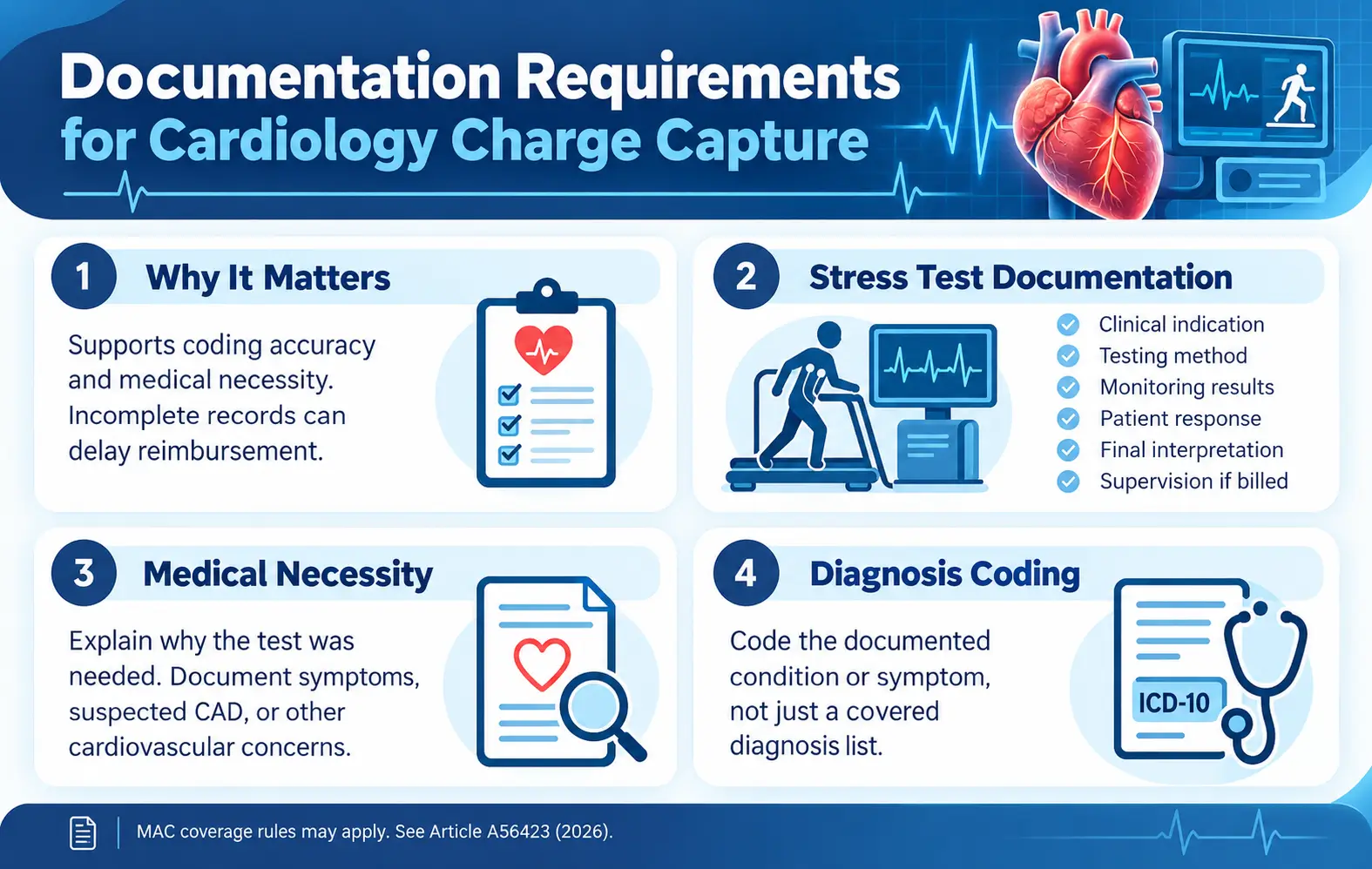
Clinical documentation supports both coding accuracy and medical necessity. Without adequate records, a correctly selected procedure code may still result in reimbursement problems.
For cardiovascular stress testing, documentation should identify the clinical indication, testing method, monitoring results, relevant patient responses, and final interpretation.
The record should also support the professional services being billed, including supervision when applicable.
Medical necessity requirements
Medical necessity explains why a cardiovascular procedure was appropriate for a patient's clinical condition.
Stress testing may be clinically indicated for evaluating selected symptoms, suspected coronary artery disease, or certain cardiovascular abnormalities.
The medical record should explain the clinical question being investigated.
For example, a patient experiencing exertional chest discomfort may undergo stress testing to help evaluate possible myocardial ischemia.
The diagnosis code should accurately represent the patient's documented condition or symptoms rather than being selected solely because it appears on a covered diagnosis list.
Medicare Administrative Contractors may maintain specific coverage requirements. Medicare billing article A56423, updated for 2026, emphasizes appropriate documentation, supported diagnosis coding, and clinical justification for cardiovascular testing.
CMS
Common cardiology charge capture challenges
Cardiology practices manage multiple diagnostic procedures, billing codes, and payer requirements. Several recurring problems can interfere with accurate charge reporting.
Missing or delayed charges
Completed procedures sometimes remain unbilled because clinical reports are unfinished or billing records have not been updated.
A stress test may be completed while its interpretation remains pending, delaying the charge capture process.
Comparing completed procedure logs with posted charges helps identify missing services before claims become significantly delayed.
Duplicate billing
Duplicate charges can occur when complete procedure codes are reported alongside component codes for the same services.
For example, reporting CPT 93015 together with CPT 93017 for an already included technical component can create an overlapping billing problem.
Medical coders should review the applicable code descriptions and coding edits before submitting claims.
Incorrect diagnosis coding
A procedure may be correctly documented but connected to an unsupported or inaccurate diagnosis code.
This mismatch can result in medical necessity denials or additional documentation requests.
Coding professionals should use the physician's clinical documentation to select the appropriate diagnosis.
Incorrect professional and technical billing
Cardiology procedures frequently involve different physicians, diagnostic facilities, and equipment owners.
Confusion about which entity performed the technical work or professional interpretation can lead to incorrect claims.
Clearly defining billing responsibilities helps prevent these errors.
CPT 93015 reimbursement considerations
Reimbursement for CPT Code 93015 depends on the payer, geographical location, date of service, place of service, and applicable payment methodology.
Medicare payment calculations under the Physician Fee Schedule consider factors such as relative value units, geographic adjustments, and applicable conversion factors.
Commercial insurers may use negotiated reimbursement rates and different coverage requirements.
The amount payable for a complete cardiovascular stress test may differ from the amounts associated with separately reported supervision, tracing, and interpretation.
Billing teams should also distinguish between physician office services and hospital-based testing because payment arrangements may vary considerably.
For accurate reimbursement estimates, practices should consult the applicable current fee schedule instead of relying on a universal payment amount.
How to improve cardiology charge capture accuracy
Improving charge capture requires consistent communication between clinical personnel, coders, and billing departments.
Maintain accurate clinical documentation
Physicians and clinical staff should complete procedure records promptly and ensure that documentation clearly describes the services performed.
The billing department should be able to identify the procedure, responsible providers, and completed professional components without relying on assumptions.
Reconcile completed procedures with charges
Routine reconciliation compares completed cardiology services against recorded charges.
For example, a practice may review all stress tests completed during the previous billing period and confirm that each examination has been appropriately charged or assigned a documented reason for remaining unbilled.
This process helps identify missing services and delayed interpretations.
Review coding and payer requirements
Billing professionals should stay informed about current CPT guidelines, Medicare coverage policies, and payer-specific billing instructions.
Changes in coding descriptions, coverage policies, or billing edits may affect previously established workflows.
Regular coding reviews can help identify outdated practices before they result in repeated denials.
Monitor billing performance
Practices can track charge entry delays, missing procedure charges, coding corrections, denials, and payment discrepancies.
Repeated problems may indicate documentation delays, staff training needs, or weaknesses in the practice management system.
Targeted audits help determine where improvements are necessary.
The importance of charge capture in cardiology revenue cycle management
Charge capture directly influences the accuracy of cardiology revenue reporting and insurance claims.
When completed services are not recorded, practices may lose opportunities to obtain appropriate reimbursement. Incorrectly recorded charges can generate denials, overpayments, or additional administrative work.
Accurate charge capture also helps billing departments maintain consistency between medical records, procedure reports, and financial transactions.
For practices performing large numbers of diagnostic examinations, even routine reconciliation can identify discrepancies that might otherwise remain unnoticed.
Effective charge capture therefore supports financial accuracy while helping providers maintain compliance with applicable coding and payer requirements.
Key takeaways for accurate cardiology charge capture
Cardiology charge capture ensures that completed cardiovascular services are documented, coded, and billed according to the work performed.
CPT Code 93015 represents the complete cardiovascular stress test, while CPT Codes 93016, 93017, and 93018 describe separately reportable components.
Healthcare providers and medical billing professionals should verify procedure documentation, medical necessity, billing responsibilities, coding combinations, and payer requirements before submitting claims.
Regular reconciliation between completed cardiology procedures and recorded charges can help prevent missed revenue, reduce coding errors, and improve reimbursement accuracy.