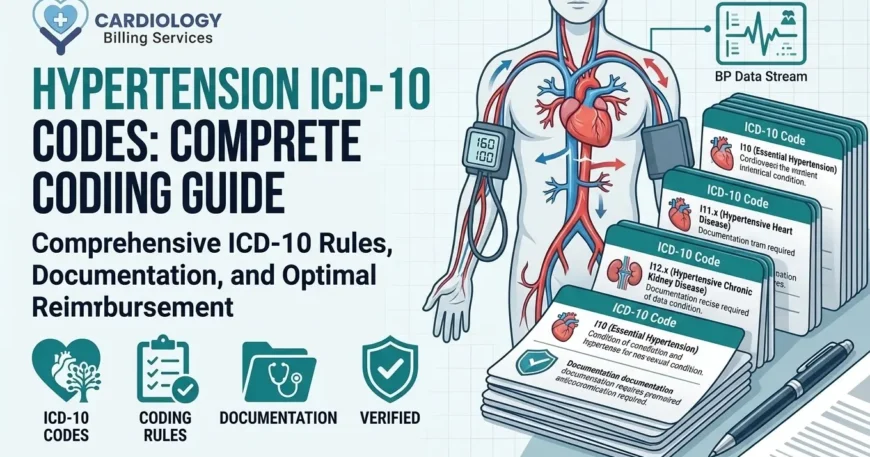
Hypertension ICD-10 Codes: Complete Coding Guide

The hardest part of coding hypertension isn’t finding I10. It’s knowing when I10 is wrong. A patient with hypertension and heart failure, or hypertension and chronic kidney disease, doesn’t get I10 at all under current ICD-10-CM rules and assigning it anyway is one of the most common reasons a diagnosis fails to support the service billed. Hypertension coding is really a set of decisions about combination codes, presumed relationships, required additional codes and what the provider actually documented and getting those decisions right is what separates a clean claim from a denial or an audit finding.
This guide covers the Hypertension ICD-10 Codes a coder actually needs: essential hypertension (I10), secondary hypertension (I15), hypertensive heart disease (I11), hypertensive chronic kidney disease (I12), the three-way combination (I13), hypertensive crisis (I16), the newer resistant hypertension code (I1A.0) and the pregnancy hypertension codes (O10–O16). Every code below was checked against the FY 2026 ICD-10-CM code set, effective October 1, 2025 through September 30, 2026. Because ICD-10-CM updates every October 1, always confirm a code’s current status before you submit; codes valid this fiscal year can change in the next.
What Is the ICD-10 Code for Hypertension?
The ICD-10-CM code for uncomplicated essential (primary) hypertension is I10. It applies when the provider documents hypertension without any associated heart disease or chronic kidney disease attributed to it. When hypertension involves the heart, the kidneys, or both, a more specific combination code from I11, I12, or I13 replaces I10. The provider’s documentation, not the blood pressure reading, determines which code applies.
That one-sentence answer covers a large share of encounters, but the rest of this guide exists because the exceptions are where denials come from.
What Does I10 Mean in ICD-10-CM?
I10 is Essential (primary) hypertension. It’s a billable, specific code that represents chronically elevated systemic arterial blood pressure without an identified secondary cause and without documented hypertensive heart or kidney disease. “Essential” and “primary” mean the same thing here: hypertension that isn’t attributed to another underlying condition.
I10 is the right code when a provider documents hypertension (or high blood pressure that the provider has diagnosed as hypertension) and the record shows no associated cardiac or renal complication and no secondary cause. It is the wrong code in several common situations: when heart failure or another qualifying heart condition is present and related, when chronic kidney disease is present, when the hypertension is secondary to another condition, during pregnancy and when the record shows only an elevated reading without an actual hypertension diagnosis. Each of those routes to a different code, covered below.
A frequent mistake worth naming early: pulling I10 forward on every visit because “hypertension” appears somewhere in the chart or problem list, without checking whether the current documentation supports a complication code instead. That habit under-codes complicated hypertension and can undercut both specificity and risk-adjusted reimbursement.
Hypertension ICD-10 Codes: Main Categories
ICD-10-CM organizes hypertensive diseases in Chapter 9 (Diseases of the Circulatory System), across categories I10 through I16, plus I1A. Pulmonary hypertension is classified separately under I27 and is not covered here, since it’s a distinct condition from systemic hypertension. Pregnancy-related hypertension lives in Chapter 15 (O10–O16). Here is how each category works and what documentation supports it.
Essential (Primary) Hypertension — I10
I10 covers uncomplicated essential hypertension, as described above. It’s the default only after you’ve ruled out an associated heart condition, CKD, a secondary cause and pregnancy. Do not report I10 in addition to I11, I12, or I13; those combination codes already include the hypertension, so pairing them with I10 is a duplication error.
Secondary Hypertension — I15
Secondary hypertension is high blood pressure caused by an identifiable underlying condition rather than arising on its own. It differs from essential hypertension in that a specific cause is documented and that cause drives the coding. The I15 subcategories are I15.0 (renovascular hypertension), I15.1 (hypertension secondary to other renal disorders), I15.2 (hypertension secondary to endocrine disorders), I15.8 (other secondary hypertension) and I15.9 (secondary hypertension, unspecified).
Secondary hypertension usually requires two codes: the I15 code for the secondary hypertension and a code for the underlying cause, sequenced according to the reason for the encounter and any applicable instructional notes. The provider must document the causal condition; you can’t infer “secondary” from lab values or a medication list. If the documentation identifies the underlying condition, code it; if it doesn’t, the coding (and often a provider query) has to reflect that gap.
Hypertensive Heart Disease — I11
Category I11 reports hypertension with an associated heart condition. There are two codes: I11.0 (hypertensive heart disease with heart failure) and I11.9 (hypertensive heart disease without heart failure). When you assign I11.0, you must also assign an additional code from category I50 to identify the type of heart failure (systolic, diastolic, combined, or unspecified). The I11 code identifies the hypertensive heart disease; the I50 code specifies the failure.
What makes I11 tricky is the relationship question, addressed in its own section below. In short, under current guidelines the classification presumes hypertension and certain heart conditions are related, but coronary artery disease is a notable exception that is not presumed related to hypertension. Don’t assume every cardiac diagnosis on a hypertensive patient’s chart belongs in I11.
Hypertensive Chronic Kidney Disease — I12
Category I12 reports hypertension with chronic kidney disease. The two codes are I12.0 (hypertensive CKD with stage 5 CKD or end-stage renal disease) and I12.9 (hypertensive CKD with stage 1 through stage 4 CKD, or unspecified CKD). An I12 code never stands alone: you must add a code from category N18 to identify the CKD stage.
The N18 stage codes are N18.1 (stage 1), N18.2 (stage 2), N18.30 (stage 3 unspecified), N18.31 (stage 3a), N18.32 (stage 3b), N18.4 (stage 4), N18.5 (stage 5), N18.6 (ESRD) and N18.9 (CKD, unspecified). If the patient is on dialysis, also report Z99.2 (dependence on renal dialysis). The CKD stage must come from provider documentation; don’t stage CKD yourself from a GFR value unless the provider has documented the stage or the diagnosis.
Hypertensive Heart and Chronic Kidney Disease — I13
When a patient has hypertension with both an associated heart condition and CKD, category I13 is the mandatory combination code; you do not report separate I11 and I12 codes. The four codes are arranged by heart-failure status and CKD stage:
- I13.0 — with heart failure and stage 1–4 CKD, or unspecified CKD
- I13.10 — without heart failure, with stage 1–4 CKD, or unspecified CKD
- I13.11 — without heart failure, with stage 5 CKD or ESRD
- I13.2 — with heart failure and stage 5 CKD or ESRD
As with I11 and I12, add an I50 code for the heart failure type when heart failure is present and always add the N18 code for the CKD stage. I13 captures the hypertension, the heart involvement and the kidney involvement in one code, with the supporting codes filling in the specifics.
Hypertensive Crisis: Urgency and Emergency — I16
Category I16 reports a hypertensive crisis: I16.0 (hypertensive urgency), I16.1 (hypertensive emergency) and I16.9 (hypertensive crisis, unspecified). Clinically, urgency is severely elevated blood pressure without acute target-organ damage, while emergency involves acute target-organ damage; the American Heart Association recommended in 2025 that “severe hypertension” replace the term “hypertensive urgency,” but coding still follows what the provider documents.
Two points matter for coding. First, I16 codes are not standalone. The category carries an instruction to also code any identified hypertensive disease (I10–I15, I1A), so a crisis code is paired with the underlying hypertension type. Second, a high blood pressure number by itself does not establish a hypertensive crisis; the provider must document the diagnosis of urgency, emergency, or crisis. If emergency is documented with a specific manifestation (for example, encephalopathy), code that manifestation as well.
Resistant Hypertension — I1A.0
Resistant hypertension now has its own code: I1A.0 (Resistant hypertension), a billable code in the current code set. This is a change many older references miss, because before it existed coders had to fall back on the general hypertension code. Clinically, resistant hypertension refers to blood pressure that stays above goal despite concurrent use of multiple antihypertensive agents, but the code is assigned based on the provider’s documented diagnosis, not on a count of medications inferred from the chart. I1A.0 is reported together with the underlying hypertension code that describes the type of hypertension. Don’t assign it simply because a patient is on several blood pressure medications; assign it when the provider documents resistant hypertension.
Hypertension in Pregnancy — O10–O16
Hypertension during pregnancy is coded from Chapter 15, not from I10–I16. The circulatory-chapter hypertension codes carry an Excludes note routing pregnancy-related hypertension to the O-codes, so submitting I10 on an obstetric claim is a technical error that will trigger an edit. The main categories are O10 (pre-existing hypertension complicating pregnancy, childbirth and the puerperium), O11 (pre-existing hypertension with pre-eclampsia), O13 (gestational, or pregnancy-induced, hypertension without significant proteinuria), O14 (pre-eclampsia), O15 (eclampsia) and O16 (unspecified maternal hypertension). O12 covers gestational edema and proteinuria without hypertension.
Most O-codes require trimester specificity and, in some cases, identification of the fetus in multiple gestations. Chapter 15 codes take sequencing priority for a pregnancy encounter, so the O-code is generally sequenced first and the ordinary hypertension code stays off the claim. When pre-eclampsia develops on top of pre-existing hypertension, O11 captures both in one code rather than reporting O10 plus a separate pre-eclampsia code. Verify the specific subcodes and trimester requirements against the current code set for each encounter.
Hypertension vs. Elevated Blood Pressure: The Coding Difference
A single high reading is not a diagnosis. R03.0 (Elevated blood-pressure reading, without diagnosis of hypertension) exists specifically for the situation where the record documents an elevated blood pressure but the provider has not established hypertension, or where the elevated reading is an isolated incidental finding. The Tabular List notes that R03.0 is generally not sufficient as a principal diagnosis to justify acute inpatient admission.
The practical rule: don’t assign I10 (or any hypertensive disease code) from a blood pressure value alone. Code the diagnosis the provider documented. If the note says “elevated BP, will recheck” without a hypertension diagnosis, R03.0 is appropriate; if the note documents “hypertension,” code the hypertension. The distinction protects both coding accuracy and medical-necessity support, because assigning a chronic-disease diagnosis the record doesn’t establish is exactly the kind of mismatch that surfaces on audit. The same caution applies to the terms “uncontrolled hypertension,” “hypertensive urgency,” and “hypertensive emergency”: these are separate documented diagnoses, not interchangeable labels for a high number and each has its own coding path.
Hypertension ICD-10 Code Table
This table summarizes the main categories. It is not a “one code fits all” list; the correct code depends on the documentation, the associated conditions and the applicable guidelines. Verify each code against the current ICD-10-CM code set before use.
Condition | ICD-10-CM code / category | When it may apply | Additional coding considerations |
Essential (primary) hypertension, uncomplicated | I10 | Hypertension without associated heart or kidney disease and no secondary cause | Do not report with I11–I13; not for pregnancy |
Secondary hypertension | I15.0–I15.9 | Hypertension caused by a documented underlying condition | Also code the underlying cause; sequence per the encounter |
Hypertensive heart disease | I11.0 (with HF), I11.9 (without HF) | Hypertension with a related heart condition | Add an I50 code for heart failure type when HF is present |
Hypertensive chronic kidney disease | I12.0 (stage 5/ESRD), I12.9 (stage 1–4/unspecified) | Hypertension with CKD | Always add the N18 stage code; add Z99.2 if on dialysis |
Hypertensive heart and CKD | I13.0, I13.10, I13.11, I13.2 | Hypertension with both heart involvement and CKD | Add I50 (if HF) and the N18 stage code |
Hypertensive crisis | I16.0 (urgency), I16.1 (emergency), I16.9 (unspecified) | Provider documents a hypertensive crisis | Also code the underlying hypertension (I10–I15, I1A) |
Resistant hypertension | I1A.0 | Provider documents resistant hypertension | Also code the type of hypertension |
Hypertension in pregnancy | O10, O11, O13, O14, O15, O16 | Any hypertensive condition during pregnancy/puerperium | Chapter 15 codes sequence first; trimester specificity often required |
Elevated BP, no hypertension diagnosis | R03.0 | Elevated reading without an established hypertension diagnosis | Not a hypertension code; not usually a principal admission dx |
The Presumed Causal Relationship Rule
This is the single concept that trips up experienced coders, so it deserves its own section. Under the current ICD-10-CM Official Guidelines (Section I.C.9), the classification presumes a causal relationship between hypertension and heart involvement and between hypertension and kidney involvement, because those conditions are linked by the word “with” in the Alphabetic Index. The guidelines instruct that these conditions should be coded as related even without provider documentation explicitly linking them, unless the documentation clearly states the conditions are unrelated.
In practice, this means:
- Hypertension + CKD (any N18 stage) is presumed related. Assign a code from I12 plus the N18 stage code, regardless of which condition is the stated reason for the encounter, unless the provider documents the CKD is not due to the hypertension.
- Hypertension + heart failure (I50.-) or certain other heart conditions (in the I51.4–I51.9 range) is presumed related. Assign a code from I11 (with the I50 code when heart failure is present), unless the provider documents they are unrelated.
- Hypertension + both heart involvement and CKD routes to I13.
The important exception is coronary artery disease (I25.-), which is not presumed to be caused by hypertension. Atherosclerotic heart disease and hypertension are coded separately unless the provider documents a causal link, because CAD isn’t among the conditions linked to hypertension by “with” in the classification. So a hypertensive patient with coronary artery disease does not automatically get an I11 code. This distinction, presumed for heart failure and CKD, not presumed for CAD, is where a lot of incorrect I11 assignments originate.
When the provider’s documentation states two conditions are unrelated, follow that documentation and code them separately. The presumption is a default, not an override of explicit provider statements.
How to Choose the Correct Hypertension ICD-10-CM Code
A reliable code-selection process keeps these rules straight and keeps the code tied to the record.
Start with provider documentation. Read the assessment and plan, not just the problem list. Identify the type of hypertension and any documented heart condition, heart failure, CKD, CKD stage, secondary cause, crisis, or pregnancy status. The documentation drives everything that follows.
Check the Alphabetic Index, then verify in the Tabular List. Locate the condition in the Index under “Hypertension,” follow the subterms and any “see” cross-references, then confirm the code in the Tabular List. Never code straight from the Index and never code from memory; the Tabular List is where you catch the instructional notes.
Apply combination-code instructions. Decide whether the documentation supports I10 alone or a combination code (I11, I12, or I13). Remember that combination codes include the hypertension, so I10 is not reported alongside them.
Assign required additional codes. Add the I50 heart-failure code when heart failure is present with I11.0, I13.0, or I13.2. Add the N18 stage code with every I12 and I13 code. Add the underlying hypertension code with I16 and I1A.0. Add the underlying cause with secondary hypertension.
Watch exclusion notes. Note the Excludes instructions, especially the one routing pregnancy-related hypertension out of I10–I16 and into O10–O16 and the separate classification of pulmonary hypertension under I27.
Confirm the current code set. Verify you’re using the FY 2026 codes (or the code set in effect for the date of service), since the annual October 1 update adds, deletes and revises codes.
For practices where these decisions are inconsistent across coders and providers, dedicated cardiology medical coding review before submission catches combination-code and additional-code gaps before they become denials.
Common Hypertension ICD-10 Coding Errors
These are the recurring, preventable mistakes behind hypertension-related coding denials and audit findings.
Coding mistake | Why it is a problem | What to review |
Assigning I10 when a complication is documented | Under-codes complicated hypertension; combination code required | The assessment for documented heart failure, heart disease, or CKD |
Coding hypertension from a BP reading alone | No provider diagnosis to support the code | Whether the provider documented hypertension vs. an elevated reading (R03.0) |
Reporting I10 with I11, I12, or I13 | Combination codes already include the hypertension | The claim for duplicate hypertension coding |
Omitting the N18 stage code with I12 or I13 | The stage is a required additional code | Provider documentation of the CKD stage |
Omitting the I50 code with I11.0, I13.0, or I13.2 | Heart failure type must be specified | Documentation of the heart failure type |
Assuming CAD is related to hypertension | CAD (I25) is not presumed related; I11 is incorrect here | Whether the provider documented a causal link |
Overlooking resistant hypertension (I1A.0) | Misses a specific, billable diagnosis | Provider documentation of resistant hypertension |
Coding pregnancy hypertension with I10–I16 | Chapter 15 (O10–O16) applies; triggers an edit | Pregnancy status and the correct O-code |
Reporting I16 without the underlying hypertension | Crisis codes are not standalone | The record for the underlying hypertension type |
Using an outdated or deleted code | Fails current-code-set edits | The FY 2026 code set for validity |
Skipping the Tabular List and its notes | Misses “use additional code” and Excludes instructions | The Tabular List entry for the assigned code |
Coding a diagnosis the note doesn’t support | Unsupported diagnosis; audit exposure | The documentation before final assignment |
Documentation That Supports Hypertension Coding
Accurate hypertension coding depends on what the provider documents. Requirements vary by code category, service, payer and setting, so this is what to look for rather than a single universal checklist.
Documentation element | Why it matters for coding |
A provider-stated hypertension diagnosis | Distinguishes hypertension from an elevated reading (R03.0) |
Type of hypertension (essential, secondary, resistant) | Determines I10 vs. I15 vs. I1A.0 |
Associated heart condition and its relationship | Supports or rules out I11/I13 and the CAD exception |
Heart failure type when present | Required for the additional I50 code |
CKD diagnosis and stage | Required for I12/I13 and the N18 stage code |
Documented secondary cause | Required to code secondary hypertension and its etiology |
Pregnancy status | Routes coding to O10–O16 |
Crisis diagnosis (urgency/emergency) when applicable | Supports I16 beyond a high reading alone |
Assessment and plan | Ties the diagnosis to the encounter and the service |
When documentation is ambiguous, a provider query is the appropriate step, not an assumption. Coding should reflect the record; it should never be adjusted after the fact simply to obtain payment.
Hypertension Coding and Medical Necessity
Medical necessity is the payer’s determination that a service was reasonable and necessary for the patient’s documented condition. A hypertension diagnosis code helps establish that link for some services, but it does not, on its own, justify every cardiac test or procedure and no diagnosis code guarantees payment.
In cardiology this comes up constantly with diagnostic testing. Whether an echocardiogram, a stress test, an EKG, ambulatory monitoring, nuclear cardiology study, or cardiac catheterization is covered depends on the payer’s coverage policy, the documented indication and whether the diagnosis on the claim is among the covered indications for that service. Hypertension may support a given study for some payers under some circumstances, but the coverage policy and the documentation have to align and Medicare and commercial policies can differ on which diagnoses support which tests. The correct approach is to code the diagnosis the record supports and check it against the applicable coverage policy, not to select a diagnosis because it’s more likely to be covered.
Hypertension ICD-10 Codes and CPT Codes
Diagnosis coding and procedure coding answer different questions and it helps to keep them separate. ICD-10-CM codes describe the patient’s diagnoses and conditions, such as the hypertension codes in this guide. CPT codes describe the physician and professional services and procedures performed, such as an office visit or an echocardiogram. HCPCS Level II codes cover additional services, supplies and products.
A hypertension code is a diagnosis, not a procedure and it is not a substitute for the CPT code that reports the service. On a claim, the diagnosis should support the service when the service is medically necessary and documented. The relationship between a specific diagnosis and a specific procedure, meaning which diagnoses a payer accepts as supporting a given CPT code, is set by payer and coverage policy and varies by service; it is not something to assume. Reporting a hypertension diagnosis alongside a cardiology CPT code does not by itself establish coverage for that service.
Hypertension Coding in Cardiology Billing
Hypertension is one of the most frequently documented conditions in cardiology and accurate coding of it matters across much of the practice’s work: the diagnostic testing above, heart failure management where hypertensive heart disease and heart failure intersect, care for patients with CKD-related cardiovascular disease and documentation of cardiovascular risk. Specific hypertension coding also affects risk adjustment. Uncomplicated essential hypertension (I10) generally does not carry risk-adjustment weight on its own, while complications such as documented CKD stages can, so coding to the correct specificity affects risk-adjusted reimbursement under the applicable CMS-HCC model version, in addition to supporting the claim.
That said, hypertension is only one part of the coding and billing picture. It has to be coded accurately alongside the procedure codes, modifiers and documentation that make up the full claim and it doesn’t substitute for any of them.
Hypertension Coding and Claim Denials
Hypertension coding errors contribute to claim problems in several recognizable ways. A diagnosis–service mismatch occurs when the hypertension code on the claim doesn’t support the service the payer’s policy covers. An unsupported diagnosis, coded beyond what the record establishes, creates both denial and audit exposure. Insufficient specificity, such as I10 where a combination code applies, can fail coverage edits. Missing required additional codes (the N18 stage with I12, the I50 type with I11.0) can trigger edits or leave the claim incomplete. Incorrect sequencing, especially failing to sequence O-codes first in pregnancy or the underlying hypertension appropriately with I16, can cause rejections. And documentation discrepancies between the code and the record surface on payer review.
None of this means a particular hypertension code guarantees payment. Medical necessity and coverage depend on the service, the documentation, the payer’s policy and the rest of the claim. When hypertension-related denials cluster, the fix is usually upstream, in documentation or code selection, which is why tracing them to a root cause matters more than reworking them one at a time. Structured denial management exists to do exactly that: identify the pattern, correct or appeal appropriately and address the workflow that produced the denial.
Medicare Considerations
Medicare has its own coverage and documentation rules and treating them as if they applied to every payer is a reliable source of denials. For hypertension coding and the services it supports:
- Coverage for cardiology services is shaped by National Coverage Determinations (NCDs) and, more often for imaging and testing, by Local Coverage Determinations (LCDs) and their billing and coding articles published by the Medicare Administrative Contractor (MAC) for your jurisdiction. Covered diagnoses and documentation expectations can differ by MAC, so confirm the policy for your region rather than assuming a single national rule.
- Medicare medical necessity is a coverage determination and a correct hypertension code doesn’t guarantee coverage of a given test.
- Diagnosis coding must follow the ICD-10-CM Official Guidelines and use the current code set for the date of service.
- Documentation, including a valid signature and authentication, has to support the codes reported.
- NCCI edits (from CMS) can affect the procedure side of a cardiology claim; they’re relevant when hypertension supports a study that’s billed with other same-day services.
Where MAC-level or local coverage differences exist, state that clearly in your internal policies instead of applying one interpretation everywhere.
Commercial Payer Considerations
Commercial payer requirements frequently differ from Medicare and from one another. Medical policies, medical-necessity criteria, prior authorization lists, diagnosis and documentation requirements, coverage limitations, network rules, claim edits and appeal deadlines are each set by the individual payer. A rule that holds for Medicare may not hold for a commercial plan and a rule for one commercial plan may not hold for the next. Confirm any commercial-payer requirement against that payer’s current published medical policy or provider manual before relying on it and keep those references current, because they change.
Area | Medicare | Commercial payer |
Coverage rules | NCDs and MAC-level LCDs/articles | Payer-specific medical policies |
Medical necessity | CMS/MAC coverage determinations | Set by the individual payer |
Prior authorization | Limited for many services; varies by item | Common for advanced cardiac imaging and procedures; payer-specific |
Diagnosis coding | ICD-10-CM Official Guidelines, current code set | Same guidelines, but coverage edits differ |
Appeals | Defined multi-level fee-for-service process | Payer-specific process and deadlines |
The one constant across the table: the ICD-10-CM Official Guidelines apply to the code selection itself. What varies is coverage and coverage is where “code correctly” and “get paid” diverge.
Practical Hypothetical Coding Scenarios
The following are fictional illustrations for coding education, not real patient cases. For each, the point is the coding decision and the risk of getting it wrong.
Scenario 1 — Uncomplicated essential hypertension. A provider documents essential hypertension at a routine visit, with no associated heart or kidney disease and no secondary cause. Coding issue: whether any complication is present. Review: the assessment for documented heart failure, heart disease, or CKD. Approach: I10 alone. Risk if wrong: if a complication was documented but overlooked, I10 under-codes the encounter and misses required additional codes.
Scenario 2 — Hypertension with CKD. A provider documents hypertension and chronic kidney disease, stage 3b. Coding issue: the presumed relationship and the required stage code. Review: the documented CKD stage. Approach: I12.9 (stage 1–4 or unspecified) plus N18.32 (stage 3a would be N18.31; 3b is N18.32). Risk if wrong: omitting the N18 code leaves the claim incomplete; using I10 ignores the presumed hypertension–CKD relationship.
Scenario 3 — Hypertension with heart failure. A provider documents hypertension and diastolic heart failure. Coding issue: whether the conditions are related and which heart-failure code applies. Review: whether the documentation links them or states they’re unrelated and the heart-failure type. Approach: if related (the default under the presumption), I11.0 plus the appropriate I50 code for the diastolic heart failure. Risk if wrong: coding I10 plus the heart failure separately, when the presumption calls for I11.0, or omitting the required I50 code.
Scenario 4 — Hypertensive heart and CKD. A provider documents hypertension, heart failure and CKD stage 4. Coding issue: the three-way combination. Review: heart-failure type and CKD stage. Approach: I13.0 (with heart failure, stage 1–4 or unspecified) plus the I50 heart-failure code plus N18.4. Risk if wrong: reporting separate I11 and I12 codes instead of the mandatory I13 combination, or dropping a required additional code.
Scenario 5 — Secondary hypertension. A provider documents hypertension secondary to a documented endocrine disorder. Coding issue: coding the secondary hypertension and its cause. Review: the documented underlying condition. Approach: I15.2 plus the code for the underlying endocrine condition, sequenced per the encounter. Risk if wrong: coding I10 as if it were essential hypertension ignores the documented cause and the dual-coding requirement.
Scenario 6 — Elevated blood pressure without a hypertension diagnosis. The record shows an elevated blood pressure reading and the provider documents a plan to recheck, without diagnosing hypertension. Coding issue: whether a diagnosis exists. Review: the assessment for an actual hypertension diagnosis. Approach: R03.0, not I10. Risk if wrong: assigning I10 records a chronic disease the record doesn’t establish, an unsupported-diagnosis problem.
Scenario 7 — Hypertensive emergency. A provider explicitly documents a hypertensive emergency with a specific acute manifestation. Coding issue: the crisis code, the underlying hypertension and the manifestation. Review: the documented diagnosis and manifestation, not just the blood pressure value. Approach: I16.1 plus the underlying hypertension code plus the manifestation code. Risk if wrong: assigning a crisis code from a high reading alone, without the documented diagnosis, or omitting the underlying hypertension code.
Hypertension Coding Audit Checklist
A quick internal-review checklist for hypertension claims:
- Is hypertension documented by the provider (versus only an elevated reading)?
- Is the type of hypertension clear (essential, secondary, resistant)?
- Is I10 actually appropriate, or is a complication documented?
- Is there documented heart disease and is the relationship supported (or CAD, which isn’t presumed related)?
- Is heart failure documented and is the I50 type code assigned when required?
- Is CKD documented and is the N18 stage code assigned?
- Is secondary hypertension documented with its underlying cause?
- Is pregnancy relevant, routing the code to O10–O16?
- Are combination-code rules satisfied (no I10 with I11–I13)?
- Are all required additional codes present?
- Were the Alphabetic Index and Tabular List both reviewed?
- Do any Excludes notes apply?
- Is the current ICD-10-CM code set in use for the date of service?
- Does the documentation support every diagnosis on the claim?
Practices can run this against a sample of charts periodically, comparing codes to documentation, checking combination and additional codes, verifying CKD staging and reviewing pregnancy coding, then feed the findings into provider education and coder training. Monitoring hypertension-related denials and reviewing the ICD-10-CM update each October keeps the process current.
How to Prevent Hypertension Coding Errors
Prevention works best spread across the revenue cycle rather than concentrated at the back end. Before the visit, verify eligibility, benefits and any referral or authorization requirements for the planned service, since coverage rules vary by payer. During the encounter, the documentation should capture the hypertension diagnosis, any associated heart condition and its relationship, heart failure and its type, CKD and its stage, any secondary cause and pregnancy status where relevant. During coding, review code selection, combination-code and additional-code requirements, sequencing, exclusion notes and the current code-set year. Before submission, confirm the diagnosis and procedure codes, the diagnosis-to-service relationship, payer requirements, claim edits and documentation availability. After submission, monitor rejections and denials, watch for medical-necessity and coding-related denials, track payer trends, work appeals and accounts receivable follow-up and analyze root causes so the same errors don’t recur.
Accurate diagnosis coding should happen before the claim goes out, based on the documentation and should not be changed later simply to obtain reimbursement. When the volume of payer rules, annual code updates and denials outpaces a practice’s staff, that’s the practical point at which outside cardiology medical billing and coding support becomes worth considering, judged on fewer avoidable denials and cleaner claims rather than on any promise of guaranteed payment.
Frequently Asked Questions
What is the ICD-10 code for hypertension? For uncomplicated essential (primary) hypertension, the code is I10. When hypertension involves the heart, the kidneys, or both, a more specific code from I11, I12, or I13 applies instead and pregnancy-related hypertension uses O10–O16. The provider’s documentation determines which of the Hypertension ICD-10 Codes is correct for the encounter.
What does I10 mean in ICD-10-CM? I10 is Essential (primary) hypertension: chronically elevated blood pressure without an identified secondary cause and without documented hypertensive heart or kidney disease. It’s a billable code, but it’s only appropriate after ruling out complications, a secondary cause and pregnancy.
Is I10 the code for essential hypertension? Yes. I10 represents essential (primary) hypertension, which is uncomplicated hypertension not attributed to another underlying condition. It should not be reported alongside I11, I12, or I13, which already include the hypertension.
What is the ICD-10 code for secondary hypertension? Secondary hypertension is reported from category I15 (I15.0 renovascular, I15.1 secondary to other renal disorders, I15.2 secondary to endocrine disorders, I15.8 other, I15.9 unspecified), along with a code for the documented underlying cause.
What is the ICD-10 code for hypertension with CKD? Hypertension with chronic kidney disease is coded from category I12: I12.0 for stage 5 CKD or ESRD and I12.9 for stage 1 through 4 or unspecified CKD. An N18 code for the CKD stage is always required in addition.
How is hypertension with heart failure coded? When hypertension and heart failure are related (the default under the presumed-relationship rule), assign I11.0 (hypertensive heart disease with heart failure) plus a code from category I50 to identify the heart failure type. If both CKD and heart failure are present, use the I13 combination instead.
How is hypertensive heart and chronic kidney disease coded? Use category I13 when hypertension coexists with both an associated heart condition and CKD: I13.0, I13.10, I13.11, or I13.2 depending on heart-failure status and CKD stage. Add an I50 code for heart failure type when present and always add the N18 stage code. Do not report separate I11 and I12 codes.
Can an elevated blood pressure reading be coded as hypertension? No. If the provider hasn’t diagnosed hypertension, an isolated elevated reading is coded R03.0 (elevated blood-pressure reading, without diagnosis of hypertension). A hypertension code requires a documented hypertension diagnosis, not just a high number.
Does hypertension have a different ICD-10 code during pregnancy? Yes. Hypertension during pregnancy is coded from Chapter 15 (O10–O16), not from I10–I16. Submitting I10 on an obstetric claim is a technical error, because an Excludes note routes pregnancy-related hypertension to the O-codes, which usually sequence first.
Is resistant hypertension assigned a separate ICD-10-CM code? Yes, as of the current code set. Resistant hypertension is coded I1A.0, reported together with the underlying hypertension type. It’s assigned based on the provider’s documented diagnosis, not on an inferred medication count.
What is the difference between hypertension and hypertensive heart disease coding? Uncomplicated hypertension is I10. Hypertensive heart disease (I11) applies when a related heart condition is documented and it may require an additional heart-failure code. The key is whether an associated heart condition is present and related; coronary artery disease, notably, is not presumed related to hypertension.
What documentation supports hypertension coding? A provider-stated hypertension diagnosis, the type of hypertension, any associated heart condition and its relationship, heart failure type, CKD and its stage, any secondary cause, pregnancy status and a crisis diagnosis when applicable. Requirements vary by code category, service and payer.
Can incorrect hypertension coding cause claim denials? Yes. Diagnosis–service mismatches, unsupported diagnoses, insufficient specificity, missing required additional codes and incorrect sequencing all contribute to denials and audit exposure. No hypertension code, however, guarantees payment; coverage depends on the service, documentation and payer policy.
How do Medicare rules affect hypertension ICD-10 coding? Medicare coverage for the services a hypertension diagnosis supports is governed by NCDs and MAC-level LCDs, which can vary by jurisdiction and diagnosis coding must follow the ICD-10-CM Official Guidelines and the current code set. Medicare rules are specific to Medicare and don’t automatically apply to commercial payers.
Do commercial insurers use the same hypertension coding rules as Medicare? The ICD-10-CM Official Guidelines for code selection apply across payers. Coverage rules do not: prior authorization, medical policies, documentation requirements and appeal deadlines are set by each commercial payer and differ from Medicare and from each other. Confirm each requirement against the specific payer’s current policy.
Key Takeaways
- I10 is essential (primary) hypertension and it’s only correct for uncomplicated cases with no associated heart or kidney disease, no secondary cause and no pregnancy.
- Current guidelines presume hypertension is related to heart failure/certain heart conditions and to CKD, routing to I11, I12, or I13, unless documentation states otherwise; coronary artery disease is the notable exception that is not presumed related.
- I12 and I13 always require the N18 CKD stage code; I11.0, I13.0 and I13.2 require an I50 heart-failure code.
- Do not report I10 with I11, I12, or I13; the combination codes already include the hypertension.
- Resistant hypertension has its own code, I1A.0, reported with the underlying hypertension type.
- An elevated reading without a diagnosis is R03.0, not a hypertension code and pregnancy hypertension uses O10–O16.
- Code from provider documentation and the current code set, verify in the Tabular List and never change a diagnosis simply to obtain reimbursement.
- A correct code supports, but never guarantees, coverage; medical necessity depends on the service, documentation and payer policy.
Conclusion
Coding hypertension well comes down to a few disciplined habits: read the documentation before reaching for I10, apply the presumed-relationship rule while remembering the coronary-artery-disease exception, assign the required additional codes for CKD stage and heart-failure type and keep pregnancy and elevated-reading cases out of the I10–I16 range where they don’t belong. The Hypertension ICD-10 Codes in this guide, from I10 through I16, I1A.0 and the O-codes, were verified against the FY 2026 code set, but the discipline matters more than any single code, because the code set changes every October and the denials come from the decisions around the codes, not the codes themselves. When the combination-code logic, annual updates and payer coverage rules become more than a practice can manage alongside patient care, cardiology-specific coding and denial-management support is a reasonable way to keep claims accurate and defensible, measured by fewer avoidable denials rather than by any promise of guaranteed payment.