

TEE Billing Guide: CPT Coding, Reimbursement, Denials and Billing Rules

A transesophageal echocardiogram takes about the same imaging time whether the cardiologist is hunting for a left atrial thrombus before cardioversion or an anesthesiologist is watching ventricular filling during a bypass. On the claim, those two services could hardly be further apart. The first pays as a diagnostic test. The second, under Medicare rules, usually pays nothing beyond the anesthesia fee.
That gap explains most of the trouble in TEE billing. Eight CPT codes describe the procedure, three of them exist only to split the work between two physicians, and one cannot be used by the doctor performing the intervention it supports. This guide covers how to choose among them, what Medicare pays in 2026, and where claims fail.
TEE CPT codes and what each one covers
Three questions settle the code. Is the patient being evaluated for a congenital anomaly? Did one physician do everything, or was the work divided? And was the study diagnostic, for monitoring, or for guiding a transcatheter procedure?
| CPT code | What it reports | Who typically bills it |
|---|---|---|
| 93312 | Complete TEE: probe placement, image acquisition, interpretation and report | One physician who did all of it |
| 93313 | Probe placement only | Often the anesthesiologist |
| 93314 | Image acquisition, interpretation and report only | The interpreting cardiologist |
| 93315 | Complete TEE for congenital cardiac anomalies | One physician |
| 93316 | Congenital TEE, probe placement only | Placing physician |
| 93317 | Congenital TEE, acquisition, interpretation and report only | Interpreting physician |
| 93318 | TEE for monitoring, with continuous assessment of cardiac pumping function | Monitoring physician |
| 93355 | TEE guidance of a transcatheter structural intervention such as TAVR | A physician other than the operator |
Add-on codes for Doppler and 3D
Spectral Doppler (+93320 complete, +93321 limited) and color flow mapping (+93325) are not built into the TEE base codes, so they are listed separately when performed and documented. The American Society of Anesthesiologists’ statement on TEE pairs them with the core codes 93312, 93314, 93315 and 93317. They do not attach to probe-placement codes.
The 3D add-on, +93319, took effect on January 1, 2022 with a work RVU of 0.50, according to Susan A. Mayer, MD, writing in the American Society of Echocardiography’s Echo magazine that month. It is reported with the same four core codes. Mayer notes it cannot be added to 93355, because that code already includes 3D imaging.
93355 has its own rules
Code 93355 is reported once per intervention and only by someone who is not performing the interventional procedure, as the ASE coding FAQ explains. The ASA statement describes it as covering every echo modality needed for guidance, which rules out reporting it alongside 93312 through 93325, 76376 or 76377.
Diagnostic or monitoring: the distinction that decides payment
Medicare’s position is written into Chapter II, Section B.6 of the 2026 NCCI Policy Manual. Codes 93312 through 93317 are part of the anesthesia service when the probe is used for monitoring. Code 93318 is bundled into anesthesia without exception, and 93355 appears on the same list of integral services.
The manual leaves one opening. A TEE performed for diagnostic purposes and documented with a formal report may be treated as a significant, separately identifiable service. Nothing comparable is offered for 93318.
In practice, an anesthesiologist who places a probe at the start of a mitral valve repair and glances at the screen for six hours has provided monitoring. If the same physician is asked to evaluate a new regurgitant jet after the patient comes off bypass, records images and dictates findings that change the surgical plan, that portion is a diagnostic study and can be reported as 93312.
How the rule changed over time
The diagnostic exception was not always available. AAPC’s Anesthesia Coding Alert reported that NCCI version 9.1 blocked anesthesiologists from using modifier 59 on most TEE codes, and that a later release restored it for 93312, 93313, 93315 and 93316 from July 1 of that year. Older payer contracts sometimes still reflect the stricter version, which is worth checking when a commercial plan denies a diagnostic intraoperative TEE.
Anesthesia for someone else’s TEE
A different situation arises when a cardiologist performs the TEE and an anesthesia provider only sedates the patient. The anesthesia provider reports 01922 (anesthesia for non-invasive imaging) with time units, according to AAPC guidance, and no TEE code at all.
Modifiers and split billing
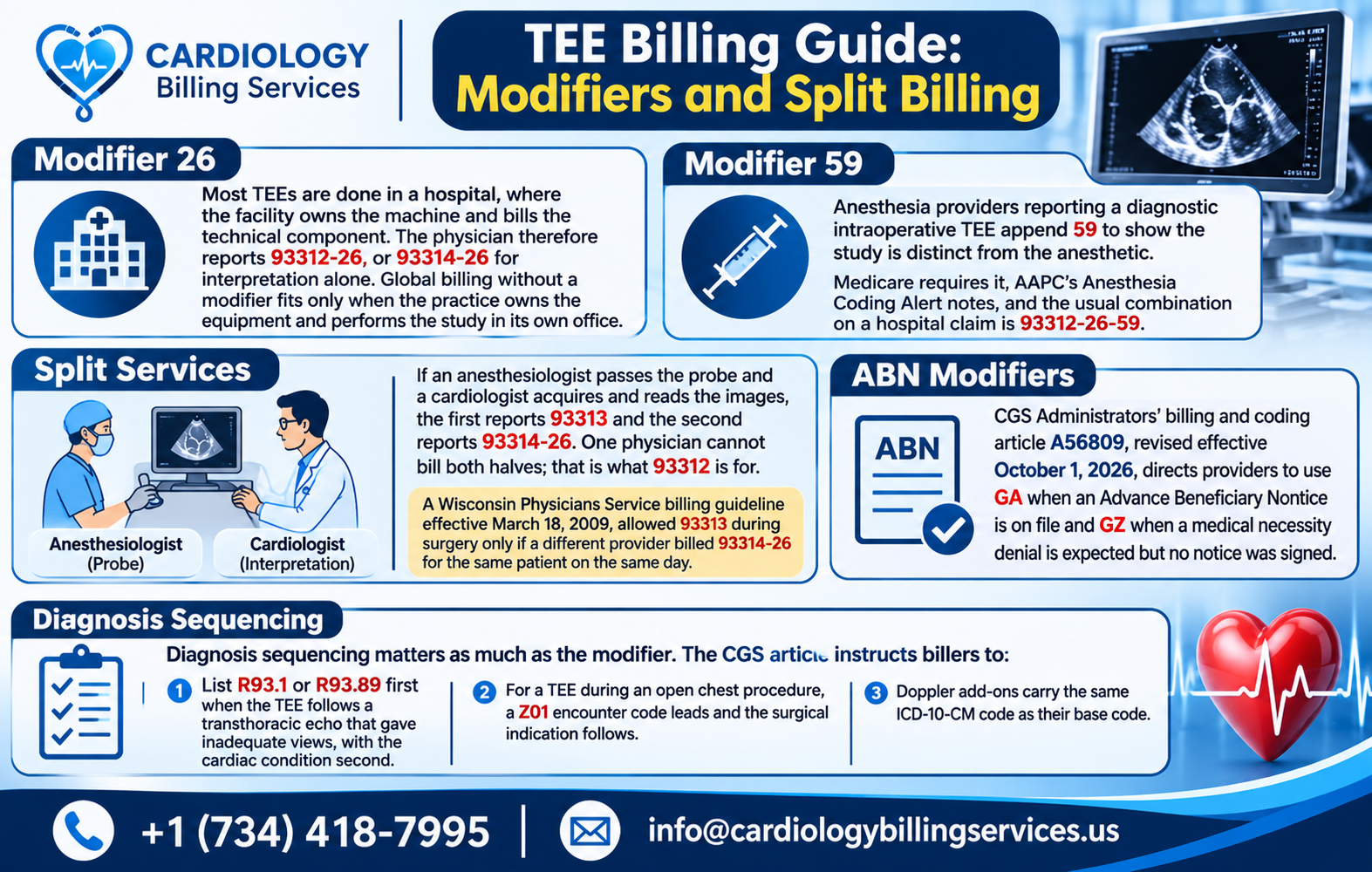
Modifier 26. Most TEEs are done in a hospital, where the facility owns the machine and bills the technical component. The physician therefore reports 93312-26, or 93314-26 for interpretation alone. Global billing without a modifier fits only when the practice owns the equipment and performs the study in its own office.
Modifier 59. Anesthesia providers reporting a diagnostic intraoperative TEE append 59 to show the study is distinct from the anesthetic. Medicare requires it, AAPC’s Anesthesia Coding Alert notes, and the usual combination on a hospital claim is 93312-26-59.
Split services. If an anesthesiologist passes the probe and a cardiologist acquires and reads the images, the first reports 93313 and the second reports 93314-26. One physician cannot bill both halves; that is what 93312 is for. A Wisconsin Physicians Service billing guideline effective March 18, 2009 went further, allowing 93313 during surgery only if a different provider billed 93314-26 for the same patient on the same day.
ABN modifiers. CGS Administrators’ billing and coding article A56809, revised effective October 1, 2026, directs providers to use GA when an Advance Beneficiary Notice is on file and GZ when a medical necessity denial is expected but no notice was signed.
Diagnosis sequencing matters as much as the modifier. The CGS article instructs billers to list R93.1 or R93.89 first when the TEE follows a transthoracic echo that gave inadequate views, with the cardiac condition second. For a TEE during an open chest procedure, a Z01 encounter code leads and the surgical indication follows. Doppler add-ons carry the same ICD-10-CM code as their base code.
What Medicare pays for TEE in 2026
For the first time, the Physician Fee Schedule has two conversion factors. The American College of Cardiology reported on November 6, 2025 that CMS set $33.5675 for qualifying alternative payment model participants and $33.4009 for everyone else, up from $32.3465 in 2025.
The national, unadjusted amounts below use the $33.4009 factor. They were compiled by One O Seven RCM from the CMS Physician Fee Schedule Look-Up, with data dated July 1, 2026.
| Code | 2026 national amount |
|---|---|
| 93312 global (7.17 total RVUs) | $239.48 |
| 93312-26 (3.15 total RVUs) | $105.21 |
| 93313 | $10.35 |
| 93314-26 | $88.51 |
| 93318-26 | $101.87 |
| 93355 | $192.06 |
Two figures deserve a second look. Probe placement pays about ten dollars, so an anesthesiologist who places the probe and also performs a documented diagnostic study gives up roughly $95 by reporting 93313 instead of 93312-26. And 93355 fell from $213.49 in 2025, a drop of about 10% in a year when the conversion factor rose.
The $101.87 listed for 93318-26 is a fee schedule value, not a promise of payment. Because NCCI bundles 93318 into anesthesia, an anesthesia provider billing Medicare will not collect it. Local amounts also differ from these, since every payment is adjusted by geographic practice cost indices.
Common TEE denials and how to prevent them
Four patterns account for most rejected claims.
- Bundled into anesthesia (CARC 97). The payer treated the TEE as monitoring. Check that modifier 59 is present and that the record holds a separate, signed report with a stated diagnostic question. Without that report, the denial is correct and an appeal will fail.
- Not medically necessary (CARC 50). The diagnosis is missing from the payer’s covered list. CGS covers 93312 through 93314 for roughly 390 ICD-10-CM codes, including endocarditis, valve disorders and embolism, and the congenital codes for a much shorter list of 71.
- Returned as incomplete. CGS returns claims that lack a valid ICD-10-CM code, and services that need an order must show the referring physician’s name and NPI.
- Wrong reporting physician. 93355 submitted by the interventionalist, or 93313 and 93314 submitted by the same doctor, will hit an edit regardless of documentation.
One warning from the field: a coder on AAPC’s forum described anesthesiologists billing 93312-59 during valve replacements and seeing about 90% denied across payers. A single anecdote proves little, but it matches what the NCCI text predicts. Routine intraoperative TEE is monitoring unless the chart shows otherwise.
Documentation that supports the claim
Report requirements differ by code. In a Q&A published after its July 17, 2025 provider call, Medicare contractor Noridian said 93318 may be documented within the procedural or anesthesia note, because its descriptor mentions no separate report. For 93355, Noridian expects a separate written report.
Diagnostic codes sit at the strict end. A defensible 93312 record contains:
- the clinical question and who asked it
- archived images
- findings and measurements for each structure examined
- an interpretation signed and dated by the billing physician
- Doppler findings, if +93320 or +93325 is on the claim
CGS adds that the chart should hold the ordering provider’s assessment, relevant history and prior test results. A TEE ordered after a non-diagnostic transthoracic study is much easier to defend when that earlier report is in the record.
TEE billing comes down to a short sequence of checks: congenital or not, one physician or two, diagnostic, monitoring or guidance. Get those right, attach 26 in the hospital and 59 for a diagnostic study under anesthesia, and a 93312-26 claim should pay about $105 at the 2026 national rate. Get the monitoring question wrong and Medicare pays nothing for it.