

Loop Recorder Billing: CPT Codes, Coding Rules, Documentation and Denial Prevention

Loop recorder billing looks simple until the first remote transmission arrives. An implantable loop recorder (ILR) is a device placed under the skin of the chest, and Cigna’s coverage policy 0547 notes it can stay in place for three or more years. Over that time a single patient produces claims for insertion, in-person checks, monthly remote reviews and eventually removal. Each stage uses a different code family with its own edits.
CPT now calls the device a “subcutaneous cardiac rhythm monitor.” AAPC’s Cardiology Coding Alert explains that CPT 2019 deleted codes 33282 and 33284 and replaced them with 33285 and 33286. Descriptors in the 93285 to 93299 range were changed at the same time. Coders who still search for “loop recorder” in an older code book can land on deleted codes.
Insertion and removal codes
33285 describes insertion of a subcutaneous cardiac rhythm monitor, including programming. Programming is part of the code, so 93285 is not billed separately on the insertion date. CPT Assistant (April 2019) states that 33285 and 33286 also apply to implant and explant of older ILR models where medically necessary.
33286 describes removal of the monitor.
The 2026 Medicare national averages published in Boston Scientific’s coding reference (based on the CY2026 Physician Fee Schedule final rule, before the 2% sequestration reduction) show how much the setting matters:
| Code | Service | Physician, office | Physician, facility |
|---|---|---|---|
| 33285 | Insertion | $4,016 | $76 |
| 33286 | Removal | $129 | $75 |
When the procedure happens in a facility, the facility is paid separately. The same source lists $7,176 for an ambulatory surgery center and $8,455 for hospital outpatient (APC 5222) for 33285, and $389 and $723 for 33286. Hospitals also report HCPCS C1764 for the implantable event recorder. For inpatient claims, the ICD-10-PCS codes are 0JH632Z (insertion into chest subcutaneous tissue) and 0JPT32Z (removal).
Replacement in the same session
A battery-depleted device is often removed and a new one inserted during the same encounter. Boston Scientific’s LUX-Dx replacement guide states that a National Correct Coding Initiative (NCCI) procedure-to-procedure edit exists between 33286 and 33285, and that modifier 59 on 33286 allows both to be reported. Without the modifier, one line is denied as bundled.
Follow-up codes: in-person and remote
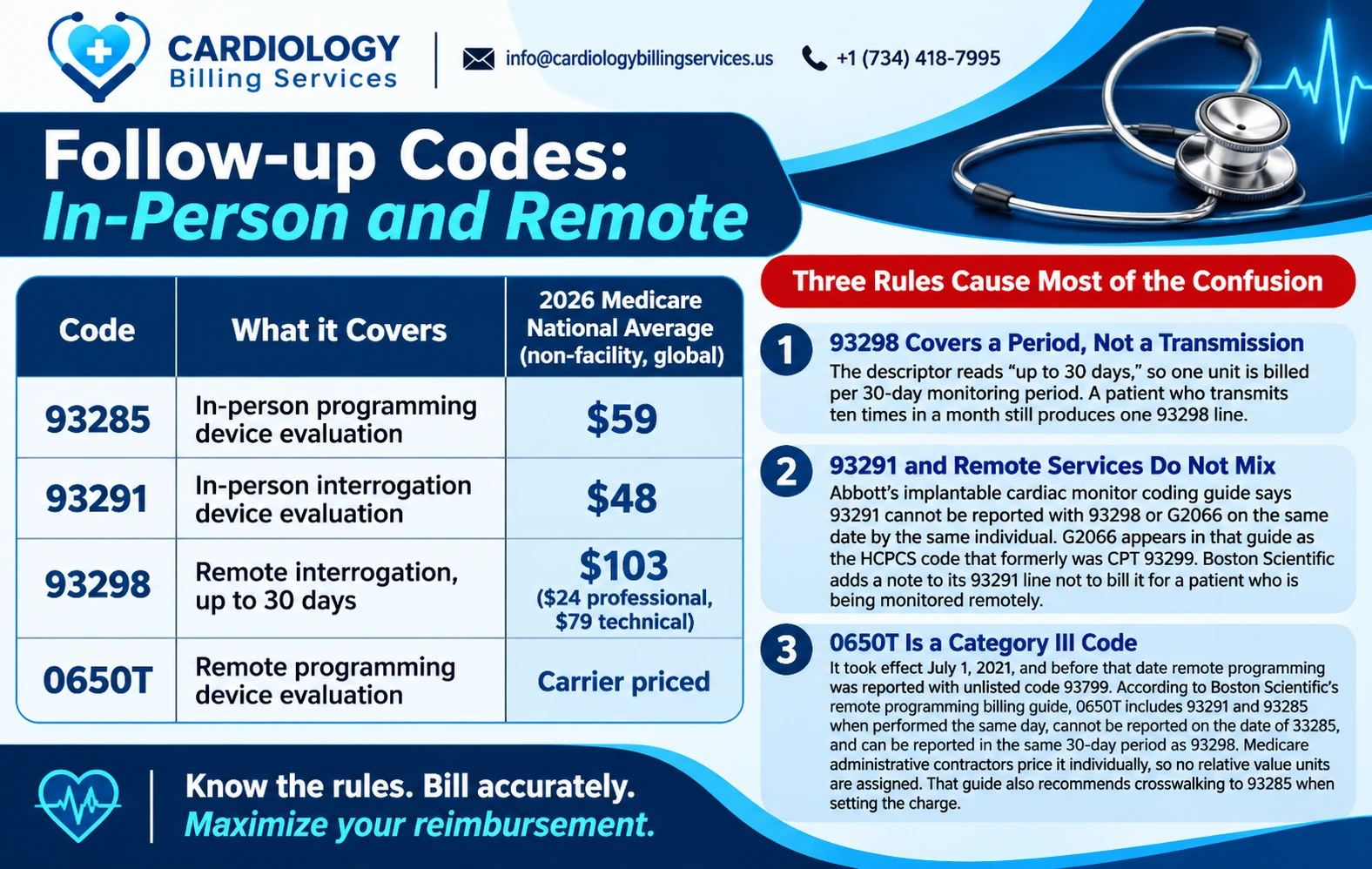
| Code | What it covers | 2026 Medicare national average (non-facility, global) |
|---|---|---|
| 93285 | In-person programming device evaluation | $59 |
| 93291 | In-person interrogation device evaluation | $48 |
| 93298 | Remote interrogation, up to 30 days | $103 (professional $24, technical $79) |
| 0650T | Remote programming device evaluation | Carrier priced |
Rates come from Boston Scientific’s 2026 quick reference guide.
Three rules cause most of the confusion.
First, 93298 covers a period, not a transmission. The descriptor reads “up to 30 days,” so one unit is billed per 30-day monitoring period. A patient who transmits ten times in a month still produces one 93298 line.
Second, 93291 and remote services do not mix. Abbott’s implantable cardiac monitor coding guide says 93291 cannot be reported with 93298 or G2066 on the same date by the same individual. G2066 appears in that guide as the HCPCS code that formerly was CPT 93299. Boston Scientific adds a note to its 93291 line not to bill it for a patient who is being monitored remotely.
Third, 0650T is a Category III code. It took effect July 1, 2021, and before that date remote programming was reported with unlisted code 93799. According to Boston Scientific’s remote programming billing guide, 0650T includes 93291 and 93285 when performed the same day, cannot be reported on the date of 33285, and can be reported in the same 30-day period as 93298. Medicare administrative contractors price it individually, so no relative value units are assigned. That guide also recommends crosswalking to 93285 when setting the charge.
Diagnosis coding and medical necessity
Most ILR denials come from policy criteria, not code selection. Cigna policy 0547 (effective September 15, 2026) is a useful benchmark because it spells out the criteria in detail. For adults, it considers an ILR medically necessary in these situations:
- Recurrent or unexplained syncope, when non-arrhythmic causes have been excluded and at least 14 days of noninvasive monitoring was inconclusive.
- Cryptogenic stroke, transient ischemic attack or systemic thromboembolic event with suspected atrial fibrillation, after at least 14 days of noninvasive monitoring that was inconclusive.
- Selected atrial fibrillation or flutter situations, such as after cavotricuspid isthmus ablation in a patient at high thromboembolic risk who is not anticoagulated.
The same policy treats routine monitoring of an already documented arrhythmia, or checking whether arrhythmia treatment works, as not medically necessary. It also allows device replacement only when the patient still meets the original criteria and the existing monitor is out of warranty and cannot be repaired, for example because the battery is nearly depleted.
Diagnosis codes on that policy’s covered list include R55 (syncope and collapse), R00.2 (palpitations), I48.0 (paroxysmal atrial fibrillation), I49.5 (sick sinus syndrome), I63.9 (cerebral infarction, unspecified) and Z86.73 (personal history of TIA and cerebral infarction without residual deficits). Other payers publish different lists, so always check the payer’s own table before submitting.
The clinical logic behind these criteria is well documented. The 2024 ACC/AHA/ACCP/HRS atrial fibrillation guideline gives a Class 2a recommendation for an implantable loop recorder when extended monitoring is needed after stroke or TIA of undetermined cause. For syncope, Krahn and colleagues reported in Circulation (2001) that a prolonged monitoring strategy reached a diagnosis in 55% of 60 patients, compared with 19% for conventional testing.
What the record must show
An ILR claim stands or falls on the chart. Auditors look for the following:
- The failed external workup. Dates, device type and duration of the Holter, patch or event monitor, plus a statement that results were non-diagnostic.
- Exclusion of other causes. For syncope, orthostatic vitals, ECG, echocardiogram and the evaluation for reflex or volume-related causes.
- Stroke workup for cryptogenic stroke. The 2021 AHA/ASA secondary prevention guideline defines cryptogenic stroke as imaging-confirmed stroke with no known source after a full evaluation that includes arterial imaging, echocardiography, extended rhythm monitoring and key laboratory studies.
- Procedure note. Insertion site, device model and serial number, and confirmation of programming.
- Each remote review. The date range of the 30-day period, who reviewed the transmissions, findings and the report. The physician’s interpretation supports the professional component, and the technician’s data handling supports the technical component.
- Patient consent for remote services. Boston Scientific’s billing guide notes that Medicare consent for remote evaluation must be obtained annually and that a 20% beneficiary copay applies.
Common denials and how to prevent them
Bundled removal and insertion. Cause: 33286 and 33285 billed together without a modifier. Fix: append modifier 59 to 33286 when the clinical situation supports it.
Duplicate or overlapping remote claims. Cause: more than one 93298 line inside the same 30-day window. Fix: track the start date of each period in the billing system, not only in the device clinic software.
Same-day conflicts. Cause: 93285 or 93291 reported with 33285, or 93291 reported with a remote code. Fix: build claim scrubber rules for these pairs.
Category III rejection. Cause: payer does not recognize 0650T or prices it at zero. Fix: confirm the policy before the first claim, attach the crosswalk to 93285 and a description of the service, and prepare an appeal. The Boston Scientific billing guide includes a sample letter that cites ACC and HRS recommendations for coverage of remote programming.
Medical necessity denial. Cause: chart does not show failed external monitoring or exclusion of other causes. Fix: obtain prior authorization where required and attach the monitoring reports.
Indication outside policy. Cause: ILR placed to follow a known arrhythmia. Fix: verify criteria before scheduling, since some payers, including Cigna, exclude this use.
Putting it together
Accurate loop recorder billing depends on matching each service to the right code family: 33285 and 33286 for the procedure, 93285 and 93291 for in-person checks, 93298 for each 30-day remote period, and 0650T for remote programming where a payer accepts it. Medicare rates are published, but payer criteria such as 14 days of failed external monitoring decide whether the claim is paid. Billers who keep the workup documentation, the 30-day calendar and the modifier rules in one checklist avoid most of the denials described above.