August 25, 2026
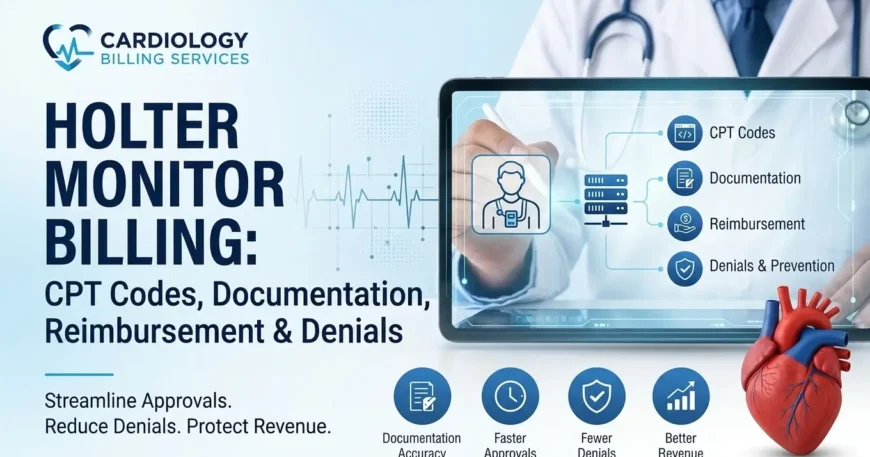
Holter Monitor Billing: CPT Codes, Documentation, Reimbursement & Denials

Holter monitor billing looks straightforward until a claim actually gets denied. A cardiologist orders a 48-hour recording for a patient with unexplained palpitations, the technical company scans the data, the physician writes an interpretation and three weeks later the remittance advice shows a denial that nobody on staff can immediately explain. Usually the root cause traces back to one of a handful of recurring issues: the wrong code was chosen for how the service was actually performed, the diagnosis on the claim doesn’t connect to the reason the monitor was ordered, or the practice billed a component that belonged to another entity.
This guide walks through how Holter monitor billing works in practice: the CPT codes involved, how they differ from other forms of ambulatory cardiac monitoring, what documentation supports the claim, why denials happen and how a cardiology practice corrects and appeals them. It’s written for the people who actually touch these claims, physicians, coders, billers and practice managers, not as a sales pitch for any particular billing service.
Because 93225, 93226 and 93227 are the individual pieces that make up 93224, coding guidance is explicit that these component codes should never be billed together with 93224, or with each other, for the same monitoring episode by the same entity. Doing so represents duplicate billing of work already bundled into the global code.
Date of service matters for these codes and is a frequent source of confusion. Coverage guidance published by a Medicare Administrative Contractor specifies that when billing the global code (93224) or the interpretation code (93227), the date of service is the date the physician actually performed the review and interpretation. When billing the recording-only code (93225) or the analysis-only code (93226), the date of service is the date that piece of the service was performed. A practice that defaults to using the hook-up date for every line of the claim can end up with a date-of-service mismatch that triggers a rejection.
For recordings shorter than 12 continuous hours, coding guidance calls for modifier 52 (reduced services) to reflect that a full monitoring period was not obtained. This typically comes up when a patient removes the device early or a technical failure cuts the recording short and it should be tied to documentation explaining why the full period wasn’t captured.
The clinical decision about which type of monitor to use depends on how frequently the patient’s symptoms occur and whether real-time detection is needed. The billing decision depends on which service was actually documented as performed, confirmed against the equipment used and the report generated, not on which code is easiest to remember or most frequently reimbursed.
Not every payer categorizes or codes these denial reasons identically, so the billing team’s response should be based on the actual denial reason stated on the remittance advice rather than an assumption carried over from a different payer.
Payer systems and portals don’t always use these three terms consistently, so the biller working the claim needs to read the actual remittance language rather than relying on the outcome category alone to decide what to do next.
What Is Holter Monitor Billing?
Holter monitor billing is the process of translating an ambulatory ECG recording, typically 24 to 48 hours of continuous rhythm data collected through a small wearable recorder, into an accurately coded insurance claim. That process involves several distinct pieces of work: connecting the patient to the device, recording the data, scanning and analyzing the recording and having a physician or other qualified health care professional review and interpret the results. Depending on who performs which piece, a single Holter study can be billed as one global claim or split across multiple claims from different entities. Getting this right matters because Holter monitoring is one of the more frequently ordered diagnostic tests in general and preventive cardiology and it’s also one of the more commonly denied. A large share of denials trace back to coding or documentation problems rather than genuine non-coverage, which means many of them are preventable with a consistent billing workflow.How Holter Monitoring Works From a Billing Perspective
A standard Holter study involves four components that a biller needs to be able to identify separately, even when one entity performs all of them:- Connection (hook-up): applying the leads and starting the recording
- Recording: the continuous data capture itself, up to 48 hours for standard Holter monitoring
- Scanning analysis: technical review of the recorded data with a generated report
- Physician review and interpretation: the physician’s or qualified health care professional’s clinical read of the scanned data, resulting in a signed interpretation
Holter Monitor CPT Codes and Coding Considerations
Choosing the correct CPT code
Standard Holter monitoring, up to 48 hours of continuous recording, is reported using a family of four related CPT codes:| CPT code | What it represents | Who typically bills it |
| 93224 | Global service: hook-up, recording, scanning analysis and physician interpretation and report, up to 48 hours | A practice that owns the equipment and performs every step in-house |
| 93225 | Recording only, including connection, recording and disconnection (technical) | A facility or vendor that only places and removes the device |
| 93226 | Scanning analysis with report only (technical) | A facility or vendor that only processes the recorded data |
| 93227 | Physician or other qualified health care professional review and interpretation only (professional) | A physician who interprets data recorded and scanned elsewhere |
Monitoring duration and service characteristics
Standard Holter monitoring (93224–93227) is built around a coverage period of up to 48 hours, reported as one unit of service regardless of exactly how many hours within that window were actually captured. When a physician orders monitoring beyond 48 hours, up to 15 days, a separate family of extended ambulatory ECG monitoring codes in the 93241–93248 range applies, again split between global and component reporting depending on which entity performs which part of the service. These extended codes are billed differently than standard Holter codes and should not be interchanged with them; selecting the wrong duration-based family is itself a common source of denials.Professional and technical components
Holter monitoring is typically split by component code rather than by appending modifier 26 (professional component) or modifier TC (technical component) to a single code, since CPT already provides dedicated codes (93225, 93226, 93227) for the individual pieces of the service. Some payers and some related ambulatory monitoring codes outside the core 93224–93227 family do use the 26/TC modifier structure, so a coder should confirm the correct approach for the specific code being billed rather than assuming 26/TC applies uniformly across every cardiac monitoring service. Whichever structure a payer uses, the underlying principle is the same: bill only for the piece of the service your entity actually performed and be able to show, through documentation, that the other piece was performed by someone else.Units and modifiers
Holter monitoring codes are reported as one unit per monitoring episode within the applicable duration window; they aren’t billed per day of recording within that window. Modifiers that can legitimately apply to Holter claims include modifier 52 for a shortened recording period described above and in less common circumstances modifiers such as 76 or 77 (repeat procedure by the same or a different physician) when a monitoring study is genuinely repeated rather than duplicated in error. Modifier 59 (distinct procedural service) is occasionally relevant when Holter monitoring is billed alongside another same-day cardiac diagnostic service that would otherwise be bundled, but it should only be appended when the documentation supports that the services were genuinely distinct, not as a routine workaround for a bundling edit.Holter Monitor vs Other Cardiac Monitoring Services
Not every ambulatory cardiac monitoring service is coded the same way and treating them as interchangeable is a common source of both coding errors and denied claims.| Monitoring type | Typical service characteristics | Billing consideration |
| Holter monitor (24–48 hr) | Continuous recording of every heartbeat over a short, fixed window | Reported with 93224–93227; best suited to frequent, near-daily symptoms |
| Extended ambulatory ECG monitor (up to 15 days) | Continuous recording over a longer window, often a patch-style device | Reported with a separate 93241–93248 code family, not the standard Holter codes |
| Cardiac event monitor | Patient- or auto-triggered recording of discrete episodes rather than continuous data | Uses its own CPT code family distinct from Holter and extended monitoring |
| Mobile cardiac telemetry (MCT) | Continuous, real-time transmitted monitoring with near-immediate alerting | Coded separately from Holter monitoring, generally with component (technical/professional) reporting when the device vendor and interpreting physician are different entities |
Documentation Requirements for Holter Monitor Billing
Documentation that supports a Holter monitor claim generally includes the clinical reason for the order, the ordering provider, the date the device was placed and removed, confirmation of the actual monitoring duration achieved, the technical scanning report and a signed physician interpretation containing findings and a clinical impression. Documentation supporting the service performed is not the same thing as documentation a specific payer requires to process the claim; a payer’s medical policy may ask for additional detail, such as a symptom diary or a specific format for the interpretation, that goes beyond what CPT coding guidance itself requires. Practices billing across multiple payers should expect this variation rather than assuming one documentation template satisfies every plan. A signed and dated interpretation report is one of the more frequently missing pieces during an audit or appeal. An unsigned report, or one signed well after the date of service without explanation, is a common trigger for recoupment requests even when the underlying clinical findings are sound.Medical Necessity and Insurance Coverage
Holter monitoring has to be clinically supported by the reason it was ordered, not just accompanied by a qualifying diagnosis code on the claim form. Payers generally expect the clinical documentation to connect a specific indication, such as unexplained palpitations, syncope or near-syncope, evaluation of a known or suspected arrhythmia, assessment of response to antiarrhythmic therapy, or monitoring for atrial fibrillation after a cryptogenic stroke or following ablation, to the decision to order monitoring. A diagnosis code alone does not guarantee payment; the payer is evaluating whether the documented symptoms and clinical reasoning actually justify the test that was billed. Medicare coverage of Holter monitoring is generally addressed through coverage articles and Local Coverage Determinations issued by individual Medicare Administrative Contractors, which means specific requirements can vary somewhat by jurisdiction even though the underlying CPT structure is national. Commercial payers frequently publish their own medical policies for ambulatory cardiac monitoring that list covered indications and those indications don’t always match Medicare’s coverage language word for word. Frequency limitations, such as how often a patient can be monitored within a given period without additional justification, are also payer-specific and should be checked against the applicable policy before repeat monitoring is ordered.ICD-10-CM Diagnosis Coding for Holter Monitoring
Diagnosis coding accuracy has a direct effect on Holter monitor reimbursement because it’s the primary mechanism payers use to evaluate medical necessity. Diagnosis codes commonly associated with Holter monitor orders include R55 (syncope and collapse), R00.2 (palpitations), R00.1 (bradycardia, unspecified) and the I48 series for atrial fibrillation and flutter (for example I48.91 for unspecified atrial fibrillation), along with codes describing a suspected underlying arrhythmia or a cryptogenic stroke workup where monitoring is being used to look for occult atrial fibrillation. Specificity matters. When a physician has documented that syncope was caused by a specific underlying condition, coding guidance calls for sequencing the causative condition first with the symptom code reported secondarily, rather than defaulting to the symptom code alone. An unsupported or overly generic diagnosis code, one that doesn’t match what’s actually documented in the chart, is a frequent and avoidable cause of medical necessity denials. No diagnosis code, however specific, automatically guarantees coverage; it still has to be paired with documentation that ties the code to the clinical picture and the payer’s own coverage policy.Common Holter Monitor Billing Denials
Denial reasons for Holter monitor claims tend to fall into a fairly consistent set of categories across payers, though the exact denial code and language a payer uses will vary.| Denial reason | Why it happens | Prevention |
| Medical necessity | Diagnosis or documentation doesn’t support the ordered service | Confirm the clinical indication is documented before the claim is coded, not after a denial arrives |
| Incorrect CPT code | Global code billed when only a component was performed, or wrong duration family used | Confirm which entity performed which piece of the service before selecting a code |
| Diagnosis-service mismatch | The billed diagnosis doesn’t logically connect to Holter monitoring as a test | Cross-check the diagnosis against the documented reason for the order |
| Missing or incomplete documentation | No signed interpretation, or duration not confirmed in the record | Require a signed, dated report before the claim is released |
| Missing or mismatched authorization | Authorization wasn’t obtained, or the authorized service doesn’t match what was billed | Verify authorization requirements and match the auth number to the actual CPT billed |
| Eligibility issue | Coverage had lapsed or the wrong payer was billed | Verify eligibility close to the date of service, not weeks in advance |
| Frequency limitation | Repeat monitoring exceeds what the payer allows in a given period without added justification | Check payer-specific frequency rules before ordering repeat studies |
| Duplicate claim | Component and global codes billed together, or the same service billed twice | Reconcile internal billing with what any third-party monitoring vendor has already submitted |
| Incorrect units or modifier | Extra units billed, or a modifier applied without documentation support | Confirm units and modifiers against the actual service before submission |
| Timely filing | Claim submitted after the payer’s filing deadline | Track claim age against payer-specific deadlines, not a single internal default |
| Provider enrollment issue | Interpreting physician not enrolled or credentialed with the payer | Confirm enrollment status before billing under a given NPI |
Rejection vs Denial vs Underpayment
These three outcomes require different responses and treating them the same way slows down resolution.| Outcome | What it means | Typical next step |
| Rejection | The claim never entered adjudication, usually due to a data or formatting error | Correct the error and resubmit; this isn’t an appeal |
| Denial | The claim was adjudicated and payment was refused for a stated reason | Determine whether the issue is correctable (resubmit a corrected claim) or requires an appeal |
| Partial denial / underpayment | Some but not all of the billed service was paid, or payment doesn’t match the contracted rate | Compare the payment against the contract and payer policy, then request a review or reprocessing |
Holter Monitor Billing Workflow
A practical end-to-end workflow for Holter monitor billing looks roughly like this:- Verify patient eligibility and review benefits and coverage.
- Confirm whether the payer requires authorization and obtain it if so.
- Confirm the clinical order and the documented indication for monitoring.
- Perform the monitoring service and confirm the actual duration achieved.
- Confirm the technical scanning report and physician interpretation are documented and signed.
- Select the CPT code based on which entity performed which component of the service.
- Select the ICD-10-CM diagnosis code(s) that match the documented clinical indication.
- Apply modifiers and units only where the documentation supports them.
- Validate payer information and confirm the correct payer is being billed.
- Submit the claim and monitor its status through the clearinghouse or payer portal.
- Review any rejection or denial message promptly rather than letting it age in a queue.
- Correct or appeal as appropriate, based on the actual reason given.
- Track reimbursement and post payment and adjustments accurately.
- Log recurring problems so the same error doesn’t repeat on the next claim.
How to Handle a Denied Holter Monitor Claim
When a Holter monitor claim comes back denied, the workflow that tends to resolve it fastest is:- Identify the denial and read the payer’s stated reason carefully, rather than assuming based on past experience with a similar denial.
- Pull the original claim and compare it line by line against the medical record.
- Verify the CPT code matches what was actually performed and by whom.
- Verify the ICD-10-CM code matches the documented clinical indication.
- Check whether authorization was required, obtained and correctly matched to the billed service.
- Review the applicable payer policy for the specific service and diagnosis combination.
- Determine the root cause, a data error, a coding error, a documentation gap, or a genuine coverage issue.
- Decide whether a corrected claim resubmission or a formal appeal is the appropriate path.
- Gather the supporting documentation the specific denial reason calls for.
- Submit within the payer’s stated deadline and track the response.
- Post the final payment or adjustment once resolved.
- Record the root cause so the billing team can prevent the same denial pattern going forward.
How to Appeal a Holter Monitor Claim Denial
An appeal is warranted when the denial reason is disputable, meaning the documentation actually does support the billed service and the payer’s determination appears to be in error, rather than when the underlying issue is a straightforward coding mistake that a corrected claim would resolve instead. A solid appeal generally: states the specific denial reason being contested, references the applicable payer policy or coverage guidance, includes the relevant portions of the medical record (the order, the interpretation report and documentation of the clinical indication) and explains concisely why the documentation supports the billed service. Appeal deadlines and required formats vary by payer and by the type of denial, so the exact process and how many levels of appeal are available, should be confirmed against that specific payer’s guidelines rather than assumed to be uniform.Documentation for Holter Monitor Claim Appeals
Not every appeal requires every possible document. Which records matter depends on the denial reason:- A medical necessity denial typically calls for the clinical documentation showing the symptoms or condition that justified the order, along with the physician’s interpretation and findings.
- A coding-related denial typically calls for the documentation that shows which entity performed which component of the service, supporting the CPT code that was billed.
- An authorization-related denial typically calls for proof the authorization was obtained and matches the service billed, or documentation of why the service was medically urgent if authorization wasn’t feasible beforehand.
- A frequency-limitation denial typically calls for documentation explaining why repeat monitoring was clinically warranted within the payer’s stated window.
Medicare Holter Monitor Billing Considerations
Medicare’s coverage of Holter monitoring is generally governed at the Medicare Administrative Contractor level through coverage articles and Local Coverage Determinations, meaning the underlying CPT structure (93224–93227 for standard Holter monitoring) is consistent nationally, but specific documentation expectations, covered diagnoses and frequency guidance can differ somewhat depending on which MAC processes the claim. Medicare guidance is specific about date-of-service rules for the global versus component codes, described earlier in this guide and about the use of modifier 52 for recordings under 12 hours. NCCI edits also apply to prevent billing the global code (93224) alongside its own component codes (93225–93227) for the same episode of care. Because MAC-specific policy can change and because coverage articles are periodically updated, practices billing Medicare for Holter monitoring should confirm current guidance for their specific MAC jurisdiction rather than relying on rules that applied in a prior benefit year.Commercial Insurance Considerations
Commercial payer requirements for Holter monitoring frequently differ from Medicare’s in several practical ways: many commercial plans require prior authorization for ambulatory cardiac monitoring where Medicare typically does not, referral requirements can apply under certain plan types, medical policies listing covered indications don’t always mirror Medicare’s coverage language exactly and timely filing and appeal deadlines are set independently by each payer rather than following a single national standard. A commercial payer’s own published medical policy for ambulatory ECG monitoring, when available, is the most reliable source for that payer’s specific documentation and coverage expectations and it should be checked before assuming Medicare rules apply.Holter Monitor Billing and Reimbursement Challenges
Cardiology practices that see recurring Holter monitor reimbursement problems are often dealing with one or more of the following: inconsistent coordination with third-party monitoring vendors that leads to duplicate or mismatched billing, physicians whose interpretation reports lag behind the scanning date, staff defaulting to the global code out of habit rather than confirming which entity performed which component and diagnosis coding that reflects the patient’s general problem list rather than the specific reason monitoring was ordered. These issues tend to be workflow problems rather than one-off errors, which is why they show up repeatedly in denial data rather than as isolated incidents.How to Analyze Holter Monitor Denial Trends
Identifying recurring Holter monitor billing problems generally involves tracking denials by payer, CPT code, ICD-10-CM code, ordering and interpreting provider, location, denial reason, dollar amount, authorization status and days to resolution. When the same denial reason clusters around a specific payer, a specific provider, or a specific referral pattern (for example, monitors ordered by a covering physician who isn’t the one interpreting the results), that pattern usually points to a workflow gap, a documentation habit, or a training need rather than a series of unrelated errors.Denial Metrics Cardiology Practices Should Track
Useful metrics for monitoring Holter billing performance include the denial rate for Holter-specific CPT codes, denied claim volume and dollar value, the top recurring denial reasons, denial rate broken out by payer, the share of denials tied to coding versus authorization versus medical necessity, the appeal overturn rate and average days from denial to resolution. A basic denial rate can be calculated as denied claims divided by applicable adjudicated claims, multiplied by 100, but practices should define their own denominator clearly (for example, whether rejected claims are included) since organizations don’t always define this metric identically and comparing numbers calculated on different bases can be misleading.Common Holter Monitor Billing Mistakes
| Billing mistake | Potential consequence | Prevention |
| Billing the global code (93224) when a vendor performed the technical work | Denial or recoupment for duplicate billing | Confirm which entity performed each component before coding |
| Billing component codes alongside the global code | NCCI edit denial | Never combine 93224 with 93225, 93226, or 93227 for the same episode |
| Using the wrong date of service on component claims | Rejection or processing delay | Apply the date-of-service rule specific to the code being billed |
| Diagnosis code doesn’t match the documented indication | Medical necessity denial | Cross-check diagnosis against the physician’s stated reason for the order |
| Missing modifier 52 on a recording under 12 hours | Overpayment flag or post-payment recoupment | Confirm actual recording duration before finalizing the code |
| Unsigned or late-signed interpretation report | Denial or audit finding | Require signature and date before the claim is released to billing |
| Authorization not verified before the service | Denial for missing or mismatched authorization | Confirm authorization requirements and match the number to the billed CPT |
| Eligibility not checked close to the date of service | Denial for coverage termination or wrong payer | Re-verify eligibility near the actual date of service |
| Extended monitoring billed with standard Holter codes | Incorrect CPT selection and denial | Confirm the actual duration ordered and performed before code selection |
| Duplicate claims from practice and monitoring vendor | Duplicate claim denial for one or both parties | Reconcile internal billing against the vendor’s submission before claims go out |
| Provider not enrolled with the billed payer | Denial for provider enrollment issue | Confirm credentialing status before billing under that NPI |
| Repeat monitoring without documented justification | Frequency limitation denial | Check payer-specific frequency policy before ordering a repeat study |
Cardiology-Specific Billing Scenarios
The following are illustrative hypothetical scenarios, not real patient cases, meant to show how these issues play out in practice. Scenario 1: Diagnosis doesn’t support the billed service. A practice bills 93224 with a diagnosis of essential hypertension because that’s the patient’s primary problem-list entry, when the actual reason the monitor was ordered was intermittent palpitations documented in the visit note. The payer denies for medical necessity because hypertension alone doesn’t typically support Holter monitoring. What should be reviewed: whether the diagnosis coding reflects the documented reason for the order rather than the patient’s general chart. Prevention: code from the visit note’s stated indication, not the problem list. Scenario 2: Missing authorization. A commercial plan requires prior authorization for ambulatory cardiac monitoring, but the practice’s front desk didn’t flag it because Medicare patients on the same schedule don’t require it. The claim denies for missing authorization. What should be reviewed: whether the payer-specific authorization requirement was checked before the appointment. Prevention: build authorization checks into scheduling rather than relying on staff memory across different payer rules. Scenario 3: Incorrect CPT selection. A physician orders 10 days of extended monitoring, but the coder defaults to 93224 out of habit because most orders in the practice are standard 48-hour Holter studies. The payer denies because the duration doesn’t match the code’s coverage window. What should be reviewed: the ordering documentation for the actual monitoring duration requested and performed. Prevention: confirm duration against the order before defaulting to the practice’s most common code.How Professional Cardiology Billing Services Can Help
Many of the denial patterns described in this guide, global-versus-component coding errors, diagnosis-service mismatches, missing authorization and inconsistent date-of-service handling, are workflow issues rather than one-time mistakes, which is why they tend to recur until the underlying process changes. Practices that see repeated Holter monitor denials sometimes bring in dedicated cardiology medical billing support to review coding accuracy, or specifically work with cardiology coding specialists who handle the technical-versus-professional component splits common in cardiac diagnostic testing. Where the pattern is specifically about claims not getting corrected and resubmitted quickly enough, denial management support focused on tracing denials back to a root cause can reduce how often the same error repeats. None of this replaces good documentation habits inside the practice, it supplements them by catching what a busy clinical schedule sometimes misses.Frequently Asked Questions
What is Holter monitor billing?
It's the process of coding and submitting insurance claims for ambulatory ECG monitoring, typically 24 to 48 hours of continuous heart rhythm recording, using CPT codes that reflect which parts of the service (hook-up, recording, analysis and interpretation) were performed and by which entity.
What CPT codes are used for Holter monitoring?
Standard Holter monitoring up to 48 hours uses 93224 (global), 93225 (recording only), 93226 (scanning analysis with report) and 93227 (physician interpretation only). Monitoring beyond 48 hours, up to 15 days, uses a separate 93241–93248 code family.
How is a Holter monitor billed?
If one practice performs every step of the service, it bills the global code, 93224. If the technical and professional work are split between different entities, such as a hospital and an outside cardiologist, each entity bills only its own component code.
What documentation is needed for Holter monitor billing?
Generally, the clinical indication for the order, confirmation of the monitoring duration, the technical scanning report and a signed, dated physician interpretation with findings and clinical impression.
What diagnosis codes may support Holter monitoring?
Commonly used codes include R55 (syncope and collapse), R00.2 (palpitations), R00.1 (bradycardia) and codes from the I48 series for atrial fibrillation, though the correct code always depends on the specific documented indication.
Does Medicare cover Holter monitoring?
Medicare coverage is addressed through coverage articles and Local Coverage Determinations issued by Medicare Administrative Contractors, so the core CPT structure is national but specific documentation and coverage details can vary by MAC jurisdiction.
Do commercial insurers require prior authorization for Holter monitoring?
Many do, though not all and requirements vary by plan. Authorization requirements should be confirmed against the specific payer's policy before the service is performed.
What causes Holter monitor claim denials?
Common causes include medical necessity issues, incorrect CPT code selection, diagnosis-service mismatches, missing or unsigned interpretation reports, missing or mismatched authorization, eligibility problems and duplicate billing between a practice and a monitoring vendor.
Key Takeaways
- Standard Holter monitoring (up to 48 hours) uses CPT codes 93224 (global), 93225 (recording), 93226 (scanning analysis) and 93227 (physician interpretation); these component codes should never be billed alongside the global code.
- Date of service differs by code: the global and interpretation codes use the date of physician review, while recording-only and analysis-only codes use the date that specific work was performed.
- Extended ambulatory monitoring beyond 48 hours, up to 15 days, is billed under a separate code family and shouldn’t be confused with standard Holter codes.
- Medical necessity depends on documentation connecting the diagnosis to the actual reason monitoring was ordered, not the diagnosis code alone.
- Most Holter monitor denials trace back to preventable issues: coding errors, diagnosis-service mismatches, missing authorization, or incomplete documentation.
- Medicare coverage details can vary by Medicare Administrative Contractor and commercial payer requirements, especially around prior authorization, frequently differ from Medicare’s.
Conclusion
Holter monitor billing isn’t complicated in concept, code for what was actually performed, support it with documentation and match the diagnosis to the real clinical reason for the test, but it breaks down when practices default to habit instead of checking each claim against what actually happened. The recurring denial categories covered here, global-versus-component errors, diagnosis mismatches, missing authorization and documentation gaps, are almost all preventable with a consistent workflow applied before the claim goes out rather than after it comes back.