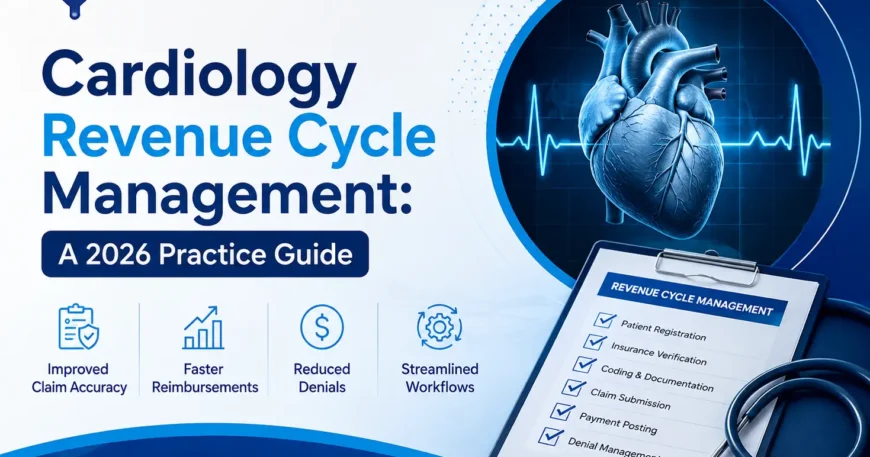
Cardiology Revenue Cycle Management: A 2026 Practice Guide

A cardiology group in the Midwest brought me their AR aging report last spring. Forty-one percent of their outstanding balances were sitting past 90 days. Nothing dramatic had happened no major payer dispute, no compliance investigation. Just a slow accumulation of small breakdowns: eligibility checks skipped during a busy stretch, a coder new to interventional cases under-documenting medical necessity, a front desk team that stopped verifying prior authorization for stress tests because “it usually goes through anyway.”
That’s what revenue leakage looks like in real cardiology practices. Not one big mistake. A hundred small ones, compounding.
Cardiology revenue cycle management is the discipline that catches those breakdowns before they become a cash flow problem or catches them early enough that they’re cheap to fix. This guide walks through how the process actually works, where cardiovascular practices lose money, what CMS changed for 2026 and how to build a revenue cycle that holds up under the specialty’s specific coding and documentation demands.
What Is Cardiology Revenue Cycle Management?
Cardiology revenue cycle management (RCM) is the end-to-end financial process that tracks a patient encounter from scheduling through final payment specifically structured around the coding, documentation and payer rules unique to cardiovascular care.
It covers:
- Patient registration and insurance eligibility verification
- Prior authorization for procedures like cardiac catheterization, stress testing and device implants
- Clinical documentation review
- Medical coding (CPT, ICD-10-CM, HCPCS Level II)
- Charge entry and claims submission
- Payment posting and reconciliation
- Denial management and appeals
- Accounts receivable (AR) follow-up
Generic medical billing treats these as generic steps. Cardiology RCM treats them as specialty-specific problems, because a cardiology practice bills differently than a family medicine clinic or an orthopedic group. Interventional procedures carry bundling rules that don’t exist elsewhere. Diagnostic testing echocardiograms, nuclear stress tests, Holter monitoring has its own medical necessity documentation standards. Device implants and electrophysiology procedures involve global periods and multiple-procedure reductions that generalist billers routinely miscalculate.
Why It Matters More in Cardiology Than in Most Specialties
Cardiology sits at the intersection of high-dollar procedures, complex coding and a payer environment that scrutinizes cardiovascular claims heavily. A single miscoded cardiac catheterization or misapplied modifier can swing reimbursement by hundreds of dollars and across a busy interventional practice, that adds up fast.
A few things make cardiology uniquely exposed:
Procedure complexity. Diagnostic and interventional cardiology often involve multiple codes for a single encounter imaging, catheter placement, intervention and closure device each with its own bundling and modifier logic.
Frequent coding updates. CPT and HCPCS codes for cardiovascular imaging, electrophysiology and structural heart procedures change more often than in many other specialties, as new technologies (like leadless pacemakers or transcatheter valve repairs) move through CMS coverage decisions.
Site-of-service sensitivity. Where a procedure happens office, hospital outpatient, ambulatory surgical center significantly changes reimbursement and 2026 CMS policy has widened that gap further (more below).
Medical necessity documentation. Payers, including Medicare Administrative Contractors (MACs), routinely request records for cardiac imaging and interventional claims. Weak documentation is one of the most common reasons cardiology claims get denied or recouped after payment.
How the Cardiology Revenue Cycle Actually Works
Think of it as a chain. Every link has to hold, because a break anywhere downstream shows up as a denial or a delayed payment weeks later.
1. Patient Registration & Eligibility Verification
Demographic and insurance data are captured before the visit. For cardiology specifically, this means confirming the plan covers cardiovascular specialty care, checking referral requirements for HMO plans and verifying whether the patient has met deductibles that will affect same-day collections.
2. Prior Authorization
Cardiac catheterization, PCI, implantable device procedures and even some advanced imaging studies frequently require prior authorization. Skipping this step or securing authorization for the wrong CPT code is one of the single biggest sources of preventable denials in cardiology.
3. Clinical Documentation
The provider documents the encounter. For E/M visits, that means meeting medical decision-making or time-based documentation standards. For procedures, it means documenting indication, technique, findings and medical necessity in enough detail to support the codes billed.
4. Medical Coding
Certified coders translate documentation into CPT, ICD-10-CM and HCPCS Level II codes. This is where cardiology-specific expertise matters most knowing when Modifier 25 legitimately applies to a significant, separately identifiable E/M service billed alongside a procedure, or how bundling edits apply to same-day diagnostic and interventional cardiac procedures.
5. Charge Entry & Claims Submission
Coded charges are entered and claims are scrubbed against payer-specific edits before submission through a clearinghouse. Clean-claim rates above 95% are the realistic benchmark for a well-run cardiology practice.
6. Payment Posting
ERAs and EOBs are posted against expected reimbursement. This step is also where underpayments get caught if a payer reimburses below the contracted rate and no one is reconciling against the fee schedule, that gap never gets recovered.
7. Denial Management & Appeals
Denials are triaged by root cause eligibility, authorization, coding, medical necessity, timely filing and either corrected and resubmitted or appealed with supporting documentation.
8. AR Follow-Up
Unpaid claims are worked on a schedule (typically 30/60/90-day intervals) until resolved. This is the step most understaffed practices let slide and it’s where money quietly disappears.
Common Billing and Coding Errors in Cardiology
| Error | Why It Happens | Typical Impact |
| Missing or incorrect Modifier 25 | Coder unclear whether the E/M was truly separate from the procedure | Denial or post-payment recoupment |
| Unbundling cardiac catheterization components | Billing components separately that should be bundled under NCCI edits | Claim denial, potential audit flag |
| Insufficient medical necessity documentation for stress testing or echo | Templates don’t capture indication clearly enough | Denial or documentation request (ADR) |
| Wrong place-of-service code | Confusion between office, outpatient hospital and ASC settings | Underpayment or denial |
| Outdated CPT codes for EP or structural heart procedures | Annual code changes not updated in the practice’s charge master | Claim rejection at clearinghouse |
| Missing prior authorization for device implants | Scheduling moves faster than the authorization process | Full claim denial |
| Incorrect ICD-10 specificity (e.g., unspecified heart failure type) | Documentation doesn’t distinguish HFrEF vs. HFpEF | Reduced risk adjustment, possible denial |
None of these are exotic mistakes. They’re the everyday friction points that show up in almost every cardiology practice that hasn’t built specialty-specific coding review into its workflow.
Claim Denials: Where the Money Actually Goes Missing
Denial patterns in cardiology tend to cluster around a few recurring causes:
- Authorization-related denials the procedure performed doesn’t match what was authorized, or authorization expired before the procedure date.
- Medical necessity denials particularly for advanced cardiac imaging (nuclear stress tests, cardiac MRI, CT angiography), where payers apply strict appropriate-use criteria.
- Bundling/NCCI edit denials billing separately for services that Medicare’s National Correct Coding Initiative considers inclusive to a primary procedure.
- Timely filing denials often avoidable, usually the result of AR follow-up gaps rather than payer policy.
- Duplicate claim denials common when front-office and billing staff resubmit claims without confirming original claim status first.
A practical rule of thumb: if a practice’s denial rate sits above 10%, something structural is wrong not just a bad month. Well-managed cardiology RCM typically holds denial rates in the 4–8% range, with first-pass resolution on the majority of those within 30 days.
Appeals Strategy That Actually Works
Effective appeals aren’t just resubmissions with a cover letter. A strong appeal for a cardiology claim typically includes the original medical necessity documentation, a reference to the applicable Local Coverage Determination (LCD) or National Coverage Determination (NCD) where relevant and a clear, specific explanation of why the service met coverage criteria not a general restatement of the visit note.
Compliance: CMS, Medicare and Commercial Payer Considerations
Cardiology billing sits under more regulatory scrutiny than many specialties, partly because of claim dollar volume and partly because cardiovascular imaging and interventional procedures have historically been flagged in OIG work plans. A compliant cardiology RCM program should account for:
- Medical necessity alignment with applicable LCDs from the practice’s Medicare Administrative Contractor
- Documentation retention sufficient to support claims under audit, including additional documentation requests (ADRs)
- HIPAA-compliant handling of patient data across every RCM touchpoint, including any outsourced billing function
- Accurate use of modifiers, particularly Modifier 25 and, where contextually applicable, Modifier 59, which should never be appended simply to bypass a bundling edit without genuine clinical justification
- Awareness of OIG audit priorities affecting cardiovascular services, which have periodically included cardiac catheterization and stress testing utilization
Medicare vs. Commercial Payers: Where the Rules Diverge
| Factor | Medicare | Commercial Payers |
| Coverage determinations | Governed by LCDs/NCDs, often MAC-specific | Vary by plan; some mirror Medicare, others set independent policy |
| Prior authorization | Limited for most physician services, but expanding for select procedures | Frequently required for imaging, device implants and interventional procedures |
| Appeals timeline | Structured multi-level process with defined deadlines | Varies by contract; timelines can be shorter |
| Site-of-service payment | Increasingly differentiated between office and facility settings | Often follows Medicare’s lead but with contract-specific variations |
| Documentation audits | ADRs and RAC audits are common for cardiology | Payer-specific audit programs, less standardized |
Practices that treat Medicare and commercial claims identically tend to leave money on the table commercial contracts often have negotiated rates and authorization rules that don’t map cleanly onto Medicare policy.
2026 CMS Updates Cardiology Practices Should Know
CMS finalized the 2026 Medicare Physician Fee Schedule with changes that materially affect cardiology reimbursement. The PFS conversion factor increased to $33.5675 for qualifying alternative payment model participants and $33.4009 for non-qualifying participants, increases of 3.77% and 3.26% respectively, with part of that increase tied to legislated adjustments rather than underlying valuation changes.
The more consequential shift for cardiology practices is site-of-service related. CMS finalized a negative 2.5% efficiency adjustment applied to intra-service time and work RVUs for most non-time-based codes and revised how indirect practice expense is paid for facility-based services. The practical effect: office-based payments are projected to increase around 5%, while payments for services performed in facility settings are projected to decrease around 7%.
For a cardiology group that performs a meaningful share of procedures in hospital outpatient or ASC settings, that’s not a rounding error it changes the financial calculus of where certain services get scheduled. On the quality side, CMS maintained the MIPS performance threshold at 75 points for 2026 and removed four measures from the cardiology specialty measure set, which practices tracking MIPS scoring should factor into their 2026 quality reporting strategy.
None of this is guesswork a practice should be doing alone in a spreadsheet once a year. It’s the kind of policy shift that should be built into fee schedule updates and charge master reviews as soon as it’s finalized which is one of the recurring reasons practices lean on a team that watches CMS rulemaking full-time through revenue cycle management for cardiology rather than catching it after a quarter of underpayments.
Documentation Best Practices
Good documentation isn’t about writing more. It’s about writing what actually supports the code.
- State medical necessity explicitly. Don’t make the coder infer why a stress test was ordered document the clinical indication in the note itself.
- Distinguish E/M from procedure work clearly when both occur on the same day, so Modifier 25 use is defensible on record review.
- Use specific ICD-10 codes, not unspecified codes, whenever the clinical picture supports it heart failure type, arrhythmia classification and vessel-specific findings all affect both coding accuracy and risk adjustment.
- Document time or complexity elements consistently for E/M coding under current guidelines.
- Keep procedure notes complete: approach, findings, complications (or lack thereof) and closure method, especially for catheterization and EP procedures.
Coding Best Practices
- Recheck CPT and HCPCS updates annually cardiology, electrophysiology and structural heart coding sets change more than most specialties.
- Apply NCCI edits proactively during charge entry, not after a denial.
- Validate modifier use against payer-specific policy, since Medicare and commercial plans don’t always align.
- Cross-check place-of-service codes against where the procedure was actually performed.
- Build a second-level coding review for high-dollar interventional and EP claims before submission.
Technology and Automation in Cardiology RCM
Claim scrubbing software, eligibility verification tools and automated ERA posting have become table stakes rather than differentiators. Where practices see real gains now is in predictive denial analytics flagging claims likely to deny before submission based on historical patterns and automated prior authorization tracking that prevents scheduled procedures from proceeding without confirmed approval. Automation reduces manual error, but it doesn’t replace coder judgment on cardiology-specific medical necessity questions; the two need to work together.
KPIs That Actually Tell You Something
| KPI | Healthy Benchmark | What It Signals |
| Clean claim rate | 95%+ | Front-end accuracy (eligibility, coding, charge entry) |
| Denial rate | 4–8% | Overall RCM process health |
| Days in AR | Under 40 days | Speed of the full collection process |
| First-pass resolution rate | 85%+ | Claims paid without rework |
| Net collection rate | 95%+ | How much of contractually owed revenue is actually collected |
| Cost to collect | Under 4% of collections | Operational efficiency of the billing function |
If a practice can’t answer these six numbers on demand, that’s usually the first sign the revenue cycle isn’t being actively managed it’s being reacted to.
Manual In-House Billing vs. Outsourced Cardiology RCM
| Factor | In-House Billing | Outsourced Cardiology RCM |
| Coding expertise | Depends on staff training and turnover | Certified coders specialized in cardiovascular coding |
| Scalability | Limited by staffing | Scales with claim volume |
| Denial management | Often reactive, understaffed | Structured root-cause process |
| CMS/payer policy tracking | Falls on already-stretched staff | Dedicated ongoing monitoring |
| Cost structure | Fixed salary and overhead | Typically performance-based |
| Audit readiness | Varies by internal process maturity | Built around compliance documentation standards |
Neither model is automatically “right.” A large, well-resourced group with a dedicated coding team can run in-house billing well. Smaller and mid-sized cardiology practices especially those layering in interventional or EP services without proportional billing staff growth tend to hit a ceiling where cardiology medical billing support closes gaps faster than hiring and training an internal team from scratch.
Real Practice Scenario: The Cost of a Small Gap
Back to that Midwest practice. The root cause of their 41% AR-over-90 problem wasn’t one dramatic failure it was that eligibility verification had quietly become inconsistent during a staffing transition and nobody was tracking denial reasons by category, so the pattern wasn’t visible until the AR report forced the issue.
The fix wasn’t complicated: reinstate eligibility verification as a non-negotiable pre-visit step, categorize every denial by root cause going forward and run a weekly AR aging review instead of a monthly one. Within two billing cycles, AR over 90 days dropped from 41% to under 18%. Nothing about the fix required new technology it required visibility into where the process was breaking.
That’s the pattern worth remembering: most cardiology revenue leakage isn’t caused by fraud or gross negligence. It’s caused by process drift that nobody is watching closely enough to catch early.
How Professional Cardiology Billing Services Help
A dedicated cardiology RCM partner isn’t valuable because it does something magical it’s valuable because it does the unglamorous, consistent work that keeps small breakdowns from becoming systemic ones: verifying eligibility on every patient, every time; tracking prior authorizations to completion instead of assuming they’ll clear; applying coding review specific to cardiovascular procedures instead of generalist billing logic; and working denials and AR on a disciplined schedule rather than whenever staff time allows.
For practices evaluating whether to bring that discipline in-house or bring in specialized support, it’s worth looking closely at services like denial management, claims submission and tracking, payment posting and medical coding services since these are usually the specific links in the chain where generalist billing teams fall short on cardiology’s coding complexity. Practices with a heavier interventional or electrophysiology caseload in particular tend to benefit from coders who work specifically in interventional cardiology billing or electrophysiology billing services, where the coding logic is meaningfully different from general cardiology visits.
Cardiology RCM Checklist
- Eligibility verified before every visit, not just new patients
- Prior authorization confirmed and matched to the exact CPT code before scheduling
- Medical necessity documented explicitly in the clinical note
- Coding reviewed against current-year CPT/ICD-10/HCPCS updates
- Claims scrubbed against payer-specific and NCCI edits before submission
- Payments reconciled against contracted rates, not just posted
- Denials categorized by root cause weekly
- AR worked on a defined 30/60/90-day cadence
- KPIs (clean claim rate, denial rate, days in AR) reviewed monthly
- CMS and payer policy changes incorporated into charge master within 30 days of effective date
Future Trends in Cardiology RCM (2026 and Beyond)
Site-of-service payment differentials are likely to keep widening rather than narrowing, given CMS’s current policy direction which means scheduling decisions are becoming financial decisions, not just clinical ones. Predictive denial analytics will keep maturing, shifting more of the coding review process to before claim submission rather than after denial. And as more advanced structural heart and EP technologies move through CMS coverage pathways, the coding sets for those subspecialties will keep changing faster than general E/M and diagnostic codes meaning ongoing coder education isn’t optional for practices doing that work.
Key Takeaways
- Cardiology RCM is a specialty-specific discipline, not generic medical billing with a different logo.
- Most revenue leakage comes from small, compounding process gaps not single dramatic errors.
- 2026 CMS changes meaningfully shift reimbursement based on site of service; practices should reassess scheduling patterns accordingly.
- Denial rates above 10% signal a structural process problem worth investigating immediately.
- The practices with the healthiest revenue cycles track KPIs monthly and treat documentation as a coding tool, not paperwork.
Frequently Asked Questions
What is the difference between medical billing and revenue cycle management in cardiology?
Medical billing typically refers to claims submission and payment collection. Revenue cycle management is broader it covers the entire financial journey from patient scheduling through final resolution, including eligibility, authorization, coding, denial management and AR follow-up.
Why do cardiology claims get denied more often than other specialties?
Cardiology procedures frequently involve bundling rules, prior authorization requirements and strict medical necessity criteria particularly for advanced imaging and interventional procedures that create more points of potential failure than a typical office-visit-only specialty.
What is Modifier 25 and when should it be used in cardiology billing?
Modifier 25 indicates a significant, separately identifiable evaluation and management service performed on the same day as a procedure. It should only be applied when documentation clearly supports that the E/M work was distinct from the procedure itself not routinely appended to every same-day visit.
How often do cardiology CPT codes change?
Cardiovascular imaging, electrophysiology and structural heart procedure codes are updated more frequently than many specialties, often in response to new CMS coverage decisions for emerging technologies. Annual review of the charge master is essential.
What’s a realistic denial rate for a well-run cardiology practice?
Generally 4–8%. Denial rates consistently above 10% usually indicate a process breakdown in eligibility verification, authorization tracking, or coding accuracy.
Does Medicare require prior authorization for cardiac catheterization?
Prior authorization requirements vary by procedure, site of service and Medicare Administrative Contractor. Practices should verify current requirements with their specific MAC rather than assuming based on prior years.
How does the 2026 Medicare Physician Fee Schedule affect cardiology reimbursement?
The 2026 final rule increases the conversion factor but also applies a 2.5% efficiency adjustment and revises facility practice expense payment, projected to increase office-based cardiology payments while decreasing facility-based payments making site of service a bigger financial variable than in prior years.
What documentation supports medical necessity for a stress test or echocardiogram?
The clinical note should state the specific indication (e.g., evaluation of chest pain, known coronary artery disease, arrhythmia workup) clearly enough that a reviewer doesn’t need to infer the reasoning from surrounding context.
Should a cardiology practice outsource billing or keep it in-house?
It depends on practice size, case mix and staffing stability. Practices with growing interventional or EP volume often find that specialized cardiology coding expertise is harder to maintain in-house than to access through a dedicated billing partner.
What is the appropriate use of Modifier 59 in cardiology coding?
Modifier 59 identifies procedures or services that are distinct or independent from other services performed the same day. It should be supported by clear clinical documentation of separate anatomic sites, separate sessions, or separate procedures never applied solely to bypass an NCCI bundling edit.
How long should a cardiology practice let a claim sit before following up?
AR follow-up should begin well before 90 days most well-run revenue cycles start working claims at the 30-day mark to catch and correct issues while timely filing windows are still open.
What’s the biggest coding mistake in interventional cardiology billing?
Incorrectly unbundling components of a cardiac catheterization or PCI procedure that should be billed together under NCCI edits, often due to unfamiliarity with how bundling rules apply to multi-vessel interventions.
Do commercial payers follow the same coverage rules as Medicare for cardiology procedures?
Not always. Some commercial payers mirror Medicare’s LCDs, but many set independent medical necessity criteria and prior authorization requirements, which is why practices need to track payer-specific policy rather than assuming Medicare rules apply universally.
How does site of service affect cardiology reimbursement in 2026?
Under the 2026 CMS final rule, office-based cardiology services are projected to see payment increases while services performed in hospital outpatient or facility settings face payment decreases, making the choice of where a procedure is scheduled a more significant financial decision than before.
What KPI best indicates whether a cardiology practice’s revenue cycle is healthy?
No single metric tells the whole story, but days in AR combined with net collection rate gives the clearest picture fast collection of what’s actually owed under the contract.
This article is intended for educational purposes and reflects general billing, coding and compliance principles as of 2026. CMS policy, payer requirements and coverage determinations vary and change; practices should verify current rules with their Medicare Administrative Contractor and individual payer contracts.