
Interventional Cardiology CPT Codes: The Complete 2026 Billing & Coding Guide

Interventional cardiology CPT codes identify catheter-based procedures used to diagnose and treat cardiovascular conditions, including coronary artery disease, blocked arteries, and structural heart abnormalities. Accurate code selection requires understanding the procedure performed, the anatomy treated, and the documentation supporting medical necessity.
For 2026, several interventional cardiology CPT codes have changed. The American College of Cardiology (ACC), in its December 4, 2025 coding update, confirmed the introduction of two new percutaneous coronary intervention (PCI) codes, 92930 and 92945. Additional changes affect coronary branch reporting, chronic total occlusion procedures, and peripheral arterial interventions.
These revisions affect how cardiology practices report multiple coronary lesions, complex stent procedures, and revascularization services.
This guide explains commonly used CPT codes, the 2026 updates, documentation requirements, and billing mistakes that healthcare providers and medical coders should understand.
What are interventional cardiology CPT codes?
Interventional cardiology CPT codes are standardized five-digit procedure codes maintained by the American Medical Association (AMA). They describe diagnostic and therapeutic cardiovascular services performed by qualified healthcare professionals.
Interventional cardiologists frequently use catheter-based techniques to diagnose coronary artery blockages, restore circulation, and treat certain cardiac abnormalities without traditional open-heart surgery.
Common procedures include coronary angiography, cardiac catheterization, percutaneous coronary intervention, coronary stent placement, atherectomy, and intravascular imaging.
Each procedure has specific coding requirements. For example, placing a coronary stent is different from performing balloon angioplasty alone, even when both techniques are used during the same intervention.
The selected CPT code must represent the documented service and follow applicable coding conventions.
Interventional cardiology CPT codes list for 2026
The following table identifies commonly reported coronary intervention codes under the 2026 CPT code set.
| CPT code | Procedure description | Coding consideration |
|---|---|---|
| 92920 | Coronary balloon angioplasty | Angioplasty within one major coronary artery and its branches |
| 92924 | Coronary atherectomy | Includes angioplasty when performed |
| 92928 | Coronary stent placement | One lesion, including lesions involving multiple segments |
| 92930 | Complex coronary stent placement | New 2026 code for qualifying multiple lesions or bifurcation treatment |
| 92933 | Coronary atherectomy with stent placement | Includes angioplasty when performed |
| 92937 | Revascularization involving a coronary bypass graft | Includes qualifying combinations of PCI techniques |
| 92941 | Coronary intervention during acute myocardial infarction | Applies to qualifying acute MI-related revascularization |
| 92943 | Chronic total occlusion revascularization | Antegrade approach |
| 92945 | Chronic total occlusion revascularization | New 2026 code for combined antegrade and retrograde approaches |
These descriptions summarize code purposes rather than reproduce the AMA's complete official descriptors. Final code selection requires reviewing the 2026 CPT instructions and applicable payer requirements.
Understanding common coronary intervention procedures
CPT code 92920: Coronary angioplasty
CPT 92920 describes percutaneous transluminal coronary angioplasty, commonly called PTCA.
During angioplasty, a balloon catheter is advanced into a narrowed coronary artery. Balloon inflation expands the affected area to improve blood flow.
The 2026 code accounts for angioplasty involving a major coronary artery and its branches under the revised coding structure.
When a stent is also placed in the treated lesion, coders should evaluate the appropriate stent procedure code rather than report balloon angioplasty separately for work already included.
CPT code 92928: Coronary stent placement
CPT 92928 is used for intracoronary stent placement involving one coronary lesion, with angioplasty included when performed.
The 2026 definition recognizes that a single lesion may extend through more than one coronary segment.
For example, a physician may deploy two overlapping stents to treat one long lesion in the left anterior descending artery. The number of stents alone does not establish eligibility for the new complex stenting code.
The extent and configuration of the lesion determine the appropriate classification.
CPT code 92930: Complex coronary stenting
Introduced January 1, 2026, CPT 92930 addresses coronary interventions involving either two or more distinct lesions treated with at least two stents in different coronary segments, or qualifying bifurcation interventions involving both the main artery and a side branch.
A qualifying bifurcation procedure may involve angioplasty in one branch and stenting in another. It does not necessarily require placing two stents.
The physician's report should describe the separate lesions, affected segments, and treatment performed in each vessel.
According to the Society for Cardiovascular Angiography and Interventions (SCAI), the distinction between CPT 92928 and CPT 92930 depends on lesion configuration and the nature of the intervention.
CPT code 92933: Atherectomy with coronary stenting
CPT 92933 applies when coronary atherectomy and stent placement are performed within the applicable coronary artery distribution.
Atherectomy uses specialized equipment to remove or modify atherosclerotic plaque. Physicians may perform it before stent deployment when lesion characteristics make preparation necessary.
The combination code includes angioplasty when performed. Reporting separate atherectomy, angioplasty, and stenting codes for the same included work can result in incorrect billing.
What changed in interventional cardiology CPT coding for 2026?
The 2026 revisions introduced substantial changes to coronary intervention reporting.
Previously, certain additional coronary branch interventions were reported using separate add-on codes. The revised code descriptions now account for qualifying work performed in a major coronary artery and its branches.
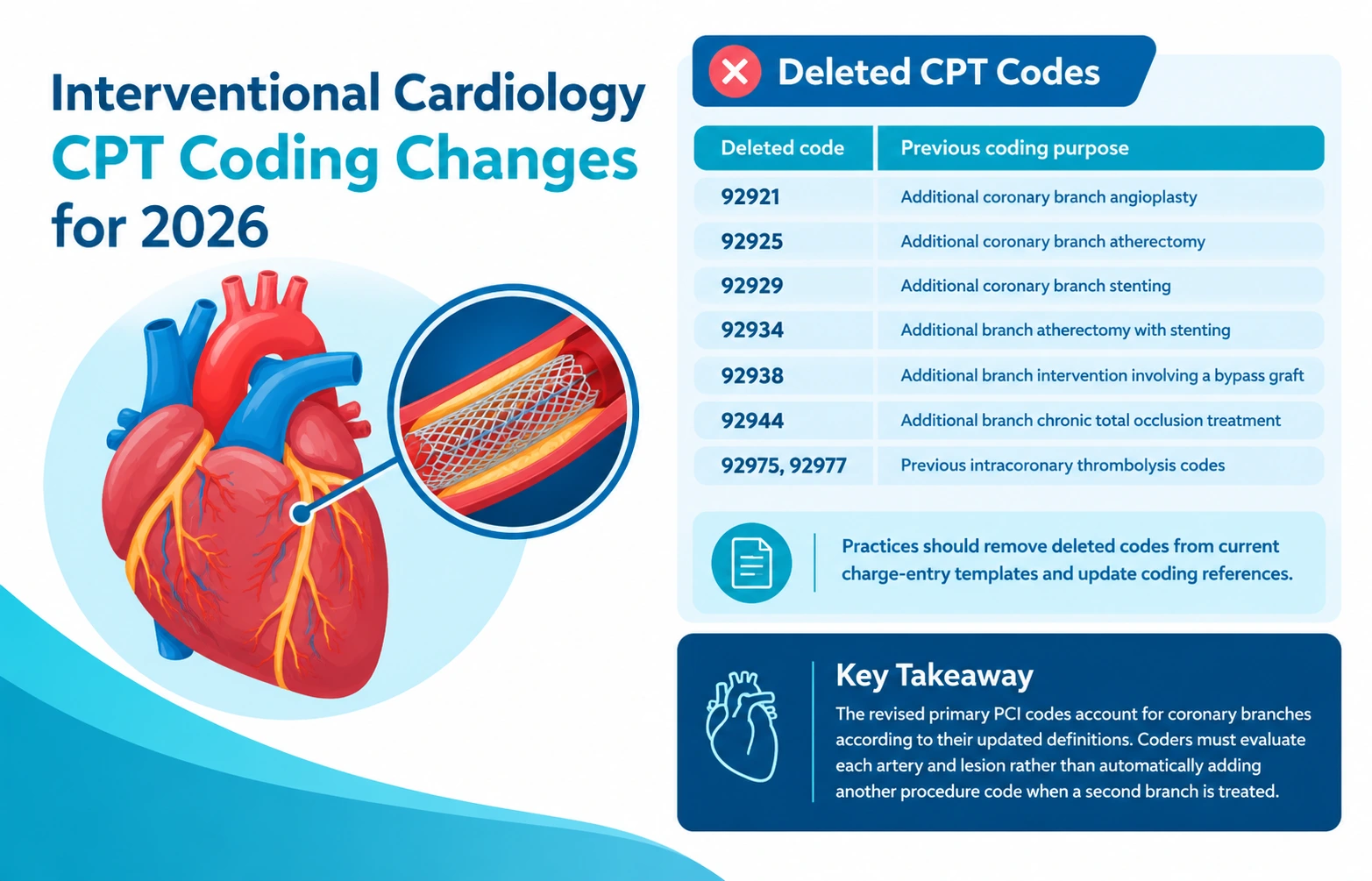
Deleted CPT codes
Effective January 1, 2026, the following codes were removed:
| Deleted code | Previous coding purpose |
|---|---|
| 92921 | Additional coronary branch angioplasty |
| 92925 | Additional coronary branch atherectomy |
| 92929 | Additional coronary branch stenting |
| 92934 | Additional branch atherectomy with stenting |
| 92938 | Additional branch intervention involving a bypass graft |
| 92944 | Additional branch chronic total occlusion treatment |
| 92975, 92977 | Previous intracoronary thrombolysis codes |
Practices should remove deleted codes from current charge-entry templates and update coding references.
The revised primary PCI codes account for coronary branches according to their updated definitions. Coders must evaluate each artery and lesion rather than automatically adding another procedure code when a second branch is treated.
These changes are reflected in the ACC's 2026 coding guidance and the Centers for Medicare & Medicaid Services (CMS) billing article A57479, revised effective January 1, 2026.
Chronic total occlusion CPT codes: 92943 vs. 92945
A chronic total occlusion (CTO) is a complete coronary artery blockage that generally has been present for at least three months.
CTO procedures can require specialized wires, catheters, and techniques to cross the blockage.
For 2026, the procedure approach distinguishes the two principal CTO revascularization codes.
CPT 92943 describes qualifying CTO revascularization performed through an antegrade approach, progressing in the normal direction of coronary blood flow.
CPT 92945 describes CTO revascularization involving combined antegrade and retrograde approaches.
A retrograde technique accesses the occlusion from its distal side, often through collateral pathways or bypass graft anatomy.
Consider a patient whose coronary occlusion cannot be crossed using the initial antegrade technique. If the physician subsequently uses a retrograde approach as part of the combined revascularization, CPT 92945 may apply.
The operative report must establish the techniques actually performed. A procedure should not be classified as combined antegrade and retrograde treatment merely because the physician considered both approaches.
Diagnostic cardiac catheterization CPT codes
Diagnostic catheterization remains an important component of interventional cardiology.
The commonly used codes include:
| CPT code | Diagnostic procedure |
|---|---|
| 93454 | Coronary angiography without left heart catheterization |
| 93455 | Coronary angiography with bypass graft imaging |
| 93458 | Coronary angiography with left heart catheterization |
| 93460 | Combined right and left heart catheterization with coronary angiography |
CPT 93458 is commonly associated with diagnostic coronary angiography performed alongside left heart catheterization.
However, diagnostic imaging performed during a PCI procedure is not always separately billable.
CMS allows separate diagnostic coronary angiography in certain circumstances, such as when no previous adequate catheter-based study exists and the diagnostic examination leads to the intervention decision.
If the physician merely performs imaging to guide stent placement or confirm the procedural result, that work is included in the PCI service.
The medical record should clearly explain why any separately reported diagnostic examination was necessary.
Intravascular imaging and coronary physiology codes
Interventional cardiologists may use intravascular ultrasound, optical coherence tomography, or pressure-based measurements to evaluate coronary disease.
These services help assess lesion characteristics, vessel dimensions, and the physiological significance of narrowing.
| CPT code | Service |
|---|---|
| 92978 | IVUS or OCT imaging, initial coronary vessel |
| 92979 | IVUS or OCT imaging, each additional vessel |
| 93571 | Coronary flow or pressure measurement, initial vessel |
| 93572 | Coronary flow or pressure measurement, each additional vessel |
| 92972 | Coronary intravascular lithotripsy |
| 92973 | Qualifying mechanical coronary thrombectomy |
Codes 93571 and 93572 may be used for qualifying fractional flow reserve (FFR) or related coronary physiological measurements.
Coronary intravascular lithotripsy, reported with add-on code 92972 when appropriate, uses acoustic pressure waves to modify calcified plaque.
These add-on services require a qualifying primary procedure and supporting documentation. The coder should verify bundling restrictions and payer rules before reporting them.
Peripheral vascular intervention CPT codes in 2026
Interventional cardiologists who treat peripheral arterial disease must also account for changes to lower extremity revascularization coding.
For 2026, the previous CPT code range 37220–37235 was deleted and replaced by 46 new codes, 37254–37299.
The updated structure organizes procedures according to the vascular territory treated, whether the lesion represents stenosis or occlusion, and the type of intervention.
For example, CPT 37254 describes qualifying angioplasty of a straightforward lesion in the iliac vascular territory, while CPT 37256 applies to a complex lesion in that territory.
The University of Texas Medical Branch, in a February 9, 2026 coding update authored by Stephanie Smith, RHIA, emphasized the need to document lesion type, vascular territory, and treatment performed under the revised system.
Documentation requirements for interventional cardiology billing
Accurate CPT selection depends heavily on the physician's procedural documentation.
The report should identify the coronary anatomy, lesion locations, interventions, and procedural findings.
For complex PCI, documentation needs to distinguish a single continuous lesion from multiple distinct lesions. This distinction became particularly important with the introduction of CPT 92930.
A complete operative report should establish:
- The indication and clinical diagnosis supporting the procedure.
- Each artery and coronary segment treated.
- The number and location of lesions and stents.
- The use of angioplasty, atherectomy, imaging, or CTO crossing techniques.
- Relevant complications, findings, and final procedural results.
Documentation should also support the billed ICD-10-CM diagnosis codes.
For example, ICD-10-CM I25.82 identifies chronic total occlusion of a coronary artery. Applicable coding instructions require reporting the underlying coronary atherosclerosis diagnosis before this code.
Vague documentation can delay accurate code assignment and lead to provider queries.
Common interventional cardiology coding and billing errors
Reporting separate procedures that are already bundled
PCI codes include several associated services, such as access, selective catheterization, intervention-related imaging, and certain closure procedures.
Submitting additional charges for included services can create incorrect claims.
Using deleted 2025 coronary branch codes
Billing software may retain older code combinations after annual CPT updates.
Claims containing deleted codes such as 92929 or 92944 for 2026 dates of service require correction using the applicable current codes.
Selecting the wrong coronary artery modifier
Coronary artery modifiers identify the vessel receiving treatment.
Common modifiers include LD for the left anterior descending artery, LC for the left circumflex artery, RC for the right coronary artery, LM for the left main artery, and RI for the ramus intermedius.
CMS contractor instructions require appropriate coronary artery modifiers for specified intravascular imaging and physiological assessment codes. Claims missing required modifiers may be returned as unprocessable.
Coding CTO procedures without documenting the approach
The distinction between 92943 and 92945 depends on procedural technique.
A description such as "complex CTO intervention completed" does not adequately establish whether the procedure involved combined antegrade and retrograde approaches.
Coders should obtain clarification when the operative report does not support the selected code.
How to improve interventional cardiology coding accuracy
Cardiology practices can reduce coding errors by updating their CPT references annually and reviewing procedure reports before submitting claims.
A useful review process begins with identifying the service performed and confirming the date of service. The coder then evaluates the treated anatomy, procedural techniques, and current CPT instructions.
For coronary interventions, particular attention should be given to the number of distinct lesions, the relationship between major vessels and branches, and any independently reportable diagnostic services.
Before final claim submission, staff should verify applicable National Correct Coding Initiative edits, payer coverage policies, and documentation supporting medical necessity.
CMS finalized revised values for the PCI code family in the 2026 Medicare Physician Fee Schedule. Practices should therefore use the applicable current fee schedule rather than relying on payment amounts from earlier years.
Conclusion
Interventional cardiology CPT codes in 2026 include substantial revisions to coronary stenting, CTO revascularization, and peripheral vascular procedures.
The introduction of CPT 92930 and 92945, removal of additional branch codes, and replacement of lower extremity revascularization codes require updated coding workflows.
Accurate billing depends on matching the documented anatomy and intervention to the current CPT instructions, applying required modifiers, and distinguishing included procedural work from separately reportable services.
For healthcare providers and medical coders, reviewing these details before claim submission helps prevent coding errors and supports defensible reimbursement.