CPT Code 33016: Procedure Description, Coding Rules, and Common Errors

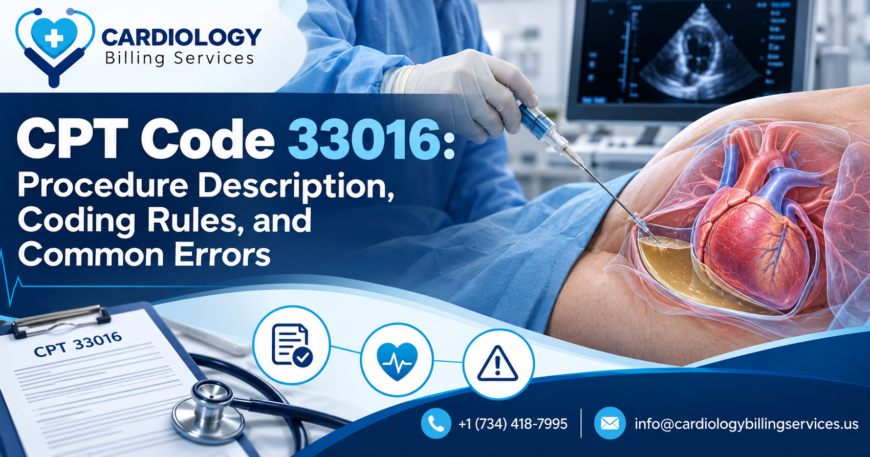
CPT Code 33016 is used to report pericardiocentesis, a procedure that removes fluid from the sac surrounding the heart. Physicians may perform it to relieve pressure caused by pericardial effusion, evaluate accumulated fluid, or treat a potentially life-threatening condition known as cardiac tamponade.
Accurate coding requires more than identifying the procedure. Medical coders must determine whether the physician performed needle aspiration alone or inserted a catheter that remained in place for continued drainage. They must also understand which imaging services are included and what documentation supports the claim.
The American Medical Association (AMA) introduced CPT 33016 in 2020 as part of changes to pericardial procedure coding. The revised code structure distinguishes pericardiocentesis from drainage procedures involving indwelling catheters.
This guide explains the CPT Code 33016 description, clinical indications, documentation requirements, billing guidelines, and common errors healthcare providers should avoid.
What is CPT Code 33016?
CPT Code 33016 describes pericardiocentesis, including imaging guidance when performed.
The code belongs to the cardiovascular surgery section of the Current Procedural Terminology (CPT) code set maintained by the American Medical Association.
During pericardiocentesis, a physician inserts a needle into the pericardial space to withdraw accumulated fluid. The procedure may be performed using ultrasound, fluoroscopy, or other appropriate imaging techniques to help identify the fluid collection and guide needle placement.
The code includes imaging guidance when used, so the guidance is not separately billed for the same procedure.
CPT 33016 at a glance
| Coding detail | Description |
|---|---|
| CPT code | 33016 |
| Procedure | Pericardiocentesis |
| Code category | Cardiovascular surgery |
| Anatomical location | Pericardial space |
| Primary technique | Percutaneous needle aspiration |
| Imaging guidance | Included when performed |
| Indwelling drainage catheter | Not described by 33016 |
| Medicare global period | 000 days |
| Common indications | Pericardial effusion, cardiac tamponade |
The zero-day Medicare global period means that the procedure does not carry a 10-day or 90-day postoperative global period. However, services performed on the procedure date remain subject to applicable global surgery and separate-reporting rules.
Why is pericardiocentesis performed?
The pericardium is a protective sac surrounding the heart. It normally contains a small amount of lubricating fluid that reduces friction as the heart beats.
When excessive fluid accumulates within this space, the condition is called a pericardial effusion.
Some effusions develop gradually and produce few symptoms. Others accumulate rapidly and increase pressure around the heart, potentially restricting normal cardiac filling.
Pericardiocentesis may be indicated in several clinical situations.
1. Cardiac tamponade
Cardiac tamponade occurs when pressure from accumulated pericardial fluid interferes with the heart's ability to fill effectively.
Patients may develop hypotension, tachycardia, shortness of breath, or other signs of circulatory compromise.
Urgent drainage may be necessary when tamponade produces hemodynamic instability. The decision depends on clinical findings and physician assessment.
2. Large or symptomatic pericardial effusion
A large effusion may cause chest discomfort, breathlessness, or other symptoms even without established tamponade.
A physician may recommend drainage based on the patient's symptoms, imaging findings, suspected cause, and clinical condition.
3. Diagnostic evaluation
Pericardiocentesis can also provide fluid for laboratory testing.
Depending on the clinical circumstances, the specimen may undergo cytological, microbiological, or biochemical analysis to investigate suspected malignancy, infection, or another cause of fluid accumulation.
The reason for performing the procedure should be clearly documented because it supports medical necessity and diagnosis selection.
How is the CPT 33016 procedure performed?
Pericardiocentesis is performed by a qualified clinician using an approach appropriate to the patient's anatomy and clinical condition.
The usual sequence involves several steps:
- Patient assessment: The physician evaluates symptoms, vital signs, and available imaging to determine the indication and suitable drainage approach.
- Site preparation: The selected area is prepared using sterile technique, with anesthesia or other supportive measures as clinically appropriate.
- Needle placement: A needle is advanced into the pericardial space, commonly with imaging assistance.
- Fluid aspiration: Accumulated fluid is withdrawn to relieve pressure or obtain a diagnostic specimen.
- Post-procedure assessment: The clinical team evaluates the patient's response and monitors for complications or recurrent fluid accumulation.
For coding purposes, the operative or procedure report should establish whether aspiration was completed without leaving an indwelling drainage catheter.
A catheter used temporarily during aspiration does not automatically mean that an indwelling catheter drainage code applies. The distinction is whether the catheter remains in place for ongoing drainage after the procedure.
CPT Code 33016 billing and coding guidelines
Correct billing depends on the service actually performed, the applicable CPT instructions, and the payer's reimbursement policies.
Imaging guidance is included
One of the most important coding rules for CPT 33016 concerns imaging guidance.
Ultrasound or other imaging may help the physician identify the effusion, choose an access site, and monitor needle placement.
However, imaging guidance is included in CPT 33016 when performed.
The AMA's CPT Assistant, January 2020, specifically identifies the following guidance codes as inappropriate to report alongside 33016 for the same procedure:
- 76942: Ultrasound guidance for needle placement.
- 77002: Fluoroscopic guidance for needle placement.
- 77012: CT guidance for needle placement.
- 77021: MRI guidance for needle placement.
The American College of Emergency Physicians (ACEP) also identifies pericardiocentesis among procedures for which ultrasound guidance is included rather than separately reportable.
Diagnostic echocardiography requires separate justification
A diagnostic echocardiogram and imaging used solely for pericardiocentesis guidance serve different purposes.
If echocardiography is performed only to guide the needle, it should not be separately reported as a diagnostic echocardiogram.
A genuinely separate diagnostic echocardiographic examination may be reportable when it meets the applicable requirements, including a distinct medical indication, appropriate images, and an interpretation.
Coders should examine the purpose and documentation of each imaging service rather than assuming every ultrasound examination qualifies for additional reimbursement.
Use the appropriate code for catheter drainage
CPT 33016 applies to pericardiocentesis without an indwelling drainage catheter.
If the physician inserts a catheter that remains in the pericardial space for continued drainage, another code may be appropriate.
This distinction should be established from the procedure report before claim submission.
CPT 33016 vs. 33017, 33018, and 33019
The AMA revised pericardial procedure coding in 2020, introducing separate codes for needle aspiration and percutaneous drainage with an indwelling catheter.
The appropriate code depends on the drainage method, imaging modality, and, for certain procedures, the patient's age or congenital cardiac condition.
| CPT code | Procedure description | Main coding distinction |
|---|---|---|
| 33016 | Pericardiocentesis, including imaging guidance when performed | Aspiration without an indwelling drainage catheter |
| 33017 | Percutaneous pericardial drainage with an indwelling catheter | Age 6 or older without congenital cardiac anomaly; ultrasound or fluoroscopic guidance included when performed |
| 33018 | Percutaneous pericardial drainage with an indwelling catheter | Birth through age 5, or any age with congenital cardiac anomaly; ultrasound or fluoroscopic guidance included when performed |
| 33019 | CT-guided percutaneous drainage of the pericardial space with placement of an indwelling catheter. | CT-guided catheter drainage |
Example: Needle aspiration without catheter placement
A patient presents with a symptomatic pericardial effusion. The physician uses echocardiographic guidance to identify the collection and performs needle aspiration.
After fluid removal, the needle is withdrawn. No drainage catheter remains in place.
Appropriate procedure code: 33016.
The ultrasound guidance used for the aspiration is included.
Example: Pericardial drainage with an indwelling catheter
A 65-year-old patient without congenital cardiac anomaly undergoes ultrasound-guided pericardial drainage.
The physician inserts a catheter and leaves it in place to permit continued drainage.
Appropriate procedure code: 33017.
The presence of the indwelling catheter changes the code selection.
If the physician initially performs aspiration and then converts to indwelling catheter drainage during the same procedure, the definitive catheter drainage service generally determines the code. The initial aspiration should not be billed separately by default.
Documentation requirements for CPT Code 33016
Medical documentation should establish the clinical reason for pericardiocentesis and confirm that the procedure described by CPT 33016 was performed.
Although CPT does not prescribe a unique documentation template for this procedure, a complete report supports code selection, medical necessity review, and payer inquiries.
What should the procedure report include?
| Documentation element | Information to record |
|---|---|
| Clinical indication | Reason for drainage, such as symptomatic effusion or tamponade |
| Pre-procedure assessment | Relevant symptoms, clinical findings, and imaging results |
| Procedure technique | Access approach and method of aspiration |
| Imaging | Type and purpose of guidance, if performed |
| Fluid removal | Volume and relevant appearance of aspirated fluid |
| Catheter status | Whether a catheter was removed or left indwelling |
| Complications | Any complication or confirmation that none occurred |
| Patient response | Relevant post-procedure clinical findings |
| Performing clinician | Identification and authentication of the procedure report |
A documented fluid volume helps explain the procedure but does not independently establish which CPT code applies.
Similarly, a diagnosis of cardiac tamponade does not automatically justify CPT 33016 if the physician actually performed a different drainage procedure.
Example of adequate documentation
Consider a procedure report describing a patient with a large symptomatic pericardial effusion.
The physician documents the indication, uses ultrasound to locate the collection, advances a needle into the pericardial space, aspirates fluid, and removes the needle without leaving a drainage catheter.
The report also records the patient's response and any complications.
This documentation supports evaluation of CPT 33016 because it identifies the aspiration technique and confirms the absence of an indwelling catheter.
ICD-10-CM diagnosis coding for CPT 33016
The CPT code identifies the service performed. ICD-10-CM coding identifies the condition or clinical reason supporting that service.
Potential diagnoses associated with pericardiocentesis include:
| ICD-10-CM code | Diagnosis |
|---|---|
| I31.3 | Pericardial effusion (noninflammatory) |
| I31.4 | Cardiac tamponade |
| I30.9 | Acute pericarditis, unspecified |
These codes are examples, not an automatic list of payable diagnoses.
A patient may have an effusion caused by infection, malignancy, inflammation, or another underlying condition. The final diagnosis selection should reflect the provider's documented findings and current ICD-10-CM conventions.
For example, I31.4 should not be assigned merely because a large effusion was present. Cardiac tamponade must be supported by the clinical documentation.
Coders must also review code-specific instructions and applicable payer coverage requirements. A clinically valid diagnosis does not guarantee payment without meeting other coverage and billing conditions.
Common CPT 33016 coding errors
Several recurring mistakes can lead to rejected claims, incorrect reimbursement, or compliance concerns.
1. Billing imaging guidance separately
Reporting 76942 or another guidance code for imaging already included in CPT 33016 duplicates a component of the primary procedure.
Correction: Review the CPT descriptor and bundled-service instructions before adding imaging codes.
2. Using 33016 for indwelling catheter drainage
A physician may initially aspirate fluid but subsequently leave a catheter in place.
If the documentation establishes an indwelling catheter drainage procedure, 33016 may not represent the definitive service.
Correction: Confirm the final catheter status and select the appropriate drainage code.
3. Reporting aspiration and catheter drainage together
Billing 33016 and 33017 for a single procedure converted from aspiration to indwelling catheter drainage can result in duplicate reporting.
Correction: Code the definitive procedure, subject to applicable instructions for any genuinely separate service.
4. Selecting a diagnosis without supporting documentation
An imaging report showing pericardial fluid does not automatically establish cardiac tamponade.
Correction: Link the claim to diagnoses supported by the treating provider's documentation.
5. Reporting guidance-only echocardiography as a diagnostic study
Ultrasound used exclusively to guide pericardiocentesis should not be billed as a separate diagnostic echocardiographic examination.
Require a distinct, clearly indicated, and adequately documented diagnostic examination before reporting any additional service.
6. Applying modifiers without a valid reason
Modifiers such as 59 or X should not be used simply to bypass a bundling edit.
Modifier 25 may be appropriate for a significant, separately identifiable evaluation and management service on the same date, but the documentation must support work beyond the usual evaluation associated with the procedure.
Correction: Verify the applicable modifier rules and supporting documentation before claim submission.
CPT 33016 Medicare reimbursement in 2026
Medicare reimbursement for CPT 33016 depends on the setting, geographic adjustment, and applicable payment system.
A 2026 interventional radiology reimbursement guide published by Cook Medical lists the following national reference figures:
| Medicare payment measure | 2026 reference amount |
|---|---|
| Physician payment | $205.10 |
| Ambulatory surgery center payment | $649.99 |
| Hospital outpatient APC payment | $1,608.25 |
| Physician work RVUs | 4.29 |
These figures are published reference amounts rather than guaranteed payments. Facility amounts are separate from physician payments, and actual reimbursement may differ because of geographic adjustments, payment policy, and other claim-specific factors.
The Centers for Medicare & Medicaid Services (CMS) also publishes the National Correct Coding Initiative (NCCI) Policy Manual. The 2026 edition became effective January 1, 2026, and provides guidance on correct code combinations and services that should not be separately reported.
Medical billing teams should confirm current payer-specific rules and fee schedules before estimating reimbursement.
How to reduce CPT 33016 claim denials
A short pre-submission review can identify many avoidable errors.
For every CPT 33016 claim, billing staff should verify that:
- The physician documented pericardiocentesis and its clinical indication.
- The report confirms aspiration without an indwelling drainage catheter.
- Imaging guidance was not separately billed for the same procedure.
- Any additional diagnostic echocardiography is separately supported.
- The ICD-10-CM diagnosis reflects documented findings.
- Use the modifier only when supported by the service provided and the applicable payer guidelines.
- The performing clinician, date of service, and claim information are accurate.
- Applicable payer coverage and NCCI requirements have been reviewed.
If the operative report does not establish whether a catheter remained in place, the coder should request clarification rather than selecting a code based on assumptions.
This is particularly important when documentation uses general terms such as pericardial drainage without describing the actual technique.
Frequently asked questions about CPT 33016
Does CPT 33016 include ultrasound guidance?
Yes. CPT 33016 includes imaging guidance when performed. Ultrasound guidance used for the pericardiocentesis should not be billed separately under CPT 76942.
Can CPT 33016 be billed without imaging guidance?
Yes. The code includes imaging guidance when performed, meaning imaging is not mandatory for code selection. The documented procedure must still meet the definition of pericardiocentesis.
What is the difference between CPT 33016 and 33017?
CPT 33016 describes pericardiocentesis without an indwelling drainage catheter. CPT 33017 describes percutaneous pericardial drainage with an indwelling catheter for patients aged six or older who do not have a congenital cardiac anomaly, with ultrasound or fluoroscopic guidance included when performed.
What is the global period for CPT 33016?
Under the Medicare Physician Fee Schedule, CPT 33016 has a zero-day global period. Separate services performed on the same date must still meet applicable reporting requirements.
Can CPT 33016 and 93308 be billed together?
They may be separately reportable when CPT 93308 represents a medically necessary diagnostic echocardiographic examination distinct from imaging used to guide pericardiocentesis. The medical record must support the separate service, and applicable payer edits must be satisfied.
Is CPT 33016 used for cardiac tamponade?
Yes. CPT 33016 may be appropriate when pericardiocentesis is performed to relieve cardiac tamponade, provided the documented procedure matches the code description.
Key points for accurate CPT 33016 coding
CPT Code 33016 describes pericardiocentesis, including imaging guidance when performed. Its correct use depends on identifying the actual procedure, particularly whether the physician performed aspiration alone or placed an indwelling drainage catheter.
The most frequent coding concerns involve separately billing included imaging guidance, confusing aspiration with catheter drainage, and selecting diagnoses that are not supported by the medical record.
For healthcare providers and medical coders, the most reliable approach is to review the complete procedure report, apply current CPT and NCCI instructions, and verify payer-specific requirements before submitting the claim.