
Cardiology Billing for Hospital-Based vs. Office-Based Procedures

A transthoracic echocardiogram done down the hall from a cardiologist's office and the same study done in a hospital outpatient department use the same CPT code, 93306. They do not produce the same claims, the same payers, or the same dollars. Cardiology billing for hospital-based vs. office-based procedures comes down to one question coders must answer before anything else: who owns the equipment, the staff, and the room?
That answer decides whether one claim or two goes out, which form it goes on, which fee schedule prices it, and, since 2026, how hard the latest Medicare policies hit it. This guide walks through the mechanics, then the rule changes that cardiology practices and hospital billing teams are working through as 2027 begins.
Two Claims or One: The Basic Split
Most cardiology diagnostic codes have two parts. The professional component covers the physician's interpretation and report. The technical component covers the equipment, supplies, technician time, and overhead.
In an office setting (place of service 11), the practice owns both parts. It bills the code once, with no modifier, on a CMS-1500 or 837P claim. This is called global billing, and Medicare pays it from the Physician Fee Schedule (PFS) at the non-facility rate.
In a hospital, the work splits. The cardiologist bills only the interpretation, appending modifier 26 on a professional claim with place of service 22 (on-campus outpatient hospital), 19 (off-campus outpatient hospital), or 21 (inpatient). The hospital bills the technical side on a UB-04 or 837I institutional claim. For outpatients, that payment comes from the Outpatient Prospective Payment System (OPPS); for inpatients, the service is folded into the MS-DRG payment.
Modifier TC exists for the reverse situation, when a practice or independent diagnostic testing facility performs a test and someone else reads it. Hospitals do not use TC on institutional claims. Their revenue code and the absence of a professional fee already tell the payer what is being billed.
Professional vs. Technical Component
| Component | What It Covers |
|---|---|
| Professional | Physician interpretation and written report. |
| Technical | Equipment, supplies, technician time, and overhead. |
| Global | Combined professional and technical components. |
Why the Same Procedure Pays Differently
PFS payment is built from three relative value units (RVUs): physician work, practice expense (PE), and malpractice. Work and malpractice RVUs stay the same in every setting. Practice expense does not.
Every code with a non-facility value carries two PE figures. The non-facility PE is higher because the practice is paying for the echo machine, the sonographer, and the lease. The facility PE is lower because the hospital is assumed to be carrying those costs and getting paid for them separately through OPPS.
Take 93306 as the working example. Under the CY 2026 OPPS, the hospital's technical payment comes through APC 5524 (Level 4 Imaging without Contrast), which the American Society of Echocardiography lists at $558.25. Add the cardiologist's professional fee and the total Medicare outlay for a hospital echo is well above what the same study pays an office under global billing. That gap is the reason site-of-service policy draws so much attention from CMS and Congress.
The spread is wider for procedures. Many diagnostic catheterization codes carry non-facility values, which is why office-based cath labs and office-based vascular labs exist as a business model. Interventional work such as PCI, TAVR, and device implants is still overwhelmingly done in facilities.
The Three RVU Components
| RVU | Coverage | Setting Difference |
|---|---|---|
| Work RVU | Physician work and effort | Generally consistent across settings |
| Practice Expense RVU | Equipment, staff, and overhead | Higher in non-facility settings |
| Malpractice RVU | Professional liability expenses | Generally consistent across settings |
What Each Claim Looks Like in Practice
In the office, the claim is simple. The practice submits one global code on a CMS-1500 or 837P, Medicare prices it at the PFS non-facility rate, the practice employs the sonographer or technologist, and the patient owes a single coinsurance amount.
The hospital outpatient version involves two submissions. The cardiologist sends the code with modifier 26 on a professional claim and is paid at the PFS facility rate. The hospital sends its own institutional claim on a UB-04 or 837I, with a revenue code such as 0483 for echocardiography, and receives an OPPS APC payment. The hospital employs the technical staff, and the patient owes coinsurance on each claim.
That second coinsurance amount matters more than many billers expect. A Medicare patient moved from an office echo lab to a hospital-owned clinic two miles away will often see two bills where there used to be one, and practices that are acquired by health systems tend to field those complaints first.
Office-Based Claim
- One global procedure code.
- Professional and technical components combined.
- CMS-1500 or 837P claim.
- PFS non-facility rate.
Hospital Outpatient Claim
- Physician submits modifier 26.
- Hospital submits a separate institutional claim.
- Physician receives the PFS facility rate.
- Hospital receives OPPS reimbursement.
Hospital-Owned Practices and the Place of Service Trap
Hospital acquisitions of cardiology groups created a category that confuses new coders: the physician who works in what looks like a private office but is legally a provider-based department of the hospital.
If that location is enrolled as provider-based, the physician claim uses POS 19 or 22 and receives the facility rate, and the hospital bills its own claim. A clinic visit there generates HCPCS G0463 on the hospital side. Reporting POS 11 from a provider-based location is a compliance problem, because it pays the physician the higher non-facility PE while the hospital is also being paid for overhead.
Off-campus locations are also separated by two institutional modifiers. PO marks an excepted (grandfathered) off-campus department, generally one that was billing under OPPS before November 2, 2015. PN marks a nonexcepted off-campus department, which Medicare pays at a reduced, PFS-equivalent rate.
| Modifier | Meaning | Billing Impact |
|---|---|---|
| PO | Excepted off-campus department | Applicable OPPS payment |
| PN | Nonexcepted off-campus department | Reduced PFS-equivalent payment |
The Three-Day Payment Window
One more hospital-ownership rule catches cardiology practices: the three-day payment window. When a hospital wholly owns or operates a physician practice, diagnostic services the practice performs in the three days before an inpatient admission are bundled into the hospital's inpatient claim. The practice bills only the professional component and adds modifier PD to flag the service. A pre-admission nuclear stress test or echo is the textbook case.
Important Coding Reminder
The appearance of a clinic does not determine its billing classification. Provider-based enrollment and the actual place of service must be verified before submitting a claim.
What the 2026 Physician Fee Schedule Changed
The CY 2026 PFS final rule, released October 31, 2025, introduced the first real site-of-service differential inside the physician payment formula.
CMS set two conversion factors for the first time: $33.57 for qualifying APM participants, a 3.77% increase from CY 2025, and $33.40 for everyone else, a 3.26% increase. Those gains came with two offsets.
The Efficiency Adjustment
The first was an efficiency adjustment. CMS applied a -2.5% adjustment to the work RVU and the matching intraservice time for non-time-based services, a category that covers nearly every cardiology procedure code.
Hospital-Based Practice Expense Adjustment
The second targeted hospital-based work directly. According to the American College of Cardiology's October 2025 summary of the final rule, the portion of indirect practice expense that is allocated by work RVUs was cut by 50% for services performed in the hospital setting, starting in 2026. CMS's stated reasoning was that physicians have moved from independent practice into hospital employment, so the hospital now carries more of their overhead.
The ACC projected a 7% decline for facility-based cardiology services and a 5% increase for non-facility services. MedAxiom put the total RVU reduction at roughly 10% for facility-based procedures such as pacemaker implants, TAVR, PCI, and ablation. Left atrial appendage closure took an additional hit when CMS cut its work RVU from 14.00 to 10.25.
For a coder, the takeaway is practical. The correct place of service code now moves more money than it did in 2025, and an audit finding on POS errors carries a larger overpayment figure.
The 2027 Rules: Lower Conversion Factors, More Site-Neutral Payment
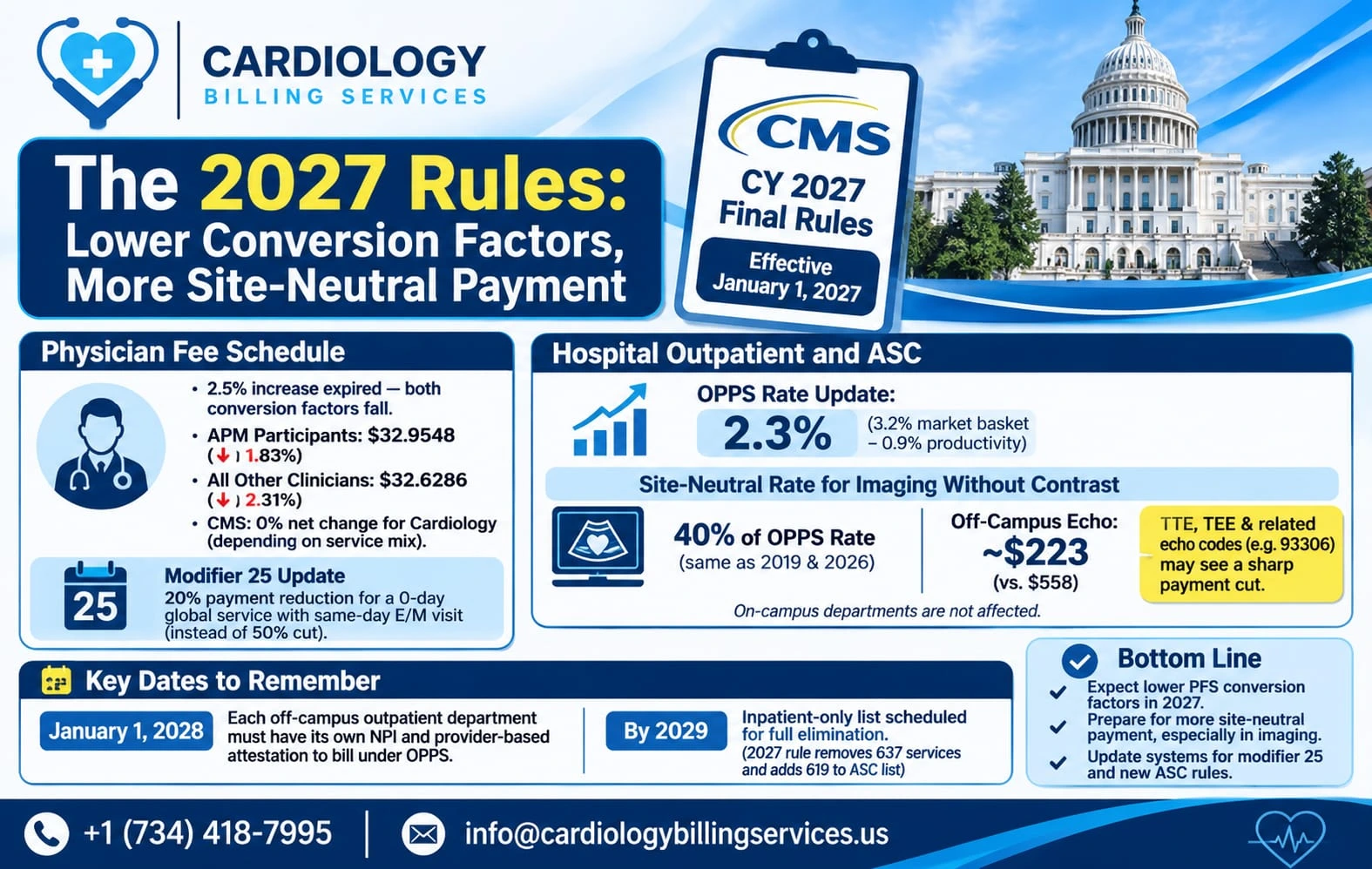
CMS released both CY 2027 final rules on November 4, 2026. They take effect January 1.
Physician Fee Schedule
The one-year 2.5% statutory increase expired, so both conversion factors fall. The 2027 figure for qualifying APM participants is $32.9548 (down 1.83%), and the figure for all other clinicians is $32.6286 (down 2.31%). CMS's own impact table shows a 0% net change for cardiology as a specialty, though individual practices will land above or below that depending on their service mix.
The change billers will notice on claims involves modifier 25. CMS had proposed a 50% cut, but the final policy reduces payment by 20% and applies only to a lower-valued 0-day global service billed on the same day as an E/M visit. Cardiology practices that pair a same-day visit with minor procedures should expect some line-item reductions and update their payment variance logic.
The Ambulatory Specialty Model for heart failure also becomes mandatory on January 1, 2027, which adds a quality and cost overlay for affected cardiologists regardless of where they practice.
Hospital Outpatient and ASC
The OPPS rate update is 2.3% (a 3.2% market basket increase minus a 0.9% productivity adjustment). The bigger story for cardiology is imaging.
CMS finalized a site-neutral rate for imaging without contrast at excepted off-campus hospital departments: 40% of the OPPS rate, the same PFS-equivalent level it applied to off-campus clinic visits in 2019 and drug administration in 2026. Because TTE, TEE, and related echo codes sit in the imaging without contrast APCs, the American Society of Echocardiography warned in its August 2026 comments that applying the policy to 93306 would cut payment sharply and immediately. At 40% of the 2026 APC 5524 rate, an off-campus echo would pay the hospital roughly $223 instead of $558. On-campus departments are not affected.
Important Upcoming Dates
Two more dates belong on a hospital revenue cycle calendar. Starting January 1, 2028, Section 6225 of the Consolidated Appropriations Act, 2026 requires each off-campus outpatient department to have its own NPI and a provider-based attestation to keep billing under OPPS. By 2029, the inpatient-only list is scheduled for full elimination. The 2027 rule removes 637 services from that list and adds 619 to the ASC covered procedures list.
The ASC as a Third Setting
For most of the last decade, cardiology site-of-service debates were a two-way contest. That changed in 2026, when CMS added six cardiac ablation codes and seven additional electrophysiology codes to the ASC covered procedures list, according to Boston Scientific's CY 2026 final rule memo. Becker's ASC Review reported that the same rule also opened the list to codes for percutaneous coronary intervention and vascular embolization or occlusion.
ASC billing follows its own pattern. The physician bills with POS 24 at the facility rate, and the ASC bills a facility fee under the ASC payment system on a CMS-1500. Some cardiology groups already own an office-based lab and are weighing a conversion to ASC status or a hybrid arrangement, so coders in those groups may need to work across all three settings within a single week.
There are limits. Left atrial appendage closure stayed on the inpatient-only list for CY 2026, so Medicare would not pay for it in an outpatient department or ASC that year. Check the 2027 IPO addenda before assuming any structural heart procedure has moved.
| Setting | Place of Service | Billing Structure |
|---|---|---|
| Office | POS 11 | Global or applicable component billing |
| Hospital Outpatient | POS 19 / 22 | Professional and institutional claims |
| ASC | POS 24 | Professional claim and ASC facility fee |
Checks That Prevent the Most Common Denials
The errors that show up most often in cardiology site-of-service audits are predictable. The most expensive is global billing for a hospital patient. If the hospital performed the test, the physician claim needs modifier 26, and a global claim produces a duplicate technical payment.
Place of service errors come next, usually at locations whose provider-based status nobody verified. Confirm the location's enrollment, not the sign on the door. Wholly owned practices also miss modifier PD on pre-admission diagnostics, and the fix is usually a scheduling flag, since most coders already know the rule.
On the hospital side, PO and PN drive very different OPPS amounts on off-campus claims, and the 2027 imaging policy widens that gap. Inpatient-only procedures billed as outpatient remain a steady source of denials too. Check the current year's IPO list each January, because it is shrinking on a fixed schedule through 2029.
The gap between hospital and office payment has been narrowing from both directions: the 2026 indirect PE cut lowered physician payment for facility work, and the 2027 site-neutral imaging rule lowers hospital payment at grandfathered off-campus sites. For billers and coding students, that makes place of service, modifiers 26 and TC, and provider-based status the first things to check on every cardiology claim, before the CPT code itself.