Cardiology E/M Billing: How to Report Office Visits and Same-Day Procedures

Cardiology practices frequently perform evaluation and management (E/M) services alongside diagnostic tests and minor procedures. A patient may arrive for a scheduled follow-up appointment, report new chest discomfort, undergo an electrocardiogram (ECG), and receive an adjustment to cardiac medication during the same encounter. Each service requires appropriate coding consideration.
Cardiology E/M billing requires careful attention to the work performed, the medical necessity of the office visit, and the documentation supporting additional procedures. Reporting an office visit with a diagnostic or procedural code is permissible when the services meet applicable coding requirements. However, the presence of multiple services on one date does not automatically justify separate payment for every reported code.
Modifier 25 is particularly important in these situations. Incorrect application can result in claim denials, payment adjustments, and additional documentation requests.
Understanding office and outpatient E/M code selection, modifier requirements, and Medicare National Correct Coding Initiative (NCCI) edits helps cardiology practices report services accurately.
Understanding E/M Coding in Cardiology
Evaluation and management codes describe professional services involving patient assessment, diagnosis, treatment planning, and ongoing medical care. Cardiologists use office and outpatient E/M codes when evaluating new patients, managing established cardiac conditions, and monitoring treatment.
The primary office and outpatient E/M code ranges are:
| Patient category | CPT code range |
|---|---|
| New patient | 99202–99205 |
| Established patient | 99211–99215 |
The appropriate code depends on whether the patient meets the CPT definition of a new or established patient and the complexity or time associated with the encounter.
A new patient generally has not received professional services from the physician or another physician of the same specialty and subspecialty within the same group practice during the previous three years. Practices should apply the CPT definition rather than assuming that a patient is new because the individual is seeing a different cardiologist.
Selecting the appropriate E/M level
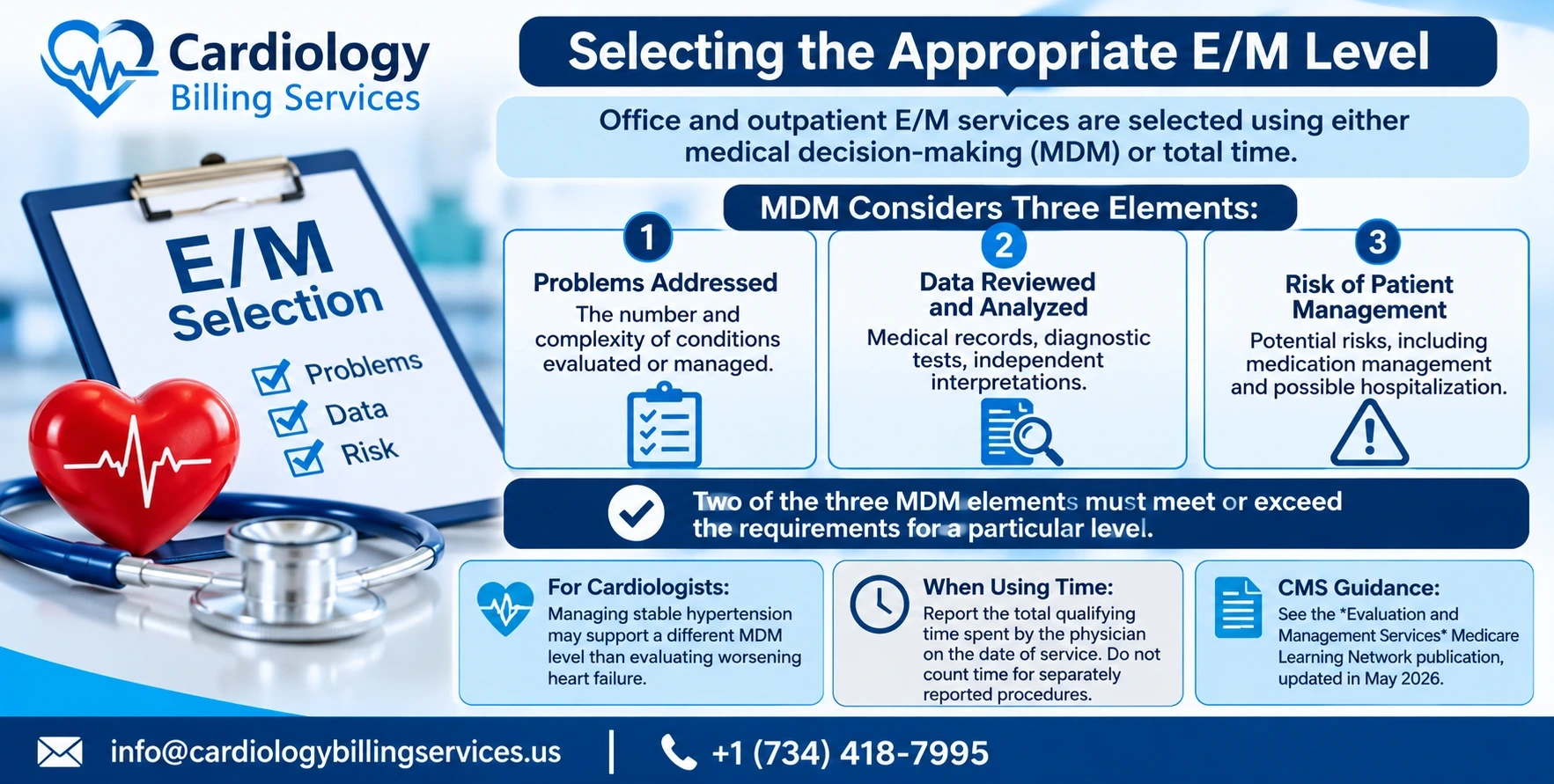
Office and outpatient E/M services are selected using either medical decision-making (MDM) or total physician or qualified healthcare professional time on the date of the encounter.
MDM considers three elements:
- Problems addressed: The number and complexity of conditions evaluated or managed during the visit.
- Data reviewed and analyzed: Relevant medical records, diagnostic tests, independent interpretations, and discussions with other healthcare professionals.
- Risk of patient management: Potential risks associated with treatment decisions, including prescription medication management and decisions regarding hospitalization.
Two of the three MDM elements must meet or exceed the requirements for a particular level.
For cardiologists, the distinction can be important. Managing stable hypertension with an established treatment plan may support a different MDM level than evaluating worsening heart failure, reviewing multiple diagnostic studies, and changing prescription medications.
When selecting a code based on time, report the total qualifying time spent by the physician or other qualified healthcare professional on the date of service. Time associated with separately reported procedures must not be counted toward the E/M service.
CMS provides additional guidance in its Evaluation and Management Services Medicare Learning Network publication, updated in May 2026.
How to Report Cardiology Office Visits With Same-Day Procedures
Cardiology appointments frequently involve multiple services. An office visit may occur on the same day as an ECG, echocardiogram, stress test, or other diagnostic procedure.
The billing team must determine whether the E/M service represents separately identifiable professional work or whether the evaluation was simply part of the procedure.
For example, a cardiologist may examine a patient with worsening shortness of breath, review the patient’s cardiac history, assess medication effectiveness, and develop a new treatment plan. The physician may also perform or order a diagnostic cardiac service during that encounter.
If the office evaluation meets the applicable E/M requirements and is separately identifiable, the practice may report both services when permitted by payer policy.
The documentation must support each reported service.
Common cardiology services reported with office E/M codes
| Cardiology service | Common CPT code examples |
|---|---|
| Office E/M visit | 99202–99205, 99211–99215 |
| Electrocardiogram, routine ECG | 93000 |
| ECG tracing only | 93005 |
| ECG interpretation and report only | 93010 |
| Complete transthoracic echocardiogram | 93306 |
| Exercise cardiovascular stress test | 93015 |
| Stress test supervision only | 93016 |
| Stress test tracing only | 93017 |
| Stress test interpretation and report | 93018 |
These codes describe different services and components. The practice must verify the actual service performed, applicable code descriptors, component billing rules, and current NCCI edits before submitting a claim.
For instance, CPT 93000 represents a complete routine ECG service, including tracing, interpretation, and report. When different entities perform the technical and professional components, the applicable component codes may be appropriate instead.
Modifier 25: Reporting a Significant, Separately Identifiable E/M Service
Modifier 25 is one of the most frequently reviewed modifiers in same-day E/M and procedure billing.
According to the Centers for Medicare & Medicaid Services (CMS), modifier 25 identifies a significant, separately identifiable E/M service performed by the same physician or qualified healthcare professional on the same date as another procedure or service.
The modifier must be appended to the E/M code, not the procedure code.
The additional E/M service must involve work beyond the usual evaluation associated with the procedure. A separate diagnosis is not mandatory.
When should cardiology practices use modifier 25?
Consider a patient scheduled for an ECG because of a history of arrhythmia. During the appointment, the patient also reports increased palpitations and episodes of dizziness.
The cardiologist performs an additional assessment, reviews medication adherence, evaluates the symptoms, examines relevant cardiac findings, and changes the treatment plan.
The ECG addresses the diagnostic testing requirement, while the additional office evaluation involves separate medical decision-making.
If the documentation supports the applicable E/M level, the practice may report the office visit with modifier 25 alongside the appropriate ECG code.
For example:
- CPT 99214-25: Established patient office visit, when supported by the documented service.
- CPT 93000: Complete routine ECG, when all required components are performed.
The actual E/M level must be determined from the documented MDM or qualifying time. The example does not establish that every similar encounter supports 99214.
When should modifier 25 not be used?
Modifier 25 should not be appended automatically whenever a procedure and office visit appear on the same claim.
It is generally inappropriate when:
- The physician performs only the routine assessment associated with the procedure.
- The documentation does not establish a significant, separately identifiable E/M service.
- The reported office visit duplicates work already included in the procedure.
- The physician reports an E/M code without supporting medical necessity.
- The E/M service does not meet the requirements of the reported code.
The American Medical Association (AMA), in its August 17, 2023 article, Setting the Record Straight on Proper Use of Modifier 25, explains that the modifier identifies a distinct E/M service supported by the medical record. The article also discusses payer practices that may reduce or deny payment for separately reported services.
Medical Documentation Requirements for Same-Day Billing
Documentation determines whether a cardiology practice can support separate reporting of an office visit and a procedure.
A claim containing modifier 25 should have sufficient clinical information to establish the medical necessity and separate nature of the E/M service.
Cardiologists and their documentation teams should address the following areas:
Reason for the encounter: Record why the patient required evaluation. Document new symptoms, changes in existing cardiac conditions, or concerns requiring additional assessment.
Clinical assessment: Include relevant examination findings, medical history, diagnostic information, and the conditions addressed during the visit.
Medical decision-making: Explain the physician’s decisions, including medication changes, additional testing, referrals, or treatment adjustments.
Procedure documentation: Maintain the appropriate technical and professional documentation for the separately reported procedure.
Treatment plan: Record follow-up instructions, medication management, additional investigations, and recommendations based on the patient’s condition.
For example, a note stating only that an ECG was performed and reviewed may not establish a separately identifiable E/M service. Additional documentation should explain the independent evaluation and management work performed during the encounter.
CMS’s Medicare Claims Processing Manual, Chapter 12, Section 30.6.6, requires sufficient documentation of both the medically necessary E/M service and the procedure. The documentation does not generally need to accompany the original claim, but the practice must retain it for review.
Understanding NCCI Edits and Global Surgery Rules
The National Correct Coding Initiative helps prevent improper payment for services that should not be separately reported under applicable coding rules.
CMS updates its Medicare NCCI Policy Manual annually. The 2026 edition became effective January 1, 2026.
Cardiology billing teams should review procedure-to-procedure (PTP) edits before submitting claims containing multiple services for the same patient on the same date.
An NCCI edit does not automatically mean that two services can never be reported together. Certain code pairs permit an appropriate modifier when the clinical circumstances satisfy the applicable requirements. Other edits do not permit a modifier to bypass the restriction.
Modifier 25 and other NCCI-associated modifiers have different purposes. Modifier 25 identifies a separately identifiable E/M service, while modifiers such as 59 and XE, XP, XS, and XU address distinct procedural services under applicable circumstances.
The appropriate modifier depends on the service and the specific coding rule.
Minor procedures and global periods
Some cardiology procedures have global surgery periods. Under Medicare policy, the payment for a procedure may include routine preoperative and postoperative services.
A separate E/M service on the same day as a minor procedure may qualify for additional payment when the physician performs significant, separately identifiable work beyond the usual procedural care.
Modifier 25 identifies the additional E/M service when its requirements are met.
Practices should also distinguish modifier 25 from modifier 57. Modifier 57 identifies an E/M service that results in the initial decision to perform major surgery. Modifier 25 generally applies to separately identifiable E/M services performed on the same day as another procedure or service.
CMS explains these requirements in its Global Surgery Medicare Learning Network booklet.
Medicare G2211 and Cardiology E/M Billing
Cardiology practices that manage patients with chronic conditions should also understand HCPCS add-on code G2211.
G2211 represents the additional complexity associated with an ongoing relationship between a practitioner and a patient. It may apply when the practitioner serves as the continuing focal point for the patient’s care or provides ongoing care for a serious or complex condition.
For example, a cardiologist managing a patient with chronic heart failure may provide ongoing treatment, coordinate care, and make decisions that account for the patient’s continuing cardiac needs.
The code does not apply automatically to every office visit or every patient with a cardiovascular diagnosis. The nature of the practitioner-patient relationship must support its use.
Medicare generally does not pay G2211 when the associated office E/M code is reported with modifier 25 on the same date by the same practitioner.
However, CMS established an exception effective January 1, 2025. Payment may be allowed when the qualifying E/M service with modifier 25 occurs on the same day as an annual wellness visit, vaccine administration, or an eligible Medicare Part B preventive service.
Cardiology practices should check the applicable CMS requirements before reporting G2211 with another service.
Common Cardiology E/M Billing Errors and How to Prevent Them
Even experienced billing teams encounter problems when reporting multiple services on the same date.
Several recurring errors deserve attention.
Automatically adding modifier 25: Applying the modifier to every office visit performed with an ECG or echocardiogram can result in unsupported claims. Review the physician’s documentation before assigning it.
Selecting an incorrect E/M level: Choosing 99214 or 99215 based on the patient’s diagnosis alone does not establish the correct code. Evaluate MDM or qualifying time.
Counting procedure time toward E/M time: Time spent performing separately billed procedures must not be included in the E/M time calculation.
Ignoring NCCI edits: Failure to review applicable PTP edits can result in preventable claim rejections or denials.
Reporting incomplete procedure components: Verify whether the physician performed the complete diagnostic service or only its professional or technical component.
Insufficient documentation: Notes that contain a procedure result but do not explain the additional evaluation may fail to support separate E/M reporting.
A practical billing review should compare the physician’s note, procedure report, selected CPT codes, modifiers, diagnosis pointers, and applicable payer requirements before claim submission.
Conclusion
Accurate cardiology E/M billing requires careful code selection, clear documentation, and an understanding of same-day procedure rules. Office visits may be reported alongside cardiac diagnostic services when the physician performs a medically necessary, significant, and separately identifiable E/M service.
Modifier 25 supports that reporting when its requirements are met. NCCI edits, global surgery rules, and Medicare G2211 policies also affect claim processing.
Cardiology practices should establish a consistent review process for office visits and same-day procedures. Matching the reported codes to the physician’s actual work helps reduce avoidable denials and supports accurate reimbursement.