Is EEG billing considered cardiology billing? A guide for medical practices

Is EEG billing considered cardiology billing? A guide for medical practices
Is EEG billing considered cardiology billing? No. Electroencephalography (EEG) measures electrical activity in the brain and belongs to neurological diagnostic testing. Electrocardiography (ECG or EKG) records electrical activity in the heart. The similar abbreviations describe different tests with different billing requirements.
The distinction becomes less obvious when a cardiologist evaluates a patient with unexplained loss of consciousness or a multispecialty group provides both services. An EEG may contribute to that patient’s evaluation, but the referring specialty does not change the procedure performed.
For billing teams, three questions deserve separate answers: What test was performed? Who provided each component? Does the service meet the applicable payer’s coverage and qualification requirements?
Why is EEG billing considered cardiology billing by some practices?
The confusion often begins with terminology. EEG and EKG differ by one letter, and both involve electrodes and electrical recordings. However, their clinical purposes and procedure codes are separate.
A second source of confusion is the referral pathway. Patients with transient loss of consciousness may undergo assessment for cardiac and neurological causes. First Coast Service Options’ Special EEG Tests LCD, L34521, revised effective January 8, 2019, recognizes selected uses of ambulatory EEG to distinguish neurological from cardiac problems. That clinical overlap does not turn an EEG into a cardiac test.
A useful administrative approach is to separate the practice’s department label from the claim’s coding requirements. A cardiology billing team can process an EEG claim, provided it understands the applicable neurodiagnostic rules. Its department name does not determine the correct CPT code.
EEG versus ECG: What changes on the claim?
The following comparison uses abbreviated descriptions for orientation. Code selection still requires the current CPT instructions and the complete procedure report.
| Feature | EEG | ECG/EKG |
|---|---|---|
| Electrical activity recorded | Brain activity | Heart activity |
| Clinical focus | Neurological assessment, including seizure evaluation | Cardiac assessment, including rhythm evaluation |
| Examples of routine codes | 95816 and 95819 | 93000, 93005 and 93010 |
| Details affecting selection | Recorded patient state, recording duration and study type | Whether the service includes tracing, interpretation or both |
| Extended testing | Long-term EEG has separate coding requirements | Ambulatory cardiac monitoring uses other procedure codes |
CMS identifies 95816 with awake and drowsy EEG recording and 95819 with awake and asleep recording. For routine ECG services, 93000 represents the complete service, 93005 the tracing, and 93010 interpretation and report. These code families are not interchangeable.
Consider a hypothetical order entered as “EKG” while the attached report describes scalp electrodes and brain-wave interpretation. The billing team should resolve the discrepancy with the clinical team before submitting a claim. Selecting a code from the appointment label alone would bypass the evidence of what actually occurred.
Which EEG coding details should billers review?
Routine EEG requires attention to the recorded states
For routine EEG, review whether the report documents wakefulness, drowsiness or sleep. The distinction between 95816 and 95819 depends on what was recorded, so a scheduling instruction requesting sleep does not establish that sleep occurred.
Make the final report the starting point for code review. If its description conflicts with the charge entry, return the discrepancy for clarification rather than assuming that a preselected charge is correct.
Long-term EEG uses a different structure
The American Academy of Neurology’s Long-term EEG Monitoring FAQs, addressing the coding changes effective January 1, 2020, explains that long-term EEG separates technical and professional services through distinct codes. Recording duration and the services provided affect selection.
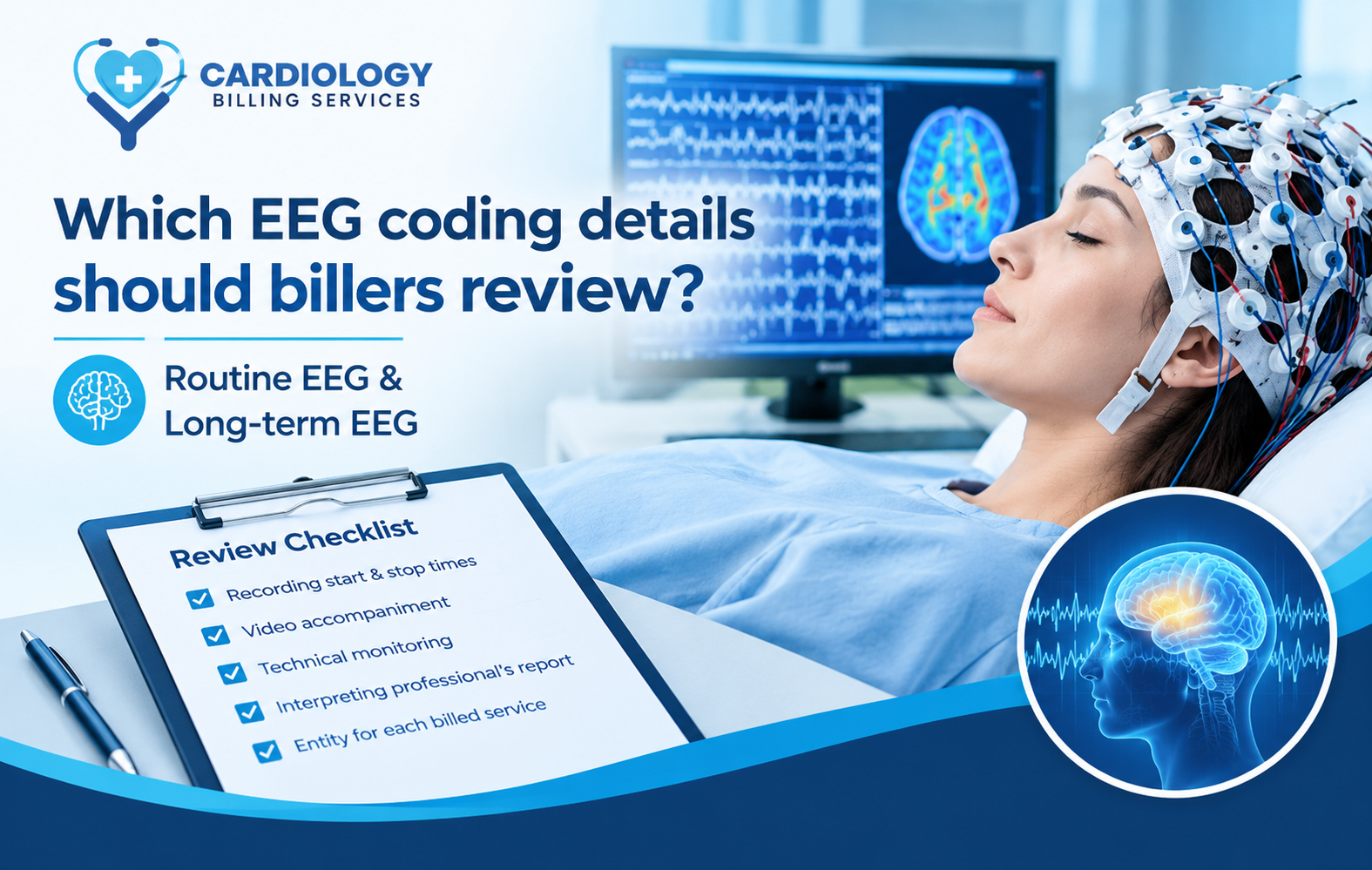
For these studies, create a review checklist that captures:
- Recording start and stop times.
- Whether video accompanied the recording.
- The technical monitoring provided.
- The interpreting professional’s report.
- The entity responsible for each billed service.
Do not carry a routine EEG billing template into long-term monitoring without checking its logic. A template that automatically appends component modifiers may conflict with codes that already identify the component.
The American Academy of Pediatrics’ February 2020 Pediatric Coding Newsletter also documented the introduction of the long-term EEG family and deletion of several older monitoring codes. Older charge sheets therefore warrant review before reuse.
Can a cardiology practice bill for an EEG?
A cardiology practice should not assume that its specialty enrollment authorizes every EEG service. Review the qualifications, supervision, enrollment and billing arrangements applicable to the test and setting.
For example, First Coast’s L34521 requires relevant physician training and experience. It also specifies that EEG services performed in an independent diagnostic testing facility require a board-certified neurologist as supervising physician and designated technologist credentials. These are requirements within that contractor’s policy, not a universal statement that every EEG must follow the same staffing arrangement.
Before adding EEG services, obtain answers to practical questions:
- Does the payer recognize the proposed rendering and interpreting providers?
- What supervision applies in this setting?
- Does the service location need separate enrollment or approval?
- Which entity will bill the technical work and interpretation?
- Can the practice produce the required training and service documentation?
Ordering, performing, supervising and interpreting are different responsibilities. Identify each one before establishing the billing workflow.
Separate the technical service from interpretation
An EEG claim should reflect the component the billing entity actually provided and is entitled to bill.
For routine EEG codes eligible for component billing, modifier 26 identifies professional interpretation, while TC identifies the technical component. Long-term EEG uses distinct component codes, so the same modifier approach should not be applied automatically. The AAN’s guidance explains this structural difference.
As a hypothetical example, an outside diagnostic company records a study and a separately billing physician interprets it. Reconcile their responsibilities before releasing charges. Ask whether either party has already submitted a claim covering work included in the other party’s proposed charge.
Palmetto GBA’s Billing and Coding: Special Electroencephalography, article A56771, revised effective November 1, 2024, instructs providers to bill only the component they furnished.
A practical safeguard is to keep the technical service record and interpretation report together during charge review, even when different organizations created them.
Does fainting establish medical necessity for EEG?
A fainting complaint does not automatically justify routine EEG.
The 2017 ACC/AHA/HRS Guideline for the Evaluation and Management of Patients With Syncope, led by Win-Kuang Shen and published online March 9, 2017, advises against routine EEG in syncope evaluation when specific neurological features suggesting seizure are absent.
That recommendation has a direct documentation implication: an EEG order should explain the neurological concern being investigated. A brief reference to “fainting” may leave a reviewer unable to understand why the clinician selected this test.
There are exceptions to the routine-testing recommendation. The same guideline states that simultaneous EEG and hemodynamic monitoring during tilt-table testing can help distinguish syncope, pseudosyncope and epilepsy in selected circumstances. This clinical recommendation does not independently establish separate reimbursement for every component.
For a hypothetical patient whose clinician documents episodes concerning for seizure, review the documented findings and the applicable EEG coverage policy. Avoid inferring epilepsy from the decision to order the study.
Choose diagnosis codes from the documented findings
A suspected outpatient diagnosis should not be reported as confirmed.
The CMS and National Center for Health Statistics FY 2027 ICD-10-CM Official Guidelines for Coding and Reporting, effective October 1, 2026, direct outpatient coding to the highest degree of certainty known for the encounter. Diagnoses documented as probable, suspected or rule-out are not coded as established conditions.
Therefore, “rule out epilepsy” on an outpatient order does not authorize an epilepsy diagnosis code. Review the documented symptoms, findings and any definitive diagnosis available under the applicable coding instructions.
A payer’s covered-diagnosis list should serve as a coverage reference. It should never become a menu for replacing the clinician’s documented reason for testing.
Check local coverage before scheduling extended studies
EEG coverage requirements can include prerequisites that are easy to miss during charge entry.
Palmetto GBA’s article A56771 requires a routine EEG before ambulatory continuous EEG. It further specifies that a routine EEG claim must have been submitted to Medicare with a service date within one year before the ambulatory study. This is a contractor-specific requirement that practices should apply only where relevant.
Build such checks into scheduling. Discovering a missing prerequisite after the extended study leaves fewer opportunities to resolve the problem.
For each payer, maintain a dated reference covering applicable authorization requirements, prior testing, covered indications, provider qualifications and documentation. Review the policy version relevant to the service date rather than assuming the latest webpage governs an older claim.
Use a focused review process for EEG denials
Organize denial review around the reason stated in the remittance or payer notice.
For a coding discrepancy, compare the submitted procedure with the report and recording details. For a component issue, reconcile the technical and professional claims. For a qualification concern, examine enrollment and credentialing records. To support medical necessity, gather the order, clinical justification, previous test results, and applicable coverage criteria.
Keep corrections tied to documented facts. Changing the specialty label or substituting a cardiac procedure code cannot correct an EEG claim that lacks supporting documentation.
Is EEG billing considered cardiology billing? EEG remains neurological diagnostic testing, even when it forms part of a cardiology patient’s evaluation. Accurate billing depends on the recorded service, appropriate provider qualifications, supported diagnoses and the payer’s applicable EEG requirements.