

CPT 92930: Complete Billing Guide, Code Description, Modifier Use, and PCI Coding in 2026

CPT 92930 is a coronary stent code that took effect on January 1, 2026. It reports stent placement, with angioplasty when performed, in a single major coronary artery when the work goes beyond a standard one-lesion stent. This indicates multiple separate lesions treated with two or more stents across two or more segments, or a bifurcation lesion addressed in both the primary vessel and the side branch. It is the more complex sibling of 92928, and it carries more physician work value.
If an older reference tells you 92930 doesn't exist or means something else, it predates the 2026 PCI restructuring. The rest of this guide covers how to select it, modify it, document it, and defend it on audit.
What Is CPT Code 92930?
CPT 92930 is a complex coronary stent code: percutaneous placement of intracoronary stent(s) in one major coronary artery and/or its branches, reserved for multi-lesion or bifurcation work. The AMA created it in the 2026 code set to recognize effort that 92928 never captured.
Before 2026, a stent in the LAD plus a stent in a diagonal meant a base code and a branch add-on. The branch add-ons, including 92929, were deleted. Branch work now rolls into one base code per major artery, and complexity is expressed through the choice of base code.
CPT 92930 Code Description
The AMA owns the official descriptor, so confirm the exact wording in your CPT 2026 Professional Edition. In plain terms, 92930 requires:
- Stent placement, with angioplasty included when performed
- One predominant coronary artery and/or its branches
- Either two or more separate lesions with two or more stents placed in two or more coronary sections, or a bifurcation lesion requiring angioplasty and/or stenting in both the primary artery and the secondary branch.
Four CPT definitions drive the choice:
- Lesion: from the proximal to the distal end of the diseased stretch. One lesion can cross several segments, or run from a major artery into its branch.
- Major arteries: left main, LAD, left circumflex, right coronary, and ramus intermedius.
- Branches: up to two each for the LAD (diagonals), circumflex (marginals), and RCA (posterior descending, posterolaterals). Left main and ramus have none.
- Segment: a portion of a major artery and/or its branches.
When CPT 92930 Is Used
It qualifies when
- Two geographically separate lesions in one artery each receive a stent, in different segments
- A bifurcation is managed using a stent in one limb and either angioplasty or a stent in the other.
- The op note describes the second lesion or side-branch treatment as an actual intervention
It does not qualify when
- Two overlapping stents address a single extensive lesion (which is 92928)
- The side branch was simply wired or safeguarded, without any treatment
- One lesion is stented and a second is only ballooned, since the descriptor calls for two or more stents. Confirm borderline cases against current CPT guidance and SCAI's coding resources.
- The work was done through a bypass graft (92937) or on a chronic total occlusion (92943/92945)
How CPT 92930 Is Billed
The professional claim for the interventionalist follows a consistent build:
- Choose one base code per major coronary artery treated, at the highest level of intervention performed.
- Append the vessel modifier for that artery.
- Link ICD-10 codes that support medical necessity for that vessel.
- List separately billable adjuncts (IVUS/OCT, FFR, lithotripsy, thrombectomy) on individual lines.
- Confirm the prior authorization and place of service.
Hospital or ASC facility billing runs on a separate claim with its own coding and payment rules. The physician claim and the facility claim must tell the same clinical story.
CPT 92930 vs Related PCI CodesimageNew vs Established Patient Context
This distinction doesn't apply to 92930. It is a procedure code, not an E/M service. What matters is whether the decision to intervene came at the same encounter as a diagnostic cath, and whether the E/M visit that led to the procedure is billed correctly on its own.
Modifier Use for CPT 92930
| Modifier | When it applies | Watch-outs |
|---|---|---|
| LM, LD, LC, RC, RI | Identifies the treated artery (left main, LAD, circumflex, RCA, ramus) | Medicare and most payers expect it. Missing or mismatched modifiers cause rejections or silent bundled payment. |
| 22 | Work substantially beyond typical 92930, such as severe calcification or extreme tortuosity | Requires a quantified description in the operative report. The length of the case by itself isn't sufficient reason. |
| 59 / XS | Truly distinct service where an edit would otherwise bundle it | Not for IVUS/OCT or FFR add-ons. Misuse looks like unbundling on audit. |
| 26 / TC | Imaging or physiology add-ons, depending on the PC/TC indicator and site of service | Check the fee schedule indicator rather than assuming. |
| 51 | Some commercial payers want it on multiple procedures | Medicare applies multiple-procedure reductions without it. |
You do not append anything to signal complexity. The code choice does that.
Documentation Requirements
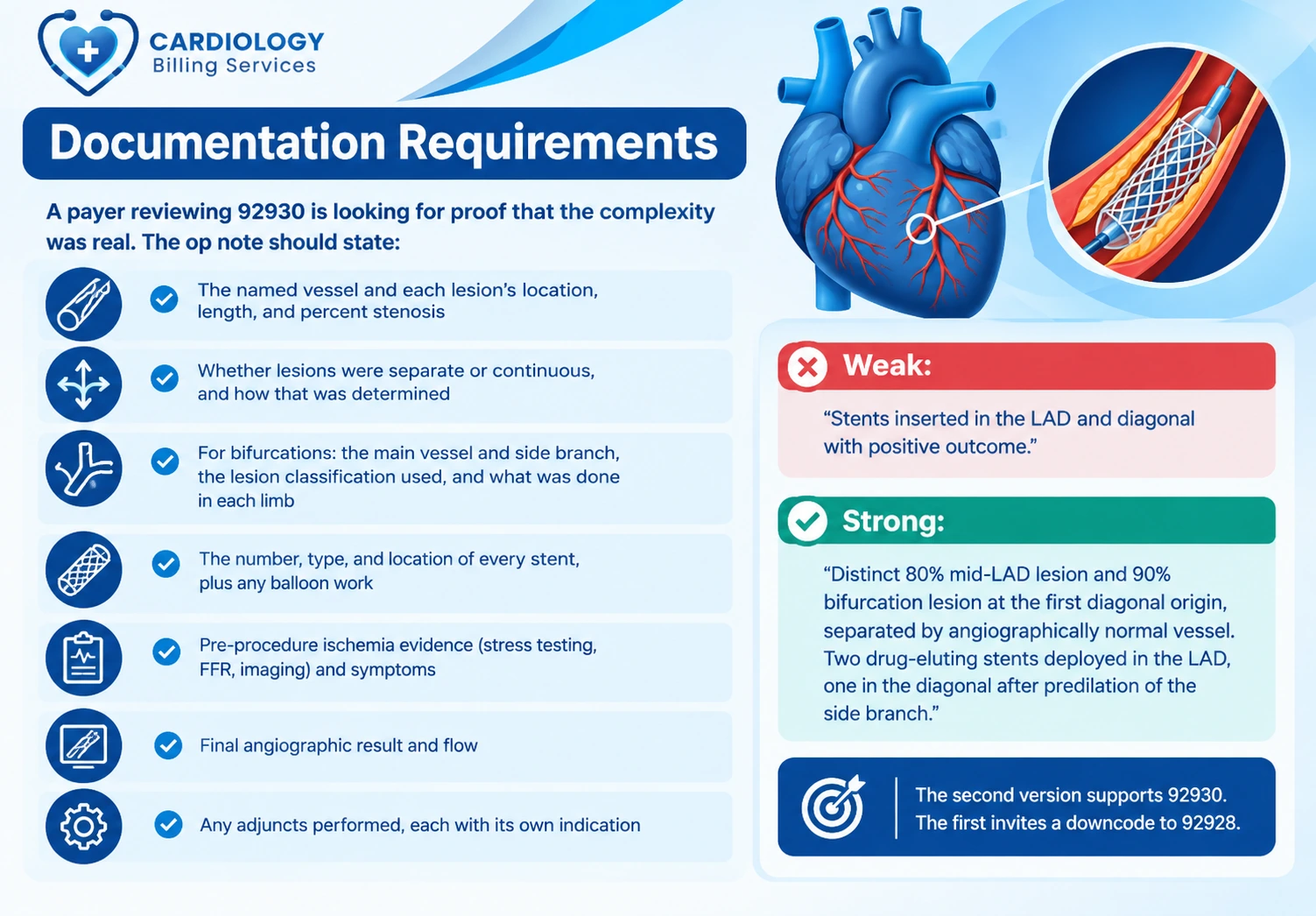
A payer reviewing 92930 is looking for proof that the complexity was real. The op note should state:
- The named vessel and each lesion's location, length, and percent stenosis
- Whether lesions were separate or continuous, and how that was determined
- For bifurcations: the main vessel and side branch, the lesion classification used, and what was done in each limb
- The number, type, and location of every stent, plus any balloon work
- Pre-procedure ischemia evidence (stress testing, FFR, imaging) and symptoms
- Final angiographic result and flow
- Any adjuncts performed, each with its own indication
Weak: "Stents inserted in the LAD and diagonal with positive outcome."
Strong: "Distinct 80% mid-LAD lesion and 90% bifurcation lesion at the first diagonal origin, separated by angiographically normal vessel. Two drug-eluting stents deployed in the LAD, one in the diagonal after predilation of the side branch."
The second version supports 92930. The first invites a downcode to 92928.
Medical Necessity
Payers measure PCI against symptom burden, ischemia evidence, and anatomy. Most lean on the ACC/AHA/SCAI revascularization guideline and appropriate use criteria, though each payer publishes its own policy.
Diagnosis coding should match the story: I25.10 or I25.110 for coronary artery disease with or without angina, I21.4 for NSTEMI, and so on. For elective cases, the note should show failed medical therapy or a high-risk anatomical or functional finding. Link diagnoses to the procedure line rather than just the encounter.
Common Billing Mistakes and Denials
| Problem | What happens | Fix |
|---|---|---|
| Billing 92930 for overlapping stents in one lesion | Downcode or recoupment on audit | Code on lesion separation, not stent count |
| Side branch only wired | Payer reverses to 92928 | Require documentation of treatment, not protection |
| Missing or wrong vessel modifier (CO-4) | Rejection or reduced payment | Hard-stop edit in charge entry |
| Diagnostic cath billed on the same vessel (CO-97) | Bundled denial | Bill only when the intervention decision followed a separate diagnostic need |
| No authorization on elective case (CO-197) | Full denial | Verify before scheduling |
| Diagnosis doesn't support the intervention (CO-11, CO-50) | Medical necessity denial | Link ischemia evidence and symptoms |
| Billing 92928 or 92930 for graft work | Wrong base code | Use 92937 for graft intervention |
| Payer fee schedule hasn't loaded 92930 | Zero pay or manual review | Track new-code handling by payer |
Medicare Billing Considerations
Traditional Medicare covers medically necessary PCI and generally doesn't require prior authorization for it, though your MAC's local coverage articles may add documentation expectations. Medicare Advantage plans often behave more like commercial payers.
Published 2026 coding resources list 92930 at roughly 12.00 work RVUs versus 9.75 for 92928, about 20% more. Verify current values on the Medicare Physician Fee Schedule, because the 2026 efficiency adjustment trims work RVUs for many procedures and the final payment depends on your locality. Expect multiple-procedure reductions when you treat more than one artery in a session.
Commercial Insurance Considerations
Policies change by payer and plan year. Treat this table as a starting point and confirm with each payer's current policy.
Examples of Correct Coding
- Bifurcation, both limbs treated: Stent in the proximal LAD, balloon and stent at the diagonal origin, one distinct bifurcation lesion. Report 92930-LD.
- Two separate lesions: Mid-LAD and distal LAD stented, with normal vessel between them. Report 92930-LD.
- One long lesion, two overlapping stents: Report 92928-LD.
- Multi-vessel: Complex LAD bifurcation plus a single RCA stent. Report 92930-LD and 92928-RC.
- Graft: Stent in a saphenous vein graft to the obtuse marginal. Report 92937 with the appropriate vessel modifier.
Real Practice Scenarios
The cath lab that undercoded. A group stented a mid and distal circumflex lesion with a clean gap between them, but the charge sheet said "two stents, LCx." Billing defaulted to 92928. The op note supported 92930-LC. A weekly op-note-to-charge reconciliation turned this up, and they refiled where timely filing allowed.
The practice that overcoded. An operator placed two overlapping stents for a long RCA lesion and the biller assumed "two stents means complex." A commercial payer's retrospective review downcoded the claim to 92928-RC and requested a refund. The lesson is to make the coder, not the charge capture template, decide.
The authorization miss. An elective multi-lesion PCI was scheduled from a diagnostic cath result, and the authorization listed 92928. The final procedure was 92930. Some payers expect the authorization to cover the billed code, so sometimes it needs updating before or immediately after the procedure.
Coding Tips for Better Reimbursement
- Build an op-note template with fields for lesion separation, bifurcation treatment, and stent count per segment
- Have coders review PCI charges before claim release for the first several months of any new code set
- Track 92928-to-92930 ratios by operator; outliers in either direction deserve a look
- Keep an audit file for every 92930 claim with angiographic images and the op note
- Check that your PM system and clearinghouse accept the code and the vessel modifiers
- Review remittances for silent downcodes, not only denials
Compliance Checklist
- Op note supports distinct lesions or bifurcation treatment
- One base code per major artery territory
- Vessel modifier matches the documented artery
- No bundled diagnostic cath on the same vessel
- Adjunct codes separately supported and linked
- Prior authorization matches the billed code
- Diagnosis codes support medical necessity
- Modifier 22 explanation documented, if used
- Facility and professional claims consistent
How Professional Cardiology Billing Services Help
New PCI codes strain a practice's workflow in three places: charge capture, payer edits, and audit exposure. A specialty team can help at each point. Cardiology billing services coders compare op notes against the charge before the claim leaves, which catches the 92928/92930 mismatches described above. Medical coding review adds a second pair of eyes on modifiers and bundling.
Upstream, eligibility verification and prior authorization support keep elective cases from reaching the cath lab without coverage confirmed. Downstream, denial management and AR follow-up work the underpayments and appeals, while accurate payment posting exposes downcodes that never produce a denial notice.
New interventionalists also depend on clean credentialing services before PCI claims can pay. All of this sits inside a broader revenue cycle management process, and your practice's wider medical billing services should be built around it.
Future Billing Considerations for 2026
Watch the payers still processing new-code configurations, and review your first-year 92930 remittances for patterns. As 2027 approaches, expect the CMS final Physician Fee Schedule rule and the next CPT release to bring further changes. Compare your 2026 data now so you can see which edits and policies actually affected you.
Key Takeaways
- 92930 is new in 2026 and covers complex single-artery stenting
- It requires two or more lesions with two or more stents, or a bifurcation treated in both limbs
- Overlapping stents in one lesion remain 92928
- Use one base code per major artery, with the vessel modifier
- Documentation of lesion separation and side-branch treatment decides the claim
- Payer policies on authorization and review differ
Frequently Asked Questions
The fundamental codes are 92920, 92924, 92928, 92930, 92933, 92937, 92941, 92943, and 92945. Common add-ons include 92972, 92973, 92974, 92978/92979, and 93571/93572. The "each additional branch" add-ons were deleted.
Reporting complex coronary stenting in one major artery: multiple distinct stented lesions or a bifurcation treated in both limbs.
It requires the coronary vessel modifier (LM, LD, LC, RC, or RI) with most payers. Others, such as 22, apply only in specific situations.
Named vessel, lesion locations and separation, stent details, side-branch treatment, ischemia evidence, and final result.
Medicare covers medically necessary PCI. Confirm current pricing and your MAC's documentation expectations.
Missing vessel modifiers, overlapping stents billed as complex, side-branch wiring counted as treatment, and absent authorization.
It sits above 92928 in complexity within the stent family. Graft, CTO, and acute MI work have their own codes.
Only when the note supports the descriptor's lesion, stent, and bifurcation requirements.
No. Report one base code per major artery, at the highest level performed.
Pair a structured op-note template with coder review before submission and authorization checks beforehand.
Yes, when separately documented and indicated, using their own codes, without unbundling modifiers.
They reconcile documentation to charges, manage authorizations, and work underpayments and appeals.
Conclusion
92930 rewards accurate documentation. When the op note shows what the operator actually did, the right code follows easily. When it doesn't, you either leave revenue behind or invite a refund request. Practices that tie documentation, coding, and payer follow-up together handle this well. For a fresh perspective on your 2026 PCI claims, reach out to us.




