Tachycardia ICD-10: Complete Coding Guide for Documentation, Billing and Denial Prevention (2026)

A heart rate over 100 at rest can land on a claim in at least seven different ICD-10-CM codes. Pick the wrong one and the claim either underpays, fails an edit, or invites a medical necessity denial on the ECG, Holter, or event monitor that followed.
This guide covers tachycardia ICD-10 coding as it stands under the FY2027 code set, which took effect on October 1, 2026 and runs through September 30, 2027. It is written for coders, billers, CDI staff, and the clinicians whose notes they work from. Most tachycardia coding errors start in the note, so documentation gets as much space here as code selection.
The Tachycardia ICD-10 Code Map
Tachycardia codes sit in three chapters. Symptom codes live in Chapter 18, defined arrhythmias in Chapter 9, and two named syndromes in the neonatal and nervous system chapters. The category headers I47, I47.1, and I47.2 are not billable; a claim needs one of the codes below.
| Code | Description | Use It When the Note Says |
|---|---|---|
| R00.0 | Tachycardia, unspecified | "Tachycardia," "rapid heart beat," or "sinus tachycardia" with no further qualifier |
| I47.10 | Supraventricular tachycardia, unspecified | "SVT" without a mechanism |
| I47.11 | Inappropriate sinus tachycardia, so stated | "Inappropriate sinus tachycardia" or "IST" in those words |
| I47.19 | Other supraventricular tachycardia | AVNRT, AVRT, atrial, junctional, or nodal tachycardia |
| I47.0 | Re-entry ventricular arrhythmia | Ventricular re-entry rhythm |
| I47.20 | Ventricular tachycardia, unspecified | "VT" or "V-tach" without a type |
| I47.21 | Torsades de pointes | Torsades, so named |
| I47.29 | Other ventricular tachycardia | A specified VT type other than torsades |
| I47.9 | Paroxysmal tachycardia, unspecified | Paroxysmal tachycardia with no origin named; also Bouveret-Hoffmann syndrome |
| G90.A | Postural orthostatic tachycardia syndrome [POTS] | POTS or postural tachycardia syndrome |
| P29.11 | Neonatal tachycardia | Tachycardia in a newborn |
The fifth-character SVT and VT codes are recent. The VT expansion (I47.20, I47.21, I47.29) took effect October 1, 2022, as reported in AHA Coding Clinic, Fourth Quarter 2022. The SVT split into I47.10, I47.11, and I47.19 followed on October 1, 2023, per Coding Clinic, Fourth Quarter 2023. POTS received G90.A on October 1, 2022; before that date it was often reported with I49.8, other specified cardiac arrhythmias. Older superbills and EHR favorites lists still carry the retired four-character codes I47.1 and I47.2, and claims built from them reject as invalid.
When R00.0 Is Correct, and When It Is Not
R00.0 is a symptom code. Section I.B.4 of the ICD-10-CM Official Guidelines allows symptom codes when the provider has not established a related definitive diagnosis, so R00.0 is legitimate for an urgent care visit where the patient is tachycardic and the cause is still under workup.
Three Excludes1 notes under R00.0 block it from appearing with I47.- (paroxysmal tachycardia), I47.11 (inappropriate sinus tachycardia), or P29.11 (neonatal tachycardia). The parent category R00 adds an Excludes2 for specified arrhythmias in I47 through I49. In practice, once a rhythm is named, R00.0 comes off the claim.
A quieter error is reporting R00.0 next to the condition that explains it. Section I.B.5 says signs and symptoms routinely associated with a disease process are not coded separately unless the classification instructs otherwise. Tachycardia in a febrile, dehydrated patient or a patient with documented hyperthyroidism is often part of that picture. Whether the heart rate is integral is a clinical call, so a query beats a guess when the note is unclear.
Setting changes the answer too. In outpatient encounters, Section IV.H bars coding "probable," "suspected," or "rule out" diagnoses, so "palpitations, rule out SVT" is coded as R00.2 (palpitations) or R00.0, never I47.10. Inpatient coders follow Section II.H instead, which lets an uncertain diagnosis documented at discharge be coded as if confirmed.
Choosing Among the I47 Subcodes
Supraventricular Tachycardia
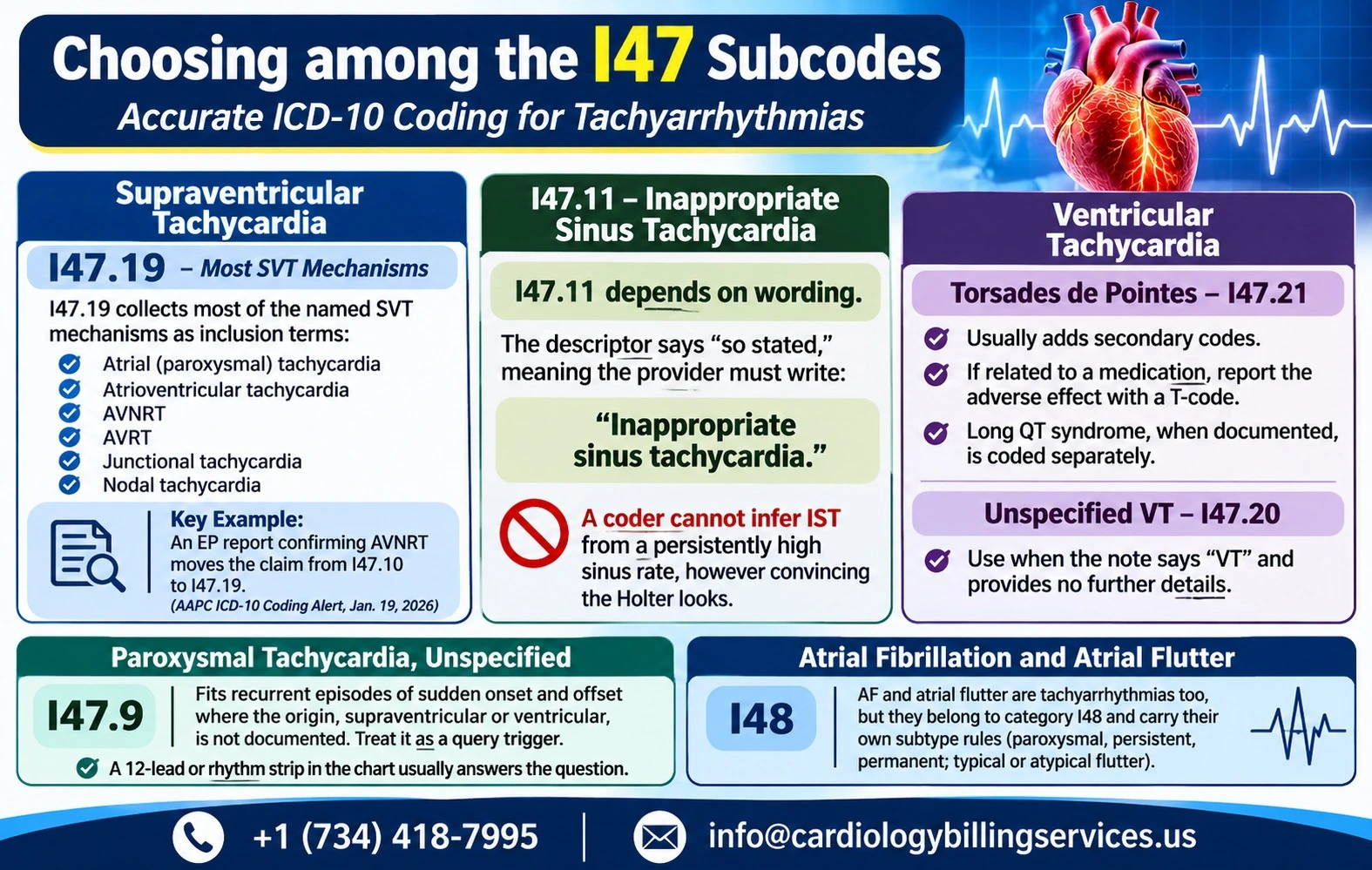
I47.19 collects most of the named SVT mechanisms as inclusion terms: atrial (paroxysmal) tachycardia, atrioventricular tachycardia, AVNRT, AVRT, junctional tachycardia, and nodal tachycardia. An electrophysiology report that confirms AVNRT moves the claim from I47.10 to I47.19. AAPC's ICD-10 Coding Alert (Suzanne Burmeister, January 19, 2026) uses that exact scenario as its SVT example.
I47.11 depends on wording. The descriptor says "so stated," meaning the provider must write "inappropriate sinus tachycardia." A coder cannot infer IST from a persistently high sinus rate, however convincing the Holter looks.
Ventricular Tachycardia
Torsades de pointes has its own code, I47.21, and the clinical context usually adds secondary codes. When the note ties torsades to a medication, the adverse effect is reported with a T-code from the drug table; long QT syndrome, when documented, is coded separately as well. Unspecified VT (I47.20) is a fallback for notes that say "VT" and stop there.
Paroxysmal Tachycardia, Unspecified
I47.9 fits recurrent episodes of sudden onset and offset where the origin, supraventricular or ventricular, is not documented. Treat it as a query trigger. A 12-lead or rhythm strip in the chart usually answers the question.
Atrial fibrillation and atrial flutter are tachyarrhythmias too, but they belong to category I48 and carry their own subtype rules (paroxysmal, persistent, permanent; typical or atypical flutter).
What Providers Need to Document
Coders can only report what the note supports. For tachycardia, five elements decide the code:
- Origin of the rhythm. Sinus, supraventricular, or ventricular. Without it, the choice collapses to R00.0, I47.9, or an unspecified fifth character.
- Mechanism or type. AVNRT, AVRT, atrial tachycardia, torsades, monomorphic VT. One phrase moves I47.10 to I47.19.
- Pattern. Paroxysmal or sustained, and how often episodes occur.
- Supporting findings. Rate, the ECG or monitor interpretation, and who read it. A diagnosis with no tracing behind it is weak under audit.
- Cause and link. "Sinus tachycardia due to hypovolemia" or "torsades secondary to methadone" tells the coder what to sequence and whether the rate is integral to another condition.
POTS has its own documentation bar. Dysautonomia International's provider letter on G90.A describes the diagnostic criterion as a sustained heart rate rise of at least 30 bpm within 10 minutes of standing or head-up tilt. Orthostatic vitals or a tilt-table result in the chart make G90.A defensible.
When a patient with VT has an implanted defibrillator, add Z95.810 (presence of automatic implantable cardiac defibrillator) so payers see the full clinical picture.
How Code Choice Affects Payment
Inpatient grouping. As a principal diagnosis, R00.0 and the I47 codes group to MS-DRGs 308 through 310, cardiac arrhythmia and conduction disorders, so specificity does not change the base DRG family. It matters more as a secondary diagnosis: I47.10 and I47.19 are designated complications or comorbidities (CCs), which can move a stay from DRG 310 to 309.
Risk adjustment. The split between SVT and VT is sharpest here. Under the CMS-HCC V28 model used for Medicare Advantage in payment year 2026, HCC 238 (specified heart arrhythmias) includes I47.0, I47.20, I47.21, I47.29, and I47.9, with a community, non-dual, aged relative factor of 0.299. The SVT codes I47.10 and I47.19 mapped to HCC 96 in the older V24 model but do not map in V28. R00.0 and G90.A map to no HCC in any current model.
That gap creates audit exposure in both directions. Reporting VT on a patient whose chart shows only SVT inflates risk scores, which is the pattern RADV audits target. Defaulting a documented VT to R00.0 understates the patient's risk.
FY2027 status. CMS finalized the FY2027 update in the IPPS final rule released August 1, 2026: 190 new codes, 30 deletions, and four revised titles. AAPC's count of 238 additions includes 48 new non-billable headers, which explains the different figures in trade coverage. The summaries reviewed for this guide, including AGS Health's August 4, 2026 analysis, place the cardiology changes in cardiomyopathy (I42.0 split into I42.00, I42.01, and I42.09) and the hypertensive crisis guideline, not in R00 or I47. Confirm against the CMS addenda before updating charge masters.
Preventing Tachycardia Claim Denials
Most rejections and recoupments on tachycardia claims trace back to five causes.
| Denial Trigger | What Happened | Fix |
|---|---|---|
| Invalid code | I47.1 or I47.2 submitted as a four-character code | Update templates to I47.10-I47.19 and I47.20-I47.29 |
| Excludes1 conflict | R00.0 billed with an I47 code on the same claim | Drop R00.0 once the rhythm is named |
| Medical necessity mismatch | A Holter (93224-93227), patch monitor (93241-93248), or event monitor (93268-93272) billed with a diagnosis the payer policy does not list | Link the test to the symptom that prompted it (R00.0, R00.2, R55) or the confirmed arrhythmia |
| Unsupported specificity | VT or SVT on the claim, no ECG interpretation in the record | Keep the tracing or monitor report with the note |
| Uncertain diagnosis coded | "Rule out SVT" coded as I47.10 on an outpatient claim | Code the presenting symptom per Section IV.H |
A common outpatient sequence shows how these fit together. A patient reports palpitations and a resting rate of 128. The first visit is coded R00.0 and R00.2, and a 14-day patch monitor is ordered. The monitor report shows AVNRT, which the cardiologist confirms. From that visit forward the claim carries I47.19, and R00.0 is dropped. If the patient later undergoes ablation, the post-procedure visits reflect what the note says about recurrence, not the historical diagnosis.
One exception is worth knowing. Guideline I.A.12.a permits two Excludes1 codes together when the conditions are unrelated, though tachycardia rarely qualifies because the rhythm and the rate are usually the same finding. A short query template asking "origin, mechanism, and supporting tracing?" resolves most of these cases before the claim leaves.
Summary for Coders and Providers
Tachycardia ICD-10 coding in 2026 comes down to one question: has the provider named the rhythm? If not, R00.0 is correct and defensible. If so, the I47 fifth-character codes apply, R00.0 leaves the claim, and the choice between SVT and VT carries real weight, since only the VT and unspecified paroxysmal codes map to HCC 238 under V28. Documenting origin, mechanism, and the tracing that proves them closes most of the gap between what happened clinically and what gets paid.