Bradycardia ICD-10: Complete Coding Guide for Sinus Bradycardia, Symptomatic Bradycardia, and Documentation Accuracy (2026)

A slow heart rate shows up on thousands of ECG strips every day, and most of those findings never need more than a single diagnosis code. The trouble starts when the chart says "symptomatic bradycardia," the patient is on metoprolol, and a pacemaker is on the schedule. At that point the bradycardia ICD-10 code you choose decides whether the claim matches the clinical story, whether the procedure meets Medicare coverage rules, and whether an auditor will agree with you two years later.
This guide covers the code set in effect for dates of service from October 1, 2026 through September 30, 2027, with notes on what carried over from FY 2026.
What ICD-10-CM code is used for bradycardia?
The default code is R00.1, Bradycardia, unspecified. It is billable, it has been in the code set since ICD-10-CM went live on October 1, 2015, and its title and notes did not change in the FY 2027 release.
The title misleads people. "Unspecified" suggests the provider failed to say what kind of bradycardia was present, yet the Tabular List places four specific terms under R00.1: sinoatrial bradycardia, sinus bradycardia, slow heart beat and vagal bradycardia.
So a cardiologist who documents "sinus bradycardia, rate 48" has given you a fully codable diagnosis, and R00.1 is the correct answer. There is no separate code for sinus bradycardia.
Two instructional notes travel with the code. The Excludes1 note at R00.1 bars neonatal bradycardia (P29.12), and the category-level Excludes1 at R00 bars abnormalities originating in the perinatal period (P29.1-). An Excludes2 note at R00 points to specified arrhythmias in I47 through I49. On the inpatient side, R00.1 as principal diagnosis groups to MS-DRGs 308 through 310 (cardiac arrhythmia and conduction disorders).
Why sinus bradycardia sits in the symptoms chapter
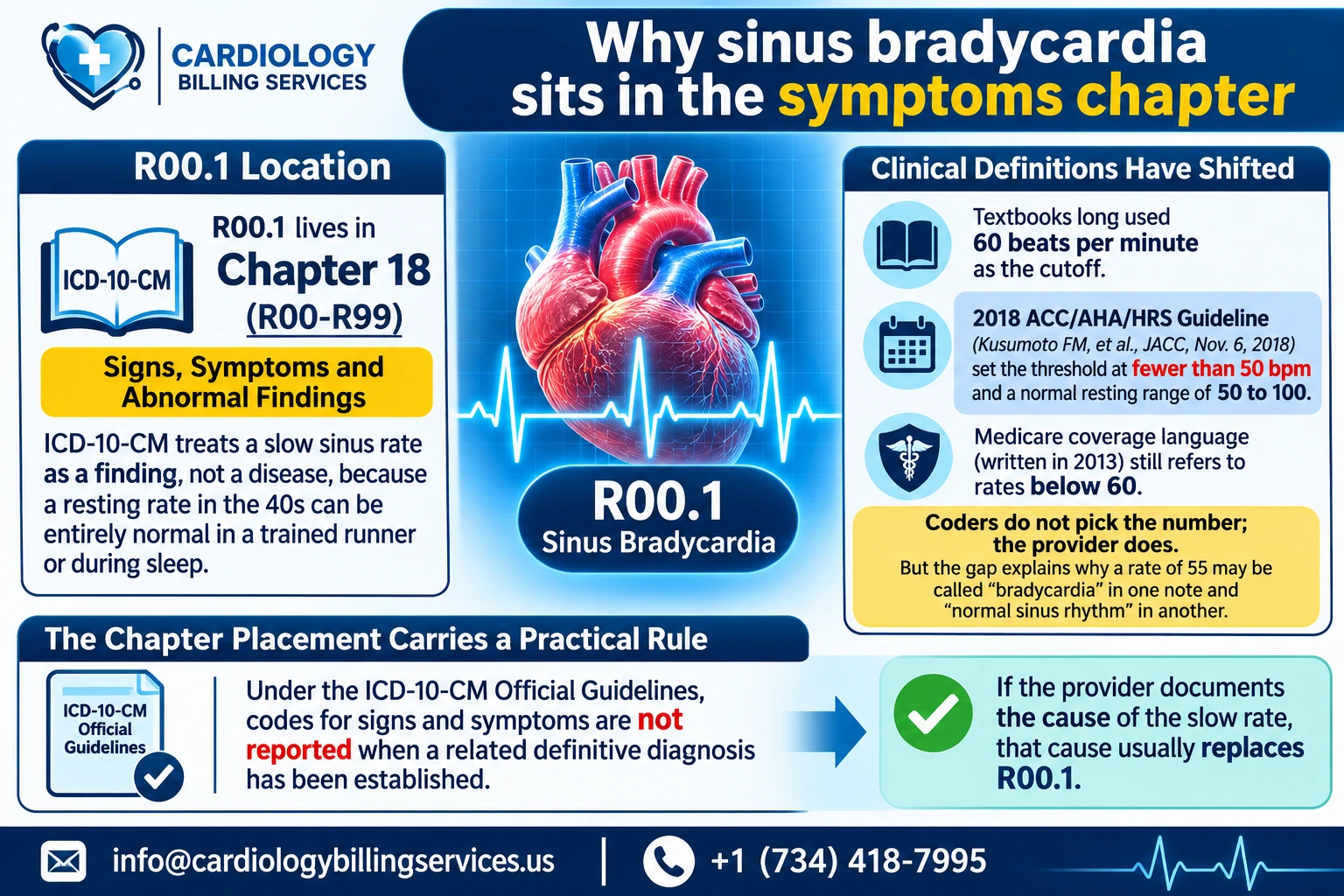
R00.1 lives in Chapter 18 (R00-R99), the chapter for signs, symptoms and abnormal findings. ICD-10-CM treats a slow sinus rate as a finding, not a disease, because a resting rate in the 40s can be entirely normal in a trained runner or during sleep.
Clinical definitions have shifted too. Textbooks long used 60 beats per minute as the cutoff. The 2018 ACC/AHA/HRS Guideline on the Evaluation and Management of Patients With Bradycardia and Cardiac Conduction Delay (Kusumoto FM, et al., Journal of the American College of Cardiology, published online November 6, 2018) set the threshold at fewer than 50 beats per minute and described a normal resting range of 50 to 100. Medicare coverage language, written in 2013, still refers to rates below 60. Coders do not pick the number; the provider does. But the gap explains why a rate of 55 may be called "bradycardia" in one note and "normal sinus rhythm" in another.
The chapter placement carries a practical rule. Under the ICD-10-CM Official Guidelines, codes for signs and symptoms are not reported when a related definitive diagnosis has been established. If the provider documents the cause of the slow rate, that cause usually replaces R00.1.
Codes that replace R00.1 when the cause is documented
Several documented conditions take the place of R00.1. Each one requires the provider to name the condition; a coder cannot infer AV block from an ECG printout.
| Documented condition | ICD-10-CM code |
|---|---|
| Sick sinus syndrome, including tachycardia-bradycardia syndrome | I49.5 |
| Sinoatrial (sinoauricular) block | I45.5 |
| First-degree AV block | I44.0 |
| Second-degree AV block (Mobitz I or II) | I44.1 |
| Complete (third-degree) AV block | I44.2 |
| AV block, unspecified degree | I44.30 |
| Neonatal bradycardia | P29.12 |
Sick sinus syndrome, including tachycardia-bradycardia syndrome, is coded I49.5, and R00.1 is not added for the slow rate. Sinoatrial (sinoauricular) block goes to I45.5, which ICD-10-CM classifies as other specified heart block.
AV block is coded by degree: I44.0 for first-degree, I44.1 for second-degree (Mobitz I or II) and I44.2 for complete (third-degree) block. When the record says only "AV block" with no degree, I44.30 applies, though a query is worth sending if the tracings support a specific degree.
In a newborn, bradycardia is coded P29.12, never R00.1, because of the Excludes1 note.
First-degree AV block deserves a second look. A first-degree block does not slow the ventricular rate, so a patient can have both sinus bradycardia and first-degree AV block, and both codes may be reported. Second- and third-degree blocks, by contrast, are themselves the cause of the slow rate, and R00.1 adds nothing.
Symptomatic bradycardia has no dedicated code
No ICD-10-CM code carries the word "symptomatic" for bradycardia. When a provider writes "symptomatic sinus bradycardia," the diagnosis code remains R00.1 (or the underlying condition from the table above). The symptoms are captured separately.
Codes such as R55 (syncope and collapse) or R42 (dizziness and giddiness) may be added when the provider documents them and links them to the slow rate. Because R00.1 is itself a symptom code, the guideline against coding integral symptoms of a definitive diagnosis applies less cleanly here; follow your facility's written policy and the provider's linkage.
The word "symptomatic" matters far more for coverage than for code selection. Medicare's National Coverage Determination 20.8.3, Single Chamber and Dual Chamber Permanent Cardiac Pacemakers (effective August 13, 2013, and still in force), covers implants for documented non-reversible symptomatic bradycardia due to sinus node dysfunction and for second- or third-degree AV block. The NCD defines bradycardia symptoms as those directly attributable to a heart rate below 60, listing syncope, seizures, congestive heart failure, dizziness and confusion as examples.
The same NCD names indications Medicare will not cover, among them asymptomatic sinus bradycardia, asymptomatic first-degree AV block, syncope of undetermined cause and bradycardia during sleep.
The dollars are measurable. CMS reported, using its 2024 Medicare Fee-for-Service Supplemental Improper Payment Data, an improper payment rate of 2.4% for permanent pacemaker implants, projected at $20.2 million.
A pacemaker scenario
A 78-year-old woman is admitted after two fainting episodes. Telemetry shows sinus pauses and rates in the high 30s alternating with bursts of atrial fibrillation. The electrophysiologist documents "tachy-brady syndrome with syncope; not medication related; dual-chamber pacemaker indicated."
The correct diagnosis is I49.5 for tachycardia-bradycardia syndrome, with I48.- for the atrial fibrillation type as documented. R00.1 is not reported, because sick sinus syndrome explains the slow rate. The phrase "not medication related" does real work here: it supports the "non-reversible" condition that NCD 20.8.3 requires.
Drug-induced bradycardia: sequencing adverse effects and poisonings
R00.1 carries a "use additional code" note directing coders to identify the drug with an adverse-effect code from T36-T50 (fifth or sixth character 5). Beta blockers, non-dihydropyridine calcium channel blockers and digoxin cause most medication-related cases.
Sequencing depends on whether the drug was taken correctly.
Adverse effect
Correct drug, correct dose. Code the manifestation first, then the T code. A patient on prescribed metoprolol with a documented drug-related rate of 42 is coded R00.1 followed by T44.7X5A (adverse effect of beta-adrenoreceptor antagonists, initial encounter). For diltiazem, the T code is T46.1X5A; for digoxin, T46.0X5A.
Poisoning
Wrong drug, wrong dose, overdose, or a drug taken with alcohol. The T code comes first. A patient who doubled her metoprolol dose by mistake is coded T44.7X1A (poisoning, accidental), then R00.1.
The seventh character changes with the phase of care: A for active treatment, D for subsequent encounters, S for sequela.
What changed for FY 2027 and what did not
The FY 2027 code set took effect October 1, 2026. CMS finalized it in the FY 2027 IPPS Final Rule released August 1, 2026, with 190 new codes, 30 deletions and four revised descriptors.
None of the bradycardia codes changed. R00.1, I49.5, I44.x and P29.12 read exactly as they did in FY 2026.
One nearby change can still trip up arrhythmia coding. I49.8 (other specified cardiac arrhythmias) became a non-billable header on October 1, 2026. Its new subcodes are I49.81 (Brugada syndrome), I49.82 (ventricular bigeminy) and I49.89 (other specified cardiac arrhythmias not elsewhere classified). Any claim still carrying I49.8 for a date of service on or after October 1, 2026 will reject. Rhythms that previously indexed to I49.8 should be rechecked against the FY 2027 Alphabetic Index before assigning I49.89.
At the same time, CMS added I49.82 and I47.22 (catecholaminergic polymorphic ventricular tachycardia) to the covered diagnosis list for NCD 20.30, Microvolt T-wave Alternans, effective October 1, 2026.
Documentation that supports accurate bradycardia coding
Most denials and queries trace back to five gaps, and a provider who wants a clean claim on the first pass should close each of them in the note.
Name the rhythm source
Sinus bradycardia, junctional rhythm, AV block (with degree) and sick sinus syndrome each code differently; "brady" alone yields R00.1 and nothing more.
Record the rate and evidence
Include the ECG, telemetry or ambulatory monitor findings and their date.
Connect symptoms to the rate
"Dizziness" in the history and "HR 44" in the vitals are two separate facts, and a coder needs the provider to link them.
Address reversibility
State whether medications, hypothyroidism, electrolyte disturbance or another treatable cause was considered; the 2018 ACC/AHA/HRS guideline devotes a table to potentially reversible causes of sinus node dysfunction.
The fifth gap is the medication itself: name the responsible drug, if there is one, and say whether it was taken as prescribed.
When these elements are missing, a compliant query is the right tool. A useful example: "Telemetry shows rates of 38-44 with 3.2-second pauses. Please clarify the underlying rhythm diagnosis, if known: sick sinus syndrome, AV block (specify degree), drug-related bradycardia (specify agent), other, or unable to determine."
Frequent bradycardia coding errors
The most common mistake is reporting R00.1 together with I49.5, I44.1 or I44.2 for the same slow rate, which double-counts a symptom the definitive diagnosis already explains. Newborn charts produce a related error, with R00.1 assigned where P29.12 belongs.
Medication cases go wrong in two ways: the T code is left off entirely when the provider attributes the slow rate to a drug, or R00.1 is sequenced first on an overdose, reversing the poisoning rule.
Two more errors are worth auditing for. A low number in the vital signs is not a diagnosis until the provider names bradycardia, and I49.8 cannot be billed for any date of service after September 30, 2026.
Summary
For FY 2027, the bradycardia ICD-10 code for sinus, sinoatrial, vagal or unspecified slow heart rate is still R00.1, and "symptomatic" changes the supporting codes and coverage status rather than the diagnosis code itself. Once a provider documents sick sinus syndrome or second- or third-degree AV block, that condition takes over and R00.1 drops off. Drug-related cases need a T code, sequenced after R00.1 for an adverse effect and before it for a poisoning. For pacemaker claims, NCD 20.8.3 still requires documented, non-reversible symptoms tied to the slow rate, and the 2.4% improper payment rate CMS reported for these implants shows how often that link is missing from the record.