
Chest Pain ICD-10 Codes: Complete Coding and Billing Guide (2026)

Chest pain sends nearly every patient down the same costly path: an ECG, serial troponins, a chest X-ray and often a night in observation. The 2021 AHA/ACC/ASE/CHEST/SAEM/SCCT/SCMR Guideline for the Evaluation and Diagnosis of Chest Pain (writing committee chaired by Martha Gulati, published in Circulation and JACC in October 2021) lists chest pain as the second most common reason US adults visit an emergency department, behind injuries. The same document reports that more than half of these patients end up with a noncardiac cause.
That gap between the workup and the final answer is where chest pain ICD-10 codes go wrong. The claim must describe what the provider knew when the encounter ended, not what the tests were searching for. This guide covers the R07 code family, the official guideline sections that control when a symptom code is allowed, sequencing in different settings, and the billing details behind common denials.
One note on code-set years. The FY2026 ICD-10-CM update (October 1, 2025 to September 30, 2026) added 487 codes. The FY2027 update, effective October 1, 2026, added 190, deleted 30 and revised four. Neither update touched the R07 chest pain codes, so the guidance below applies to dates of service across both years.
The chest pain ICD-10 code family (R07)
Category R07, Pain in throat and chest, belongs to Chapter 18 (R00-R99), the symptoms and signs chapter. R07.0 covers throat pain, so the chest codes start at R07.1.
| Code | Description | Typical documentation |
|---|---|---|
| R07.1 | Chest pain on breathing | Pain that worsens on inspiration, painful respiration |
| R07.2 | Precordial pain | Pain localized over the heart |
| R07.81 | Pleurodynia | Provider documents pleurodynia |
| R07.82 | Intercostal pain | Pain along the intercostal spaces |
| R07.89 | Other chest pain | Chest pressure, tightness, discomfort, anterior chest-wall pain |
| R07.9 | Chest pain, unspecified | "Chest pain" with no location, quality or cause |
R07.8 is a subcategory heading and cannot be billed. Only the six codes above are valid on a claim.
Two instructional notes deserve attention. Category R07 carries an Excludes2 note for jaw pain (R68.84) and breast pain (N64.4), so either can be reported alongside a chest pain code when the provider documents it as a separate complaint. In the other direction, R52 (Pain, unspecified) has an Excludes1 note for chest pain codes R07.1 through R07.9. Never pair R52 with an R07 code for the same complaint.
R07.89 or R07.9?
This is the most frequent choice coders make with chest pain, and R07.9 is overused. The Alphabetic Index sends "discomfort, chest" and "tightness, chest" to R07.89, and the tabular list gives "anterior chest-wall pain NOS" as its inclusion term. An ED note that says "chest pressure radiating to the left arm" already has enough detail for R07.89.
Reserve R07.9 for records where the final impression says only "chest pain" and nothing in the note narrows it.
The "atypical chest pain" problem
The Index routes atypical chest pain to R07.89, and noncardiac chest pain lands in the same code. The clinical language, however, is changing. The 2021 AHA/ACC guideline recommends that clinicians stop using "atypical" and instead describe chest pain as cardiac, possible cardiac or noncardiac. The code stays the same, but "noncardiac chest pain" gives a payer reviewer a much clearer picture of the provider's reasoning than "atypical," which reviewers sometimes read as "possibly cardiac." Coding educators can use this as a talking point when working with providers on templates.
Guideline rules that decide when R07 codes belong on the claim
The ICD-10-CM Official Guidelines for Coding and Reporting are a HIPAA-required standard, and four sections govern chest pain.
- Section I.B.4 allows sign and symptom codes when the provider has not established a related definitive diagnosis.
- Section I.B.5 bars reporting a symptom that is routine for a confirmed condition. Chest pain is not coded separately once the provider documents NSTEMI.
- Section IV.H (outpatient) prohibits coding conditions described as "probable," "suspected," "rule out" or "likely." Code to the highest degree of certainty, which is often the symptom.
- Section II.H (inpatient) works the opposite way. An uncertain diagnosis still documented at discharge is coded as if confirmed.
The practical effect is that the same physician wording can produce different codes depending on the patient's status.
The observation trap
Observation is an outpatient service, even when the patient spends 30 hours in a hospital bed. Section IV rules apply.
Consider a patient who presents with substernal pressure, has two negative troponins and a nonischemic ECG, and is discharged from observation with the final impression "chest pressure, probable unstable angina, outpatient stress test next week." Because the stay was observation, "probable unstable angina" cannot be coded. The correct code is R07.89.
If the same patient had been formally admitted as an inpatient and the discharge summary carried the same wording, Section II.H would apply, and the principal diagnosis would be I20.0 (Unstable angina).
Coders working ED and observation charts should check the status order before reading the final diagnosis.
Why Z03.89 usually does not fit
Z03.89 (Encounter for observation for other suspected diseases and conditions ruled out) looks appealing after a negative cardiac workup. Section I.C.21.c.6 limits the Z03 observation codes to encounters where the patient has no signs or symptoms. A patient who arrived with chest pain has a symptom, so the R07 code is correct.
When the workup finds a cause
Once the provider documents a definitive diagnosis that explains the pain, that diagnosis replaces the R07 code.
| Documented cause | ICD-10-CM code |
|---|---|
| Gastroesophageal reflux disease without esophagitis | K21.9 |
| Costochondritis (chondrocostal junction syndrome) | M94.0 |
| Panic disorder | F41.0 |
| Acute pericarditis, unspecified | I30.9 |
| Pulmonary embolism without acute cor pulmonale | I26.99 |
| Contusion of thorax, initial encounter | S20.20XA |
| Unstable angina | I20.0 |
| Type 2 myocardial infarction | I21.A1 |
Two cardiac points come up often in audits.
First, coronary artery disease with angina takes a combination code. Under Section I.C.9.b, the classification presumes a causal link between atherosclerotic heart disease and angina unless the provider documents another cause. A patient with known CAD and unstable angina is coded I25.110 (Atherosclerotic heart disease of native coronary artery with unstable angina pectoris), not I25.10 plus I20.0.
Second, an elevated troponin is not a myocardial infarction until the provider calls it one. If the note mentions "troponin leak" or "demand ischemia" without a diagnosis, send a query. Possible answers include type 2 MI (I21.A1), non-ischemic myocardial injury (I5A), or demand ischemia (I24.89), and each carries a very different weight on the claim.
Inpatient MS-DRG effects of chest pain codes
When R07.89 or R07.9 is the principal diagnosis on an inpatient claim, the case groups to MS-DRG 313 (Chest pain) in MDC 05, Diseases and Disorders of the Circulatory System. R07.1 behaves differently. Because the classification treats pain on breathing as a respiratory sign, R07.1 groups to MS-DRG 204 (Respiratory signs and symptoms) in MDC 04.
The choice between R07.1 and R07.9 therefore moves the claim to a different body system and a different payment weight. Code what the documentation supports, and query when a note mentions pleuritic features only in the HPI but not in the final impression.
Chest pain admissions also attract medical necessity review. Under the CMS Two-Midnight rule (42 CFR 412.3), Medicare inpatient admission is generally appropriate when the admitting physician expects the patient to need hospital care spanning at least two midnights. A chest pain patient who rules out within 24 hours usually belongs in observation, and an inpatient claim with DRG 313 and a one-day stay is a common audit target.
Pairing chest pain diagnoses with CPT and HCPCS services
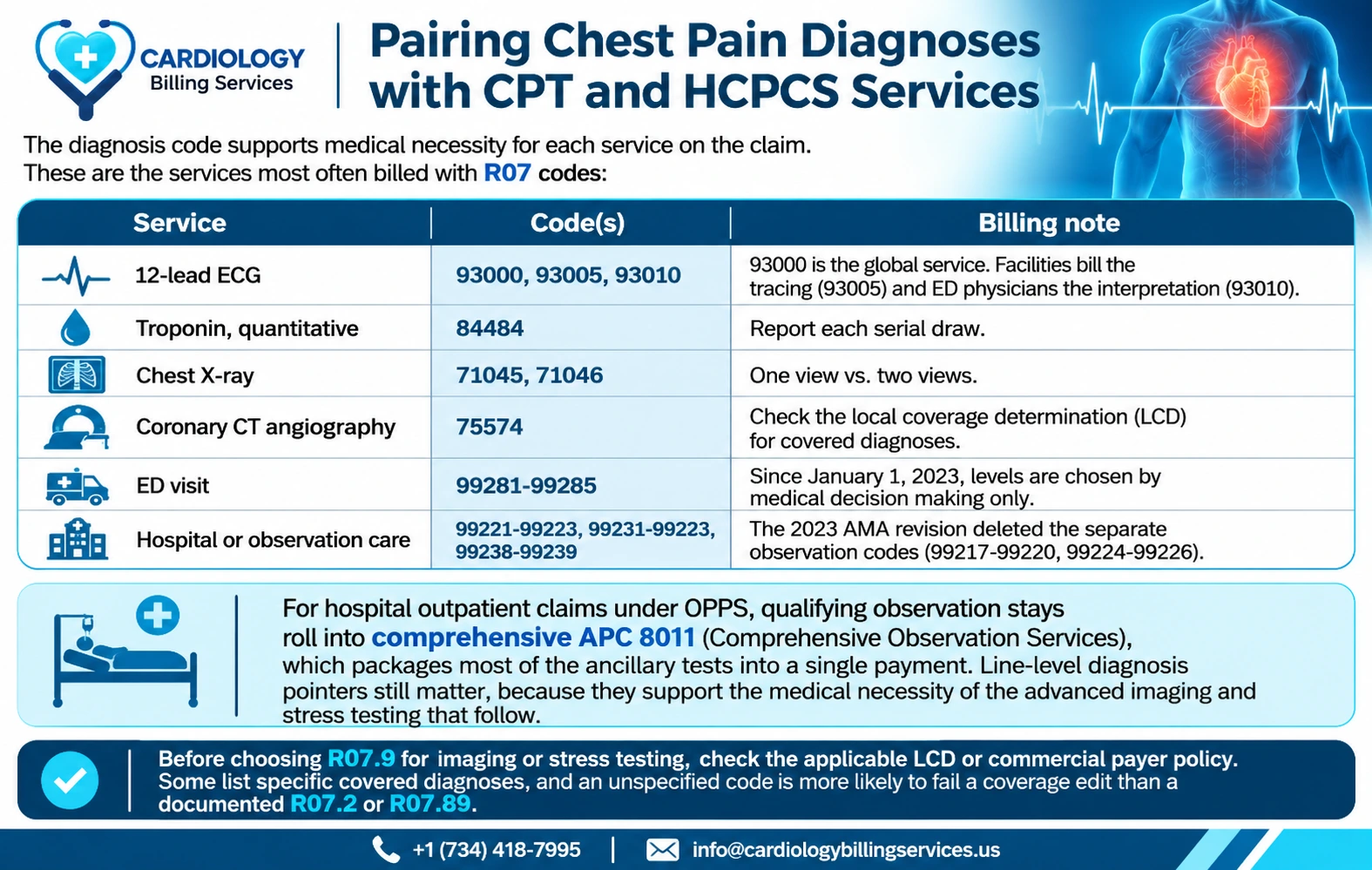
The diagnosis code supports medical necessity for each service on the claim. These are the services most often billed with R07 codes:
| Service | Code(s) | Billing note |
|---|---|---|
| 12-lead ECG | 93000, 93005, 93010 | 93000 is the global service. Facilities bill the tracing (93005) and ED physicians the interpretation (93010). |
| Troponin, quantitative | 84484 | Report each serial draw. |
| Chest X-ray | 71045, 71046 | One view vs. two views |
| Coronary CT angiography | 75574 | Check the local coverage determination (LCD) for covered diagnoses. |
| ED visit | 99281-99285 | Since January 1, 2023, levels are chosen by medical decision making only. |
| Hospital or observation care | 99221-99223, 99231-99233, 99238-99239 | The 2023 AMA revision deleted the separate observation codes (99217-99220, 99224-99226). |
For hospital outpatient claims under OPPS, qualifying observation stays roll into comprehensive APC 8011 (Comprehensive Observation Services), which packages most of the ancillary tests into a single payment. Line-level diagnosis pointers still matter, because they support the medical necessity of the advanced imaging and stress testing that follow.
Before choosing R07.9 for imaging or stress testing, check the applicable LCD or commercial payer policy. Some list specific covered diagnoses, and an unspecified code is more likely to fail a coverage edit than a documented R07.2 or R07.89.
Documentation that prevents queries and denials
Most chest pain coding problems start in the note. Providers can make accurate coding possible by documenting:
- Location (substernal, precordial, chest wall, intercostal)
- Quality (pressure, tightness, sharp, burning)
- Relation to breathing, exertion, movement or meals
- A final impression that names the cause, or states "etiology undetermined" when none was found
- Any newly confirmed diagnosis, written in definitive language at discharge
Coders should also know that R07 codes do not map to a payment HCC under CMS-HCC version 28. Risk adjustment for these patients comes from the underlying conditions, such as CAD, heart failure or diabetes, so those need to be documented and coded at every qualifying face-to-face visit.
Chest pain ICD-10 coding: quick reference
The six billable R07 codes have been stable since ICD-10-CM took effect on October 1, 2015, and remain unchanged in the FY2026 and FY2027 code sets. Accuracy depends less on memorizing them and more on applying the right guideline section to the patient's status.
In the outpatient setting, including observation, uncertain diagnoses are not coded, and the symptom stands. In the inpatient setting, uncertain diagnoses documented at discharge are coded as confirmed. R07.89 covers pressure, tightness, discomfort, "atypical" and noncardiac chest pain. R07.9 is for the record that says nothing more than "chest pain." R07.1 moves an inpatient claim from MS-DRG 313 to MS-DRG 204. A confirmed cause, whether K21.9 or I21.A1, replaces the symptom code entirely.