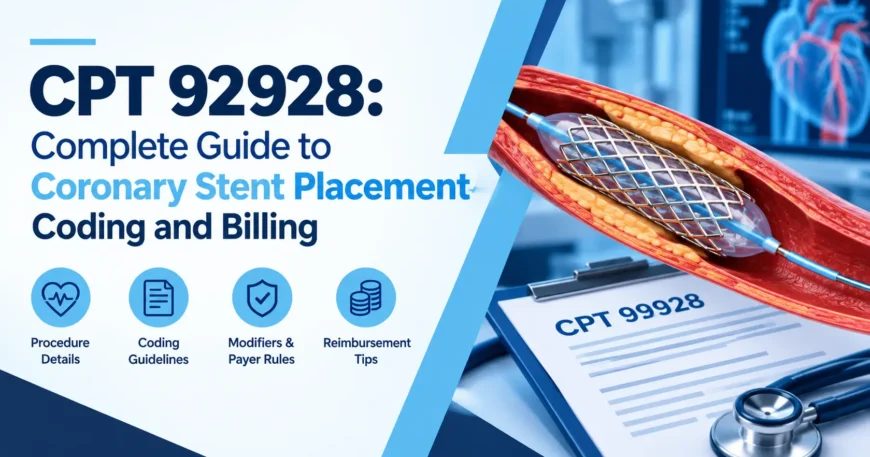
CPT 92928: Complete Guide to Coronary Stent Placement Coding and Billing

A cardiologist threads a wire past a 90% blockage in the mid-LAD, deploys a drug-eluting stent and closes the access site in under half an hour. The clinical work is finished. The billing work is just starting and if that claim goes out with the wrong vessel modifier, an unlinked diagnosis code, or a missed atherectomy detail, a routine procedure turns into a six-week appeal.
CPT 92928 is one of the highest-volume, highest-scrutiny codes in interventional cardiology. It sits inside a dense web of National Correct Coding Initiative (NCCI) bundling edits and payers audit it more than almost any other cardiovascular procedure code. This guide covers what it actually includes, where practices lose money on it and the documentation and modifier habits that keep claims moving instead of bouncing back.
What Is CPT Code 92928?
CPT 92928 is the code used to report percutaneous placement of one or more stents into a single major coronary artery or one of its branches, with balloon angioplasty of that same vessel included whenever it's performed as part of the same intervention. In plain terms: a catheter is guided to the blockage, the vessel is opened and a stent (or stents) is left behind to keep it open all in one target artery.
It belongs to a tightly bundled family of percutaneous coronary intervention (PCI) codes and it's one of the codes practices bill most often after a positive stress test, an abnormal angiogram, or an emergent catheterization for chest pain. Because of how frequently it's used and how much money moves through it 92928 shows up on nearly every payer's audit radar. For practices building out an interventional cardiology billing program, this is usually the first code new coders need to master before they're trusted with more complex PCI claims like interventional cardiology billing work involving atherectomy or bypass graft revascularization.
92928 CPT Code Description
Described in coder-friendly language rather than the exact copyrighted CPT manual wording, 92928 covers the catheter-based delivery and deployment of an intracoronary stent (or stents) into a single major coronary artery or a branch of one, with angioplasty of that vessel bundled into the same code when the physician performs it. The code lives under the American Medical Association's Coronary Therapeutic Services and Procedures section CPT® 92928, under Coronary Therapeutic Services and Procedures alongside the rest of the 92920–92944 PCI family.
Worth flagging for anyone still working off last year's cheat sheet: AMA revised the short, medium and long descriptor language for 92928 effective January 1, 2026. The clinical concept hasn't changed, but the exact wording coders see in their encoder or CPT manual has. It's a good reminder that even well-established, frequently billed codes get periodic descriptor refreshes and coding teams should confirm current-year language directly in their CPT resource rather than relying on a saved reference sheet from a prior year.
Where CPT 92928 Falls in Coronary Therapeutic Services and Procedures
The PCI code family (92920 through 92944) is organized around what was actually done to the vessel, not just that "an intervention happened." Plain balloon angioplasty without a stent sits at the low end (92920/92921). Add a stent and you move to 92928/92929. Add atherectomy on top of the stent and angioplasty and the code jumps to 92933/92934. Separate code sets exist entirely for interventions through a bypass graft (92937/92938), for acute total or subtotal occlusions treated during a heart attack (92941) and for chronic total occlusions (92943/92944).
That structure matters because it's easy to under-code or over-code by picking the "close enough" option instead of the one that matches exactly what the operative note describes. If you're building or refreshing a full reference for your team, our complete cardiology CPT codes guide maps out how this PCI family fits alongside the rest of the codes cardiology practices bill day to day.
How CPT 92928 Is Used in Cardiology Billing
The physician documents the procedure, a coder reviews that note and assigns 92928 with the appropriate vessel modifier and the claim moves to charge entry with the supporting ICD-10-CM diagnosis attached. Since 2013, CMS has bundled a long list of related work directly into every PCI code in this family vessel access, selective catheterization, related radiological supervision and interpretation, arteriotomy closure and completion imaging are all included rather than billed separately.
That bundling is why code selection for 92928 is a judgment call, not a quick lookup it depends on reading the operative note carefully every time. That's the kind of consistency a dedicated medical coding services team is built around.
Scenarios Where CPT Code 92928 Is Applicable
- Elective PCI for stable angina, where a diagnostic angiogram confirms significant single-vessel stenosis and the cardiologist proceeds to stent placement in the same or a staged session.
- Emergent PCI for a heart attack, when the culprit vessel is stented and the occlusion doesn't meet the specific criteria for the acute total/subtotal occlusion codes (92941) this distinction trips up more coders than almost any other scenario in this code family.
- Post-stress-test workup, where a positive functional study leads to catheterization and a single-vessel lesion is treated.
- Bifurcation lesions, where a stent is placed in the main branch and a second stent is placed in a side branch of the same major artery, reported with 92928 plus the 92929 add-on code.
- Restenosis of a previously stented segment, where a new stent is placed within the same vessel during a later, separate encounter.
It's not the right code when atherectomy was performed in the vessel (92933), the target is a bypass graft (92937), or the lesion is an acute total occlusion during an MI (92941). Getting this wrong in either direction is one of the fastest ways to draw payer attention.
New vs Related Coronary Intervention Codes
| CPT Code | What It Covers | Add-On Code |
|---|---|---|
| 92920 | Balloon angioplasty only, single major coronary artery or branch, no stent | 92921 (each additional branch) |
| 92924 | Angioplasty with atherectomy, no stent, single vessel | 92925 (each additional branch) |
| 92928 | Angioplasty with stent placement, single major coronary artery or branch | 92929 (each additional branch) |
| 92933 | Angioplasty with atherectomy and stent, single vessel | 92934 (each additional branch) |
| 92937 | PCI through a coronary bypass graft (any combination of stent, atherectomy, angioplasty) | 92938 (each additional vessel) |
| 92941 | PCI for acute total/subtotal occlusion during a heart attack | — |
| 92943 | PCI for a chronic total occlusion | 92944 (each additional vessel) |
CPT 92928 vs CPT 92933: Coding Differences That Affect Reimbursement
| Factor | CPT 92928 | CPT 92933 |
|---|---|---|
| Core service | Stent placement + angioplasty | Stent placement + angioplasty + atherectomy |
| When to use | No plaque-modifying device used | Rotational, orbital, or laser atherectomy performed in the same vessel before stenting |
| Add-on code | 92929 (each additional branch) | 92934 (each additional branch) |
| Documentation trigger | Standard PCI op note elements | Must clearly document the atherectomy device used and the clinical reason for plaque modification |
| Reimbursement impact | Baseline PCI value | Carries higher relative value due to the added atherectomy work exact payment still depends on your current Medicare Physician Fee Schedule locality and MAC |
The most common mistake here is a documentation gap, not confusion. If the note just says "stent placed after lesion preparation" without naming the atherectomy device, a coder has no defensible way to bill 92933 and the practice leaves legitimate reimbursement on the table.
Documentation Requirements for CPT 92928
| Documentation Element | Why It Matters |
|---|---|
| Indication for the procedure (symptoms, stress test findings, angiogram results) | Establishes medical necessity before the payer even looks at the CPT code |
| Pre-procedure stenosis percentage and vessel/segment identified | Confirms the lesion meets the threshold most payers expect for intervention |
| Access site and approach | Standard procedural detail, expected in every cath lab note |
| Exact vessel and branch treated, with laterality | Directly supports the coronary artery modifier appended to the claim |
| Stent type, size and number placed | Needed to determine whether 92929 applies for additional branches |
| Confirmation of whether atherectomy was performed | The single biggest factor separating 92928 from 92933 |
| Medical necessity for any adjunct imaging (IVUS, OCT, FFR) | These add-on services need their own justification, separate from the stent itself a detail that overlaps closely with cardiac imaging billing rules |
| Complications and post-procedure plan | Rounds out the clinical picture and supports audit readiness |
Medical Necessity and Diagnosis Support
CPT 92928 doesn't get paid on the strength of the procedure code alone it needs an ICD-10-CM diagnosis that a payer's coverage policy actually recognizes as justifying a coronary intervention. Common examples include atherosclerotic heart disease of a native coronary artery (I25.10), the same diagnosis with documented angina (I25.110/I25.119), unstable angina (I20.0) and the relevant acute myocardial infarction codes (I21.x) when the procedure is performed emergently.
Every Medicare Administrative Contractor publishes its own Billing and Coding Article listing the exact diagnosis codes it considers medically necessary for PCI procedures and commercial payers maintain similar internal lists. A clinically appropriate stent placement can still be denied if the diagnosis code attached to the claim simply isn't on that payer's approved list which is why checking the current LCD before submission matters as much as getting the procedure code right. Many of these interventions, incidentally, trace back to findings caught during routine risk-factor management or a screening stress test, which is part of why the diagnosis trail from a preventive cardiology workup through to intervention needs to stay clean and consistent across the whole episode of care.
Common Billing Mistakes
- Billing pre- or post-dilation angioplasty separately when it was performed in the same vessel as the stent it's bundled into 92928, not billable on its own line.
- Missing or incorrect coronary artery modifier, or using a modifier that doesn't match the vessel described in the note.
- Reporting 92929 as a standalone line without a corresponding primary 92928 on the same claim.
- Treating two separate major arteries (say, the RCA and the LAD) but only submitting one line, instead of two lines of 92928 each with its own vessel modifier.
- Defaulting to 92928 when the op note actually describes an atherectomy device being used, which should trigger 92933 instead.
- Attaching a diagnosis code that's clinically accurate but not on the payer's covered list for PCI.
Common Denials for CPT 92928
| Denial Reason | Likely Fix |
|---|---|
| Lack of medical necessity (often a CO-50 style denial) | Confirm the ICD-10-CM code appears on the payer's current PCI coverage list and that angiogram findings support the intervention |
| Service bundled into another procedure | Review the applicable NCCI edit before appending a bypass modifier like 59 or XS don't override an edit without a genuinely distinct circumstance |
| Missing or invalid modifier | Append the correct coronary artery modifier (LC, LD, RC, LM, or RI) matching the vessel in the note |
| Prior authorization not on file | Confirm whether the payer requires precertification for elective PCI before the case is scheduled, not after the claim is filed |
| Duplicate or conflicting line items | Verify 92929 isn't billed without its primary code and that multiple 92928 lines are properly distinguished by vessel modifier |
Most of these are preventable at the claim-scrubbing stage rather than the appeal stage which is where a structured denial management process earns its keep, catching a pattern before it repeats across dozens of claims.
Modifier Usage and When a Modifier May Be Needed
Does CPT 92928 require a modifier? Not by CPT rule alone, but in practice, yes nearly every payer, Medicare included, expects a coronary artery designation modifier so the claim identifies exactly which vessel was treated. This becomes non-negotiable the moment more than one PCI code appears on the same claim.
| Modifier | Meaning | When to Use It |
|---|---|---|
| LD | Left anterior descending artery | Vessel treated is the LAD |
| LC | Left circumflex artery | Vessel treated is the circumflex |
| RC | Right coronary artery | Vessel treated is the RCA |
| LM | Left main coronary artery | Vessel treated is the left main |
| RI | Ramus intermedius | Vessel treated is this variant branch artery |
| 59 / XS | Distinct procedural service | Used to indicate a separate, distinct vessel or session when an NCCI edit would otherwise bundle two codes together only when the clinical circumstance genuinely supports it |
| 26 / TC | Professional / Technical component | Used to split billing when the interpreting physician doesn't own the imaging or procedural equipment, most relevant in certain facility arrangements |
Medicare Billing Considerations
Coverage for PCI-family procedures like 92928 flows from a mix of national and local policy. National Coverage Determination 20.7 addresses percutaneous transluminal angioplasty broadly, while individual Medicare Administrative Contractors publish their own Local Coverage Determinations and Billing and Coding Articles spelling out the specific ICD-10-CM codes considered medically necessary for PCI in their jurisdiction so a diagnosis that clears review in one state isn't automatically covered in another.
Emergent PCI generally doesn't require prior authorization under Medicare, but elective cases and the supporting documentation remain subject to review on request. Site of service also affects payment, since facility and non-facility billing are reimbursed differently.
Commercial Insurance Considerations
| Factor | Medicare | Commercial Payers |
|---|---|---|
| Prior authorization | Not typically required for emergent PCI; documentation still subject to review | Often required for elective, non-emergent PCI, even when clinically indicated |
| Coverage criteria source | National NCD framework plus MAC-specific LCDs and Billing Articles | Individual payer medical policy, which can be stricter or structured differently than CMS guidance |
| Modifier expectations | Coronary artery modifiers commonly expected on PCI claims | Varies by plan some mirror Medicare's approach, others apply their own edits |
| Site-of-service rules | Facility/non-facility payment differences apply | Some plans steer elective PCI toward specific outpatient or ASC settings for cost reasons |
Because these rules vary this much between plans and even between product lines within the same insurer treating "the payer rules" as one uniform set of expectations is a quiet but common source of denials.
Examples of Correct Coding
Example 1 Single vessel, elective: A 90% mid-LAD stenosis is treated with one drug-eluting stent, no atherectomy performed. Reported as 92928-LD, linked to I25.110.
Example 2 Bifurcation lesion: A stent is placed in the LAD and a second stent in a diagonal branch during the same session. Reported as 92928-LD plus 92929, linked to I25.119.
Example 3 Atherectomy performed: Rotational atherectomy is used to prepare a calcified RCA lesion before stenting. This is 92933-RC, not 92928-RC, linked to I25.10.
Example 4 Two separate major arteries: The LAD and RCA are both stented in the same session, with no shared bifurcation between them. Reported as two separate lines 92928-LD and 92928-RC rather than using the 92929 add-on, since 92929 applies to an additional branch of the same major artery, not a second distinct artery.
Real Practice Scenarios
The missing modifier. A practice's EHR template never prompted for the treated vessel, so claims went out as plain 92928 with no coronary artery modifier a batch came back with CO-16 denials. A coding QA checkpoint confirming the modifier against the op note, the kind built into a solid claims submission and tracking workflow, fixed it going forward.
The atherectomy audit. A cath lab billed 92933 well above its regional peers and a payer audit found op notes mentioning "lesion preparation" without naming the atherectomy device or rationale. Several claims were retroactively downcoded to 92928, prompting a new required field in the dictation template.
The skipped prior auth. An elective outpatient PCI went forward without confirming the commercial payer's precertification rule and the claim was denied despite being clinically appropriate. The practice now checks prior authorization before scheduling, not after filing.
Coding Tips for Better Reimbursement
- Match the vessel modifier to the operative note exactly, every single time don't let a template default carry over from the last case.
- Confirm atherectomy use before defaulting to 92928; if a plaque-modifying device was used, 92933 is likely the correct code.
- Cross-check the diagnosis code against your MAC's current LCD or Billing Article before submission, not after a denial.
- Never bill angioplasty as a separate line when it was performed in the treated vessel alongside the stent.
- Review NCCI edit updates on a regular cadence bundling rules for PCI codes do change.
- Build dictation templates that force capture of vessel, device type and pre-/post-stenosis percentages so nothing critical gets left to memory.
Compliance Checklist
- Operative note is complete and reviewed before a code is assigned.
- Vessel modifier on the claim matches the vessel named in the documentation.
- Diagnosis code is verified against the current payer or MAC coverage policy.
- Atherectomy use (or absence) is explicitly documented, not implied.
- Any add-on services (92929, IVUS, FFR) have their own supporting medical necessity.
- Prior authorization is confirmed and on file for elective cases where required.
- High-dollar PCI claims get a periodic second-coder review as part of ongoing audit readiness.
How Professional Cardiology Billing Services Help
A single PCI claim touches procedure code selection, vessel-specific modifiers, NCCI bundling logic, payer-specific diagnosis rules and often prior authorization tracking. Getting all of that right consistently, across every cardiologist and every payer contract, is a full-time discipline.
That's where a team focused specifically on cardiology medical billing pays for itself coders who track NCCI and LCD updates as routine practice, a revenue cycle management process that catches denial patterns before they compound and a habit of reading every stent claim against its own operative note rather than copying the last similar case. Our about us page has more on our background in cardiovascular billing specifically.
Billing Workflow for Coronary Stent Placement Claims
- Documentation capture the operative note is finalized with all elements needed for accurate code selection.
- Coding review a coder matches the note against the correct PCI code (92928, 92929, 92933, etc.) and vessel modifier.
- Charge entry codes, modifiers and diagnosis are entered together, not as separate disconnected steps.
- Claim scrubbing the claim is checked against NCCI edits and payer-specific requirements before it ever leaves the building.
- Submission and tracking the claim is submitted and monitored through claims submission and tracking so a stalled claim gets caught in days, not months.
- Payment posting and variance review payment is compared against the expected reimbursement, flagging underpayments early.
- Denial triage any denial is routed through a defined denial management process rather than handled ad hoc.
Future Billing Considerations for 2026
Beyond the 2026 descriptor update already in effect, expect continued payer scrutiny of atherectomy billing and adjunct imaging services (IVUS, OCT, FFR), each of which carries its own medical necessity standard separate from the stent itself. Commercial payers have also been expanding prior authorization requirements for elective cardiovascular procedures, so it's worth reviewing major payer contracts rather than assuming last year's rules still apply. Tracking quarterly NCCI edit releases and MAC LCD updates remains the most reliable way to stay ahead of a policy shift instead of discovering it through a denial.
Key Takeaways
- CPT 92928 covers stent placement with angioplasty in a single major coronary artery or branch angioplasty in that same vessel is bundled in, not separately billable.
- 92929 is the add-on for an additional branch of the same major artery, not a second distinct vessel.
- If atherectomy was performed in the same vessel, the correct code is 92933, not 92928.
- Coronary artery modifiers (LC, LD, RC, LM, RI) are expected by nearly every payer, even though CPT itself doesn't universally mandate them.
- Medical necessity depends on matching the diagnosis code to what the specific payer or MAC actually covers for PCI clinical accuracy alone isn't enough.
- Most 92928 denials trace back to a documentation or modifier mismatch that could have been caught before submission.
Frequently Asked Questions
What is CPT code 92928 used for? It's used to report percutaneous placement of a stent, with angioplasty when performed, in a single major coronary artery or one of its branches most commonly for treating significant coronary artery stenosis found on angiography.
What is the 92928 CPT code description in plain terms? A catheter is guided to a blocked coronary artery, the vessel is opened (angioplasty) if needed and one or more stents are deployed to hold it open all within a single target vessel.
Does CPT 92928 require a modifier? CPT doesn't strictly mandate one, but in practice, nearly every payer expects a coronary artery modifier (LC, LD, RC, LM, or RI) identifying the exact vessel treated, especially when multiple PCI codes appear on the same claim.
Is CPT 92928 billable with an office visit on the same day? Generally not for a planned, previously scheduled procedure. An E/M service performed the same day may be separately billable only if it represents a significant, separately identifiable service and that usually needs modifier 25 along with documentation supporting the distinct visit.
What documentation is needed to support a CPT 92928 claim? At minimum: the indication for the procedure, pre-procedure stenosis findings, the exact vessel and branch treated, stent type and size, confirmation of whether atherectomy was performed and the post-procedure plan.
How is CPT 92928 different from CPT 92933? 92928 covers stent placement with angioplasty. 92933 covers the same core work plus atherectomy performed in the same vessel. The determining factor is simply whether an atherectomy device was used.
Why do CPT 92928 claims get denied most often? The leading causes are a missing or mismatched vessel modifier, a diagnosis code that isn't on the payer's covered list for PCI and bundling conflicts with other same-day procedure codes.
Does Medicare cover CPT 92928? Yes, when the procedure meets medical necessity criteria under the relevant National Coverage Determination and the local MAC's coverage policy and when documentation supports the diagnosis and procedure reported.
What ICD-10-CM diagnosis codes support CPT 92928? Commonly used examples include I25.10 and I25.110/I25.119 for atherosclerotic heart disease, I20.0 for unstable angina and the relevant I21.x codes for acute myocardial infarction though the specific accepted list varies by payer and MAC.
When should CPT 92928 not be used? It shouldn't be used when atherectomy was performed in the vessel (use 92933), when the intervention is through a bypass graft (use 92937), or when the lesion is an acute total or subtotal occlusion during a heart attack (use 92941).
Can CPT 92928 be billed more than once per session? It can appear more than once on a claim when separate major coronary arteries are each stented, provided each line carries its own distinct vessel modifier. It should not be duplicated for the same vessel.
Is prior authorization required for CPT 92928? Emergent PCI generally doesn't require prior authorization. Elective PCI often does, particularly with commercial payers, so it's worth confirming with the specific plan before scheduling rather than after the claim is filed.
How can cardiology billing services help with CPT 92928 claims? A dedicated billing team keeps up with NCCI edits and MAC-specific coverage policy changes, applies vessel modifiers consistently, verifies medical necessity before submission and manages denials through a structured process instead of case-by-case guesswork reducing both denial rates and the time it takes to get PCI claims paid.
Conclusion
CPT 92928 looks simple on paper one code for one vessel but the accuracy of that single line depends on a chain of details: the right vessel modifier, the right diagnosis code, a clear answer on whether atherectomy was involved and documentation that holds up if a payer asks questions later. Practices that treat this code as routine, rather than as one that deserves the same attention every time, are usually the ones fighting the most avoidable denials.
If your team is spending more time chasing PCI denials than you'd like, it may be worth a closer look at how your coding and claims process handles this code family specifically. Feel free to browse our blog for more cardiology coding guides, or reach out to our team to talk through what a dedicated cardiology billing partner could do for your PCI claim accuracy and turnaround.