Chest Pain ICD-10 Codes: Complete Coding Guide for Cardiology Practices (2026)

Chest pain brings more American adults to a clinician than almost any other complaint. The CDC’s 2018 National Hospital Ambulatory Medical Care Survey counted 7.1 million emergency department visits for chest pain and related symptoms, second only to abdominal pain. Many of those patients reach a cardiology office within days, usually carrying a referral that says nothing beyond “chest pain.”
That referral is where the coding questions begin. Chest pain ICD-10 codes live in Chapter 18, the symptom chapter, and the Official Guidelines for Coding and Reporting limit when a symptom can be reported once a workup produces an answer. This guide covers the R07 category as it stands in the FY2027 code set, the angina and coronary codes that often take its place, and the setting-specific rules that decide which code belongs on the claim.
What changed in the FY2027 code set (and what stayed the same)
The FY2027 ICD-10-CM code set took effect on October 1, 2026, and covers encounters and discharges through September 30, 2027. CMS finalized it in the FY2027 IPPS Final Rule released August 1, 2026, with 190 new codes, 30 deletions and four revised descriptors. That is a smaller release than FY2026, which added roughly 490 codes.
The R07 subcategory codes carry into FY2027 without changes. The cardiology updates sit nearby, in diagnoses that chest pain workups frequently end with:
- Dilated cardiomyopathy: I42.0 becomes a non-billable heading. Claims now need I42.00 (unspecified), I42.01 (familial-genetic) or I42.09 (other). Any superbill or EHR favorites list still showing I42.0 will generate rejections for dates of service on or after October 1, 2026.
- Inherited arrhythmia and cardiomyopathy codes: new codes capture arrhythmogenic cardiomyopathy, catecholaminergic polymorphic ventricular tachycardia, Brugada syndrome and ventricular bigeminy.
- Guideline edits: Section I.C.9.a.1 (hypertension with heart disease) was revised, and the hypertensive crisis guideline was updated. Practices that see hypertensive patients presenting with chest pain should reread both.
The R07 category: chest pain ICD-10 codes at a glance
Category R07 is titled “Pain in throat and chest.” R07.0 (pain in throat) shares the category but has nothing to do with cardiac complaints, and picking it from a dropdown by mistake is more common than it should be. The chest codes are:
| Code | Descriptor | Documentation that supports it |
|---|---|---|
| R07.1 | Chest pain on breathing | Pain that worsens with inspiration; “pleuritic” or “painful respiration” |
| R07.2 | Precordial pain | Pain localized over the precordium |
| R07.81 | Pleurodynia | Chest wall pain described as pleurodynia; epidemic (viral) pleurodynia goes to B33.0 instead |
| R07.82 | Intercostal pain | Pain between the ribs |
| R07.89 | Other chest pain | Anterior chest wall pain NOS, chest pressure, chest tightness, atypical chest pain |
| R07.9 | Chest pain, unspecified | “Chest pain” with no location, character or pattern recorded |
Two Excludes2 notes at the category level matter in practice. Jaw pain is coded to R68.84 and breast pain to N64.4, so a patient with chest pain radiating to the jaw can carry both codes when the provider documents both complaints.
Choosing between R07.89 and R07.9
These two codes account for most chest pain claims, and the difference rests on a single descriptive word. The Alphabetic Index sends “pressure,” “tightness” and “atypical” chest pain to R07.89. R07.9 is the fallback when the note gives the coder nothing else.
Section I.B.2 of the Official Guidelines requires coding to the highest level of specificity the record supports. A provider who writes “substernal pressure radiating to the left arm” has already given enough for R07.89, and coding R07.9 from that note understates the record.
The “atypical” problem
The 2021 AHA/ACC multisociety Guideline for the Evaluation and Diagnosis of Chest Pain (Gulati et al., Circulation and JACC, October 2021) recommended that clinicians stop using “atypical chest pain” because the term is often read as “benign.” It proposed three categories instead: cardiac, possible cardiac and noncardiac.
Those terms describe the clinician’s estimate of likelihood, not the pain itself, so they do not point to a specific R07 code. Coders working in practices that have adopted the 2021 vocabulary should look for the descriptive detail elsewhere in the HPI. “Possible cardiac chest pain, pressure-like, worse with exertion” supports R07.89. “Possible cardiac chest pain” with no description supports only R07.9, and a documentation query may be worthwhile.
When chest pain is no longer the right code
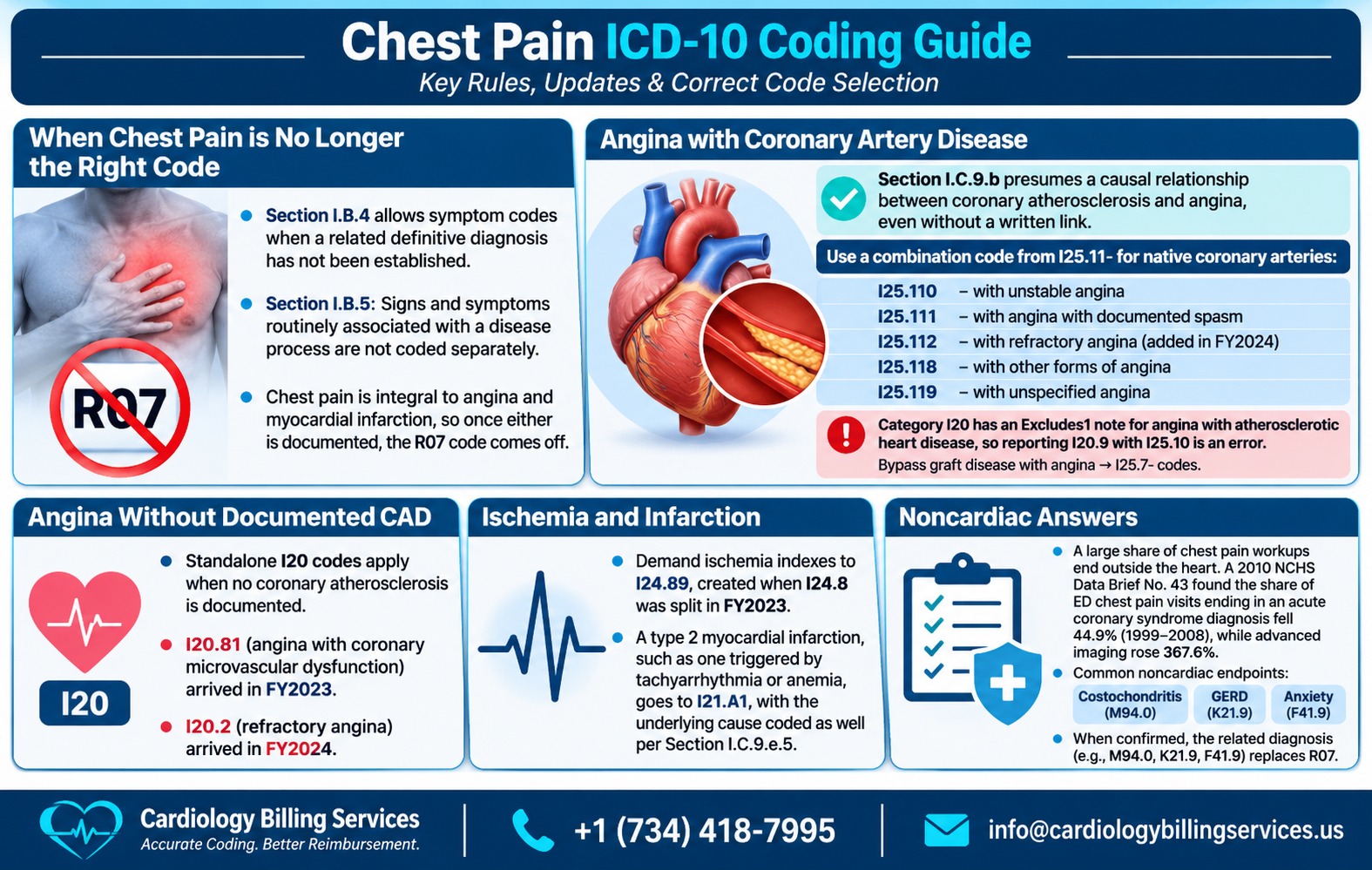
Section I.B.4 permits symptom codes when a related definitive diagnosis has not been established. Section I.B.5 adds that signs and symptoms routinely associated with a disease process are not coded separately. Chest pain is integral to angina and myocardial infarction, so once either is documented, the R07 code comes off the claim.
Angina with coronary artery disease
Section I.C.9.b presumes a causal relationship between coronary atherosclerosis and angina, even when the provider does not link them in writing. The result is a combination code from I25.11- for native coronary arteries:
- I25.110: with unstable angina
- I25.111: with angina with documented spasm
- I25.112: with refractory angina (added in FY2024)
- I25.118: with other forms of angina
- I25.119: with unspecified angina
Category I20 carries an Excludes1 note for angina with atherosclerotic heart disease, so reporting I20.9 alongside I25.10 for the same patient is an error that claim scrubbers flag routinely. Bypass graft disease with angina moves to the I25.7- codes.
Angina without documented CAD
Standalone I20 codes apply when no coronary atherosclerosis is documented. Two recent additions are worth knowing. I20.81 (angina with coronary microvascular dysfunction) arrived in FY2023, giving a home to patients with ischemia and no obstructive coronary disease. I20.2 (refractory angina) arrived in FY2024.
Ischemia and infarction
Demand ischemia indexes to I24.89, created when I24.8 was split in FY2023. A type 2 myocardial infarction, such as one triggered by tachyarrhythmia or anemia, goes to I21.A1, with the underlying cause coded as well per Section I.C.9.e.5.
Noncardiac answers
A large share of chest pain workups end outside the heart. The 2010 NCHS Data Brief No. 43 (Bhuiya, Pitts and McCaig) found that the share of ED chest pain visits ending in an acute coronary syndrome diagnosis fell 44.9% between 1999 and 2008, while advanced imaging for those visits rose 367.6%. Common noncardiac endpoints include costochondritis (M94.0), gastroesophageal reflux (K21.9) and anxiety (F41.9). When one of these is confirmed and the provider attributes the pain to it, the confirmed diagnosis replaces R07.
Outpatient versus inpatient: the uncertain-diagnosis split
The same physician note can code two different ways depending on the setting.
Outpatient encounters
In outpatient encounters, Section IV.H prohibits coding diagnoses documented as “probable,” “suspected,” “rule out” or “working diagnosis.” The coder reports the symptom instead. Observation stays are outpatient for this purpose, even when the patient spends two nights in a hospital bed.
Inpatient admissions
In inpatient admissions, Section II.H reverses the rule. An uncertain diagnosis documented at discharge is coded as though it were confirmed.
Consider a patient with known CAD whose physician documents “chest pressure, probable unstable angina, cath in the morning.” In observation, the claim carries R07.89 plus I25.10. If the patient is admitted as an inpatient and the discharge summary keeps “probable unstable angina,” the principal diagnosis becomes I25.110.
For inpatients, Section II.A also bars a symptom code as principal diagnosis when a related definitive diagnosis has been established. When chest pain stays unexplained, R07.9 as principal diagnosis groups to MS-DRG 313 (Chest pain).
A Z03.89 mistake to avoid
Z03.89 (encounter for observation for other suspected diseases and conditions ruled out) looks like a fit for a chest pain patient whose MI was excluded. Section I.C.21.c.6 says otherwise: observation Z03 codes apply only when the patient has no signs or symptoms. A patient who arrived with chest pain gets the R07 code.
Linking diagnosis codes to cardiac testing
Medicare Administrative Contractors publish Local Coverage Determinations and billing articles listing the diagnosis codes that support tests such as myocardial perfusion imaging and coronary CT angiography. Before submitting, check the current billing article for your MAC, because covered-code lists are revised after each October update.
Section IV.K adds a rule for interpreted outpatient tests: when the final report is available at the time of coding, code the confirmed diagnosis in the interpretation and drop the related symptoms. A stress echo ordered for chest pain that returns a documented diagnosis is coded from the report, not the order.
Three quick coding scenarios
Summary
Chest pain ICD-10 codes R07.1 through R07.9 are unchanged in the FY2027 code set, effective October 1, 2026, but the diagnoses that replace them shifted: dilated cardiomyopathy now requires I42.00, I42.01 or I42.09, and hypertension guidelines were revised. R07 codes belong on the claim only until a definitive diagnosis is documented, and outpatient and observation coders must keep reporting the symptom when the provider writes “probable.” The most frequent avoidable error remains R07.9 on a note that described pressure, tightness or breathing-related pain, each of which the index directs to a more specific code.