Atrial Fibrillation ICD-10 Codes: Complete Coding Guide

Atrial fibrillation ICD-10 codes fit on a single index card. Category I48 holds nine billable codes, six for fibrillation and three for flutter. The trouble is the adjectives. A cardiologist who writes “chronic” may mean something different from one who writes “permanent,” and the code set treats those two words as separate diagnoses.
Volume makes the distinction worth learning. A University of California, San Francisco study led by Jean Jacques Noubiap, published in the Journal of the American College of Cardiology on September 11, 2024, estimated that at least 10.55 million US adults have diagnosed atrial fibrillation (AF). The projection it replaced, built on 1996 to 1997 data, was 3.3 million. Senior author Gregory Marcus, MD, noted that physicians encounter AF in essentially every field of practice. Coders do too.
How atrial fibrillation ICD-10 codes are organized
Category I48, “Atrial fibrillation and flutter,” sits in Chapter 9 of ICD-10-CM (Diseases of the circulatory system, I00-I99). ICD-9-CM gave coders one code for the entire condition, 427.31. ICD-10-CM split it by clinical pattern when the US adopted the system on October 1, 2015.
That first version had only four fibrillation codes: paroxysmal (I48.0), persistent (I48.1), chronic (I48.2) and unspecified (I48.91). It aged badly. Cardiology had already divided persistent AF into two subtypes, and “chronic” had no agreed definition.
The fix arrived with the fiscal year 2020 update on October 1, 2019. I48.1 and I48.2 each gained a fifth character, producing four new codes: I48.11, I48.19, I48.20 and I48.21. The parent codes became headings, so a claim carrying a bare I48.1 or I48.2 is now invalid. That structure was unchanged in the FY 2026 code set. For dates of service on or after October 1, 2026, confirm each code against the FY 2027 Tabular List, which added 190 diagnosis codes across the classification.
The I48 codes and what each one means
The clinical definitions below follow the 2023 ACC/AHA/ACCP/HRS Guideline for the Diagnosis and Management of Atrial Fibrillation (Joglar et al., published November 30, 2023).
| Code | Descriptor | Clinical meaning |
|---|---|---|
| I48.0 | Paroxysmal atrial fibrillation | Intermittent; episodes end within 7 days |
| I48.11 | Longstanding persistent atrial fibrillation | Continuous for more than 12 months, rhythm control still on the table |
| I48.19 | Other persistent atrial fibrillation | Continuous for more than 7 days; includes “persistent NOS” and “chronic persistent” |
| I48.20 | Chronic atrial fibrillation, unspecified | Documented only as “chronic” |
| I48.21 | Permanent atrial fibrillation | Patient and clinician have stopped pursuing rhythm control |
| I48.3 | Typical atrial flutter | Type I flutter |
| I48.4 | Atypical atrial flutter | Type II flutter |
| I48.91 | Unspecified atrial fibrillation | No type documented |
| I48.92 | Unspecified atrial flutter | No type documented |
Persistent and permanent are mutually exclusive
Subcategory I48.1 carries an Excludes1 note for permanent atrial fibrillation (I48.21). The two cannot appear on the same claim.
Duration does not separate them. Permanent AF is a treatment decision: the 2023 guideline defines it as the stage where patient and clinician have jointly agreed to make no further attempts at rhythm control. A patient in continuous AF for three years who is scheduled for ablation is longstanding persistent (I48.11). The same patient managed on rate control alone, by agreement, is permanent (I48.21).
This has a billing consequence. A permanent AF diagnosis undercuts medical necessity for cardioversion, so a claim pairing the two warrants a provider query before it goes out.
The problem with “chronic”
Current US and European guidelines advise clinicians to abandon the term “chronic AF” because its definitions vary. ICD-10-CM kept it anyway. Reserve I48.20 for records that say “chronic” and nothing more. When the note reads “chronic persistent,” the Tabular List settles the matter: that phrase is an inclusion term under I48.19.
Atrial flutter and the unspecified codes
Flutter is a different arrhythmia with its own three codes. Typical flutter (I48.3) and atypical flutter (I48.4) are distinguished by the circuit the electrophysiologist identifies; I48.92 covers flutter with no type recorded.
Abbreviations cause errors here. An AAPC Cardiology Coding Alert article points out that some physicians write “AFib” for fibrillation and reserve “AF” for flutter, while most of the published literature uses “AF” for fibrillation. Read the ECG interpretation or the full assessment before assigning a code from initials.
I48.91 is legitimate when the type truly is unknown, as in a first emergency department presentation. “AFib with RVR” belongs here as well. ICD-10-CM has no code for rapid ventricular response, so the phrase adds nothing to code selection unless the provider also names the pattern.
Outside those situations, I48.91 is a documentation gap. If earlier notes or a cardiology consult name the pattern, query the provider so the current encounter states it too.
Documentation rules that change the code
Active disease versus history
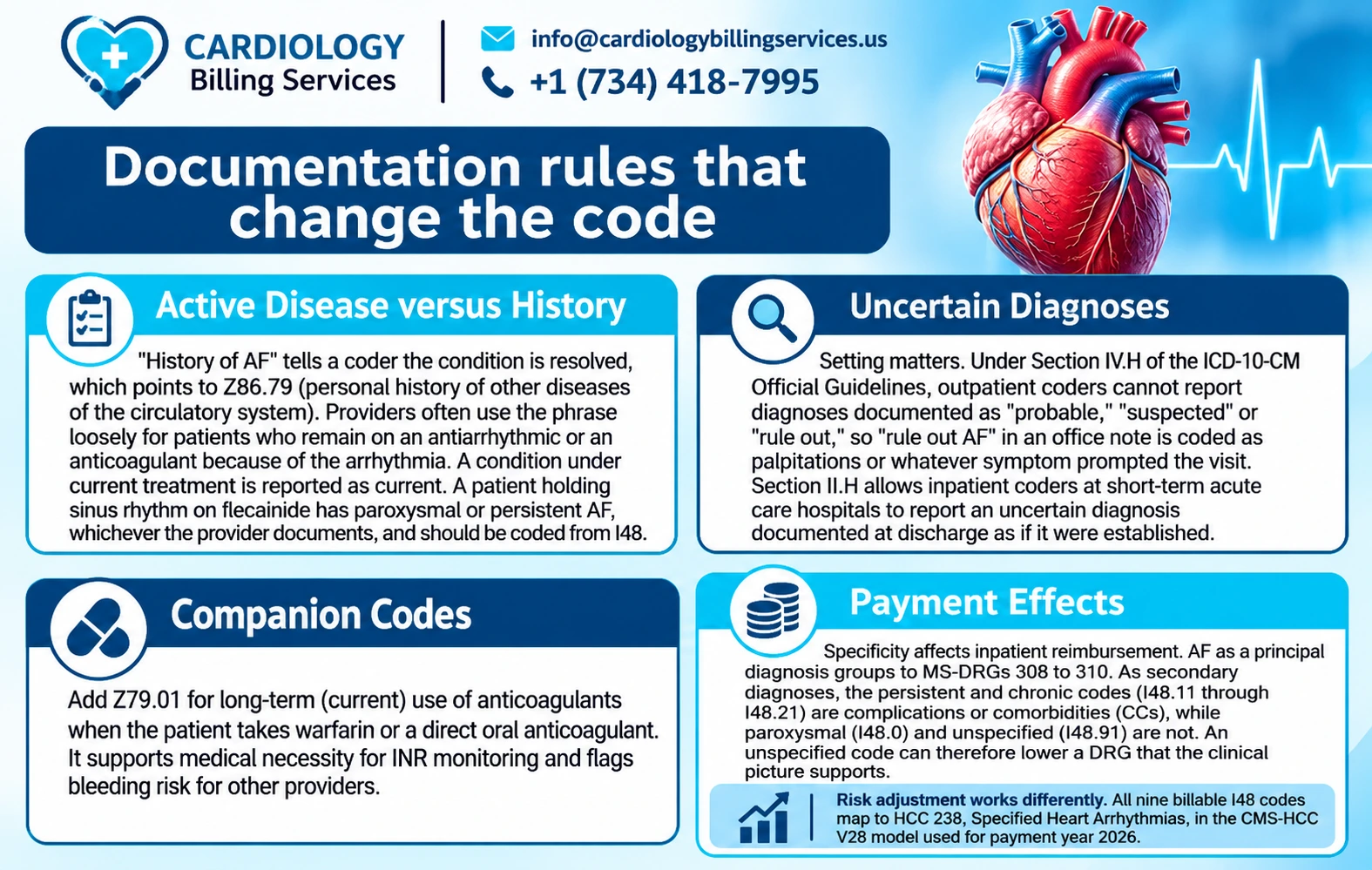
“History of AF” tells a coder the condition is resolved, which points to Z86.79 (personal history of other diseases of the circulatory system). Providers often use the phrase loosely for patients who remain on an antiarrhythmic or an anticoagulant because of the arrhythmia. A condition under current treatment is reported as current. A patient holding sinus rhythm on flecainide has paroxysmal or persistent AF, whichever the provider documents, and should be coded from I48.
Uncertain diagnoses
Setting matters. Under Section IV.H of the ICD-10-CM Official Guidelines, outpatient coders cannot report diagnoses documented as “probable,” “suspected” or “rule out,” so “rule out AF” in an office note is coded as palpitations or whatever symptom prompted the visit. Section II.H allows inpatient coders at short-term acute care hospitals to report an uncertain diagnosis documented at discharge as if it were established.
Companion codes
Add Z79.01 for long-term (current) use of anticoagulants when the patient takes warfarin or a direct oral anticoagulant. It supports medical necessity for INR monitoring and flags bleeding risk for other providers.
Payment effects
Specificity affects inpatient reimbursement. AF as a principal diagnosis groups to MS-DRGs 308 to 310. As secondary diagnoses, the persistent and chronic codes (I48.11 through I48.21) are complications or comorbidities (CCs), while paroxysmal (I48.0) and unspecified (I48.91) are not. An unspecified code can therefore lower a DRG that the clinical picture supports.
Risk adjustment works differently. All nine billable I48 codes map to HCC 238, Specified Heart Arrhythmias, in the CMS-HCC V28 model used for payment year 2026. The type does not change the category, but the diagnosis must be documented and assessed in a face-to-face encounter each calendar year to count.
Three chart scenarios
Scenario 1. A 71-year-old on amiodarone is seen in follow-up. Assessment: “chronic persistent atrial fibrillation.” Many students reach for I48.20 because of the word “chronic.” The correct code is I48.19, since “chronic persistent atrial fibrillation” is listed beneath it as an inclusion term. The American Hospital Association’s Coding Clinic gave the same direction in its Second Quarter 2019 issue, reasoning that “persistent” is the more specific term.
Scenario 2. An 80-year-old has been in AF continuously for four years. The note states: “Discussed options; patient declines further cardioversion. Continue metoprolol and apixaban.” Report I48.21 with Z79.01. The decision to stop rhythm control is documented, and that is what the permanent code requires. Without that sentence, four years of continuous AF supports only I48.11.
Scenario 3. A 58-year-old arrives in the emergency department with palpitations. ECG shows AF at 148 beats per minute. Diagnosis: “new-onset atrial fibrillation with RVR.” Report I48.91. Nobody can yet say whether the episode will stop on its own, so no pattern can be assigned.
Errors to check for before the claim goes out
- Reporting I48.1 or I48.2 without the fifth character, which payers reject as invalid.
- Coding I48.21 from duration alone when no rhythm control decision is recorded.
- Pairing I48.19 or I48.11 with I48.21 despite the Excludes1 note.
- Carrying an old “permanent” label forward after the patient has been referred for ablation.
- Using Z86.79 for a patient still taking medication for the arrhythmia.
Choosing among atrial fibrillation ICD-10 codes
Four documented facts decide nearly every case: whether the rhythm is fibrillation or flutter, whether episodes stop within seven days, whether continuous AF has passed twelve months, and whether rhythm control has been abandoned. A note containing those facts points to exactly one of the nine billable atrial fibrillation ICD-10 codes. A note missing them leaves I48.91, a code that is not a CC and tells the next clinician nothing about the patient’s course.
For providers, that means one extra phrase in the assessment. For coders, it means querying when “chronic” stands alone, and checking the plan of care before accepting “permanent” at face value.