CPT Code 93015: Description, Billing Guidelines, and Reimbursement

CPT Code 93015 is used to report a complete cardiovascular stress test that includes supervision, continuous electrocardiographic monitoring, interpretation, and a written report. Healthcare providers commonly perform this diagnostic procedure to assess how the heart responds to physical activity or medication-induced stress.
Cardiovascular stress testing helps physicians investigate symptoms associated with coronary artery disease, evaluate exercise tolerance, and identify certain abnormalities in heart rhythm or cardiovascular function. However, accurate billing depends on understanding which services were performed, who provided them, and whether the clinical documentation supports the procedure.
Medical billers must also distinguish CPT Code 93015 from related codes 93016, 93017, and 93018. Incorrectly reporting a complete test when only individual components were provided can result in claim denials, overpayments, or reimbursement adjustments.
This guide explains the CPT 93015 description, covered services, documentation requirements, billing guidelines, and reimbursement considerations for 2026.
What is CPT Code 93015?
CPT Code 93015 identifies a cardiovascular stress test involving treadmill or bicycle exercise, continuous electrocardiographic monitoring, and/or medication-induced stress when the service includes supervision, interpretation, and reporting.
The procedure measures cardiovascular responses as the patient's heart works harder. During an exercise-based examination, the patient typically walks on a treadmill or pedals a stationary bicycle while healthcare professionals monitor electrical activity, blood pressure, heart rate, and symptoms.
Exercise intensity generally increases according to a predetermined protocol. The supervising healthcare professional evaluates the patient's response and determines when testing should end.
Some patients cannot exercise adequately because of physical limitations or medical conditions. In appropriate circumstances, medications may be used to produce cardiovascular stress. The test selection and applicable coding must reflect the actual procedure.
CPT Code 93015 represents the complete stress-testing service rather than an individual portion of the examination. It does not independently include cardiac imaging procedures such as myocardial perfusion imaging or stress echocardiography.
The American Medical Association's CPT code set establishes the reporting structure, while Medicare and other insurers determine applicable coverage and payment requirements.
What services are included in CPT Code 93015?
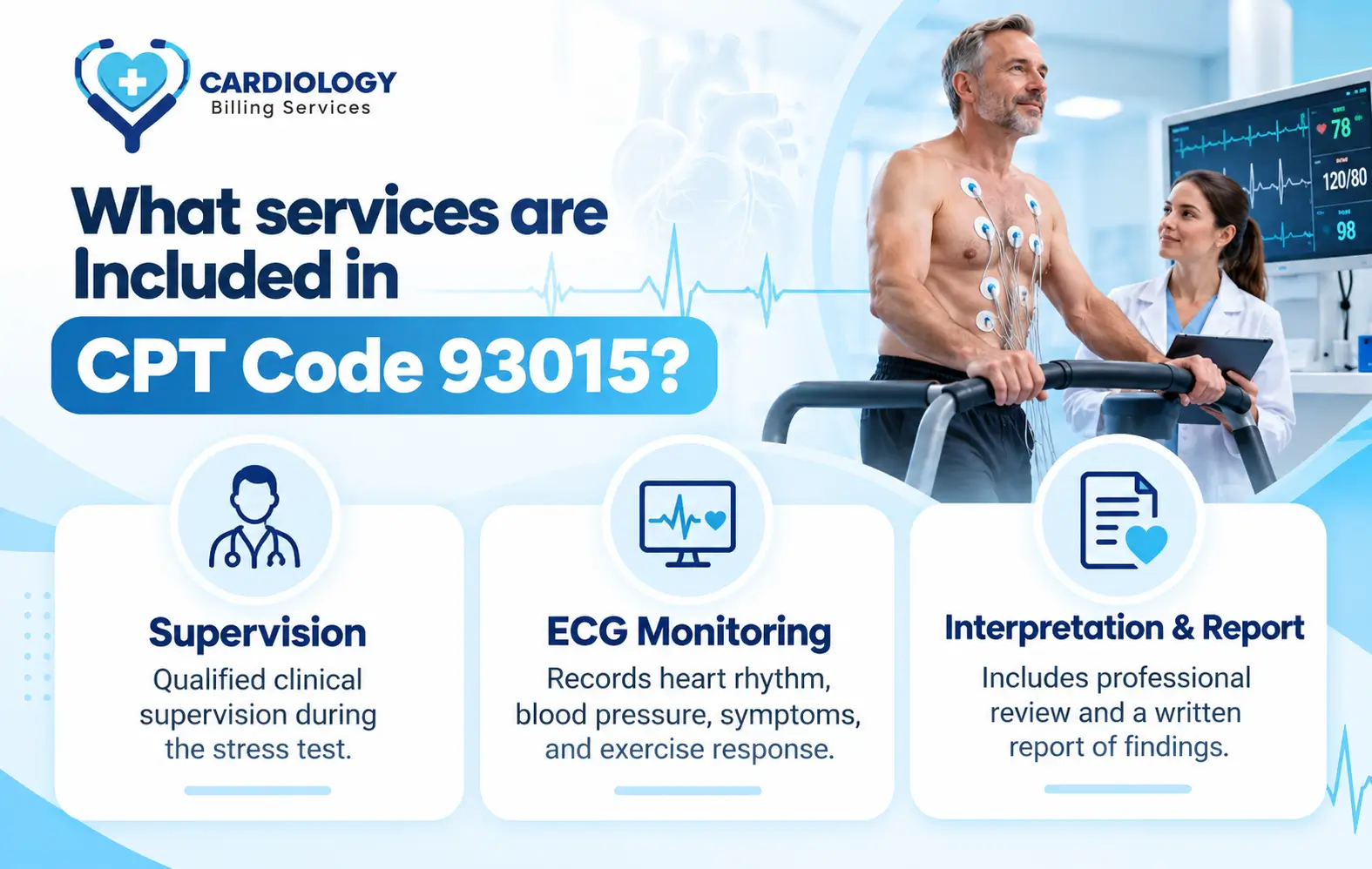
The code covers the technical performance and professional responsibilities associated with a complete cardiovascular stress test.
Supervision during cardiovascular stress testing
A qualified healthcare professional supervises the examination according to applicable clinical and payer requirements. Supervision involves assessing patient safety, observing cardiovascular responses, and ensuring that appropriate clinical assistance is available if complications develop.
The patient's condition, medical history, and testing protocol help determine the necessary level of monitoring.
ECG monitoring and test performance
Electrocardiographic monitoring records the heart's electrical response during the examination. Healthcare personnel also observe changes in heart rate, blood pressure, symptoms, and exercise tolerance.
The technical portion includes performing the test and obtaining the required recordings. These findings provide the information needed for the interpreting clinician to evaluate the patient's cardiovascular response.
Interpretation and written report
After the examination, the interpreting physician or other appropriately qualified professional evaluates the results.
The report should address relevant findings, including exercise performance, heart rhythm changes, blood pressure response, symptoms, and any clinically significant ECG abnormalities.
A documented interpretation is necessary because a recording alone does not establish that the complete service represented by CPT 93015 was provided.
Difference between CPT Codes 93015, 93016, 93017, and 93018
Cardiovascular stress testing can involve different professionals or organizations performing separate portions of the service.
The CPT code family distinguishes complete testing from supervision, technical performance, and interpretation.
| CPT code | Description | Billing component |
|---|---|---|
| 93015 | Complete cardiovascular stress test with supervision, technical performance, interpretation, and report | Global service |
| 93016 | Cardiovascular stress test supervision without interpretation and report | Supervision only |
| 93017 | Cardiovascular stress test tracing without interpretation and report | Technical component |
| 93018 | Cardiovascular stress test interpretation and written report | Interpretation only |
These distinctions are particularly important when testing occurs in a hospital outpatient department rather than an independent physician's office.
For example, a hospital may perform the technical portion while physicians separately provide supervision and interpretation. In that arrangement, the services may be reported using the applicable component codes instead of the complete CPT 93015 code.
The billing organization must identify exactly which responsibilities it fulfilled before selecting a code.
CPT Code 93015 billing guidelines
Correct stress test billing requires more than matching the procedure name to a CPT code. The billing team must review the setting, provider responsibilities, documentation, and applicable payer rules.
When should CPT 93015 be billed globally?
Global billing generally applies when a physician practice provides the complete service, including the technical examination, appropriate supervision, interpretation, and written report.
Consider a cardiology office that operates its own treadmill testing equipment. The practice performs the examination, provides the required supervision, and completes the physician's interpretation.
If every component is furnished and the applicable payment requirements are satisfied, CPT 93015 may represent the complete service.
However, global reporting would be inappropriate if the practice provided only interpretation while another organization performed the technical examination.
Billing cardiovascular stress testing in hospitals
Hospital outpatient billing commonly separates facility services from physician services.
The hospital may report CPT 93017 for the technical test, while the appropriate physician bills CPT 93016 for supervision and CPT 93018 for interpretation and reporting.
These professional services must actually have been furnished and documented.
The payment structure also depends on whether the claim falls under the Medicare Physician Fee Schedule, the Hospital Outpatient Prospective Payment System, or another payer arrangement.
A hospital-based test should therefore not automatically be submitted under CPT 93015 simply because all three components occurred during the same appointment.
Can CPT 93015 be billed with 93016, 93017, or 93018?
For the same complete stress test, CPT 93015 should not be reported in addition to its component codes to obtain payment for overlapping services.
Doing so would duplicate portions of the examination already included in the global code.
When individual components are independently reportable, the billing team should use the appropriate component codes and follow the insurer's rules for the organizations and professionals involved.
Modifiers 26 and TC should not be used to divide CPT 93015 into professional and technical services. The code family already provides specific reporting options for those responsibilities.
Medical necessity requirements for CPT 93015
Medical necessity is an essential consideration in cardiovascular stress testing.
A test may be clinically indicated when a physician needs additional information about symptoms, cardiovascular performance, or the possibility of coronary artery disease.
Examples of circumstances that may support testing include exertional chest discomfort, certain unexplained symptoms suggesting myocardial ischemia, suspected exercise-related arrhythmias, or assessment of functional capacity in selected cardiac conditions.
The reason for testing must be consistent with the patient's clinical history and the applicable coverage policy.
Medicare Administrative Contractors publish Local Coverage Determinations that describe qualifying indications and limitations in their jurisdictions.
For example, the CMS Medicare coverage policy for non-emergent outpatient stress testing discusses symptomatic patients with an appropriate pretest probability of coronary artery disease and circumstances in which testing may guide treatment.
Routine screening of asymptomatic patients is not automatically covered merely because cardiovascular risk factors are present.
ICD-10-CM diagnosis coding considerations
The diagnosis reported with CPT 93015 should accurately describe the documented clinical reason for the examination.
Potential diagnosis categories include chest pain, known coronary artery disease, and certain rhythm abnormalities, depending on the patient's established condition and evaluation.
For example, ICD-10-CM code R07.9 describes unspecified chest pain. However, this code should only be selected when it accurately represents the documented condition and the record does not support a more specific diagnosis.
A diagnosis appearing on an insurer's covered-code list does not guarantee payment. The clinical record must also satisfy applicable medical necessity requirements.
Billers should review the current ICD-10-CM code set and the relevant payer's diagnosis policies for the date of service.
CMS
Documentation requirements for CPT Code 93015
Complete documentation provides evidence that the reported cardiovascular stress test was performed and medically justified.
The patient's medical record should establish why testing was ordered, which protocol was used, and what clinical information was obtained.
Pre-test clinical documentation
Before the examination, the record should identify the patient's presenting symptoms, relevant medical history, and reason for testing.
The clinician should document pertinent cardiovascular findings and identify factors that may affect exercise capacity or testing safety.
Relevant contraindications and decisions about the stress-testing method should also be addressed.
Procedure documentation
The examination record should identify the testing protocol and the patient's response.
For exercise testing, useful details include the duration of exercise, achieved workload, heart rate response, blood pressure measurements, ECG findings, and symptoms experienced during testing.
If the examination ends before the planned endpoint, the record should explain why.
Interpretation and final report
The final interpretation should summarize the diagnostic findings and their clinical significance.
Merely attaching ECG tracings to the chart is insufficient to establish that the interpretation and report components were completed.
When physicians or facilities share responsibilities, the record should clearly establish who supervised the procedure and who interpreted the findings.
CPT Code 93015 reimbursement in 2026
Reimbursement for CPT Code 93015 varies according to the insurer, location, payment methodology, and services provided.
Medicare physician payments are generally determined using relative value units for physician work, practice expenses, and malpractice expenses. Geographic Practice Cost Indices and the applicable conversion factor influence the final Medicare Physician Fee Schedule amount.
Other factors include the date of service, facility or non-facility classification, and applicable payment policies.
CMS maintains a Physician Fee Schedule Look-Up Tool that allows billing professionals to review payment information and policy indicators for the relevant year and Medicare locality.
CMS+1
Factors that affect reimbursement
A complete stress test performed in an independent physician's office may be reimbursed differently from services supplied in a hospital outpatient department.
Private insurers may also establish negotiated rates that differ from Medicare allowances.
The applicable reimbursement depends on whether the claim represents the complete examination or only an individual component.
For accurate payment estimates, billing teams should verify the current fee schedule for the patient's insurance plan, service location, and billing arrangement.
A single national dollar amount should not be treated as the guaranteed reimbursement for every CPT 93015 claim.
Common CPT 93015 billing mistakes
Some stress-testing claims are denied because the billing code does not match the documented services.
Incorrect global billing occurs when a practice reports CPT 93015 despite furnishing only one or two portions of the examination.
Duplicate billing is another concern. Reporting CPT 93015 alongside CPT 93016, 93017, or 93018 for the same services can create an overlapping payment request.
Medical necessity errors also occur when documentation fails to establish why cardiovascular testing was appropriate.
An additional issue involves stress tests performed with cardiac imaging. Stress echocardiography and nuclear myocardial perfusion imaging have separate coding requirements, and the related stress-testing components must be reviewed under applicable bundling rules.
Billing teams should also investigate missing interpretation reports, unsupported diagnosis codes, incorrect places of service, and incomplete provider information.
These errors may be identified through routine claim audits before submission.
Practical example of CPT 93015 billing
Consider a hypothetical patient referred to a cardiology practice after reporting chest discomfort during physical activity.
The physician orders an exercise treadmill stress test to evaluate the patient's cardiovascular response.
The examination is performed at the physician's independent office using the practice's equipment. Appropriate supervision is provided throughout the test, and the physician subsequently reviews the ECG findings and completes the interpretation report.
Assuming the relevant billing requirements are met, CPT 93015 may be appropriate because the practice provided the complete examination.
Now consider the same patient undergoing testing in a hospital outpatient department.
The hospital performs the technical examination, while physicians provide the necessary supervision and interpretation.
In this situation, the respective organizations and professionals may report CPT 93017, 93016, and 93018 according to the services furnished and applicable payment rules.
The patient's clinical reason for testing is unchanged, but the appropriate billing structure differs.
How to reduce CPT 93015 claim denials
A useful claim-review process begins by comparing the procedure performed against the code selected.
The billing specialist should verify that the medical record supports the ordered examination, appropriate supervision, technical testing, and interpretation.
The claim should also contain the correct patient information, rendering or supervising provider details as required, diagnosis coding, and place of service.
Before submission, confirm whether another organization is billing a portion of the same examination. This helps prevent duplicate or conflicting claims.
Finally, review any applicable prior authorization requirements, medical necessity limitations, coding edits, and payer reimbursement policies.
Maintaining these checks within the normal billing workflow can reduce preventable corrections and improve claim accuracy.
CPT Code 93015: Key billing considerations
CPT Code 93015 represents a complete cardiovascular stress test involving supervision, technical performance, interpretation, and a written report. It is generally appropriate when the billing entity furnishes all required components and the medical record supports the examination.
When services are divided among physicians and facilities, CPT Codes 93016, 93017, and 93018 provide separate reporting options.
Accurate reimbursement depends on selecting the correct code, documenting medical necessity, and following the insurer's current payment policies.
For healthcare providers and medical billing professionals, the most reliable approach is to verify the actual services performed before submitting CPT Code 93015 rather than assuming every cardiovascular stress test qualifies for global billing.