

CPT 92945 Billing Guide: Chronic Total Occlusion PCI, Documentation, Reimbursement, and 2026 Updates

A cath report that said "CTO of the mid-RCA, recanalized, two DES placed" used to be enough to land on a CTO code. In 2026 it isn't. The CPT code set now asks a question the note has to answer: how did the wire cross?
CPT 92945 is the new answer for the hardest occlusions, the ones that need both an antegrade and a retrograde approach. 92943 stays for antegrade-only cases, and the add-on 92944 that many practices barely used is gone. This guide covers what the code describes, when it's supportable, how it differs from its neighbors, and where claims tend to fall apart. Payer policy varies, so treat everything here as a starting point for your own contractor checks.
What Is CPT 92945?
Quick answer: CPT 92945 reports percutaneous revascularization of a chronic total occlusion (CTO) in a coronary artery, branch, or bypass graft when the lesion was treated with combined antegrade and retrograde approaches. It is new for dates of service on or after January 1, 2026, and covers any mix of angioplasty, atherectomy, and stenting (ACC).
The 92945 CPT code description rests on CPT's own definition of a CTO. As MedAxiom's 2026 PCI briefing summarizes it, a CTO means no antegrade flow through the true lumen, plus supporting angiographic and clinical features such as bridging collaterals, calcification at the occlusion, and no current ST-elevation or Q-wave MI attributable to the target. Subtotal occlusions, and occlusions with dye staining that suggests fresh thrombus, don't qualify (MedAxiom).
The "retrograde" part has a specific meaning. A wire travels through a non-occluded artery and its collaterals to reach the occlusion from the distal cap, in addition to the antegrade attempt from the front.
For diagnosis coding, the same briefing says to code coronary atherosclerosis first (I25.1-, I25.7-, I25.81-) and the CTO diagnosis second. That second code is I25.82 in ICD-10-CM, so confirm it against your current code book.
Why 92945 Exists in the 2026 PCI Update
Before 2026, CTO PCI had one base code (92943) and an add-on for additional vessels (92944). Whether the operator crossed by simple wire escalation or spent four hours building a retrograde channel, the claim looked identical. The 2026 revision splits that:
- 92943 is revised to describe the antegrade approach.
- 92945 is new for combined antegrade and retrograde.
- 92944 was deleted along with the other branch add-ons (92921, 92925, 92929, 92934, 92938). Base codes now say "branch(es)" instead.
- 92930 arrived for complex stenting, and CPT added formal definitions of "lesion" and "segment."
The RUC also reviewed the family. MedAxiom's table of final CY 2026 work RVUs shows 92943 rising from 12.31 to 13.69 and 92945 debuting at 15.00. Why does that matter for your practice? Because the new code rewards documentation of technique, and the old habit of writing "CTO PCI performed" now leaves money, or compliance, on the table.
How CTO PCI Is Billed: The Hierarchy Behind It
PCI codes follow a progressive hierarchy. The more intensive service includes the less intensive one, and you report one base code per major coronary artery and its branches. The CPT guidelines build in access, selective catheterization, lesion crossing, related imaging, and closure, and CMS's NCCI policy manual likewise treats catheterization, dye injection, and fluoroscopic guidance as part of the intervention.
Two consequences follow:
- Stenting, atherectomy, and angioplasty inside a CTO don't generate extra codes. They're already part of 92943 or 92945.
- Each bypass graft counts as its own major artery. A native LAD plus a LIMA-to-LAD graft is two interventions.
- A donor vessel wired only to reach the distal cap is part of how the CTO was crossed. Whether it also received its own revascularization is a coding question the note must answer explicitly.
92945 vs 92943 vs 92944
| Feature | CPT 92943 | CPT 92945 | CPT 92944 |
|---|---|---|---|
| 2026 status | Active, revised | Active, new | Deleted Jan 1, 2026 |
| Approach | Antegrade | Combined antegrade and retrograde | Not applicable |
| Code type | Base code | Base code | Former add-on |
| 2026 work RVU | 13.69 | 15.00 | None |
| Common error | Used when retrograde was also required | Used on "retrograde" template text without proof | Still appearing on 2026 claims |
For the 92945 vs 92943 billing difference, the test is simple: was the retrograde route actually used to cross the occlusion? And for 92945 vs 92944, the answer is that 92944 no longer exists. A claim with a 2026 date of service can't carry it. Dates of service before January 1, 2026 still follow the old code set.
Never report 92943 and 92945 together for the same CTO. They're alternatives in the same hierarchy.
When to Bill CPT 92945
Bill it when the record supports all of the following:
- A lesion that meets CPT's CTO definition.
- A documented antegrade attempt and a documented retrograde route through collaterals.
- Revascularization completed with any combination of balloon, atherectomy, or stent.
- An identified vessel, branch, or graft.
If only antegrade techniques were used, even sophisticated ones like subintimal tracking and reentry, the supported code is 92943. If the operator started antegrade and converted to retrograde, the note should say when and why.
Failed or abandoned attempts raise separate questions about modifiers and payer policy. Get a written answer from your major payers before those cases land in your queue.
How to Bill CPT 92945
- Confirm the occlusion meets the CTO definition.
- Read the procedure note for the approach actually used, not the template language.
- Select 92943 or 92945, never both.
- Report one base code per major artery, with the appropriate artery modifier.
- Add diagnostic angiography only if its criteria are met, with the correct modifier.
- Review add-on codes for physiology, imaging, or mechanical thrombectomy against CPT parentheticals.
- Link ICD-10 codes: atherosclerosis first, then I25.82.
- Check prior authorization requirements. MedAxiom suggests requesting authorization for both CTO codes so the approach is covered up front.
92945 Documentation Requirements
Medical Necessity
Payers seek to understand the rationale for attempting a CTO: indications remaining despite medical treatment, evidence of objective ischemia or viability when the policy requires it, and the justification for selecting revascularization. Requirements differ by Medicare Administrative Contractor and by commercial plan, so pull the specific LCD or medical policy rather than relying on memory.
Modifier Usage
| Modifier | Use with 92945 | Watch for |
|---|---|---|
| LM, LD, LC, RC, RI | Identifies the major artery treated | Missing or mismatched modifier |
| 59 or XS | May be required on a same-day diagnostic cath when its criteria are met | Using it without documented justification |
| 25 | Applies to a separately identifiable E/M visit, not to the PCI code | Misapplied to the procedure |
Two-operator CTO cases deserve a payer conversation. Don't assume a co-surgery modifier is accepted for PCI codes.
Medicare Billing Considerations vs. Commercial Insurance
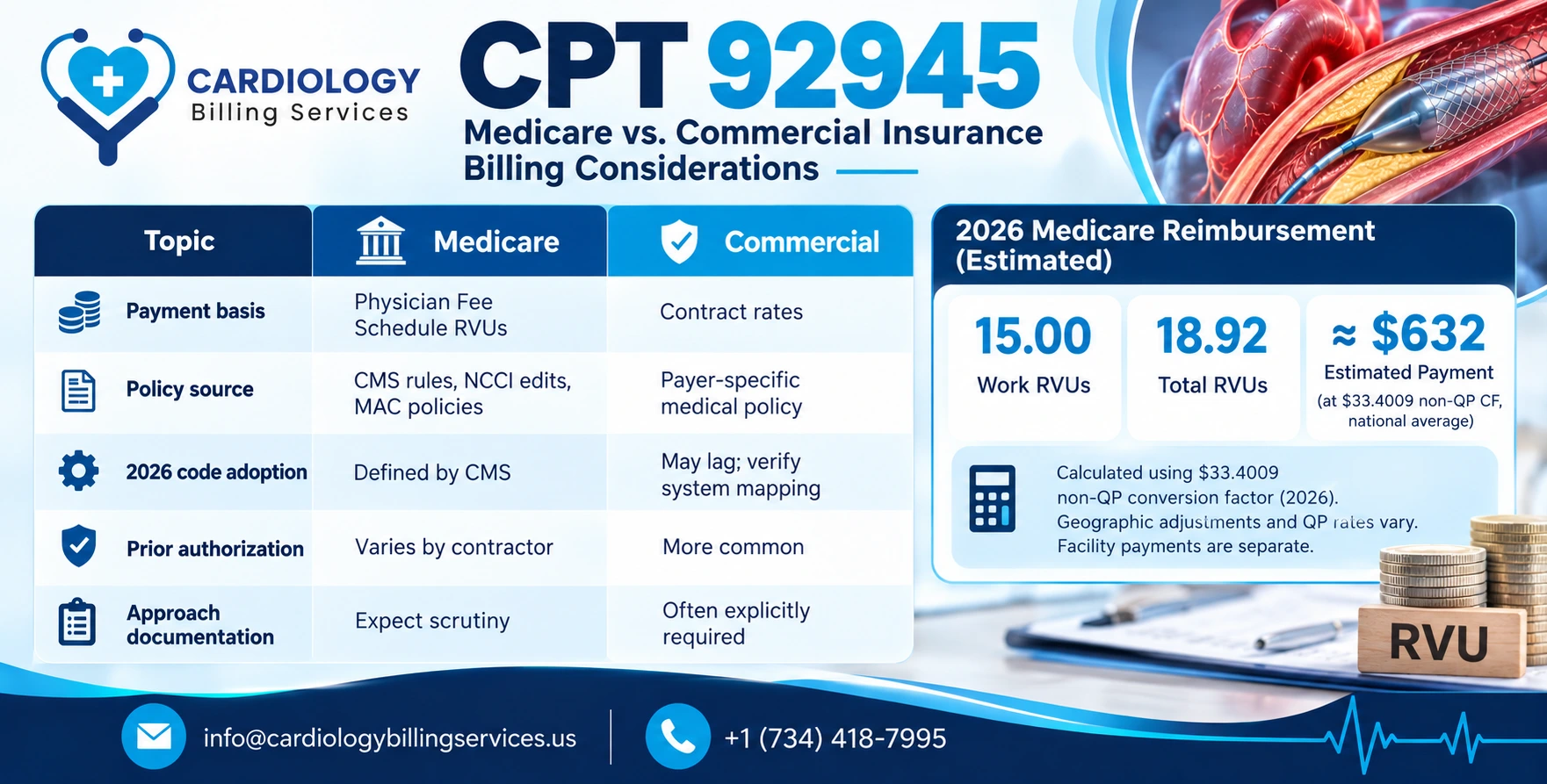
| Topic | Medicare | Commercial |
|---|---|---|
| Payment basis | Physician Fee Schedule RVUs | Contract rates |
| Policy source | CMS rules, NCCI edits, MAC policies | Payer-specific medical policy |
| 2026 code adoption | Defined by CMS | May lag; verify system mapping |
| Prior authorization | Varies by contractor | More common |
| Approach documentation | Expect scrutiny | Often explicitly required |
On reimbursement: one published breakdown of the CMS 2026 RVU file lists 92945 at 15.00 work RVUs and 18.92 total RVUs. At the $33.4009 non-QP conversion factor, that works out to roughly $632 nationally before geographic adjustment (fastrvu). Medtronic's 2026 coronary reimbursement guide shows a similar figure. Treat both as estimates, and confirm in CMS's Physician Fee Schedule Look-Up Tool for your locality. QP conversion factors differ, and facility payments are separate from professional payment. Never model revenue from a blog number alone, including this one.
Common Billing Mistakes and Denials
Examples of Correct Coding
| Scenario | Likely coding | Note |
|---|---|---|
| RCA CTO crossed with antegrade wire escalation, two DES placed | 92943-RC | Stent count doesn't change the base code |
| LAD CTO, antegrade failed, crossed via septal collateral from RCA, then stented | 92945-LD | Both approaches documented |
| RCA CTO (combined) plus separate LAD stenting same session | 92945-RC plus the LAD base code with LD | Separate arteries, separate base codes |
| No prior angiogram, full diagnostic study, then CTO PCI | Cath code with modifier, plus 92945 | Document the decision to intervene |
Think about a standard group practice: the cath lab template automatically sets to "retrograde approach utilized" regardless of whether it was used or not. A coder trusting the template bills 92945 on a straightforward antegrade case, and an audit later exposes the mismatch. The reverse also happens, where a true combined case gets billed as 92943 because the physician wrote only "CTO crossed." Both errors share one root: the narrative and the code were never reconciled.
Coding Tips for Better Reimbursement
- Ask physicians to name collaterals and crossing strategy in plain language.
- Build a pre-bill review for every CTO case.
- Retire 92944 from charge masters now.
- Track 92943 vs 92945 mix by operator to spot template drift.
- Keep payer-specific CTO policy notes in one shared place.
Compliance Checklist
- CTO criteria documented
- Approach matches the code selected
- One base code per major artery
- Artery modifiers present
- Diagnostic cath justified or omitted
- ICD-10 sequencing correct
- Authorization confirmed
- DOS matches the 2026 code set
How Professional Cardiology Billing Services Help

CTO claims are low in volume and high in value, which is exactly why a single coding slip hurts. A dedicated interventional cardiology billing team reviews approach documentation before the claim leaves, while medical coding services can audit templates for the drift described above.
Upstream, eligibility and authorization checks are part of cardiology medical billing. Downstream, claims submission and tracking, denial management, and accurate payment posting show whether a payer is underpaying a new code. Practices that want the full picture can look at revenue cycle management for cardiology. Related reading: the guides to CPT 92941 and CPT 92937. If you'd like a second set of eyes on your CTO claims, you can contact the team.
Future Billing Updates for 2026
Payers and CMS keep publishing guidance as 2026 progresses. Watch contractor bulletins, annual fee schedule rulemaking, and AMA code-cycle changes, and re-verify RVUs each year.
Key Takeaways
- 92945 means CTO PCI with combined antegrade and retrograde approaches.
- 92943 is antegrade-only. 92944 no longer exists.
- One base code per major artery.
- Write the approach in narrative form.
- Verify payment against the official fee schedule.
Frequently Asked Questions
What is CPT 92945?
A 2026 code for CTO PCI using combined antegrade and retrograde approaches.
What does CPT 92945 describe?
Revascularization of a CTO in a coronary artery, branch, or graft by any combination of balloon, atherectomy, or stent.
Is 92945 used for CTO PCI?
Yes, but only when both approaches were used.
How is 92945 different from 92943?
92943 is antegrade-only; 92945 requires the retrograde route too.
What is the difference between 92945 and 92944?
92944 was a deleted add-on. 92945 is a new base code.
When should 92945 be billed?
When the record shows a qualifying CTO, both approaches, and completed revascularization.
What documentation is required for 92945?
CTO criteria, approach details, vessel, intervention, and outcome.
Does Medicare reimburse CPT 92945?
Medicare pays under the Physician Fee Schedule. Check your MAC's coverage policy.
What payer issues can cause denials for 92945?
Missing authorization, thin approach documentation, bundled diagnostic cath, and wrong code set.
What are the billing guidelines for CPT 92945?
One base code per artery, correct modifiers, and ICD-10 sequencing starting with atherosclerosis.
What is the 92945 RVU?
Work RVU is 15.00 per published CMS data. Verify locally.
Can I bill 92945 for a 2025 procedure?
No. Use the code set valid on the date of service.
Conclusion
CPT 92945 rewards precision. The clinical skill involved in crossing a CTO retrogradely is real, and the documentation should show it. Reconcile the narrative with the code before billing, verify payer rules, and check payments against the official fee schedule.