
CPT Code for Cardiology Office Visit: Complete Billing Guide (2026)

A cardiology office visit is billed with the same CPT codes every other specialty uses for outpatient evaluation and management (E/M): 99202 through 99205 for new patients and 99211 through 99215 for established patients. The codes are shared. The content behind them is not. One cardiology visit can include a resting ECG, a review of an echo performed at another hospital, an anticoagulant adjustment and a discussion about admission, and each of those facts moves the level up, down or onto a separate line of the claim.
This guide explains how to pick the right CPT code for a cardiology office visit in 2026, which add-on codes apply, how Medicare's 2026 payment rules treat office visits, and what CMS has already finalized for January 1, 2027.
The CPT Codes for a Cardiology Office Visit
Level selection depends on medical decision making (MDM) or total practitioner time on the date of the encounter. Since the 2024 descriptor update, the time listed for each code must be met or exceeded.
| CPT Code | Patient Type | MDM Level | Total Time (Met or Exceeded) |
|---|---|---|---|
| 99202 | New | Straightforward | 15 minutes |
| 99203 | New | Low | 30 minutes |
| 99204 | New | Moderate | 45 minutes |
| 99205 | New | High | 60 minutes |
| 99211 | Established | Not required | Not applicable |
| 99212 | Established | Straightforward | 10 minutes |
| 99213 | Established | Low | 20 minutes |
| 99214 | Established | Moderate | 30 minutes |
| 99215 | Established | High | 40 minutes |
Code 99211 is the outlier. It may not require a physician or other qualified health professional to be present, and cardiology practices mostly use it for clinical staff visits such as a blood pressure recheck billed under incident-to rules.
New or Established: The Three-Year Rule in a Cardiology Group
CPT treats a patient as new when they have not received face-to-face professional services from the same physician, or another physician of the same specialty and subspecialty in the same group, within the past three years. Reading an ECG tracing on a patient the cardiologist never met does not, by itself, make that patient established.
The subspecialty piece matters more in cardiology than in most fields because Medicare enrolls cardiologists under separate specialty designations. CMS created specialty code C3 for interventional cardiology effective January 1, 2015 (Change Request 8812), and its E/M utilization files list cardiac electrophysiology and advanced heart failure and transplant cardiology as specialties distinct from general cardiology. A patient seen by a general cardiologist 18 months ago and now referred to an electrophysiologist in the same group may qualify as new if the two physicians are enrolled under different specialty codes. Commercial payers define subspecialty in their own ways, often through taxonomy codes, so confirm before billing a new patient code in this situation.
Choosing the Level by Medical Decision Making
MDM has three elements: the number and complexity of problems addressed, the amount and complexity of data reviewed and analyzed, and the risk of patient management. Two of the three determine the level.
That two-of-three rule produces results that surprise new coders. Take a patient with well-controlled hypertension whose lisinopril is renewed. The problem is one stable chronic illness (low). Prescription drug management is moderate risk. Unless the data element also reaches moderate, the visit lands at 99213, not 99214, because only one element is moderate.
Add a second stable chronic illness, such as hyperlipidemia on a statin, and the problem element rises to moderate. With prescription drug management already at moderate risk, the visit now supports 99214.
A 99215 in cardiology usually involves a chronic illness with severe exacerbation or a threat to bodily function. A patient with heart failure who arrives with 4 kg of weight gain, orthopnea and new edema, and for whom the cardiologist decides on hospital admission, meets high complexity for problems and high risk (decision regarding hospitalization).
The Data Element and Separately Billed Tests
Cardiology visits are data-heavy, which makes one AMA rule easy to miss: when the physician reports the professional interpretation of a test separately, the ordering and interpretation of that test cannot also count toward MDM. If the cardiologist bills 93000 for today's ECG, that ECG adds nothing to the data element of the E/M visit.
What does count includes independent interpretation of a test billed by someone else (for example, personally reviewing the tracing from an emergency department ECG), review of external notes, ordering tests that will be billed by another provider, and discussion of management with an external physician such as the patient's nephrologist.
Choosing the Level by Time
Total time includes everything the billing practitioner does on the date of service: preparing by reviewing records, the face-to-face encounter, ordering tests, documenting, and coordinating care. It excludes clinical staff time and time spent on separately reported services. A cardiologist who spends 32 minutes on an established patient's visit, three of which were spent interpreting a separately billed ECG, has 29 billable minutes, which supports 99213 rather than 99214.
Prolonged Services: 99417 or G2212
CPT add-on 99417 begins at 75 minutes for 99205 and 55 minutes for 99215. Medicare does not accept 99417 and requires HCPCS G2212, which starts at 89 minutes for 99205 and 69 minutes for 99215, because CMS counts from the end of the base code's former time range. A 90-minute established Medicare visit is reported as 99215 plus two units of G2212. Commercial payers vary on which code they accept.
G2211 and Longitudinal Cardiology Care
Medicare began paying separately for G2211, the visit complexity add-on, with codes 99202-99205 and 99211-99215 in 2024. The 2026 final rule extended it to home or residence visits (99341-99350).
G2211 fits cardiology when the cardiologist is providing ongoing care for a single serious or complex condition, such as a patient whose heart failure regimen they have managed for years. It does not fit a one-time evaluation where care returns to the referring physician afterward.
The add-on is not payable when the E/M visit carries modifier 25, with exceptions CMS added for same-day annual wellness visits, vaccine administration and Medicare Part B preventive services. In practice, a cardiology visit billed with a procedure and modifier 25 generally loses G2211.
Uptake has been lower than CMS expected. CMS projected G2211 would appear on about 38% of outpatient E/M visits at first, yet a Health Affairs Forefront analysis published in October 2026 found use below 20% even for level 4 and level 5 established visits.
Modifier 25, ECGs and Same-Day Testing
The ECG codes most often billed with a cardiology office visit are 93000 (tracing with interpretation and report), 93005 (tracing only) and 93010 (interpretation and report only). Code 93306 covers a complete transthoracic echocardiogram with Doppler and color flow.
Medicare's modifier 25 policy is written around procedures that carry a global surgical period. ECGs and echocardiograms carry no global period, so Medicare contractors generally process the E/M and the test together without the modifier. Many commercial payers run their own edits and deny the pair without modifier 25, which is why some practices append it routinely. Check each payer's policy instead of applying one rule to every claim.
Consultation Codes and Telehealth
CPT still includes office consultation codes 99242-99245 (99241 was deleted in 2023). Medicare stopped paying consultation codes on January 1, 2010, so a referred Medicare patient is billed with 99202-99215 instead. Some commercial plans and workers' compensation carriers still pay consult codes.
For telehealth, CMS again declined to add the CPT telemedicine E/M codes (98000-98015) to the Medicare Telehealth Services List for 2026. Medicare video visits continue to use 99202-99215 with the appropriate place of service and telehealth modifiers.
How 2026 Medicare Payment Rules Affect Office Visits
Medicare payment equals the code's relative value units multiplied by the conversion factor. The CY 2026 final rule set two conversion factors: $33.5675 for qualifying participants in advanced alternative payment models and $33.4009 for all other clinicians.
The same rule introduced a -2.5% efficiency adjustment to work RVUs for most non-time-based services. Office E/M codes are exempt. ECGs, echocardiograms and other diagnostic tests are not. The American College of Cardiology projected an aggregate increase of roughly 1% for cardiology in 2026, with facility-based services falling about 7% and non-facility services rising about 5%. For an office cardiology practice, E/M visits carry a larger share of revenue than they did in 2025.
Changes Finalized for 2027
CMS released the CY 2027 physician fee schedule final rule on November 4, 2026, effective January 1, 2027. Three provisions affect cardiology office billing:
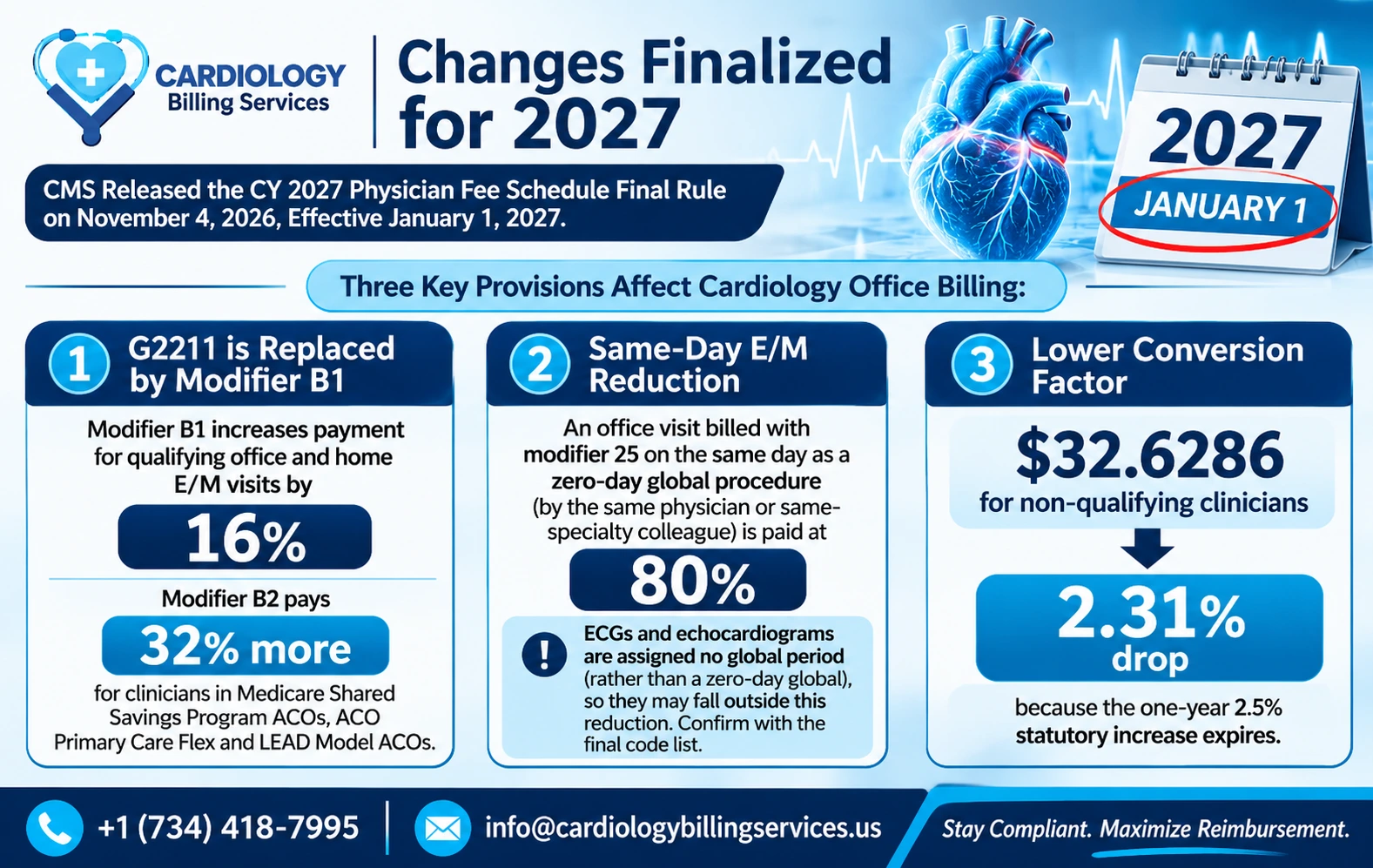
- G2211 is replaced by modifier B1, which increases payment for qualifying office and home E/M visits by 16%. Modifier B2 pays 32% more for clinicians in Medicare Shared Savings Program ACOs, ACO Primary Care Flex and LEAD Model ACOs.
- Same-day E/M reduction: an office visit billed with modifier 25 on the same day as a zero-day global procedure, by the same physician or a same-specialty colleague in the group, is paid at 80%. ECGs and echocardiograms are assigned no global period rather than a zero-day global, so they appear to fall outside this reduction; confirm against the final code list.
- Lower conversion factor: $32.6286 for non-qualifying clinicians, a 2.31% drop, because the one-year 2.5% statutory increase expires.
Documentation That Supports the Code
Auditors look for the reasoning behind the level, not the length of the note. For each visit, the record should show:
- The status of each problem addressed (stable, worsening, severe exacerbation)
- Which external records, tests or independent historians contributed, and which tests were ordered
- The management decision and its risk, such as starting an anticoagulant or deciding on admission
- Total minutes and the activities performed, if the level is based on time
- The ongoing relationship with the patient, when G2211 (or modifier B1 from 2027) is reported
For 2026, a cardiology office visit is coded 99202-99215 by MDM or time, Medicare adds G2212 rather than 99417 for prolonged time, and G2211 applies only to longitudinal care without modifier 25. Office E/M codes escaped the 2.5% efficiency cut that reduced diagnostic testing, and starting January 1, 2027, coders will need to replace G2211 with modifier B1 and watch the new 20% same-day reduction on procedure days.